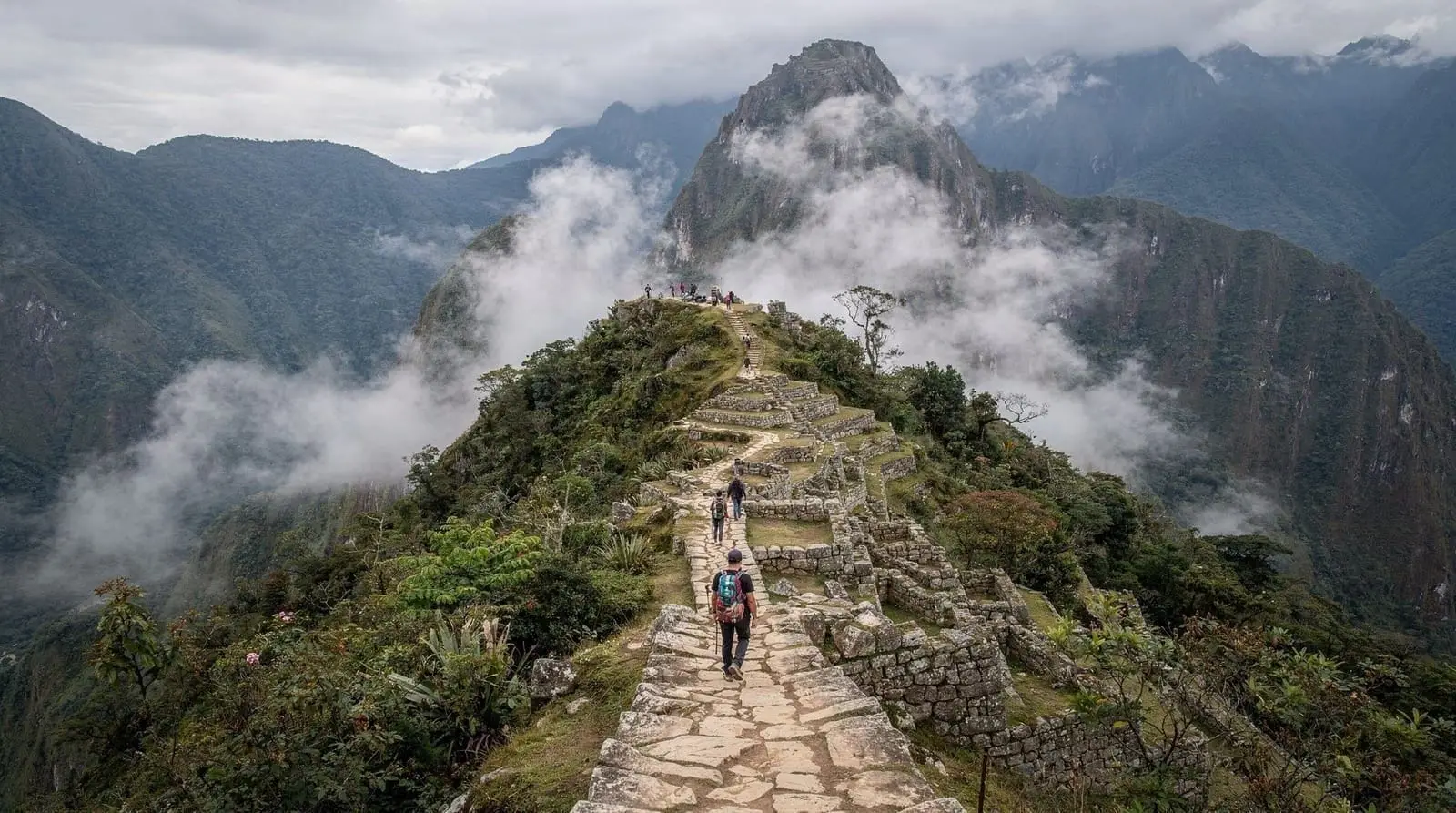
Inca Trail
The classic Inca Trail to Machu Picchu: permit quotas, the February closure, licensed operators, the 4,215 m pass, and how to book months ahead. Honest guide.
From Cusco: 4-Day Inca Trail Guided Trek to Machu Picchu
Quick facts
- Highest pass
- Dead Woman's Pass, 4,215 m / 13,830 ft
- Classic length
- 4 days / 3 nights, ~43 km
- Permit
- Required; ~500/day total, sells out months ahead
- February
- Closed entirely for maintenance
- Operator
- Must be a government-licensed company
Read this before you do anything else: permits
If you want to walk the classic Inca Trail, the most important thing on this page is not the difficulty or the scenery — it is that you must book months in advance.
| Where | Sacred Valley to Machu Picchu, Cusco region |
| Cost | Full package (permit, guide, porters, meals, entry) — ask operators for current pricing |
| Time needed | 4 days / 3 nights (classic) or 2 days (short trail) |
| Getting there | Trailhead at Km 82, reached by van/train from Cusco or Ollantaytambo |
| Best time | May to September (dry season); closed every February |
Two more hard facts. First, the Inca Trail closes for the entire month of February every year for maintenance and to let the path recover — if your trip falls in February, the classic trail is simply not available, and you will need Salkantay or another route. Second, you cannot legally hike the Inca Trail independently; you must go with a government-licensed operator. Plan around these realities from the very start, because no amount of money or persistence will get you a permit that does not exist.
What the Inca Trail is
The Camino Inca is a 43-km section of the vast Inca road network that runs from the Sacred Valley up over high passes and down to the Sun Gate (Inti Punku) above Machu Picchu. Its appeal is not just the scenery — it is the archaeology. You walk on original Inca stonework, past a string of ruins (Llactapata, Runkuraqay, Sayacmarca, Phuyupatamarca, Wiñay Wayna) that you cannot reach any other way, and you arrive at Machu Picchu on foot through the Sun Gate, looking down on the citadel as the Incas intended. That experience — the cumulative ruins and the Sun Gate arrival — is what people pay and plan for, and it is something no other trek to Machu Picchu can offer.
The trail starts at “Km 82” on the railway in the Sacred Valley, below Ollantaytambo, and finishes at Machu Picchu, with most groups spending the final night in Aguas Calientes before a relaxed second visit to the citadel.
The classic 4-day trek, day by day
The standard classic Inca Trail is 4 days / 3 nights:
- Day 1: Km 82 (~2,600 m) along the Urubamba valley, a gentle warm-up past Llactapata, camping around 3,000 m.
- Day 2: The hardest day. A long climb to Dead Woman’s Pass (Warmiwañusca) at 4,215 m — the high point of the trek and where altitude hits hardest — then a steep descent. Camping around 3,600 m.
- Day 3: The most beautiful and ruin-rich day, crossing two more passes and walking through cloud forest past Sayacmarca, Phuyupatamarca, and Wiñay Wayna. The longest day on the feet.
- Day 4: A pre-dawn start to reach the Sun Gate at sunrise, then down to Machu Picchu for a guided tour before returning to Cusco by train.
| Day | Route | Altitude | Difficulty |
|---|---|---|---|
| 1 | Km 82 → first camp, past Llactapata | ~2,600–3,000 m | Gentle warm-up |
| 2 | Climb to Dead Woman’s Pass, then descend | Up to 4,215 m | Hardest day |
| 3 | Two more passes, cloud forest, three ruins | 3,600–3,900 m | Longest on the feet |
| 4 | Pre-dawn to Sun Gate, down to Machu Picchu | 2,430 m (Machu Picchu) | Short, exhilarating |
The 4-day Inca Trail guided trek to Machu Picchu covers the permit, a licensed guide, porters for the camping gear, all meals, and the Machu Picchu entry and train return — the full package, which is the only legal way to walk it.
If permits are gone: the short trail and alternatives
Not everyone gets a classic-trail permit, and not everyone has four days. There are legitimate shorter options:
- The 2-day short Inca Trail. This walks the final, most scenic stretch — from Km 104 up past Wiñay Wayna to the Sun Gate and Machu Picchu — in a single long day, with a night in Aguas Calientes. It still requires a permit (also limited, though slightly easier to get than the 4-day) and still delivers the Sun Gate arrival. The Machu Picchu short Inca Trail 2-day tour is the standard version; a comfort-focused variant, the 2-day Inca Trail with panoramic train, pairs the short hike with a scenic rail leg.
- The Salkantay trek. No permit needed, bookable late, often cheaper, and arguably grander mountain scenery — but no Inca ruins along the way and no Sun Gate entry. The standard fallback for travellers who miss classic-trail permits.
If the classic permit is unavailable for your dates, the short trail is the closest substitute for the Sun Gate experience, and Salkantay is the best alternative if you want a full multi-day mountain trek.
Difficulty and altitude
The classic Inca Trail is moderately to seriously demanding. The crux is day two’s climb to Dead Woman’s Pass at 4,215 m — a long, relentless ascent of stone steps in thin air. Day three is the longest on the feet, with thousands of Inca steps up and down through cloud forest that are hard on the knees. You do not need technical skills, but you need real hiking fitness and stamina across consecutive long days.
Altitude is the recurring challenge:
- Acclimatise first. Spend at least two to three days at Cusco or Sacred Valley altitude before the trek. The Sacred Valley (2,800 m) is a gentler base than Cusco (3,400 m) for the days before you start.
- Pace the pass. Walk slowly to Dead Woman’s Pass, hydrate constantly, and tell your guide at the first sign of anything worse than a mild headache.
- Pack for extremes. Cold nights near 3,600 m, warm humid cloud-forest days, and strong sun. Bring layers, a windproof shell, gloves, hat, sunscreen, insect repellent, and broken-in boots.
- Coca tea and leaves are the traditional aid; acetazolamide is an option to discuss with a doctor before you travel.
Choosing an operator: licensed vs dubious
Because the Inca Trail can only be walked with a licensed operator, your choice of company matters more here than almost anywhere. Only operators authorised by Peru’s Ministry of Culture can secure permits, and the quality gap between them is wide. The honest guidance:
- Verify the licence. A legitimate operator will hold a current government permit-issuing licence and book your permit in your name, with your passport details, months ahead. If a company promises last-minute availability for the classic trail in peak season, treat it as a red flag.
- Ask about porter welfare. Reputable operators respect the legal weight limits for porters (their loads are weighed at checkpoints) and pay and feed their crews fairly. Suspiciously cheap tours often cut corners here, which is both an ethical and a safety problem.
- Confirm what is included. Permit, guide, porters, meals, camping gear, Machu Picchu entry, and train return should all be spelled out. Hidden extras are a common complaint with bargain operators.
Booking through a recognised platform with a verified licensed operator, such as the 4-day guided Inca Trail trek, removes much of the guesswork around permits and licensing.
How the Inca Trail fits a Peru trip
The classic trail needs four dedicated days plus acclimatisation time, and — crucially — it must be locked in months before everything else, because your permit date anchors the rest of your itinerary. Most travellers build their Cusco days around the permit they managed to secure: a few days in Cusco, the Sacred Valley, Pisac, and Ollantaytambo to acclimatise and sightsee, then the trek, finishing at Machu Picchu.
If your dates fall in February, or permits are gone, pivot to Salkantay early rather than hoping a permit appears. To plan permit timing, season, and acclimatisation, see the /itineraries/, the planning /guides/, and the seasonal /tools/ page.
Frequently asked questions about the Inca Trail
How far in advance do I need to book the Inca Trail?
For the classic 4-day trail, book four to six months ahead, and for peak season (May to August) the moment permits are released. The government caps the trail at roughly 500 people per day — only about 200 of them trekkers — and these permits sell out fast. There is no reliable last-minute option, so the booking date effectively anchors your whole trip.
Is the Inca Trail closed in February?
Yes. The classic Inca Trail closes for the entire month of February every year for maintenance and to let the path recover from the rainy season. If your trip falls in February, you cannot walk the classic route and should plan the Salkantay trek or another alternative instead. Machu Picchu itself remains open in February.
Can I hike the Inca Trail without a guide?
No. The classic Inca Trail can only be walked with a government-licensed operator and a guide — independent hiking is not permitted. This makes choosing a reputable licensed company essential, both to secure a valid permit in your name and to ensure fair treatment of the porters who carry the camping gear.
How hard is the Inca Trail?
Moderately to seriously hard. The crux is day two’s climb to Dead Woman’s Pass at 4,215 m, a long ascent of stone steps in thin air, followed by day three’s many thousands of knee-punishing Inca steps. No technical skills are needed, but real hiking fitness, stamina for consecutive long days, and prior acclimatisation are essential.
What is the short Inca Trail?
The short Inca Trail is a 2-day version that walks only the final, most scenic stretch from Km 104 past Wiñay Wayna to the Sun Gate and Machu Picchu, with a night in Aguas Calientes. It still requires a permit and still delivers the Sun Gate arrival, making it the closest substitute when 4-day permits are sold out or you lack the time.
What is the difference between the Inca Trail and the Salkantay trek?
The Inca Trail needs a permit booked months ahead, follows original Inca stonework past ruins, and arrives at Machu Picchu through the Sun Gate. The Salkantay trek needs no permit, is bookable late, is often cheaper, and offers grander raw mountain scenery — but no Inca ruins along the way and a standard entry to Machu Picchu rather than the Sun Gate.
Top experiences
Bookable activities with verified prices and instant confirmation on GetYourGuide.
