Machu Picchu circuits explained: every route
Machu Picchu: Entry & Exclusive Guided Experience
How does the Machu Picchu circuit system work?
Since 2024 the citadel is divided into three numbered circuits, each split into sub-routes. You enter on one circuit, walk it in a single direction with no backtracking, and cannot switch circuits or re-enter. Circuit 1 covers the upper panoramic terraces, Circuit 2 the full classic route through the temples, and Circuit 3 the lower royal route and the mountain trailheads.
Reading the citadel as a set of fixed routes
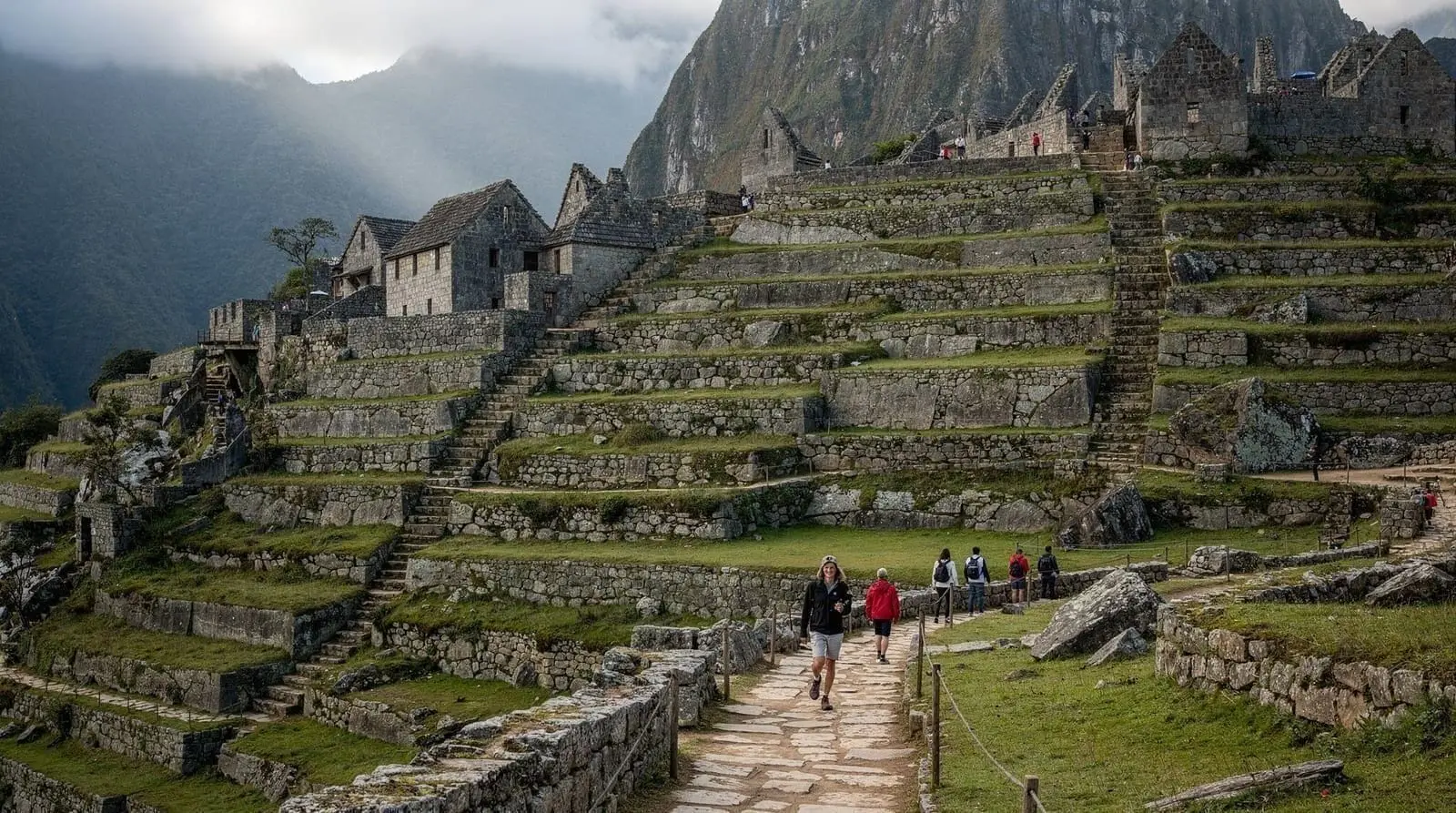
Most visitors arrive picturing Machu Picchu as an open ruin you wander freely. It is not. Since 2024 the Ministry of Culture has divided the site into three numbered circuits, each further split into lettered sub-routes, and you walk exactly one of them in one direction. Wardens keep the flow moving, there is no backtracking, and once you exit you cannot return. So it pays to know, before you book, what each route physically passes — which terraces, which temples, which viewpoints — because that is what you will and will not see.
This guide is the descriptive map: every circuit and sub-route, the structures along it, rough walking times, and what the route gives you on the ground. If what you want instead is help deciding which one to book, the circuits compared guide makes the recommendation. Here the goal is to understand the geography itself.
| Where | Machu Picchu citadel, 3 numbered circuits |
| Cost | S/152 (~$41) standard entry per circuit |
| Time needed | 1.5–2.5 hours walking, one direction only |
| Structure count | Circuit 2 passes the most named temples |
| Booking | Ministry of Culture portal, weeks ahead in dry season |
How the system is structured
There are three main circuits. Each is divided into sub-routes labelled with letters — 1-A, 1-B, 1-C, and so on — that differ mainly in how far up the terraces they climb and exactly which viewpoints and structures they include. When you book through the Ministry portal you select a circuit and, depending on availability, a sub-route. The core principle never changes: one circuit, one direction, no switching, no re-entry.
Allow roughly 1.5 to 2.5 hours to walk a standard circuit at an unhurried pace with photo stops. Circuit 2 takes the longest because it covers the most ground; the lower routes are quicker. Adding a mountain via Circuit 3 turns the day into a half or full day depending on which peak.
Circuit 1 — the panoramic upper routes
Circuit 1 keeps you high, on the agricultural terraces above the built citadel. This is the photographer’s circuit.
What it passes. The upper sub-routes climb the terraces toward the Guardian’s House (Casa del Guardián) and the upper viewpoint, where the citadel spreads out below you with Huayna Picchu rising behind — the single most photographed angle in Peru. You also pass the funerary rock and the agricultural sector’s stepped terraces, which show how the Inca farmed the steep slope.
The sub-routes. The lettered variants differ in how high they go and whether they reach the very top of the terraces. Sub-route 1-C is the one to want if your priority is the framed overview from near the Guardian’s House; lower sub-routes give a view but from a less iconic angle.
What it skips. Circuit 1 stays above the urban core, so you do not walk among the major temples. You see the citadel as a whole rather than its interior detail.
Circuit 2 — the classic designed routes
Circuit 2 is the fullest walk and the one most first-timers should understand in detail, because it threads through the built heart of the site.
What it passes. After a high overview point, the route descends into the urban sector and the Sacred Plaza, passing in sequence: the Temple of the Sun, a curved tower built over a sacred carved rock; the Principal Temple and the Temple of Three Windows around the Sacred Plaza; the Intihuatana, the carved ritual stone often called the “hitching post of the sun”; the sacred rock, whose silhouette echoes the mountain behind it; and the Temple of the Condor, where natural and carved stone form the spread wings of a condor over a chamber.
Why it is the complete route. No other circuit passes this many named structures. You get both a usable overview shot near the start and the close detail of the temples as you descend. It is also the busiest, precisely because it shows the most.
Walking it. Budget the full 2 to 2.5 hours. The descent through the urban sector is where people slow down for photos and where the path can bunch up at midday — an early slot makes the temples far calmer.
Circuit 3 — the royal lower routes and the mountains
Circuit 3 runs lowest, through the agricultural and urban sectors from below, and it is the only circuit that connects to the two climbs.
What it passes. The lower royal route takes in the lower urban sector, parts of the agricultural terraces from beneath, the water channels and fountains, and the Temple of the Sun viewed from below rather than above. It is the quietest of the three because fewer first-timers choose it.
The mountain trailheads. This is the circuit’s defining feature. The base ticket pairs with two separate peaks:
- Huayna Picchu — the sheer pinnacle behind the citadel in every photo. A strenuous, exposed 45–75 minute climb up Inca-cut steps with a separate permit. The summit looks straight down on the citadel.
- Machu Picchu Mountain (Montaña) — the taller, broader summit opposite Huayna Picchu, reached by a wider, less vertiginous 1.5–2 hour trail with sweeping views down the Urubamba valley.
To walk either peak you need the combined ticket. A standalone Machu Picchu Circuit 3 entry ticket is the base for the quiet lower route, and the Machu Picchu Mountain entry ticket adds the higher of the two summits if you prefer altitude and panorama to vertigo.
What the sub-route letters actually change
The lettered sub-routes are where most confusion arises, because the booking system presents them without much explanation. In practice the letters mainly adjust two things: how far up or down the route takes you, and which specific viewpoints or structures fall within it.
On Circuit 1, the higher-lettered upper sub-routes climb further into the agricultural terraces and reach the prime viewpoint near the Guardian’s House, while lower ones give a view from a less elevated angle. If your booking offers a choice, the upper sub-route is the one that delivers the framed overview.
On Circuit 2, the sub-routes vary in how much of the urban sector and how many of the temples they include, and whether they begin from a higher overview point or drop more directly into the built core. The fuller sub-routes are the ones worth seeking if you want the complete temple sequence.
On Circuit 3, the base lower route is fairly consistent, and the meaningful variation is whether you add Huayna Picchu or Machu Picchu Mountain on top of it. The mountain you choose, rather than the sub-route letter, is what changes your day.
The practical takeaway: do not agonise over the exact letter. Pick the circuit that matches your priority, take the sub-route the system offers for your slot, and if you have a genuine choice on Circuit 1 or 2, lean toward the higher or fuller variant.
How the trail flows and where it bottlenecks
Knowing the physical flow helps you pace the visit. After the entrance turnstiles, all circuits begin with a short climb or contour before splitting toward their assigned routes. The single busiest pinch point on the whole site is the upper viewpoint area near the Guardian’s House, where Circuit 1 walkers and the upper portion of Circuit 2 converge for the classic photo — at midday in peak season this spot backs up noticeably. An early slot is the only real cure.
The descent through the urban sector on Circuit 2 is the next slow stretch, partly because the lanes are narrow and partly because every temple draws a pause. The Temple of the Condor at the lower end of Circuit 2 is a frequent cluster point, as is the Intihuatana platform, which has limited space and a one-way flow.
On Circuit 3, the bottleneck is not the citadel route but the mountain trailhead checkpoints, where wardens log climbers in and out within fixed entry windows. If you have a peak, arrive at the trailhead inside your assigned window or you may be turned away.
Making sense of the routes on the ground
Because there is almost no signage inside, knowing the route in advance is half the value. The other half is having someone explain what you are looking at. A Machu Picchu entry with an exclusive guided experience walks your assigned circuit with a licensed guide who names the structures as you reach them — useful on Circuit 2 in particular, where a dozen temples blur together without context. It also satisfies the official rule that first-time entrants be accompanied by a guide.
A few practical notes that apply to every route:
- One pass only. Decide your photo stops before you start; you cannot loop back.
- Mornings are clearer. On any circuit, an early entry slot beats cloud build-up and crowds.
- Bathrooms are at the gate only. None inside on any circuit — go before you enter.
- The peaks need stamina. Both Huayna Picchu and Machu Picchu Mountain are real climbs; do not book one if exposure or altitude effort worries you.
How the trekking routes join the circuits
If you arrive on foot rather than by train, your route into the citadel differs at the start but converges with the circuit system once you are inside. The classic Inca Trail enters through the Sun Gate (Inti Punku) high above the site, giving the celebrated first dawn view before you descend to the entrance and pick up an assigned circuit. The Salkantay and other treks generally end in Aguas Calientes the night before, so trekkers enter the next morning exactly as train visitors do, through the main gate and onto their booked circuit.
The key point is that finishing a trek does not exempt you from the circuit and ticket rules. Reputable trekking operators include the correct entry ticket and circuit in the package, but it is worth confirming which circuit you are booked onto, because it determines what you see after the long walk in. For how the treks compare, see the best treks to Machu Picchu.
A short history of why the circuits exist
The circuit system is recent, and understanding why it was introduced helps make sense of its rigidity. Machu Picchu was built in the mid-15th century under the Inca emperor Pachacuti and abandoned roughly a century later, never found by the Spanish, and brought to international attention by Hiram Bingham in 1911. For decades visitors wandered the ruins freely. As numbers climbed past a million a year, the unrestricted foot traffic began to wear the fragile masonry and erode the terraces.
The numbered circuits, timed slots, and one-way flow introduced in their current form in 2024 are the Ministry’s response: they cap concentration at the most delicate structures, keep people moving, and spread the daily quota across the site rather than funnelling everyone through the same lanes. The rules can feel bureaucratic when you are standing at a barrier unable to backtrack for a photo, but they exist to keep the citadel walkable for the next generation of visitors. Knowing that makes the constraints easier to plan around rather than fight.
For the recommendation on which route to actually book, see the circuits compared guide. For the whole trip — tickets, train, bus, and timing — read the complete Machu Picchu guide.
What guides actually point out along each route
Because there is almost no on-site signage, a good guide adds more than most first-timers expect. On Circuit 2 in particular, a guide typically explains the astronomical alignment of the Intihuatana, the water-channel engineering that kept the terraces from eroding for over 500 years, and the theories behind the Temple of the Condor’s carved wings — details that are easy to walk straight past without commentary.
On Circuit 1’s upper terraces, a guide can point out the agricultural zoning that let the Inca grow different crops at different elevations within a few hundred metres. If you are torn between self-guiding with a written description and hiring one on-site, the deciding factor is usually whether you want the “what” (which this guide gives you) or the “why” (which a licensed guide adds in real time).
What changes if you visit during the shoulder or wet season
The physical routes do not change by season, but how they feel does. In the wet season (November–March), the upper viewpoint near the Guardian’s House on Circuit 1 is more often clouded in by mid-morning, so an early slot matters even more than usual if the panorama is your goal. The stone steps throughout all three circuits also get slippery in rain, which slows the pace on Circuit 2’s narrower descents and on Circuit 3’s lower sections near the water channels. In the shoulder months of April and October, crowds thin closer to wet-season levels while the weather still resembles the dry season more often than not, which is why several of our guides flag those months as the best-value time to book any circuit.
Frequently asked questions about Machu Picchu circuits explained: every route
What is a Machu Picchu sub-route?
Can I walk a circuit backwards or skip parts?
How long does each circuit take to walk?
What does the Guardian's House overlook?
Which structures does Circuit 2 pass?
Is a guide worth it for understanding the circuits?
Does the wet season change how the circuits feel?
Top experiences
Bookable activities with verified prices and instant confirmation on GetYourGuide.

