Machu Picchu by train: the complete guide
Cusco: Machu Picchu + Tourist Train + Entrance Ticket
Which train should I take to Machu Picchu?
Board at Ollantaytambo, not Cusco — the leg is shorter, cheaper, and runs far more often. PeruRail and IncaRail both serve the line at near-identical prices. The standard Expedition / Voyager class is fine for most; the Vistadome / 360 panoramic class is worth the extra $30–50 only if the glass-roof views matter to you.
The one stretch of the journey you cannot drive
The last leg into Machu Picchu has no road. The town at the foot of the citadel, Aguas Calientes, sits at the bottom of a steep canyon reachable only by rail or on foot. That makes the train more than a scenic add-on — it is the load-bearing piece of the whole trip, and the part most likely to derail your plans if you book it wrong. The carriages are limited, the best slots sell out, and the schedule rewards people who understand how the line is structured.
This guide explains the railway in the order you need it: which station to board at, who runs the trains, what the classes actually give you, how the 2026 prices stack up, and how to time your departures so you are not stranded or scrambling. If you want the budget alternative that skips the train entirely, see the Hidroeléctrica route. Everything here assumes you are paying for rail.
| Where to board | Ollantaytambo (not Cusco/Poroy) |
| Cost | Around $130–220 round trip, standard to panoramic class |
| Time needed | About 1h40 each way from Ollantaytambo |
| Getting there | Taxi, colectivo, or Sacred Valley day tour to the station |
| Booking | Entry ticket first, then the train — afternoon returns sell out fastest |
Where to board: Ollantaytambo beats Cusco
The single most useful thing to know is that almost nobody boards in Cusco. The direct Cusco departures leave from Poroy station, 20 minutes outside the city, and that service is frequently suspended for track work or operational reasons. Even when it runs, it is longer and more expensive.
The standard, reliable plan is to travel by road to Ollantaytambo in the Sacred Valley — about two hours from Cusco by taxi, colectivo, or as part of a Sacred Valley day — and pick up the train there. The Ollantaytambo–Aguas Calientes leg is roughly 1 hour 40 minutes, runs many times a day, and is the cheapest stretch of track. Boarding here also means you have already descended to a lower altitude, which is gentler if you have just arrived in the Andes.
A handful of trains also stop at Urubamba and Poroy in the high season, but Ollantaytambo is where the schedule density is. Plan your road transfer to land you at the station with 30–40 minutes to spare; the platform is small and boarding is by carriage.
PeruRail vs IncaRail: how to choose
Two operators share the line, and travellers waste a lot of energy debating which is “better.” On the Ollantaytambo route they are close to interchangeable: same gauge, same canyon scenery, comparable carriages, near-identical pricing.
PeruRail is the larger operator with more daily departures and the only one running the ultra-premium Hiram Bingham service. Its standard class is Expedition; its panoramic class is Vistadome.
IncaRail runs fewer but well-regarded services. Its standard class is The Voyager; its panoramic class is The 360, whose carriages have slightly larger windows and an open-air balcony car on some departures. Its top tier is First Class.
The honest advice: do not pick the brand, pick the departure time and price for your specific dates. Pull up both operators’ schedules for your day, find the trains that fit your entry slot and return plan, and book whichever has the slot you need at the better price. If you would rather not juggle the booking at all, a packaged Machu Picchu day trip with the tourist train and entrance ticket bundles the rail, the bus, and the timed entry into one reservation and assigns the train for you.
Train classes and 2026 prices
Prices are round trip from Ollantaytambo, foreign visitor, and move with season and demand. Use these as planning figures:
- Expedition / The Voyager (standard tourist class): large panoramic side windows, a basic snack and drink. Roughly $130–170 round trip. This is the right choice for most people; the side windows already give you the canyon, the river, and the peaks.
- Vistadome / The 360 (panoramic class): glass-roof carriages, more legroom, a hot snack and drink, and on the return journey a short live music-and-fashion show. Around $160–220 round trip. Worth the extra $30–50 only if the overhead glass and the slightly roomier carriage genuinely matter to you.
- Premium (Hiram Bingham / First Class): fine dining, a bar car, live music, and brunch or dinner depending on direction. $500+ round trip. A luxury experience in its own right rather than transport.
The view is the same out of the side windows in every class — the cliffs, the Urubamba rapids, the orchid-draped cloud forest. The glass roof in Vistadome / 360 mainly adds the upper canyon walls, which are dramatic in places but not transformative. Many seasoned travellers take standard down and panoramic back, when the return-journey snack and show make the upgrade feel more earned.
Timing your trains around the entry slot
This is where bookings go wrong. Your Machu Picchu entry ticket has a fixed timed slot, and everything else must fit around it. Book the entry ticket first, then the train.
Outbound. Aim to arrive in Aguas Calientes about 90 minutes before your gate time. From the station you still need to clear the Consettur bus queue (up to 45 minutes in peak season) and ride 25 minutes up to the gate. An early morning entry slot pairs with the first trains of the day.
Return. The early-afternoon trains, roughly 1 to 3 pm, sell out first because they are the only ones that let you get back to Cusco the same day. If you are doing a day trip, these slots are the bottleneck of the entire plan — book them the moment your entry ticket is confirmed. If you are staying overnight, you have more flexibility and can take a later, cheaper return the following day.
For a two-day version that removes the timing puzzle entirely, the 2-day Machu Picchu tour from Ollantaytambo coordinates the train, the overnight in Aguas Calientes, the bus, and the entry as a single booking. From Cusco itself, the Sacred Valley and Machu Picchu 2-day train tour folds the train ride into a broader Sacred Valley loop.
What the ride is actually like
The journey down the Urubamba canyon is one of the more scenic rail trips in South America, and worth knowing what to expect so you sit on the right side and pack accordingly.
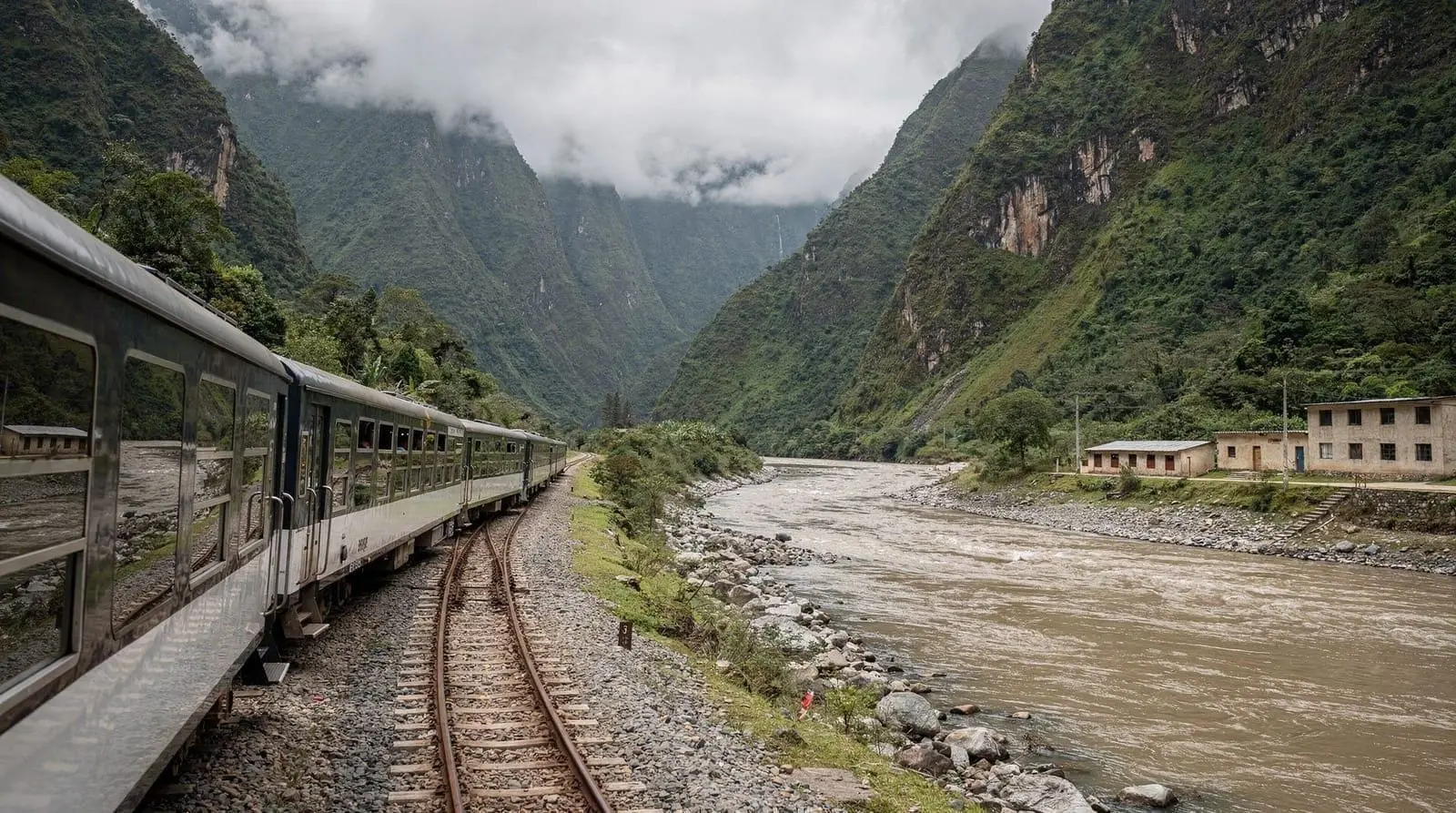
From Ollantaytambo the train drops steadily, following the river as the dry Sacred Valley landscape gives way to humid cloud forest. The canyon walls close in, waterfalls thread down the rock, and bromeliads and orchids cling to the trees as the altitude falls toward Aguas Calientes at 2,040 m. The light is best in the morning going down; on the return the late-afternoon sun lights the upper walls.
There is no universally “better” side — the river weaves back and forth, so both sides get views — but the carriages are designed around it: the panoramic side windows wrap upward, and on Vistadome and 360 services the glass roof catches the canyon tops. Carriages are heated, which matters on early departures, and staff serve a snack and drink on the way. On the return, the panoramic classes run a short live performance: a dancer in a traditional ukuku costume followed by an onboard “fashion show” of baby-alpaca garments that are then sold. It is unabashedly commercial, but mild fun and easy to ignore if you would rather watch the canyon.
Pack a layer — the canyon is warm but the carriages can be over-air-conditioned — and keep your camera handy for the first sight of Machu Picchu Mountain rising above the trees shortly before town.
Families travelling with children generally find the ride itself relaxing rather than stressful — there is no altitude to worry about on the descent, seats are assigned and comfortable, and the scenery keeps young travellers occupied for the roughly 90-minute leg. The main planning consideration is timing naps and meals around the departure rather than the ride itself.
Booking the train: portals, agents, and what to watch
You can book the train three ways, and they differ in price and hassle.
Direct on the operator sites is usually cheapest and gives you the full schedule. Both PeruRail and IncaRail sell online; you choose station, class, time, and seat, and you receive a ticket carrying your name. This is the best route for independent travellers comparing slots.
Through a Cusco travel agency costs a little more for the convenience of having someone match the train to your entry slot. Reputable agencies are fine; the risk is markup and, occasionally, an agency booking you onto a Poroy departure that then gets cancelled. Confirm the boarding station.
As part of a package folds the train into a tour with the bus and entry, removing the coordination entirely. A Machu Picchu day trip with the tourist train and entrance ticket is the single-day version; the Sacred Valley and Machu Picchu 2-day train tour spreads it over two days from Cusco.
Whichever route you choose, the rule is the same: lock the entry ticket first, then the train, and prioritise the afternoon return slot. For the full ticket-and-circuit picture, the complete Machu Picchu guide lays out the booking order.
Reading the schedule and avoiding mistakes
Match station names carefully. Tickets specify the boarding and alighting station. “Ollantaytambo” outbound and “Machu Picchu” (the operators’ name for Aguas Calientes station) inbound is the normal pairing. Do not accidentally book a Poroy departure unless you have confirmed it is running.
Carry photo ID. Both operators check your passport against the ticket name at boarding, exactly as the citadel gate does. The names must match.
Baggage is limited. Carriages allow a small bag only — typically one daypack up to 5 kg plus a personal item. Leave large luggage at your Cusco or Sacred Valley hotel. This matters because large backpacks are also barred inside the citadel.
Buffer the connection. If you are road-transferring from Cusco to catch a morning train, build in margin for traffic and the occasional roadworks delay on the Cusco–Ollantaytambo route. Missing a fixed train is expensive to fix.
Screenshot everything. Signal is patchy in the canyon. Save your train ticket, entry ticket, and bus ticket offline before you leave.
Getting to Ollantaytambo to catch the train
Since the train almost always leaves from Ollantaytambo, the first practical question is how to get there from Cusco. There are three common ways:
Private transfer or taxi. The most comfortable and flexible: a car door-to-door in about two hours, $40–70 depending on negotiation and season. Worth it if you have an early train and want zero uncertainty about timing.
Colectivo (shared van). The budget standard. Shared vans to Urubamba and Ollantaytambo leave from Calle Pavitos in Cusco when full, costing S/15–25, and take a little over two hours. Cheap and frequent, but you wait for the van to fill, so build in margin for an early train.
As part of a Sacred Valley day. Many travellers see the Sacred Valley — Pisac, Maras, Moray, Ollantaytambo — on the way and overnight in Ollantaytambo before an early train the next morning. This doubles as acclimatisation, since the valley sits lower than Cusco. The getting around Sacred Valley guide covers the local options.
Whichever you choose, allow a comfortable buffer. The Cusco–Ollantaytambo road occasionally hits roadworks or traffic, and missing a fixed train is the one mistake the whole plan cannot easily absorb.
A note on luggage and where to leave it
Because train carriages allow only a small bag and the citadel bars large backpacks, plan where your main luggage stays. Most Cusco and Sacred Valley hotels store bags for guests at no charge while you make the overnight or day trip to Machu Picchu — confirm this when you book. Take only a daypack with water, a layer, sun protection, your passport, and your tickets. Travelling light also makes the bus queue and the citadel walk far easier.
For the full picture of circuits, entry slots, the bus, and what to see once you are up there, read the complete Machu Picchu guide. For where to sleep around the train, see the Aguas Calientes guide and the Ollantaytambo destination page.
Train versus the alternatives
It is worth being clear-eyed about what the train buys you compared with the other two ways in. Against the Hidroeléctrica budget route, the train is faster and far less physically tiring, but costs roughly double once you add up the road and the walk — you are paying for comfort and time, not for a better view of the citadel itself.
Against a straightforward day trip from Cusco, the train is simply the transport leg that makes a single-day visit possible at all; the choice there is really about classes and timing, not whether to take the train. If your itinerary already includes an overnight in the Sacred Valley, boarding at Ollantaytambo the next morning also means you have already partly acclimatised at a lower elevation than Cusco, which makes the whole day easier on your body regardless of which train class you choose.
Seasonal differences worth knowing
The trains run year-round, but the experience shifts with the season. In the dry season (May–September), demand is highest, seats on the popular early-morning and mid-afternoon departures sell out weeks ahead, and the canyon scenery is at its clearest under blue skies. In the wet season (November–March), trains run the same schedule but occasionally face short delays from track maintenance after heavy rain, and the cloud forest is greener and mistier — some travellers find the atmospheric fog adds to the ride rather than detracts from it. Shoulder months (April and October) combine good availability with decent weather, and are often the easiest time to get the exact departure you want without booking months in advance.
Frequently asked questions about Machu Picchu by train: the complete
Is PeruRail or IncaRail better?
Can I take the train all the way from Cusco?
How far ahead should I book the train?
What's the difference between Expedition and Vistadome?
Do I need to book the train before my Machu Picchu ticket?
Is the train much better than the Hidroeléctrica budget route?
Does the train run differently in the wet season?
Top experiences
Bookable activities with verified prices and instant confirmation on GetYourGuide.
