Larco Museum guide: tickets, highlights, and how to visit
Lima: Guided Tour of Museo Larco
Is the Larco Museum worth visiting in Lima?
Yes. The Museo Larco holds one of the world's best pre-Columbian collections, opens late (until 10 pm), and sits 20 minutes from Miraflores. Entry is S/35 (about $9). Budget two to three hours plus time for the well-known garden café.
What the Museo Larco actually is
The Museo Larco occupies an 18th-century viceregal mansion built over a pre-Columbian pyramid in Pueblo Libre, a quiet residential district about 20 minutes west of Miraflores. It was founded in 1926 by Rafael Larco Hoyle, a sugar-plantation heir who became one of Peru’s most important archaeologists, and it still houses the private collection he assembled over decades. That origin matters: this is not a state museum cobbled together from confiscated pieces but a single coherent collection built around one man’s obsession with the Moche, Chimú, Nazca, and Inca cultures of Peru’s north coast and highlands.
The result is roughly 45,000 catalogued objects, of which a generous selection is on permanent display. For most visitors this is the single best place in Lima to understand pre-Columbian Peru before continuing to Cusco, Machu Picchu, or the northern sites around Trujillo. If you only have time for one museum in Lima, this is the one most worth your half-day.
| Where | Avenida Bolivar 1515, Pueblo Libre, ~20min from Miraflores |
| Cost | around S/35 adults, S/15 students, café extra |
| Time needed | 2-3hrs galleries, add time for the café |
| Getting there | app taxi (Cabify/InDriver/Uber), no direct public transport |
| Best time | late afternoon to early evening, open until 10pm |
Tickets and opening hours
General admission is S/35 (about $9) for adults. Seniors over 60 pay S/30, and students with a valid ID pay S/15. Children under eight enter free. There is no advantage to buying online in terms of price, but on busy December and January evenings — or when a cruise group is in town — pre-purchasing or arriving with a guided tour avoids a short queue at the ticket window.
The museum is open every day from 9 am to 10 pm, including most public holidays. That late closing is genuinely unusual in Lima, where many museums shut by 5 or 6 pm, and it turns Larco into a flexible evening activity. If you spend the day at Huaca Pucllana and the colonial historic centre, you can still reach Larco for a relaxed 7 pm visit and dinner.
A licensed guide is not included in the standard ticket. You can hire one at the entrance for around S/40-60 for a small group, rent the audio guide for about S/20, or book a structured visit in advance. The guided tour of the Museo Larco includes a trained guide who walks you through the chronology and the iconography in a way the standalone audio guide does not match, which is useful if pre-Columbian history is new to you.
How to get there
Larco sits at Avenida Bolívar 1515, Pueblo Libre. There is no convenient public-transport route from Miraflores or Barranco, so a taxi is the sensible choice.
- App taxi from Miraflores: S/18-25 (about $5-7), 20-30 minutes. Use Cabify, InDriver, or Uber rather than flagging a street taxi.
- App taxi from the historic centre: S/15-20, around 15 minutes.
- From Barranco: S/25-30, 30-35 minutes.
If you are visiting several Lima sights in one day, a combined city tour removes the taxi logistics entirely. The Larco Museum and city tour with lunch pairs the museum with the colonial centre and the San Francisco catacombs, and the city tour combining Larco, Huaca Pucllana, and central Lima covers the three archaeological anchors of the city in a single sweep. Both make sense if you would otherwise be paying for three or four separate taxi rides.
The building and its history
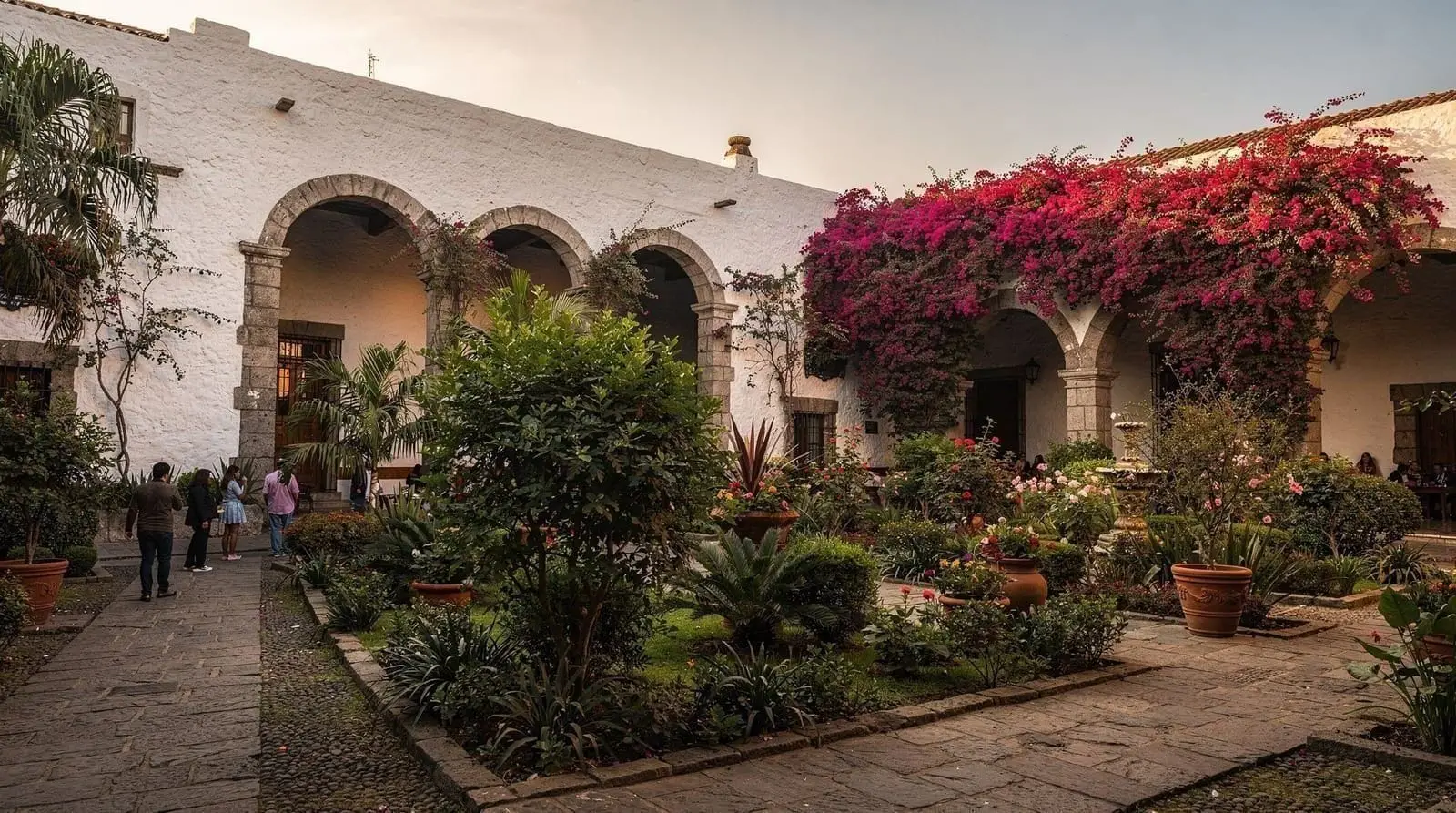
It is easy to focus on the collection and overlook the setting, which is part of what makes Larco distinctive. The museum occupies the Casa Larco, an 18th-century viceregal mansion built, like much of old Lima, directly on top of a far older pre-Columbian pyramid — a 7th-century adobe huaca that is still visible in the grounds. The whitewashed walls, the colonnaded courtyard, and the riot of bougainvillea give the place a serene, almost private feel that the larger state museums lack. Rafael Larco Hoyle bought the property in 1925 and opened the museum the following year, and the family foundation still runs it, which explains the consistent, well-funded presentation throughout.
That family stewardship matters in a country where the history of archaeology is tangled up with looting and the antiquities trade. The Larco collection was assembled over decades, much of it from the family’s own land and from documented excavations on the north coast, and the museum is transparent about provenance in a way that builds trust. When you read a label here, you are generally getting careful scholarship rather than a guess pinned to a beautiful object of murky origin.
The galleries worth your time
The chronological halls
The main building runs you through Peruvian prehistory in roughly chronological order, from the early Cupisnique and Chavín cultures through the Moche, Nazca, Wari, Chimú, and finally the Inca. The Moche material is the heart of the collection. These were master potters of the north coast (roughly 100-700 CE), and their portrait vessels — ceramic heads modelled with such individual character that you sense you are looking at real people — are among the most arresting objects in any Peruvian museum. Pay attention to the labels explaining how the Moche encoded mythology, medicine, and ritual into everyday pottery.
The storerooms
The single most distinctive feature of the Museo Larco is its open storeroom (depósito). Rather than hide the bulk of the collection, the museum lines an entire wing with floor-to-ceiling glass shelving holding tens of thousands of ceramics that did not make the curated display. Walking the aisles past row after row of Moche, Chimú, and Nazca vessels gives you a visceral sense of the collection’s scale that no spotlit display case can. Most visitors rush past this room; spend ten minutes in it.
The gold and silver gallery
A separate, dimly lit and well-secured room holds the precious-metal collection: Moche and Chimú gold headdresses, ceremonial knives, nose ornaments, and the famous turquoise-and-gold funerary masks. The lighting is deliberately low to protect the pieces and create atmosphere, so allow your eyes to adjust. This gallery is also where you will see the textile fragments, including pieces from the Paracas and Nazca cultures of the south coast.
The erotic gallery (Sala Erótica)
The museum’s best-known room sits in a small separate building at the back of the garden. It holds the Moche “huacos eróticos” — explicit ceramic vessels depicting sexual acts that scholars read as fertility symbolism rather than pornography. It generates most of the museum’s online attention, but it is genuinely a footnote to the collection. It is easy to skip if you are visiting with children, since you have to choose to walk into the building.
The café and the garden
The Café del Museo, set in the bougainvillea-draped courtyard, is a destination in its own right and frequently lands on lists of Lima’s most attractive restaurant settings. It is not cheap by Lima standards — main courses run S/45-70 (about $12-19) — but the food is genuinely good Peruvian fare and the terrace at dusk, when the garden is lit, is one of the more pleasant places to eat in the city. Reservations are advisable for dinner, especially on weekends. If you are watching your budget, you can visit the galleries and skip the café without feeling you missed the point of the museum.
Larco versus Lima’s other museums
It is worth being clear about where Larco sits among Lima’s museum options, because the city has several and they are not interchangeable.
The Museo Nacional de Arqueología, Antropología e Historia del Perú, a five-minute walk away in Pueblo Libre, covers broadly the same pre-Columbian ground for a fraction of the entry price (around S/15). It is the older, state-run institution, and while it holds genuinely important pieces — including the Tello Obelisk from Chavín de Huántar — the presentation is dated, the labelling is thin on English, and the lighting and flow cannot compare with Larco. It is a worthwhile add-on for enthusiasts who are already in the neighbourhood, but it is not a substitute.
The brand-new Museo Nacional del Perú (MUNA), on the southern edge of the city near Pachacámac, is a vast modern complex intended to become the country’s flagship museum. It is impressive in ambition and scale, but it is far out, still filling its galleries, and inconvenient for a short Lima stay. The downtown Museo de Arte de Lima (MALI) is excellent for those interested in colonial and republican-era painting rather than pre-Columbian artefacts.
For the typical two- or three-day visitor, the honest hierarchy is simple: if you see one museum, see Larco. If you see two, add either the cheap archaeology museum next door or, if your taste runs to painting, MALI downtown. Skip the rest unless you have a specific interest.
How Larco fits into a Lima visit
For most travellers, Larco is a half-day event slotted into a two- or three-day Lima stay. A common and sensible plan is to spend the morning in the colonial historic centre, break for a ceviche lunch in Miraflores, and arrive at Larco in the late afternoon when the light in the garden is best and the day-tour crowds have thinned.
See /guides/lima-in-2-days/ for a full two-day structure that builds Larco into the itinerary, and /guides/is-lima-worth-visiting/ if you are still deciding how much time to give the city. For the wider picture of Lima’s neighbourhoods, museums, and food, the /guides/lima-complete-guide/ covers everything in one place.
If you are travelling onward, the context you gain at Larco pays off across the country: the Moche material connects directly to the Huacas de Moche and Chan Chan near Trujillo, while the Inca rooms set up your visit to Cusco and the Sacred Valley.
Visiting with children, limited mobility, or limited time
With children: Larco works better for families than most archaeology museums. The garden gives kids room between galleries, the gold room and the portrait vessels hold attention, and the explicit Sala Erótica is in a separate building you simply do not enter. The café has space for a relaxed break. Keep the visit to about ninety minutes for younger children and lead with the gold gallery and the storerooms, which have the most visual impact.
With limited mobility: The main galleries and the café are accessible, and staff are accommodating, but this is a converted historic mansion, so expect a few uneven thresholds and some ramps that are steeper than ideal. If accessibility is a concern, call ahead or book a guided visit so a staff member can route you efficiently and flag the easiest path.
With limited time: If you have only an hour, go straight to three things — the storerooms, the gold gallery, and a quick pass through the Moche portrait vessels in the chronological halls — and skip the café and the erotic gallery. That core gives you the essence of the collection without the full circuit.
What to do nearby
Pueblo Libre is a pleasant, low-key district that rewards a short wander. Beyond the neighbouring national archaeology museum, the Plaza Bolívar and the surrounding streets retain an old-Lima feel, and the historic Antigua Taberna Queirolo, a century-old bar and pisco bodega near the plaza, is a characterful spot for a pisco sour or a simple lunch before or after the museum. Because Pueblo Libre is off the main tourist track, prices here are noticeably lower than in Miraflores, which makes it a good place to eat if you have come this far west.
Why the collection matters before you head to the Andes
It is tempting to treat Larco as a pleasant Lima afternoon and nothing more, but for travellers continuing into the Andean and northern circuits, the museum is the single best primer in the country. The chronological halls give you a working mental map of who came before the Inca — the Moche and Chimú of the north coast, the Nazca and Paracas of the south, the Wari of the highlands — so that when you reach the actual sites, you are not seeing them cold.
The Moche galleries connect directly to the Huacas de Moche and the vast Chimú capital of Chan Chan near Trujillo. The textile and ceramic material from the south coast sets up a visit to the Paracas peninsula and the Nazca region. And the Inca rooms — the masonry, the trapezoidal forms, the gold — are the prelude to Cusco, the Sacred Valley, and Machu Picchu. Two hours at Larco at the start of a trip pays dividends for the next two weeks; it is one of the highest-return uses of a Lima afternoon for anyone with a wider Peru itinerary.
Honest practical notes
- Best time to visit: Late afternoon to early evening (5-8 pm). The garden light is best, the museum stays open until 10 pm, and most organised day tours have already left.
- Wheelchair access: The main galleries and the café are accessible, though the historic mansion has a few uneven thresholds. Staff are helpful if you ask in advance.
- Combine, don’t isolate: Because Pueblo Libre is out of the way, do not make a special trip for Larco alone if you can attach it to a city tour or the nearby Museo Nacional de Arqueología (a five-minute walk away, much cheaper, far less polished).
- Skip the gift shop ceramics as “antiques”: The shop sells well-made reproductions, clearly labelled as such. Nothing in any Lima shop or market that you can legally export is a genuine pre-Columbian antiquity; exporting real artefacts is a serious crime in Peru.
Larco as the start of a wider Lima day
Because Larco sits out in Pueblo Libre, the most efficient plans treat it as one stop in a broader Lima loop rather than an isolated errand. Pairing it with Huaca Pucllana in Miraflores gives you a pre-Inca and colonial-era contrast in a single day, and a stop at Pachacámac on the way out to the airport rounds out the archaeological picture if your flight schedule allows a detour. For travellers building a full first day in the city, the things to do in Lima guide and Lima day trips guide both help sequence Larco against the rest of the capital’s sights.
Frequently asked questions about Larco Museum guide: tickets, highlights, and how to visit
How much does the Larco Museum cost?
What are the Larco Museum opening hours?
How do I get to the Larco Museum from Miraflores?
How long do you need at the Larco Museum?
Is the famous erotic gallery suitable for children?
Can I take photos inside the Larco Museum?
What else should I pair with a Larco Museum visit?
Top experiences
Bookable activities with verified prices and instant confirmation on GetYourGuide.
