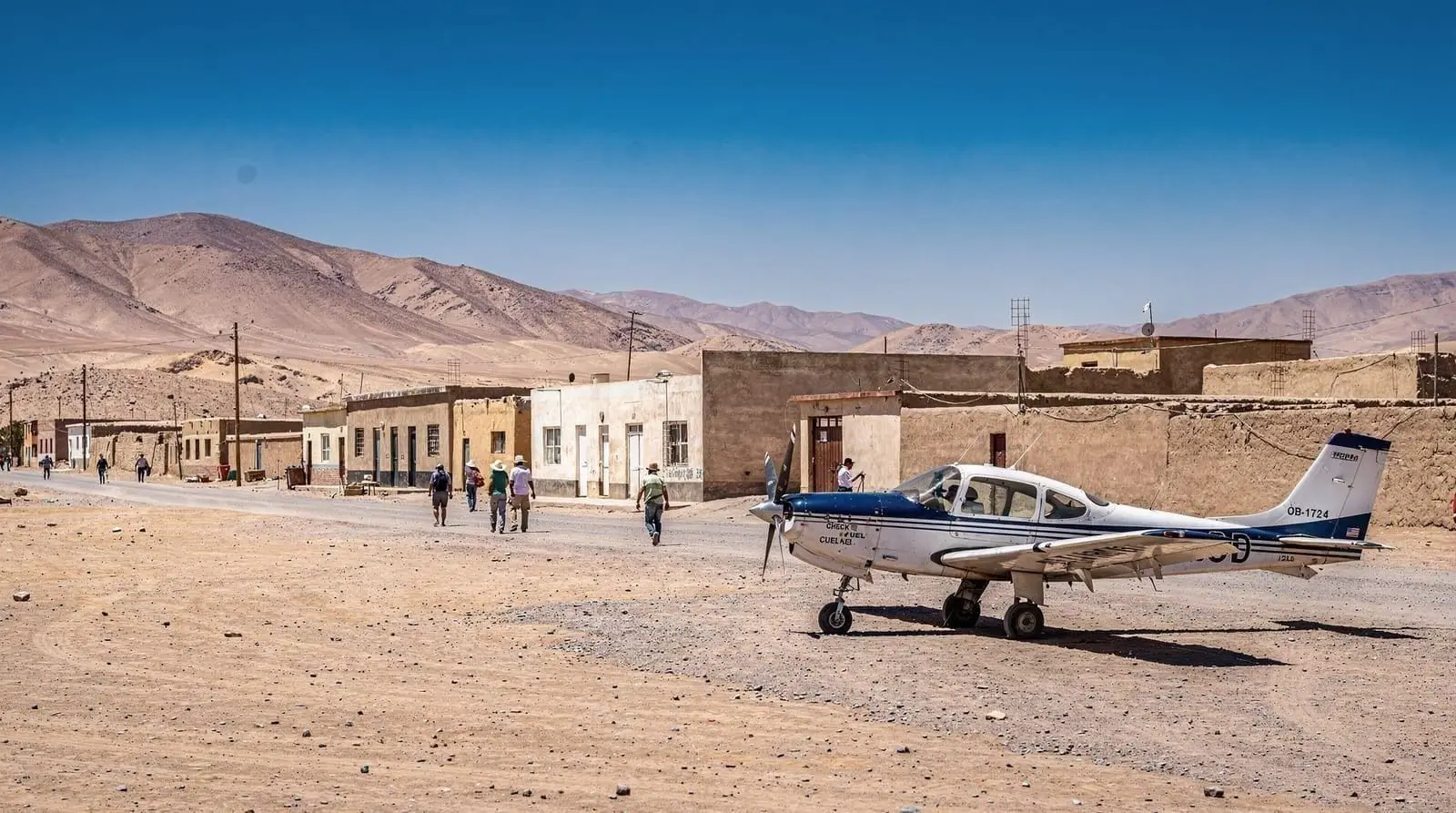
Nazca
See the Nazca Lines by overflight or mirador, visit Chauchilla cemetery, and get honest tips on flight safety, cost, and worth.
From Nazca: 30-Minute Flight over Nazca Lines
Quick facts
- Country
- Peru
- Altitude
- 520 m (1,706 ft)
- Currency
- Peruvian sol (S/) — USD widely used
- Best for
- Archaeology, desert mysteries, overflights
Most travellers come to Nazca for roughly 30 minutes of airborne bewilderment — a small plane banking sharply over the Pampa Colorada while a pilot points out a hummingbird, a spider, or a pair of hands etched into the desert below. Those 30 minutes are genuinely extraordinary. But Nazca is also a full day on the ground: a 2,000-year-old open-air cemetery, aqueducts still flowing after two millennia, and a museum dedicated to the German mathematician who spent half her life trying to decode the whole puzzle. You don’t need to fly to find Nazca worthwhile — though if your stomach can take it, the flight is worth every sol.
| Where | Pampa Colorada, 446 km south of Lima on the Panamericana Sur |
| Cost | Overflight ~S/450–550 ($120–145); mirador tower S/2; Chauchilla tour ~S/60–80 |
| Time needed | 1 full day, 2 if you want the pampa museums unhurried |
| Getting there | 7–8hr overnight bus from Lima, or 2–3hr from Paracas/Ica |
| Best time | May–October dry season, morning flights for stable air |
What the Nazca Lines actually are
The geoglyphs cover roughly 450 km² of the Pampa Colorada, a high plateau between the Andes and the Pacific. The Nasca culture (note the alternate spelling used by archaeologists) created them between about 100 BCE and 800 CE by removing the reddish-brown iron-oxide-coated pebbles on the surface and exposing the yellowish ground beneath. The lines stay visible because there is almost no rain and very little wind at ground level — a kind of natural preservation that makes this one of the driest inhabited places on Earth.
There are more than 300 figures: animals, plants, humans, and geometric forms. The spider is about 46 m long. The condor stretches to 135 m. The monkey has a spiralled tail. No single theory explains them all convincingly. María Reiche, who mapped the geoglyphs from the 1940s until her death in 1998, argued they were an astronomical calendar. Others have proposed ritual pathways, water-worship sites, or — less credibly — alien landing strips. The current academic consensus leans towards ceremonial and water-related functions, but there is genuine ongoing debate, which is part of the fascination.
The overflight: honest assessment
The classic way to see the figures is a 30- to 35-minute light-aircraft flight departing from the small Nazca airport. Operators charge roughly S/450–550 (about $120–145 USD) for the standard loop from Nazca itself. Flights from Ica or Pisco airport cost more because the aircraft must travel farther, but they suit travellers basing themselves in Ica or Paracas who don’t want to make the extra bus hop. From Lima, a full-day tour including the flight is available but involves very long travel times.
Safety is a real concern. Nazca has had serious accidents over the years, including a fatal crash in 2010 and incidents since. The industry has improved — DGAC (Peru’s civil aviation authority) tightened operator licensing — but small planes in turbulent desert thermals still carry inherent risk. The key practical steps: book only with operators that hold current DGAC certification, avoid the very cheapest deals sold by street touts, and check that the pilot is the actual licence holder rather than a trainee. Reputable agencies include Alas Peruanas and AeroParacas. Your hotel in Nazca can often verify current standing.
Motion sickness affects a substantial minority of passengers. The planes bank steeply to show figures on both sides, repeatedly. If you are prone to car sickness, take medication (dimenhydrinate / Dramamine) at least an hour before the flight, eat lightly, and sit as close to the front as possible. Pilots are used to passengers feeling unwell — it is not unusual.
Is it worth it? If you have no motion sickness issues and a moderate budget, yes. The scale of the figures is only legible from above and seeing them for real rather than in a photograph is legitimately moving. If you are budget-constrained or nervous about small aircraft, the roadside mirador (watchtower) gives a ground-level view of two or three figures for S/2 entry. It is genuinely inferior to the overflight, but it is not nothing.
From Nazca: 30-Minute Flight over Nazca LinesIf you are based in Ica or Huacachina, the flight from Ica airport is often more convenient and roughly the same price:
From Ica: Flight over the Nazca LinesChauchilla Cemetery
Thirty kilometres south of Nazca, Chauchilla is one of the few pre-Columbian burial sites in Peru where mummies remain in situ. The Nasca and later Inca-era dead were mummified in a seated, foetal position and placed in underground tombs called fardos, wrapped in textiles. Grave robbers (huaqueros) ransacked the site heavily in the 20th century, leaving bones and textiles scattered across the desert — the eerie exposure you see today. Since the 1990s, archaeologists have reinterred some remains in reconstructed tombs that are now open to the public under glass.
The visit takes about 90 minutes. Tombs are clearly labelled, and a local guide (included with most tours) explains burial customs, the preservation caused by extreme aridity, and the cultural context of the Nasca. It is not morbid tourism so much as a window into how a sophisticated desert civilisation thought about death and the afterlife. Combine it with a stop at the pottery workshops and the Cantalloc aqueducts on the same circuit.
Nazca: Chauchilla Cemetery Archaeological TourCantalloc aqueducts and the puquios
About 4 km from central Nazca, the Cantalloc spiral wells (puquios) are Nasca-engineered underground aqueducts that channel snowmelt from the Andes through filtration trenches to the surface. The spiral openings — which look almost like geoglyphs themselves when seen from above — funnel wind underground to create pressure that pushes water upward. Some of them still function. A 2016 study in the Journal of Archaeological Science Reports proposed they may be far more central to understanding the Nasca geoglyphs than previously thought, suggesting the lines and spirals map the underground water network. Whether or not that is true, they are an impressive feat of desert engineering from a culture with no metal tools.
The María Reiche Museum
The house where María Reiche lived and worked for decades has been preserved as a small museum on the edge of the pampa. It contains her instruments, maps, and notebooks. She paid her own living expenses for years to continue mapping the geoglyphs, was largely dismissed by the academic establishment in her lifetime, and is now considered the founding figure of Nazca scholarship. The museum is modest but genuinely interesting for anyone who wants context beyond “the aliens did it.”
Overflight vs mirador vs skipping it
| Option | Cost | What you see | Best for |
|---|---|---|---|
| Overflight (Nazca) | ~S/450–550 | Full figures, all of Pampa Colorada | Anyone without motion-sickness concerns |
| Overflight (Ica/Pisco) | Higher | Same figures, longer flight | Travellers based in Ica or Paracas |
| Mirador tower | S/2 | 2–3 partial figures, ground level | Budget or medical restrictions on flying |
| Skipping the lines | Free | Chauchilla, Cantalloc, museums only | Those with no interest in the geoglyphs |
If you are weighing these up in detail, the is the Nazca flight worth it guide walks through the trade-offs, and the flight safety guide covers the operator-vetting steps in full.
Nazca town: the practical reality
Nazca is a small, quiet desert city with one main commercial street — the Jirón Lima strip near the Plaza de Armas — and not much tourist infrastructure beyond the overflight operators, a handful of mid-range hotels, and a few restaurants. It is not a destination you linger in for ambience; it is a destination you arrive at, do extraordinary things, and continue from.
The local market covers basic supplies. Restaurants cluster around the Plaza de Armas and Jirón Lima; the standard lunch menu (S/15–20) is as good a value here as anywhere in Peru. La Taberna is the well-worn traveller favourite for dinner — unremarkable food at fair prices but reliable. The town museum (Museo Arqueológico Antonini) on Avenida de la Cultura is worth 90 minutes: it holds the best single collection of Nasca ceramics available to the public, along with a scale model of the geoglyphs that helps orient first-time visitors before the flight.
The main operator strips are on Jirón Lima and around the Plaza. Never book a flight from a tout who approaches you on the bus; always book in person at a licensed operator’s office or through a reputable travel agency. Ask to see the pilot’s licence and the plane’s registration document.
Where to stay in Nazca
Most travellers need only one night, so location matters less than reliability. Hotels cluster within walking distance of the Plaza de Armas and Jirón Lima, close to the flight-operator offices, which is convenient if your pickup is early morning. Mid-range guesthouses with fans or basic air conditioning are the norm — Nazca’s dry heat makes a working fan more useful than décor. Book ahead around Peruvian holidays and the July–August European summer peak, when the handful of comfortable mid-range options fill first. If you plan to fly first thing, ask your hotel to confirm the pickup time with the operator the evening before rather than trusting a voucher alone.
Getting to Nazca
Nazca sits 446 km south of Lima, roughly 7–8 hours by bus on the Panamericana Sur. The better Cruz del Sur, Oltursa, and Tepsa services run overnight and semi-cama seats — comfortable enough for a night journey. From Paracas or Ica it is 2–3 hours south by bus or shared colectivo. From Huacachina the easiest option is a day tour that handles transport both ways.
The bus terminal is a few kilometres from the centre; a mototaxi into town costs S/3–5. Most travellers stay one night, do the overflight in the morning (better visibility before afternoon thermals), and combine Chauchilla and Cantalloc in the afternoon.
Food in Nazca
Nazca’s food scene is modest but reliable rather than exciting. Menú del día lunches (S/15–20) around the Plaza de Armas and Jirón Lima are the best value — soup, a main of rice with chicken or fish, and a drink, aimed squarely at locals and bus travellers rather than tourists. La Taberna remains the well-worn evening choice: unremarkable but dependable, and one of the few places open late for travellers arriving on the overnight bus. If you are coming from Ica, where the pisco-bodega restaurants are noticeably better, temper your expectations for Nazca — it is a working desert town built around the flight industry, not a culinary stop.
Combining Nazca with the south coast circuit
Nazca works best as the southern anchor of the south coast loop. The logic runs: Lima → Paracas (Ballestas Islands, reserve) → Ica / Huacachina (pisco bodegas, dune buggy sunset) → Nazca (overflight, Chauchilla) → bus north back to Lima, or continue south toward Arequipa and the Colca Canyon. The total loop takes 4–7 days depending on pace.
Travellers pressed for time can do the overflight from Ica (avoiding the extra bus hop to Nazca), though this removes the option of combining ground activities. For the full experience, one night in Nazca itself — arriving in the afternoon, flying the next morning — is the minimum. Deeper exploration of the pampa, the various theory museums, and the outlying geoglyphs accessible only by 4WD merits a second day.
For itinerary ideas covering the full south coast, see the south coast itinerary section and the guide to what the Nazca flight is actually like.
Practical planning
Best time to visit: May through October. The dry season produces clearer skies, which matters for overflight visibility and for seeing the desert landscape at its starkest. November to April brings occasional cloud at pampa level and, rarely, rain — which can delay or cancel flights.
Money: Bring enough cash. Nazca has ATMs (Banco de la Nación and BBVA) but they sometimes run dry on weekends. Flight operators typically accept USD or soles; some accept cards. Chauchilla and the museum are cash-only.
Altitude: At 520 m, Nazca presents no altitude issues. It is dramatically hotter than Cusco or Arequipa — expect 28–35°C in summer and a dry, dusty heat year-round. Drink more water than you think you need.
For a joined-up itinerary combining Paracas, Huacachina and Nazca, see the Lima to Paracas and Nazca itinerary guide and the things to do on the south coast overview. The Nazca Lines complete guide covers every figure, theory, and operator in more depth.
If you prefer to do the whole circuit as a guided multi-day experience from Lima, the two-day Paracas–Huacachina–Nazca tour combines the main highlights with accommodation included.
Frequently asked questions about Nazca
Is the Nazca Lines flight safe?
It is safer than it was a decade ago following stricter DGAC regulations, but small-plane overflights carry inherent risk. Book with a licensed, established operator — not from a street tout — and verify current DGAC certification. Accidents have occurred, so doing your due diligence matters.
How much does the Nazca overflight cost?
From Nazca airport, expect to pay S/450–550 (approximately $120–145 USD) for the standard 30-minute flight. Flights from Ica or Pisco are pricier. Avoid any offer significantly below S/350 — corners will have been cut somewhere.
Can you see the Nazca Lines without flying?
Yes. The roadside mirador on the Panamericana gives a partial ground-level view of two or three figures (the lizard and tree are visible). The observation tower costs S/2. It gives a fraction of the experience of the overflight but is free of motion-sickness risk and costs almost nothing.
How far is Nazca from Ica and Huacachina?
About 130 km south, roughly 2 hours by bus or colectivo. Most travellers visit Nazca as a day trip from Ica or as part of an overnight coming from Huacachina.
What is Chauchilla Cemetery?
Chauchilla is a pre-Columbian burial site 30 km south of Nazca where Nasca-culture mummies are displayed in their original tombs. Visits take 1–2 hours and are usually combined with the Cantalloc aqueducts on the same half-day tour.
When is the best time to fly over the Nazca Lines?
Early morning (07:00–10:00) generally offers the smoothest air and best visibility. Afternoon thermals can make the flight rougher and reduce visibility in the dry season haze. Book the first available slot if motion sickness is a concern.
Is one day enough in Nazca?
Yes for most travellers. Arrive the night before if you want the early-morning flight. A single day covers the overflight, Chauchilla, Cantalloc, and the María Reiche Museum. Those wanting to explore the pampa more deeply or combine it with a visit to the Nazca town museum may benefit from a second half-day.
Top experiences
Bookable activities with verified prices and instant confirmation on GetYourGuide.
