The Inca empire for travellers
City Tour in Cusco: Qorikancha and Sacsayhuaman
What do I need to know about the Incas before visiting Peru?
That the Inca empire — Tawantinsuyu — was a roughly century-long superstate (c. 1438–1533) run from Cusco without writing, money, or the wheel, yet it built astonishing roads, terraces, and stonework. Knowing the basics of its rise, organisation, and Spanish conquest turns the ruins from pretty stones into a coherent story.
Why a little history changes the whole trip
You can visit Machu Picchu knowing nothing and still be moved by it. But the ruins of the Inca world are, for most visitors, a sequence of beautiful walls and terraces that blur together by the third day — unless you carry a thread of the story with you. This guide is that thread: enough of the who, when, and how to make Cusco, the Sacred Valley, and Machu Picchu read as chapters of one narrative rather than a slideshow of grey stone.
It is deliberately a traveller’s primer, not an academic one. The aim is that when you stand at Qorikancha and see Inca walls under a Spanish convent, or at Ollantaytambo and see a fortress where the conquest was briefly reversed, you know what you are looking at and why it matters.
| Empire | Tawantinsuyu, c. 1438–1533, under a century |
| Capital | Cusco |
| Extent | Southern Colombia to central Chile, ~4,000 km |
| Language | Quechua, still spoken by millions today |
| End | Spanish capture of Cusco, 1533; resistance to 1572 |
The single most surprising fact: it was brief
Most people assume the Inca empire was ancient and long-lived. It was neither. The empire phase lasted under a century — roughly 1438 to 1533. The Incas existed earlier as one ethnic group among many in the Cusco valley, with a semi-legendary line of early rulers. But the explosion from a regional kingdom into the largest empire the Americas ever saw happened in just three or four generations.
The hinge figure is Pachacuti (reigned from around 1438), who, the chronicles say, repelled an invasion by the rival Chanca and then turned that defensive victory into a programme of relentless expansion. He and his successors — Túpac Yupanqui and Huayna Capac — pushed the empire from southern Colombia to central Chile, perhaps ten to twelve million people across modern Peru, Bolivia, Ecuador, and beyond. When the Spanish arrived in the 1530s, much of this empire was within living memory of having been conquered, which is part of why it proved so fragile.
Tawantinsuyu: how the empire was organised
The Incas called their realm Tawantinsuyu — “the four parts together” — four great quarters meeting at Cusco, the literal and ceremonial centre. Understanding how it ran is the key that unlocks the sites.
- No money, no markets, but a labour tax. There was no currency. Instead, subjects owed the state mit’a, a rotating labour obligation — so many days a year building roads, farming state land, serving in armies, or hauling stone. The terraces, fortresses, and roads you photograph were built with this taxed labour.
- No writing, but the quipu. Administration ran on the quipu, knotted cords of dyed wool encoding numbers (and, scholars increasingly argue, more). Specialist quipucamayocs kept the records of an empire of millions without a single written word.
- The road network. The Qhapaq Ñan, the royal Inca road system, ran some 40,000 km across brutal terrain, with tambos (way-stations) and chasquis (relay runners) carrying messages — and, famously, fresh fish from the coast to the emperor’s table.
- Storehouses and resettlement. State qollqas (storehouses) stockpiled food against famine and war, and the empire forcibly resettled whole populations (mitmaq) to secure new territory and break up resistance.
- Religion and the Sapa Inca. The emperor, the Sapa Inca, was held to descend from Inti, the sun. The state religion centred on the sun, the earth mother Pachamama, and ancestor worship — including the mummified bodies of dead emperors, who “owned” estates and were consulted as if alive.
Hold these in mind and the sites snap into focus: Qorikancha was the sun temple at the empire’s heart; the Sacred Valley terraces were imperial agriculture; Machu Picchu was very likely a royal estate of Pachacuti himself.
The earlier civilisations the Incas stood on
A common misconception is that the Incas invented Andean civilisation. They did not — they were its last and most organised flowering. For roughly three thousand years before them, other cultures built, farmed, and worshipped across Peru:
- The Chavín (c. 900–200 BCE) set early religious and artistic templates in the highlands.
- The Nazca drew their vast desert lines on the south coast.
- The Moche raised adobe pyramids and produced some of the finest ceramics of the ancient Americas on the north coast.
- The Wari and Tiwanaku ran earlier highland states whose roads and terracing the Incas inherited.
- The Chimú built the vast adobe city of Chan Chan near modern Trujillo — and were conquered and absorbed by the Incas in the 1470s.
For the north-coast cultures specifically, the Moche and Chimú civilisations guide goes deeper. The point for the traveller: the Incas were brilliant synthesisers who scaled up inherited Andean knowledge to imperial size, rather than lone inventors.
The conquest, in honest brief
The fall of the empire (1532–1533) is so improbable it sounds like myth, but the mechanism is clear enough.
First, disease arrived ahead of the Spaniards. Smallpox, sweeping down from Spanish contact in the Caribbean and Mesoamerica, killed the emperor Huayna Capac and his designated heir around 1527, before Pizarro ever reached the highlands. The succession crisis triggered a brutal civil war between two of Huayna Capac’s sons, Atahualpa and Huáscar.
Into that exhausted, divided empire walked Francisco Pizarro with fewer than 200 men in 1532. At Cajamarca he ambushed and captured Atahualpa — fresh from defeating his brother — held him for an enormous ransom of gold and silver, then executed him anyway. The Spanish then exploited Inca factions, installed puppet rulers, and took Cusco in 1533. Resistance continued for decades — Manco Inca’s rebellion briefly besieged Cusco and fought at Ollantaytambo and Sacsayhuamán, and a rump Inca state held out at Vilcabamba until 1572 — but the empire as a functioning whole was gone within two years of Pizarro’s arrival.
Steel, horses, guns, and ruthlessness mattered. But disease and a civil war that had already gutted Inca leadership mattered more.
Where to see the empire: a site-by-site reading list
The southern Peru highlands are one of the most legible imperial landscapes anywhere, because so much survives within a compact region.
Cusco — the capital. The navel of Tawantinsuyu. Qorikancha, the Temple of the Sun, shows the empire’s religious core literally underneath the Spanish convent that replaced it — the clearest single image of conquest in stone. Above the city, Sacsayhuamán — colossal interlocking blocks, some over 100 tonnes — was a ceremonial and military complex and the site of a desperate battle in Manco Inca’s revolt.
A guided city tour ties these together with context; the Cusco city tour of Qorikancha and Sacsayhuamán covers the two anchor Inca sites in one morning, while the broader half-day Cusco city tour with Sacsayhuamán and Qenqo adds the carved rock shrine above town.
The Sacred Valley — the breadbasket and the frontier. Ollantaytambo is a living Inca town with a terraced temple-fortress where Manco Inca won a rare victory over the Spanish. Pisac crowns a ridge with terraces and a sun temple. At Maras and Moray, the concentric terraced bowls of Moray are read by many as an agricultural research station — different microclimates on each ring — beside salt pans worked since pre-Inca times.
Machu Picchu — the royal estate. Not a lost city in the romantic sense but, most scholars now think, a royal estate built for Pachacuti, abandoned around the conquest and never found by the Spanish, which is why it survived so intact. Its temples, terraces, and astronomical stonework distil the whole imperial repertoire into one spectacular ridge.
For deeper context before you go, Cusco’s archaeological sites maps what is where, and the tourist ticket guide explains the boleto that gets you into most of them. For the two Cusco anchor sites individually, the Qorikancha guide and the Sacsayhuamán guide go deeper than this overview can, and the Maras and Moray day trip guide covers the agricultural sites in the Sacred Valley in full.
Food and market life, then and now
The empire’s food system left a surprisingly direct legacy in what you eat in Cusco today. The potato varieties, maize, and quinoa that fed Tawantinsuyu’s storehouses are still the backbone of Andean cooking, sold alongside charqui and fresh produce in San Pedro market much as earlier generations would have traded at a local tambo. The San Pedro market food guide is worth reading before you go, both for what to try and for the etiquette of photographing vendors who are working, not performing.
Inca engineering, decoded for the trail
A few features you will see again and again, and what they mean:
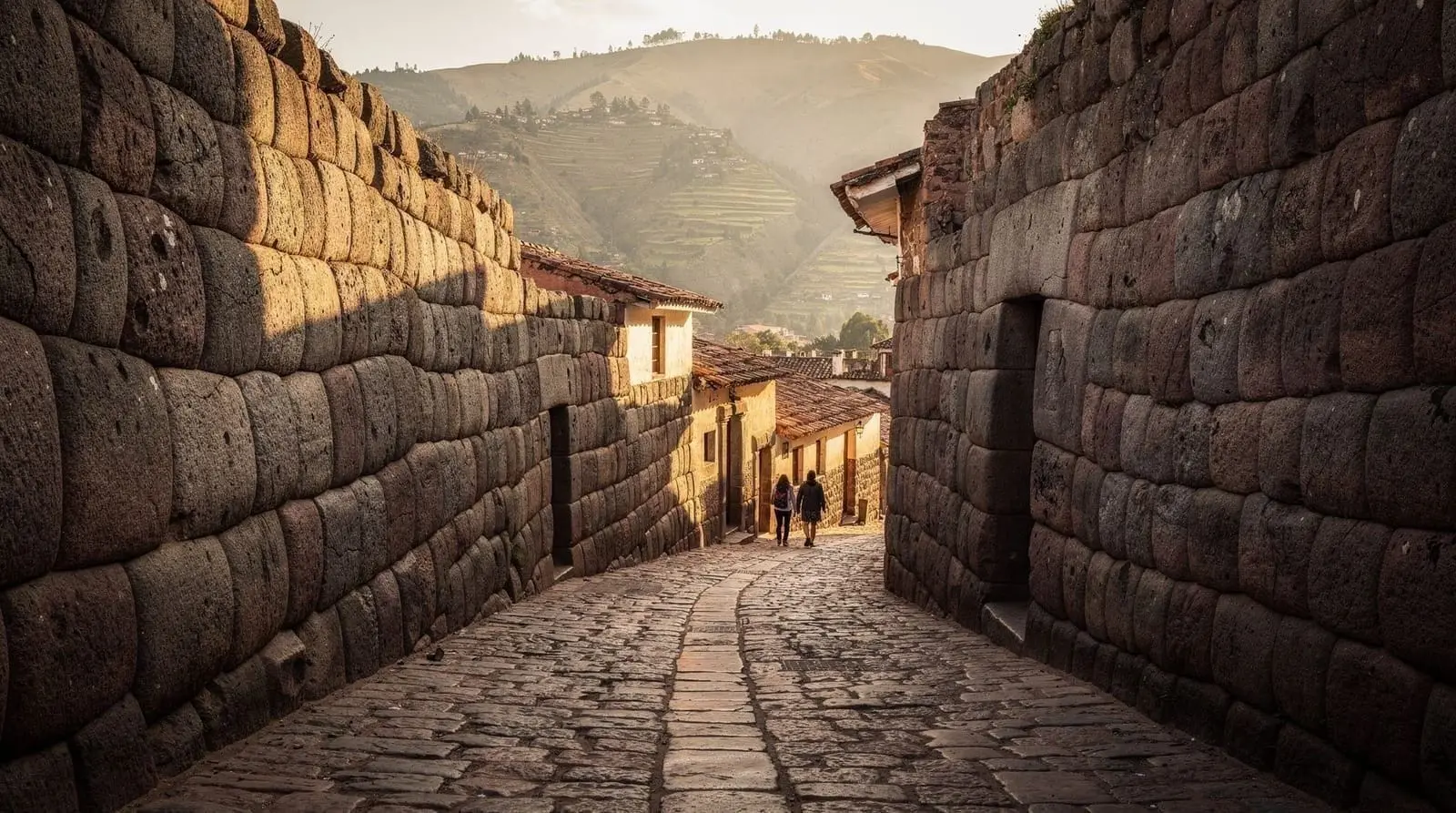
- Polygonal masonry. The famous mortarless walls of irregular, perfectly fitted stones — earthquake-resistant because the blocks shift and resettle. The “twelve-angled stone” on Cusco’s Hatun Rumiyoc street is the showpiece.
- Trapezoidal doors and windows. Wider at the base, narrower at the top — a deliberately stable, earthquake-resistant shape that instantly marks a structure as Inca.
- Andenes (terraces). Stepped agricultural platforms that prevented erosion, created flat farmland on slopes, and managed frost and water — the backbone of feeding the empire.
- Water channels and fountains. Precise hydraulic engineering carries spring water through Machu Picchu and the Sacred Valley sites still, centuries on.
Spot these and you can date and read a ruin yourself, without a placard.
Daily life in the empire
It is easy to fixate on emperors and conquest and forget that Tawantinsuyu was, for most of its people, a working agricultural society. The base unit was the ayllu, an extended kin group that held land collectively and owed labour to the state — a structure so durable that Andean communities still organise around recognisably similar lines today.
Most people were farmers. The Andean diet rested on crops the rest of the world would later adopt: the potato, in hundreds of frost- and altitude-adapted varieties, plus maize, quinoa, and beans, supplemented by charqui (the sun-dried llama meat that gives us the word “jerky”). The llama and alpaca provided wool, meat, and transport; there were no cattle, horses, sheep, or pigs until the Spanish brought them.
Textiles, not gold, were the empire’s most prized goods. Fine cloth — cumbi, woven by specialist women — was a form of wealth, diplomacy, and ritual offering, sometimes burned as sacrifice. The gold and silver the Spanish melted down was sacred and ornamental rather than money; the Incas valued the labour and artistry in fine weaving far above the metal. You can still see this textile tradition alive in the Sacred Valley weaving communities and in Cusco’s San Pedro market.
Religion saturated daily life. Beyond Inti and Pachamama, the landscape itself was sacred: mountains were apus, living deities, and springs, caves, and unusual rocks were huacas that received offerings. This is why so many Inca sites sit where they do — not for defence or convenience, but because the place itself was holy. Standing at Sacsayhuamán or beside a carved outcrop at Qenqo, you are looking at sacred geography, not just architecture.
The Incas today: a living culture, not a dead one
A subtle thing for travellers to carry: the Inca story did not end in 1533, and the people did not vanish. Quechua, the language of the empire, is still spoken by millions across the Andes, and you will hear it in markets and villages throughout the Cusco region. The terracing, the textile patterns, the crops, the festivals, and the reverence for Pachamama and the apus all persist, woven through a Catholicism layered on top during the colonial centuries.
This shows up vividly in Cusco’s festivals — most famously Inti Raymi, the festival of the sun, revived in the twentieth century and now staged each June at Sacsayhuamán, a dramatic if theatrical reconstruction of the imperial sun ceremony. The Inti Raymi festival guide covers tickets and timing if your trip can align with it, and the Inti Raymi diary gives a first-hand sense of what the day is actually like on the ground.
The point for the respectful visitor is that the descendants of the empire are the guides, weavers, farmers, and hosts you meet — the culture is contemporary and ongoing, not a museum piece. Treating it that way, rather than as a romantic ruin, makes for a richer and more honest trip.
The weaving tradition is one of the clearest living threads back to the empire’s textile economy described above. In Chinchero, women’s cooperatives still spin, dye with natural pigments, and weave on backstrap looms using patterns with pre-Hispanic roots; the weaving with Chinchero women account describes what a respectful visit to one of these workshops looks like, well beyond a quick souvenir stop.
A short glossary to carry
- Tawantinsuyu — the empire, “the four parts together.”
- Sapa Inca — the emperor.
- Inti — the sun god; Pachamama — the earth mother.
- Quipu — knotted-cord record-keeping.
- Mit’a — the rotating labour tax.
- Qhapaq Ñan — the royal road network.
- Tambo — a road way-station (hence Ollantatambo).
- Andenes — agricultural terraces.