Moche and Chimú civilizations
Trujillo: Full-Day City Tour with Visit to Chan Chan
Who were the Moche and the Chimú?
The Moche (roughly 100–800 CE) and the Chimú (roughly 900–1470 CE) were powerful pre-Inca civilisations of Peru's north coast. The Moche are known for painted pyramids and lifelike pottery; the Chimú for Chan Chan, the largest adobe city on earth. Both predate the Inca and are best seen around Trujillo.
A coast with a history older than the Inca
Mention ancient Peru and most people picture Machu Picchu and the Inca. But the Inca empire was a latecomer — its great expansion only began in the 1400s, and within a century the Spanish had ended it. Long before any of that, Peru’s north coast was home to civilisations that built monumental cities, mastered metalworking, ran continent-spanning trade, and produced some of the finest art in the pre-Columbian Americas. The two that matter most for travellers are the Moche and the Chimú, and you can stand inside both of their worlds in a couple of days around Trujillo.
Understanding who they were — and how they differ — transforms a visit to the ruins from “old mud walls” into a readable story spanning fourteen centuries. This guide gives you that backbone before you walk the sites.
| Where | Around Trujillo, Peru’s north coast |
| Sites | Huacas de Moche, El Brujo (Moche); Chan Chan (Chimú) |
| Time needed | 1 full day for the essentials, 2 days with El Brujo |
| Getting there | Fly Lima–Trujillo (around 1hr), then taxi or tour to each site |
| Cost | Site tickets are modest (a few PEN–USD each); guided day tours add more |
| Best time | Year-round; the coast is dry desert, so weather rarely disrupts plans |
The Moche (c. 100–800 CE)
The Moche (also spelled Mochica) were not a single unified empire but a constellation of powerful valley-based polities sharing a common culture along the north coast, roughly from the Lambayeque valley to the Nepeña. They thrived for some seven centuries in one of the driest deserts on earth, made habitable by sophisticated irrigation canals drawing on rivers that descend from the Andes.
A people without writing
One thing to keep in mind throughout: neither the Moche nor the Chimú left a written language. Everything we know about them comes from archaeology — their architecture, their tombs, their goldwork, and above all their pottery — interpreted by generations of researchers. This is why the great tomb discoveries like the Lord of Sipán and the Lady of Cao matter so much: each one is, in effect, a primary document, telling us who held power, what they valued, and how they understood the world. It also means interpretations evolve as new sites are dug, so the story you hear from a good guide today is richer and sometimes different from what was taught a generation ago.
Art and pottery
The Moche are, above all, famous for their ceramics. Their portrait vessels — startlingly individual depictions of human faces — are among the most lifelike art produced anywhere in the ancient world. Their pottery also records ritual, warfare, disease, and daily life in extraordinary detail, functioning almost as a visual archive of Moche society. Much of what we know about them comes from these vessels rather than written records, since the Moche left no writing system.
Gods and ritual
At the centre of Moche religion stood Ai Apaec, the fanged “Decapitator” deity, whose snarling face repeats across the painted friezes of their temples. Ritual was bloody: archaeological and pictorial evidence shows the Sacrifice Ceremony, in which captured warriors were bled and offered to the gods, likely to appease the forces behind the droughts and floods that periodically devastated the coast.
Where to see the Moche
The Moche heartland is visible at the Huacas de Moche just south of Trujillo, where the Huaca de la Luna preserves multi-layered painted friezes of Ai Apaec. North of the city, the El Brujo complex holds the tomb of the Lady of Cao, the female ruler whose 2006 discovery proved Moche power was not exclusively male. Further north near Chiclayo, the Lord of Sipán tomb — one of the richest unlooted burials ever found in the Americas — shows the dazzling gold and turquoise of a Moche lord at the height of his power.
What ended the Moche
There is no single neat cause, but climate is central to the story. The north coast lives and dies by the El Niño cycle, and the evidence points to a series of catastrophic El Niño events from around the 6th century onward — torrential floods that destroyed irrigation networks, followed by prolonged drought. The agricultural base that supported the great temples buckled. Combined with social and political stress, the Moche cultural system fragmented by around 800 CE, giving way to successor cultures (such as the Lambayeque/Sicán) and, eventually, the Chimú.
The Chimú (c. 900–1470 CE)
Out of the post-Moche north coast rose the Chimú (or Chimor), a far more centralised empire that, at its height, controlled a thousand-kilometre stretch of coast — the largest polity in the Andes before the Inca. Where the Moche were a network of valley powers, the Chimú were a kingdom with a single capital, a hereditary dynasty, and a bureaucratic command economy.
Chan Chan
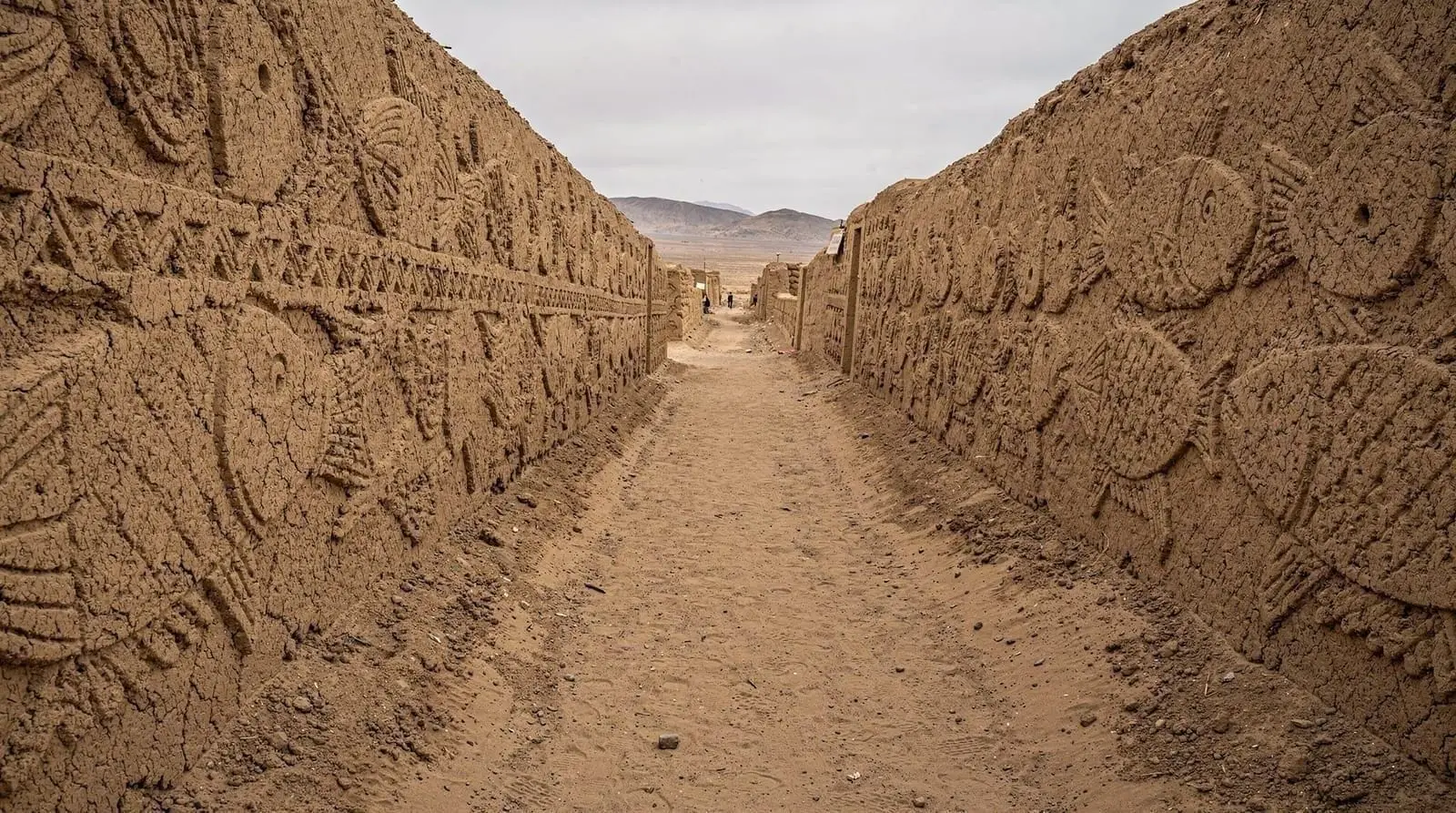
That capital was Chan Chan, the largest adobe city ever built and the largest pre-Columbian city in South America. Spread across roughly 20 sq km west of Trujillo, it housed an estimated 30,000–40,000 people in nine vast royal compounds, each constructed by a successive king and sealed as his mausoleum when he died. The carved friezes that survive — fish, sea otters, pelican-like seabirds, fishing nets — reveal a maritime cosmology centred on the Pacific. The Chimú revered the moon (which controls the tides) above the sun.
Craft and economy
The Chimú were master metalworkers, producing gold and silver objects on something close to an industrial scale, and they ran a planned economy of specialised craft workshops within Chan Chan. Their ceramics, by contrast with the individual brilliance of Moche pottery, were mass-produced in moulds and typically finished in a distinctive glossy black — efficient, standardised, imperial.
Where to see the Chimú
Chan Chan is the essential site, along with its outlying friezed huacas (Arco Iris / El Dragón and Esmeralda) covered by the same combined ticket. The Museo de Arqueología in Trujillo and the Larco Museum in Lima hold significant Chimú metalwork.
What ended the Chimú
The Chimú met a more decisive end than the Moche: conquest. In the 1470s the expanding Inca empire, under Tupac Inca Yupanqui, defeated Chimor — reportedly by cutting the canals that fed Chan Chan, starving the desert city of water. The Inca deported Chimú goldsmiths and craftsmen to Cusco, which is why later Inca metalwork carries a clear Chimú influence. Within a couple of generations, the Spanish arrived, and Chan Chan’s gold was looted.
How the north coast made civilisation possible
It is worth pausing on the setting, because it explains almost everything about both cultures. Peru’s north coast is one of the driest deserts on earth — some stretches go years without measurable rain. Yet it is cut by rivers descending from the Andes, and both the Moche and the Chimú built their power on engineering water: vast canal systems that turned desert into farmland, and reservoirs that tapped the high coastal water table.
Whoever controlled the canals controlled the food supply, and therefore the labour, and therefore the temples and palaces. This is why the irrigation network at the Huacas de Moche mattered as much as the pyramids, and why the Inca conquered Chan Chan by the simple expedient of cutting its water.
The same desert that demanded this engineering also preserved its results. The bone-dry climate is why Moche pigment survives on temple walls after a thousand years, why textiles and even human remains like the Lady of Cao emerged intact, and why adobe — sun-dried mud that would dissolve in a wetter climate — could be used to build the largest earthen city on the planet. The fragility is the flip side: the rare but catastrophic El Niño rains that occasionally break the drought are precisely what damaged the Moche and what threaten Chan Chan today.
A note on the Sicán / Lambayeque
Between the Moche and the Chimú, and overlapping with both, sat another north-coast culture worth knowing: the Sicán (also called Lambayeque), centred further north around modern Chiclayo from roughly 750 to 1375 CE. The Sicán were extraordinary metalworkers — much of the gold associated in popular imagination with “ancient Peru” is in fact Sicán — and they built the great adobe pyramids you can still visit at Túcume and Batán Grande. They were eventually absorbed by the expanding Chimú. If your interest runs deep, the Chiclayo region’s museums and pyramid fields are the essential complement to Trujillo’s Moche and Chimú sites.
The timeline at a glance
- c. 100–800 CE — Moche valley polities flourish; painted pyramids, portrait pottery, the Lady of Cao.
- c. 6th century onward — severe El Niño events disrupt Moche agriculture.
- c. 800 CE — Moche culture fragments; successor cultures emerge.
- c. 900–1470 CE — Chimú empire rises; Chan Chan built and expanded.
- c. 1470s — Inca conquer the Chimú.
- 1532 — Spanish conquest of Peru.
Why this history is worth your time
For travellers weighing whether to detour from the Inca-focused south, the honest case for the Moche and Chimú is this: they offer a completely different chapter of Andean civilisation, told in a completely different landscape, and largely without crowds. The Inca were brilliant stonemasons and administrators who built an empire in a single century; the Moche and Chimú were coastal peoples who, across more than a millennium, mastered desert irrigation, metallurgy, and monumental adobe architecture, and produced art — the Moche portrait vessels above all — that ranks among the finest of the ancient Americas.
Seeing both halves of Peru’s past gives you a far truer sense of the place than the standard Cusco-and-Machu-Picchu loop alone. And because the north-coast sites draw a fraction of the visitors, you experience them the way archaeology is meant to be experienced: quietly, at your own pace, often nearly alone. The north vs south Peru guide lays out the trade-offs if you are deciding where to spend limited days.
How to see it all on the ground
The most coherent way to experience this history is a Trujillo-based circuit. Use the Trujillo complete guide to plan logistics, then chain the Huacas de Moche (Moche), Chan Chan (Chimú), and — with an extra day — El Brujo and the Lady of Cao.
Round it off with a Huanchaco lunch where fishermen still paddle reed boats unchanged since Moche times. To extend north toward the Lord of Sipán and the Túcume pyramids, see the northern Peru route guide, and to weigh the north against the Inca south, read north vs south Peru.
A guided full-day tour is the easiest way to string the Moche and Chimú sites together without arranging separate taxis, and a good guide is the difference between “old mud walls” and a story you actually follow.
Full-day Trujillo city, Chan Chan and Huacas tour
If your schedule allows a second day, El Brujo and the Lady of Cao sit far enough north of the city that a dedicated tour is worth the extra time.
El Brujo and Lady of Cao guided excursion
Moche vs Chimú, side by side
The two cultures are often confused because both left adobe ruins on the same stretch of coast, but they differ in almost every respect that matters for a visit.
| Moche | Chimú | |
|---|---|---|
| Period | c. 100–800 CE | c. 900–1470 CE |
| Political structure | Valley-based polities, no single ruler | Centralised empire, one capital |
| Signature site | Huacas de Moche, El Brujo | Chan Chan |
| Best known for | Portrait pottery, painted friezes | The largest adobe city on earth |
| Ended by | Climate stress (El Niño), fragmentation | Inca conquest, 1470s |
| Typical visit time | Half day for both sites together | Half day, more with outlying huacas |
Prioritising if you only have one day
If time is tight, prioritise Chan Chan and the Huacas de Moche — together they cover both civilisations’ defining achievements in half a day each, leaving time for a Huanchaco lunch. El Brujo and the Lady of Cao are worth the detour but are the first thing to cut if you are pressed, since the story of Moche art and religion is already well told at the Huacas de Moche. Travellers heading further north toward Chiclayo can pick up the Lord of Sipán and Sicán/Lambayeque story there instead of trying to squeeze it into a single Trujillo day.