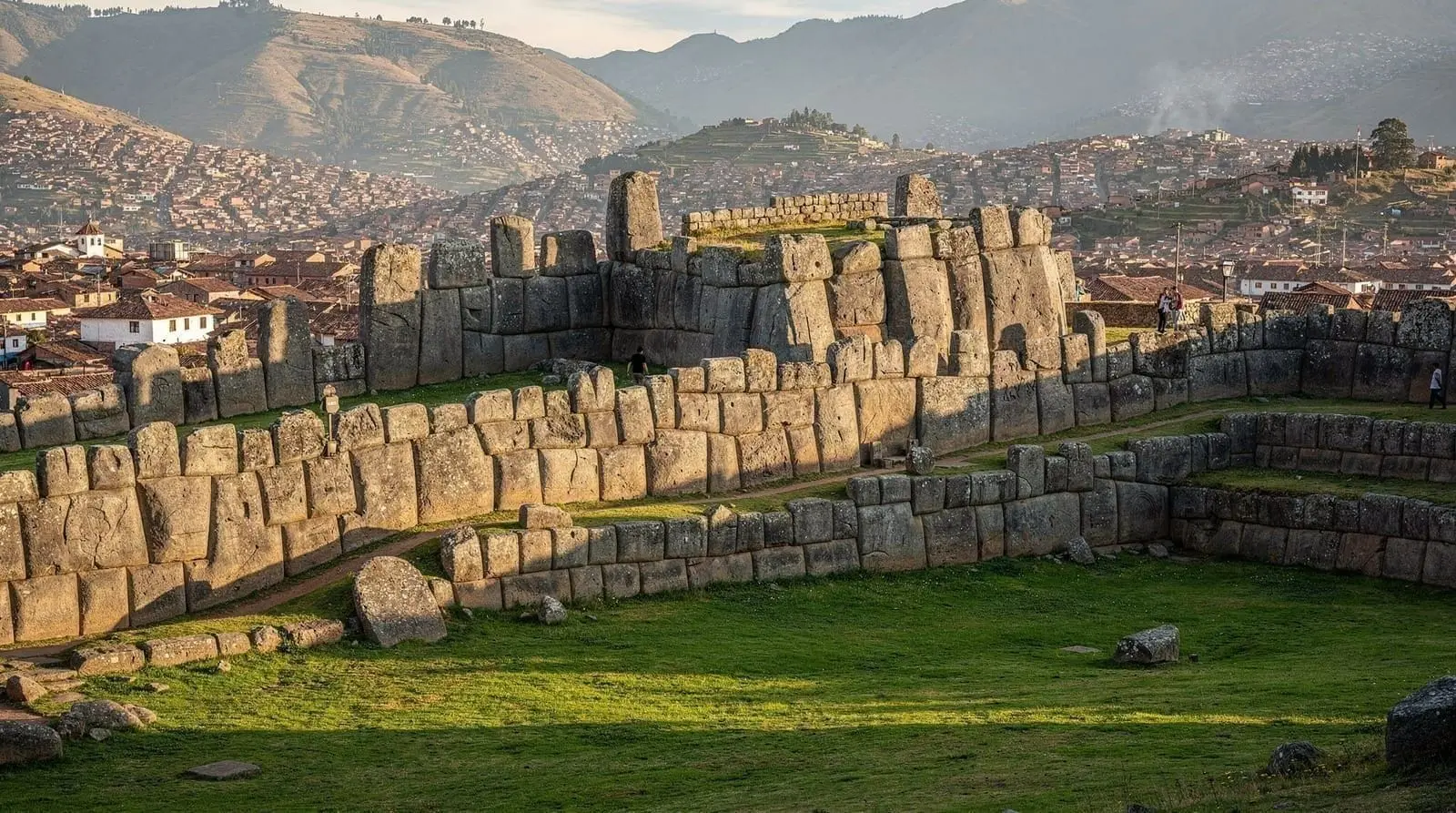
Sacsayhuamán guide: the megalithic fortress above Cusco
Cusco: Half-Day City Tour with Sacsayhuaman and Q’enco
Do I need a ticket for Sacsayhuaman and how do I visit?
Yes. Sacsayhuaman is only covered by the Boleto Turistico (S/130 full, valid 10 days, or S/70 partial Circuit I valid for the four Cusco-city ruins). It sits a steep 30-minute walk or short taxi above Cusco's Plaza de Armas. Open daily, roughly 07:00 to 17:30.
The stones that defeated the myth-makers
Stand at the base of Sacsayhuamán’s lower terrace wall and the thing that hits you is scale. The largest block in the zigzag ramparts above Cusco is estimated at well over a hundred tonnes — a single piece of limestone shaped, hauled and slotted so precisely against its neighbours that you cannot push a sheet of paper into the joints. There is no mortar. The blocks are irregular polygons, each cut to lock into the ones around it, and the walls have shrugged off five centuries of earthquakes that flattened the Spanish colonial buildings down in the city. It is the single most impressive piece of stonework in the entire Cusco region, and it sits a 30-minute uphill walk from the Plaza de Armas.
| Where | Hill immediately north of Cusco’s Plaza de Armas |
| Cost | Boleto Turístico only — S/70 partial Circuit I or S/130 full General |
| Time needed | 60-90 minutes, more if combined with the other city ruins |
| Getting there | 25-35 min steep walk, or S/10-15 taxi to the upper gate |
| Best time | just after 07:00 opening or after 15:30, avoiding the midday tour buses |
That accessibility is also the problem: because it is so close to the city and so heavily toured, Sacsayhuamán attracts a lot of half-truths, dubious “guides,” and a fair bit of mysticism about aliens and lost technology. This guide cuts through that. It covers what the site actually is, the ticket you genuinely need, how to get up there, when to go to avoid the crowds, and the traps to ignore. For the wider context of the Inca world it belonged to, the Inca empire for travellers guide is the best companion piece.
What Sacsayhuamán actually was
Forget the word “fortress” for a moment. Sacsayhuamán was almost certainly more than a military structure, though it did serve a defensive role and was the site of a brutal 1536 battle when Manco Inca’s forces besieged the Spanish-held city below. Most archaeologists read it as a major ceremonial and administrative complex on the northern edge of imperial Cusco — part temple, part parade ground, part stronghold. The Inca city of Cusco was famously laid out in the shape of a puma, and Sacsayhuamán is traditionally said to form the puma’s head, with the great zigzag walls as its teeth.
What you see today is a fraction of the original. After the conquest, the Spanish quarried the smaller dressed stones to build colonial Cusco, which is why the surviving walls are mostly the gigantic blocks too heavy to cart away. The complex once had towers and structures on the flat esplanade above the walls; their foundations are still visible. Across the open field sits the rocky outcrop of the Rodadero with its carved channels and the natural stone slides locals and children still use.
The big unanswered question — how the Inca moved and fitted hundred-tonne blocks without iron tools, the wheel, or draft animals — has a mundane but genuinely impressive answer: enormous organised labour, ramps, log rollers, sand-abrasion fitting, and generations of accumulated stoneworking skill. It did not require lost technology. It required an empire.
Tickets: the boleto you need
Sacsayhuamán cannot be visited on a standalone gate ticket. It is covered only by the Boleto Turístico del Cusco, and you must buy the boleto before or at the gate.
- Boleto General (full): S/130 (about $35), valid 10 days, covers 16 sites across Cusco, the Sacred Valley and the South Valley, including Sacsayhuamán.
- Boleto Parcial Circuito I (partial): S/70 (about $19), valid 1 day, covers the four Cusco-city ruins — Sacsayhuamán, Q’enqo, Puka Pukara and Tambomachay.
If you are seeing the four city ruins in a single morning and nothing else on the boleto, the partial Circuit I ticket is the better value. If you also plan to visit the Sacred Valley ruins or the Qorikancha museum, buy the General. Buy at the COSITUC office on Av. El Sol 103 in Cusco, or at the Sacsayhuamán gate itself. Bring cash — card acceptance is unreliable. Students with an ISIC card get a discount on the General ticket. The full ticket logic is in the Cusco tourist ticket guide, and the wider set of city sites is mapped in Cusco’s archaeological sites.
Opening hours are roughly 07:00 to 17:30 daily. Go early or late to dodge both the crowds and the harshest midday sun.
Getting up there
Sacsayhuamán sits on the hill immediately north of the centre, and you have three sensible ways up.
Walk. From the Plaza de Armas it is a steep 25–35 minute climb, much of it up the stepped lanes through and above San Blas. It is genuinely tiring at 3,400+ metres if you have just arrived in Cusco — do not attempt it on your first day before acclimatising. Done later in your trip, it is a fine walk with city views.
Taxi. A taxi from the centre to the upper gate costs roughly S/10–15 (about $3–4) and saves you the climb and the altitude effort. The smart play for many is to taxi up and walk down.
On a tour. Most Cusco city tours include Sacsayhuamán along with the other three city ruins, handling the transport and a guide. The half-day Cusco city tour with Sacsayhuamán and Q’enqo is the standard version, and the Cusco city tour with Qorikancha and Sacsayhuamán adds the great sun temple in the centre. A guide is worth it here — the site rewards explanation, and an official guide will save you from the freelance touts at the gate.
When to go
Time of day. Early morning (just after 07:00) and late afternoon (after about 15:30) are the quiet, golden-light windows. Midday brings the tour buses and the fiercest UV. Sunset from the walls over the city is excellent if you can stay until closing.
Time of year. The dry season (May to September) gives the clearest skies and best photography. The rainy months (November to March) mean greener grass, fewer people, and a higher chance of an afternoon downpour — bring a layer either way, because the wind on the exposed esplanade is cold once the sun drops.
Inti Raymi. If you visit around 24 June, Sacsayhuamán is the stage for the grand finale of the Inti Raymi festival, the reconstructed Inca festival of the sun — a huge costumed pageant on the esplanade. It is spectacular but the site is mobbed and ticketed grandstand seating sells out far ahead. The Inti Raymi festival guide covers how to attend.
How long you need and what to combine it with
Allow 60–90 minutes to do Sacsayhuamán justice — the walls, the esplanade, the Rodadero outcrop and the views. Most people pair it with the three smaller nearby ruins on the same Circuit I ticket: Q’enqo, Puka Pukara and Tambomachay, strung along the road above the city. All four together make a comfortable half-day. If you want the great sun temple too, add Qorikancha down in the centre, whose curved golden-era walls survived under the Spanish church built on top of them.
What to look for on the ground
It is easy to walk the walls, take a photo and leave without seeing what makes the site remarkable. A few things reward closer attention.
The three terraced ramparts. The lower walls are the famous ones, built in three tiers of zigzag — a shape that is both structurally clever (it spreads earthquake stress and removes any straight section to batter) and, in the puma reading, the animal’s teeth. Walk the full length to grasp the scale; the largest stones are at the western end.
The fitted joints. Get close to a junction between two of the big polygonal blocks. The faces are slightly bevelled inward, which throws a shadow line that makes each stone read as a distinct unit, and the contact surfaces are ground to a near-perfect fit. This is the craftsmanship the photographs cannot convey.
The Rodadero and the carved rock. Across the esplanade, the Suchuna or Rodadero outcrop has natural and worked stone slides, carved seats and channels — likely a ceremonial area as well as a spot where Cusqueño families still let their children slide on the smooth rock.
The water channels and the throne. Look for the carved “Inca throne” (K’usilluc Jink’ian) and the stone water channels that show the Inca obsession with controlled water even on a hilltop.
The view itself. From the walls you look straight down over the red-tiled roofs of Cusco and can trace the grid of the old Inca city. On a clear evening it is one of the best vantage points over the capital.
Combining Sacsayhuamán into a Cusco day
Most people do not visit Sacsayhuamán in isolation, and you should not either — it pairs naturally with the rest of the city’s Inca circuit on the same boleto. A sensible half-day, working outward from the city, runs: taxi up to Tambomachay (the highest of the four), then walk or drive back downhill via Puka Pukara and Q’enqo, finishing at Sacsayhuamán with the city laid out below and the best afternoon light.
Add Qorikancha in the centre either before you head up or after you come down. The four city ruins plus Qorikancha make a full, satisfying day of Inca Cusco without leaving the city’s orbit, and the Cusco archaeological sites guide sequences them in detail.
How Sacsayhuamán fits your wider Cusco understanding
Sacsayhuamán is easier to appreciate once you know where it sits in the Inca story rather than treating it as an isolated pile of impressive stones. It was built under the empire’s expansion in the 15th century, the same era and organisational capacity that produced Machu Picchu and the great terraced valley sites of the Sacred Valley.
The Inca empire for travellers guide traces that bigger arc — how a highland state grew, organised labour on this scale, and then fell to a small Spanish force within a few decades of Sacsayhuamán’s completion. Seeing the megalithic walls with that context in mind changes the site from a curiosity into evidence of exactly how the empire worked.
Photography and getting the best out of a visit
Sacsayhuamán photographs well at almost any hour, but a few habits separate a postcard shot from a forgettable one. Shoot the zigzag walls from a low angle near the western end, where the largest blocks sit, to exaggerate the scale against the sky. Late afternoon light rakes across the stone joints and throws the polygonal fitting into sharp relief, which is the single best time to photograph the craftsmanship rather than just the silhouette. If you want the classic view over red-tiled Cusco, walk to the esplanade’s edge rather than staying at the wall itself — the framing opens up considerably. Bring a zoom lens if you want detail shots of the joint-fitting without climbing on the (off-limits) stones themselves.
A note on Inti Raymi ticketing
If your dates land near 24 June and you want to see Inti Raymi at Sacsayhuamán rather than just visit the ruins, understand that this is a different, ticketed experience from a normal daytime visit. Grandstand seating is sold in tiers months ahead through official channels, and same-week availability is rare. Free public viewing areas exist further back on the esplanade, but sightlines are limited and the crowds are dense. If Inti Raymi itself is not your priority, visiting a few days before or after the festival gives you the empty site and avoids both the ticket scramble and the road closures around the city that week.
Tourist traps and honest warnings
Freelance “guides” at the gate. Unofficial guides cluster at the entrance offering tours at vague prices. Some are knowledgeable; many recite the alien-stonework myths. If you want a guide, book an official one or take a proper tour rather than agreeing a fuzzy price on the spot.
The “free” llama photos. Costumed locals with llamas on the esplanade will pose with you and then ask for a tip. That is fair — they are working — but agree a figure (S/2–5) before the photo, not after.
Climbing on the walls. It is prohibited and guards will whistle you off. The big blocks are a UNESCO-protected monument, not a climbing frame.
Walking up on day one. The biggest self-inflicted trap. The steep climb at altitude on your first day in Cusco is a fast route to a headache. Acclimatise first, or take a taxi up. See the altitude sickness in Cusco guide.
Assuming you can pay at the gate per-site. You cannot. No boleto, no entry — and there is no single-site ticket.
Frequently asked questions about Sacsayhuamán
How do you pronounce Sacsayhuamán?
Roughly “sahk-sigh-wah-MAN,” with the stress on the last syllable. The popular English mnemonic is “sexy woman,” which Cusco guides cheerfully use because it gets close enough. The name comes from Quechua and is variously spelled Saksaywaman or Sacsayhuamán.
Is Sacsayhuamán suitable for children?
Yes — it is one of the more family-friendly Inca sites. The open esplanade gives kids room to run, the Rodadero stone slides are a genuine hit, and there is no dangerous drop or technical terrain. The only caution is the altitude and the steep walk up from the city, so take a taxi up rather than hiking it with young children.
How much does it cost to visit Sacsayhuamán?
There is no standalone ticket — entry is only via the Boleto Turístico. The partial Circuit I ticket (S/70, about $19, valid one day) covers Sacsayhuamán plus the three other Cusco-city ruins; the full Boleto General (S/130, about $35, valid 10 days) covers those plus the Sacred Valley and South Valley sites.
How do I get to Sacsayhuamán from Cusco?
It is a steep 25–35 minute walk up from the Plaza de Armas, or a S/10–15 taxi to the upper gate. Most city tours include it. Because of the altitude, taxi up and walk down if you have only recently arrived in Cusco.
How long should I spend at Sacsayhuamán?
About 60–90 minutes to see the great walls, the esplanade and the Rodadero outcrop. Combined with the three smaller nearby ruins on the same ticket, it makes a half-day.
Is Sacsayhuamán worth visiting?
Yes — it has the most impressive megalithic stonework in the Cusco region, the surviving walls are extraordinary, and it is the easiest major Inca site to reach from the city. It is one of the few sites that genuinely lives up to its reputation.
What time does Sacsayhuamán open and when is it least busy?
It is open roughly 07:00 to 17:30 daily. The quietest, best-lit times are just after opening and after about 15:30; midday is the busiest with tour buses.
Can I visit Sacsayhuamán without a guide?
Yes — with the boleto you can enter and explore independently. But a guide adds a lot of value here, because the site is easy to misread, and an official guide spares you the freelance touts and the alien-stonework folklore at the gate.
Top experiences
Bookable activities with verified prices and instant confirmation on GetYourGuide.
