San Pedro Market food guide: eating well in Cusco's market
Cusco: San Pedro Market and Peruvian Cooking Class
Is it safe to eat at San Pedro Market in Cusco and what should I try?
Yes, if you choose busy stalls with high turnover. Highlights are the fresh fruit juices, caldo de gallina (chicken soup), a set lunch menu for around S/10-15, and tropical fruit you cannot find at home. Go mid-morning to lunchtime, bring small cash, and skip empty stalls.
Where Cusco actually shops and eats
Two blocks downhill from the Plaza de Armas, behind an iron-and-glass hall designed by a student of Gustave Eiffel, the Mercado Central de San Pedro is where Cusco does its real eating. Tourists pass through for the photogenic flower stalls and the wall of dried frogs and herbal remedies; locals come for breakfast soup, a S/12 lunch, sacks of potatoes in thirty varieties, and the fruit juices that have made the market’s “juice ladies” a small institution. It is loud, cheap, occasionally bewildering, and one of the best-value food experiences in the city — if you know how to navigate it.
| Where | Calle Túpac Amaru, two blocks southwest of the Plaza de Armas |
| Cost | around S/6-15 per dish; a full set lunch S/10-15 |
| Time needed | 45 minutes to browse, 1-2 hours with a proper meal |
| Getting there | 5-10 minute walk from the historic centre |
| Best time | mid-morning to early afternoon (roughly 9am-2pm) |
This guide is about eating at San Pedro, not just photographing it. It covers what to order, where the good stalls cluster, what fair prices look like in soles, how to keep your stomach happy, the best time to go, and the handful of traps that catch first-timers. For the wider context of Peruvian cuisine, pair it with the Peruvian food guide; for sit-down restaurants when you want a table and a wine list, see the best restaurants in Cusco guide.
How the market is laid out
San Pedro is roughly zoned, and knowing the zones saves you wandering. As a rough map:
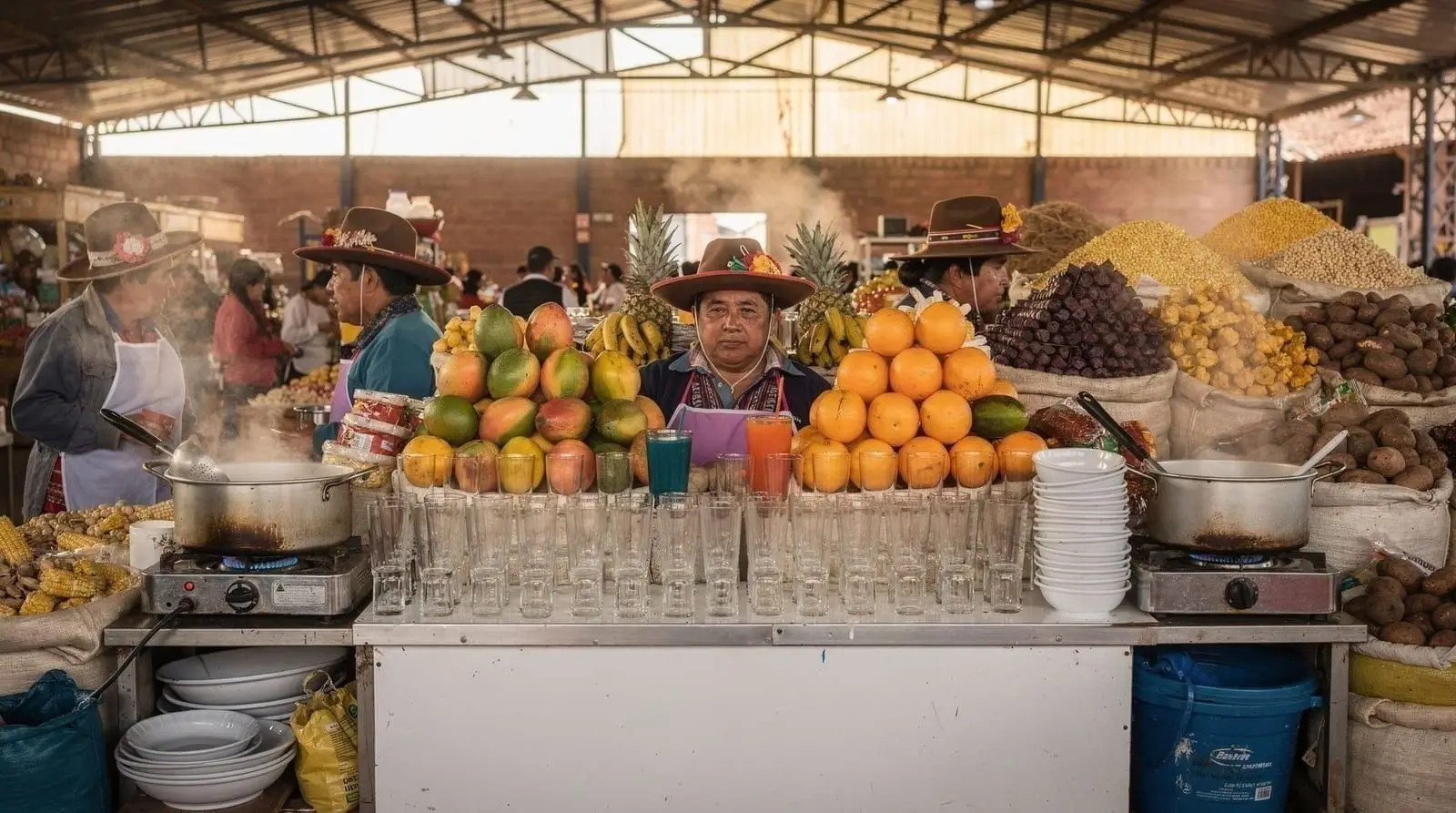
- The juice aisle — rows of stalls stacked with pyramids of fruit, each run by a vendor (the famous “señoras del jugo”) who will blend you a glass to order.
- The food court (comedor) — long communal tables where cooks ladle out soups, set lunches and grilled plates. This is where you eat a meal.
- Produce and meat halls — fruit, vegetables, the potato and corn vendors, the cheese sellers, and the butchers and fishmongers toward the back.
- The dry goods and remedies section — herbs, grains, chocolate, San Pedro cactus, dried llama foetuses and folk-medicine bundles, plus the tourist-facing chocolate and souvenir stalls near the main entrances.
The food and juice you want is mostly in the central and right-hand sections; the souvenir and chocolate stalls near the doors are the priciest and most tourist-aimed part of the hall.
What to order
Fresh fruit juices
The signature experience. For around S/6–10 the juice ladies blend you a tall glass — often a refillable jug’s worth — from whatever you point at: papaya, pineapple, maracuyá (passion fruit), the bright-orange aguaymanto (cape gooseberry), or a mixed “especial” with milk, egg, beer, or maca thrown in. Sit on the stool, watch them work, and ask for the “yapa” (the top-up) that is often included. Pick a busy stall — turnover means fresh fruit.
Caldo de gallina
The market breakfast of champions: a deeply savoury free-range chicken soup with noodles, a chunk of chicken, a boiled egg and herbs, served scalding for about S/8–12. Cusqueños swear by it as a hangover and altitude cure. Eat it early; the food court does its best soup business in the morning.
The set lunch (menú)
Between roughly noon and 2 pm the comedor cooks serve a menú del día — a soup starter plus a main (lomo saltado, a milanesa, grilled trout, rice and stew) for about S/10–15 ($3–4). It is the cheapest proper hot meal in central Cusco and the everyday lunch of market workers. Sit where the locals sit.
Tropical and Andean fruit
Even if you do not eat a meal, the fruit is worth the trip: chirimoya (custard apple), lúcuma, granadilla, pacae (the “ice-cream bean”), and varieties of banana and avocado you will not see at home. Vendors will let you taste. A small bag costs a few soles.
Snacks and extras
Tamales and humitas (steamed corn parcels, savoury or sweet), fresh bread, local cheeses, and the chocolate stalls selling cacao in every form. For the more adventurous, this is also a place to encounter cuy (guinea pig) and other Andean staples — covered in the cuy and Andean food guide.
Fair prices in soles
Knowing the going rate stops you overpaying:
- Fruit juice: S/6–10 (more for an “especial” with extras)
- Caldo de gallina: S/8–12
- Set lunch (menú): S/10–15
- A grilled trout or chicken plate: S/12–18
- A bag of fruit: S/3–8 depending on what and how much
- Chocolate bar from a stall: S/8–15 (cheaper deeper in the market than at the door)
Most food vendors charge fixed, fair prices, and haggling over a S/10 lunch is neither necessary nor welcome. The souvenir and chocolate stalls near the entrances are where mark-ups creep in. Bring small denominations — S/10 and S/20 notes and coins — because changing a S/100 for a juice will be a struggle.
Eating safely: the honest hygiene rules
Market food is safe for most travellers who use a little judgement, and the upset stomachs people blame on “street food” are often just altitude and overindulgence. A few rules keep you on the right side:
- Eat where it is busy. High turnover means fresh, hot food. An empty stall at 3 pm is a worse bet than a packed one at noon.
- Hot and cooked beats raw and sitting. The soups and freshly grilled plates are the safest choices. Be more cautious with pre-prepared salads or anything lukewarm.
- Juices are blended to order in front of you — that is part of why they are a good bet. If a stall blends with tap water and ice, and your stomach is sensitive, ask for it sin hielo (without ice) and without water.
- Go earlier rather than later. Morning and lunchtime food has been out for less time.
- Carry hand sanitiser — there is nowhere convenient to wash before you eat.
- Give your gut a day or two to adjust to Cusco before diving into the most adventurous options.
Best time to go
Mid-morning to early afternoon (roughly 9 am to 2 pm) is the sweet spot: the food court is cooking, the juice ladies are fully stocked, and the produce is fresh. The market opens early — soup is available from dawn — and winds down in the late afternoon. Mornings are quieter and better for photography and produce; lunchtime is the time to eat the menú alongside the workers. Sundays are busier and more local. Keep a hand on your bag in the crowded aisles; like any busy market, San Pedro has its pickpockets.
Beyond the food: what else to buy
Even if you came mainly to eat, San Pedro is a good place to shop for a few things, with the caveat that prices climb the closer you get to the doors.
Chocolate and cacao. Cusco sits near serious cacao country, and the market has stalls selling drinking-chocolate tablets, cacao nibs, and bars in varying quality. Taste before you commit, and buy from the vendors deeper inside rather than the polished tourist stalls by the entrance.
Coffee. Peruvian highland coffee, often sold by weight and ground to order, is excellent value here compared with the cafés on the plaza.
Coca leaves and herbal remedies. A bag of coca leaves for tea costs a few soles, and the remedy stalls sell muña (Andean mint, good for altitude and digestion) and other herbs. This is also the section with the more startling folk-medicine items.
Textiles and souvenirs — with caution. There are alpaca-blend hats, scarves and bags, but quality varies hugely and the genuinely fine weaving is better sought from a cooperative in Chinchero than from a market stall. Treat market textiles as cheap-and-cheerful, not investment pieces, and haggle gently.
What not to bother with: the mass-produced trinkets and the overpriced “artisan” goods by the main entrances, which are aimed squarely at tour groups passing through.
How San Pedro compares to a sit-down meal
San Pedro is unbeatable on price, atmosphere and authenticity, but it is not the right call for every meal. If you want a quiet table, table service, a glass of wine, or one of Cusco’s celebrated tasting menus, the market is not that — head to the restaurant scene covered in the best restaurants in Cusco guide instead. The market is for a fast, cheap, local breakfast or lunch and for understanding what Cusqueños actually eat; the sit-down restaurants are for a leisurely dinner. Budget travellers who lean on the market for daytime meals and treat themselves to one or two restaurant dinners get the best of both, a strategy the Cusco on a budget guide builds on.
A first-timer’s suggested route
If the market feels overwhelming on your first pass, a simple loop covers the best of it in under an hour. Enter from the side nearest the juice aisle and order a fresh juice first — it costs little and gives you a stool and a moment to get your bearings. From there, walk through to the comedor and take a look at what is being ladled out before choosing a stall; watching for a moment tells you far more than any menu board.
Finish in the produce halls, where you can taste-test fruit you may never have seen before, then exit past — but do not linger at — the souvenir stalls near the doors. For a broader Cusco food itinerary that folds San Pedro into a full day, the Peruvian food guide and the Cusco on a budget guide both build around a market meal or two.
Dietary needs and picky eaters
Vegetarians do reasonably well at San Pedro — the produce halls, fruit juices and simple rice-and-vegetable plates in the comedor are easy to find, though ask specifically, since a “vegetarian” menú sometimes still arrives with a piece of chicken by default. Vegans have a harder time; most soups use a meat or chicken base, and the juices sometimes contain milk or egg unless you specify otherwise. Travellers with a sensitive stomach or who are simply cautious on their first days in Cusco can still enjoy the market by sticking to fresh fruit, bottled drinks, and freshly cooked hot food rather than anything sitting out, easing into the soups and street-style dishes once their gut has adjusted to the altitude and the change in diet.
A note for early risers and night owls
The market’s rhythm rewards different visitors at different hours. Very early arrivals (soon after dawn) catch the least crowded aisles and the first fresh batches of caldo de gallina, ideal if you also want unobstructed photos of the flower stalls and the ironwork ceiling. By contrast, if you sleep in, you will still find plenty on offer through the early afternoon, though the best produce and the freshest juice fruit get picked over as the day wears on.
San Pedro is not a night market — nearly everything closes by late afternoon, so this is strictly a daytime stop to build around your morning or midday plans rather than an after-dark outing. Plan your visit as a bookend to a morning of sightseeing or a midday break between activities, not as an evening destination.
Learn to cook what you taste
If the market whets your appetite, the most rewarding follow-on is a cooking class that starts with a guided market shop and ends with you cooking ceviche and lomo saltado yourself. Several Cusco classes build the San Pedro market tour into the experience: the San Pedro Market and Peruvian cooking class pairs the market walk directly with the kitchen, while the Peruvian cooking class with a market tour is a similar format.
If you would rather skip the market portion and head straight to the stove, the 3-hour Cusco cooking class is the compact option. The Cusco cooking classes compared guide lines up the formats side by side.
A short glossary for ordering
The food court runs in Spanish, and a handful of words make ordering far smoother:
- Jugo — juice; jugo especial is the loaded version with milk, egg or extras.
- Yapa — the free top-up the juice ladies often add; it is fine to ask “¿hay yapa?”
- Caldo — broth or soup; caldo de gallina is the chicken one.
- Menú — the set lunch (soup plus main), not the à la carte list, which is la carta.
- Segundo — the main course that follows the soup in a menú.
- Para llevar — to take away; para acá or para comer aquí — to eat in.
- Sin hielo — without ice; sin azúcar — without sugar.
- La cuenta — the bill.
- ¿Cuánto cuesta? — how much is it? Your most useful phrase against tourist pricing.
You do not need fluent Spanish — pointing works — but these words signal you know the ropes, which alone tends to get you the local price.
A short history of the hall
The market is worth a moment of context. The Mercado Central de San Pedro opened in 1925 in a hall whose iron framework is attributed to the workshop of Gustave Eiffel — the same engineering tradition behind the Paris tower — giving the building its airy, light-filled span. It was built on ground long associated with trade, near the colonial San Pedro church and what became the railway station, and it has been the beating commercial heart of working Cusco ever since.
Tourism has nudged some stalls toward souvenirs, but the core function never changed: this is where the city buys its potatoes, its meat, its herbs and its lunch. Eating here is not a staged experience laid on for visitors — it is the genuine daily life of Cusco, and that is precisely what makes it worth your time.
Tourist traps and honest warnings
The souvenir stalls at the entrance. The chocolate, textile and trinket stalls clustered by the main doors charge tourist prices. The same chocolate is cheaper from vendors deeper inside.
Overpriced “tourist juice.” A few juice stalls quote inflated prices to obvious tourists. The going rate is S/6–10; if someone quotes S/20, walk to the next stall. Knowing the price is your best defence.
Photos of the vendors and their stalls. Many vendors dislike having their faces or goods photographed without a word. Ask, buy something small, or shoot wide rather than poking a lens at a señora mid-sale.
Pickpockets in the crowd. The crush around the food court and entrances is a classic spot. Keep your bag zipped and in front of you and your phone out of a back pocket.
Assuming everything is dirt cheap. Food is excellent value, but the doorway souvenirs are not, and a careless traveller can pay double. Use the price list above as your anchor.
Frequently asked questions about San Pedro Market
Is San Pedro Market safe to eat at?
Yes, for most travellers who choose busy stalls with high turnover and stick to hot, freshly cooked food and juices blended in front of them. Go at mealtimes when food is fresh, carry hand sanitiser, and give your stomach a day or two to acclimatise to Cusco before the most adventurous dishes.
How much does it cost to eat at San Pedro Market?
Very little. A fresh juice is S/6–10, a bowl of caldo de gallina S/8–12, and a full set lunch S/10–15 (about $3–4) — making it the cheapest proper meal in central Cusco. Bring small notes and coins.
What is the best thing to eat at San Pedro Market?
The fresh fruit juices and the caldo de gallina (chicken soup) are the signature experiences, and the midday set lunch is the best-value hot meal. Don’t miss tasting tropical fruits like chirimoya and granadilla that are hard to find elsewhere.
What time does San Pedro Market open?
It opens early — soup and breakfast are served from around dawn — and runs through to late afternoon. The best time for food and juices is mid-morning to early afternoon, roughly 9 am to 2 pm, when everything is freshly stocked and cooking.
Where is San Pedro Market in Cusco?
It is about two blocks downhill (southwest) from the Plaza de Armas, on Calle Túpac Amaru near the San Pedro church and the train station of the same name. It is an easy five-to-ten-minute walk from the centre.
Can I do a market tour and cooking class together?
Yes. Several Cusco cooking classes begin with a guided shop through San Pedro Market to buy your ingredients, then teach you to cook Peruvian dishes like ceviche and lomo saltado. It is one of the best ways to understand what you are looking at in the stalls.
Top experiences
Bookable activities with verified prices and instant confirmation on GetYourGuide.
