Maras and Moray day trip
Cusco: Pisac, Maras, Moray, Ollantaytambo Small Group Tour
Can you visit Maras and Moray in one day?
Yes. They sit about 15 minutes apart on the plateau above Urubamba and pair naturally into a half- or full-day. Moray costs a Boleto Turístico (S/70 partial or S/130 full); the Maras salt pans charge a separate S/18 cash entry. Both close mid-afternoon.
Two sites, one plateau, very different stories
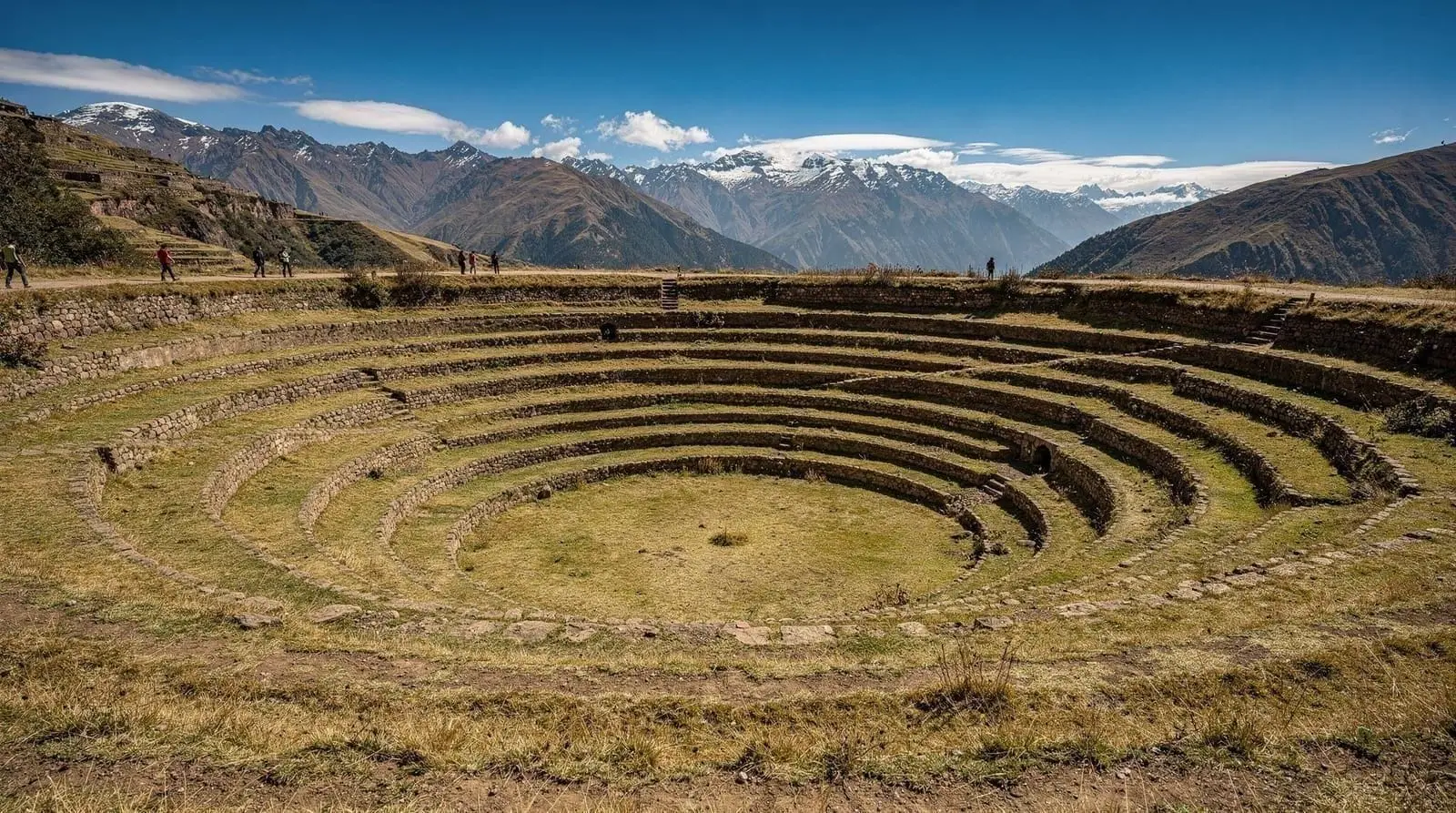
On the high plateau above Urubamba, two of the Sacred Valley’s strangest sights sit barely fifteen minutes apart. Moray is a set of vast concentric terraces sunk into the earth like an amphitheatre, almost certainly an Inca agricultural experiment. The Salineras de Maras are thousands of salt-evaporation ponds spilling down a ravine, worked by the same families for centuries. Neither is a ruin in the Pisac or Ollantaytambo sense; both are reminders that the Inca and their descendants engineered the landscape itself.
Because they are close together and share a single road off the valley floor, they pair into the most efficient half-day in the Sacred Valley. The catch is the ticketing, which trips up nearly every independent visitor: Moray is on the Boleto Turístico, the salt pans are not, and the two are paid in completely different ways. Get that straight before you go and the rest is easy.
This guide is the practical day-trip planner: prices, hours, how to combine them, tour versus taxi, the best timing, and the honest warnings. For the deep dives, see the dedicated Maras salt mines guide and the Moray terraces guide.
| Where | Plateau above Urubamba, 15 min apart |
| Moray ticket | Boleto Turístico only — S/70 partial or S/130 full |
| Salt pans ticket | Separate S/18 cash entry, not on any boleto |
| Time needed | 3-4 hours for both |
| Best time | Before 9am, dry season (May-Sep) for clearest light |
Prices and tickets, spelled out
This is the part to read twice.
Moray can only be entered with the Boleto Turístico del Cusco (Cusco Tourist Ticket). There is no single-site ticket at the Moray gate. Your two realistic options:
- Boleto Parcial Circuito III (partial): S/70 (about $19), valid 2 days, covering the four Sacred Valley sites — Pisac, Ollantaytambo, Chinchero and Moray.
- Boleto General (full): S/130 (about $35), valid 10 days, covering 16 sites across Cusco, the valley and the South Valley.
If your day is purely the valley, the partial Circuit III ticket is the better value. If you also want Cusco-city ruins, the General pays off. Our Cusco tourist ticket guide breaks down which to buy.
The Maras salt pans (Salineras) are not on any boleto. They are managed by the local salt-farming community and charge a separate S/18 entry (about $5), cash only, in soles, paid at the entrance. Tour sellers sometimes imply your tourist ticket covers everything; it does not. Always carry cash for Maras.
Children and students with valid ID get discounts on the boleto. Card payment is unreliable everywhere up here, so bring soles.
Opening hours and the best time to go
Both sites open early, around 7am, and stop selling tickets in the mid to late afternoon — roughly 4-5pm depending on the season, with the salt pans often a touch earlier.
The timing advice is firm: go early. By mid-morning the tour buses from Cusco arrive in waves, the narrow Moray paths bunch up, and the salt pans glare under harsh overhead sun that flattens the photographs. Arrive at Moray by 8am, do the terraces in calm, then drive to Maras for the salt pans before the crowds and the worst light. The white salt and the surrounding red earth photograph best in softer morning or late-afternoon light.
Weather follows the valley’s two seasons. Dry season (May-September) gives clear skies and the most dramatic salt-pan whites but the biggest crowds. Rainy season (November-March) thins the visitors and greens the hills, but heavy rain can dilute and discolour the working salt pans and make the access track slick. April and October are the quiet sweet spot. The getting around the Sacred Valley guide covers seasonal road conditions in more detail.
How to combine them in a day
The two sites sit about 15 minutes apart by road, both reached via a turnoff that climbs from the valley floor near Urubamba toward the village of Maras. A sensible order:
- Moray first, while it is quiet and cool. Allow about an hour to walk down toward the terraces and back; remember the altitude up here is around 3,500 m, so the climb back out is more tiring than it looks.
- Drive 15 minutes to the Salineras, paying the S/18 cash entry. Allow an hour for the viewpoint walk and photos.
- Optionally continue into the full valley loop with Pisac and Ollantaytambo if you have a driver or tour, or drop back to Urubamba for lunch.
Just the two sites take about 3-4 hours including transport. Folded into a full Sacred Valley day, Maras-Moray is the morning or early-afternoon block. See the wider day trips from Cusco guide for how it fits a Cusco-based itinerary.
Tour versus taxi versus colectivo
Organised tour from Cusco is the most popular and often the best value, because public transport does not link the scattered valley sites well and the tour absorbs the driving. The Pisac, Maras, Moray and Ollantaytambo small-group tour covers all four spread-out highlights in one day with transport included, which is genuinely the only painless way to do the lot without a vehicle.
A comparable option, the Sacred Valley tour with Pisac, Ollantaytambo and Chinchero plus lunch, swaps the line-up slightly and includes a meal. Check before booking whether the Maras S/18 and the boleto are included or extra; many tours leave one or both for you to pay.
Private taxi or driver from Urubamba is the independent traveller’s friend. Expect roughly S/80-120 round trip for the Maras-Moray pair, more if you chain the full valley. It lets you arrive at opening time and skip the bus convoy. Agree the route, the waiting time and the price before you set off.
Colectivo (shared minivan) is the cheapest but most awkward route: minivans from Urubamba drop you at the Maras turnoff or village, from where you still need a taxi or a long walk to each site. Doable for budget travellers with time and patience, fiddly otherwise. The getting around the Sacred Valley guide explains the colectivo network.
Where Maras-Moray fits in your wider trip
The decision most people get wrong is treating Maras-Moray as a standalone destination rather than a building block. Because both sites sit on the plateau reached by the same turnoff above Urubamba, the smartest planning question is what else you fold into the drive up.
As a half-day add-on. If you are based in the Sacred Valley, a quick taxi run from Urubamba to Moray and the salt pans takes a single morning and leaves the afternoon for Ollantaytambo or a relaxed valley lunch. This is the gentlest option and a good acclimatisation-friendly activity at moderate altitude before Machu Picchu or a trek.
As part of the classic valley loop. The standard full-day Sacred Valley tour from Cusco strings Pisac, Maras, Moray and Ollantaytambo together, returning to Cusco by evening. Maras-Moray is the mid-route block. It is efficient, but a long day, and you get limited time at each stop — read the itinerary to see how many minutes you actually get inside each site rather than how many stops are listed.
As a cycling or walking route. The plateau’s dirt tracks between Moray, the salt pans and the village of Maras are gentle enough that some visitors bike them or walk the well-known downhill trail from Maras village to the Salineras, which descends through a small canyon to emerge above the ponds — a quietly spectacular approach on foot that most bus tours skip entirely.
As a photography-focused half-day. Serious photographers sometimes plan their entire Sacred Valley schedule around this plateau specifically, arriving at Moray for the low, raking early light on the terraces and then timing the salt pans for the golden hour before closing, when the white ponds pick up a warm tint instead of the flat glare of midday. If photography is the priority over ticking off every valley site, this pair rewards patience and a slower pace far more than the standard bus-tour timing allows.
A useful sequencing note: if your trip also includes Cusco-city ruins like Sacsayhuamán, buy the full Boleto General so the single S/130 ticket covers Moray here and the Cusco sites within ten days. If you are valley-only, the partial Circuit III at S/70 is enough. Plan the ticket around your whole itinerary, not just this day, and check the Cusco tourist ticket guide and day trips from Cusco guide before deciding.
What to bring and how to prepare
A short, practical packing list for the plateau:
- Cash in soles — the S/18 salt-pan entry, snacks and stall purchases are all cash; no ATM up here.
- Your boleto for Moray, plus ID for any student or child discount.
- Sun hat, high-factor sunscreen and sunglasses — the UV at 3,500 m is fierce and shade is minimal.
- Layers and a windproof — the open plateau is breezy and cool in the shade even on sunny days.
- Water and a few snacks — staying hydrated helps at altitude.
- Sturdy shoes with grip for the uneven Moray terraces and the salt-pan paths.
- A polarising filter if you photograph seriously — it cuts the glare off the white salt.
- A small daypack rather than a large bag — both sites involve walking on uneven paths where a compact, well-secured bag is more comfortable and safer than a bulky backpack.
Above all, do not attempt this on your first day in the Andes. Both sites sit higher than the valley floor, around 3,500 m at Moray, and the walk down into the terraces and back is genuinely tiring without acclimatisation. Sleep lower in the valley first, hydrate, and treat your early days gently; the wider getting around the Sacred Valley guide covers how to phase your valley days sensibly.
Honest warnings and traps
The “your ticket covers everything” line. It does not. Moray needs a boleto; the salt pans need a separate S/18 cash entry. Budget tours sometimes quietly exclude one or both, and a few sellers blur this on purpose. Confirm exactly what is included.
Cards don’t work up here. The salt-pan entry, snacks and many local stalls are cash only. ATMs are down in Urubamba, not on the plateau. Carry small soles notes.
Midday salt-pan light. The most common photography disappointment is arriving at noon, when the harsh sun and crowds ruin both the shots and the calm. Early morning or late afternoon is dramatically better.
You can’t roam the ponds freely anymore. Older guides and photos show people walking between every salt pond. Access has been restricted to protect the working pans and for safety, so you now follow a viewing path. The view is still extraordinary; just adjust expectations.
Altitude underestimation. The plateau sits higher than the valley floor — around 3,500 m at Moray. The walk down into the terraces and back up is more demanding than it appears. Pace it, hydrate, and don’t attempt it on your first day in the Andes without acclimatising first.
Pushy textile and salt stalls. Vendors at both sites sell salt, soaps and textiles. Prices are negotiable and the first quote is rarely the real one; a small bag of Maras salt is a genuinely good souvenir if you buy sensibly.
Nearby stops worth adding if you have more time
If a half-day on the plateau leaves you wanting more of the Sacred Valley’s engineered landscapes, a few nearby stops extend naturally from Maras-Moray without doubling back. Chinchero, on the road back toward Cusco, adds Inca terracing and a living weaving tradition — the Chinchero weaving guide covers the community visits in detail.
Travellers who want to see agricultural terracing on a grander scale sometimes continue to Pisac’s ruins the same day. And for anyone building a full week around the valley rather than a single day, the Sacred Valley complete guide lays out how Maras-Moray fits alongside Chinchero, Pisac and Ollantaytambo across multiple days rather than one rushed loop.
Sacred Valley tour with Pisac and ChincheroFrequently asked questions about Maras and Moray day trip
How much does it cost to visit Maras and Moray?
What are the opening hours for Maras and Moray?
Are the Maras salt mines on the tourist ticket?
Tour or taxi for Maras and Moray?
How long do you need for Maras and Moray?
Can you still walk among the Maras salt ponds?
Top experiences
Bookable activities with verified prices and instant confirmation on GetYourGuide.


