Qorikancha: the Inca Temple of the Sun
City Tour in Cusco: Qorikancha and Sacsayhuaman
What is Qorikancha?
Qorikancha was the most important temple of the Inca empire — the Temple of the Sun in Cusco, whose walls were once sheathed in gold. After the conquest the Spanish stripped the gold and built the convent of Santo Domingo directly on top of its Inca foundations. Today you visit a single building where Inca masonry and colonial architecture sit fused together. It is not on the boleto turístico; entry is about S/15.
A temple inside a convent inside a story
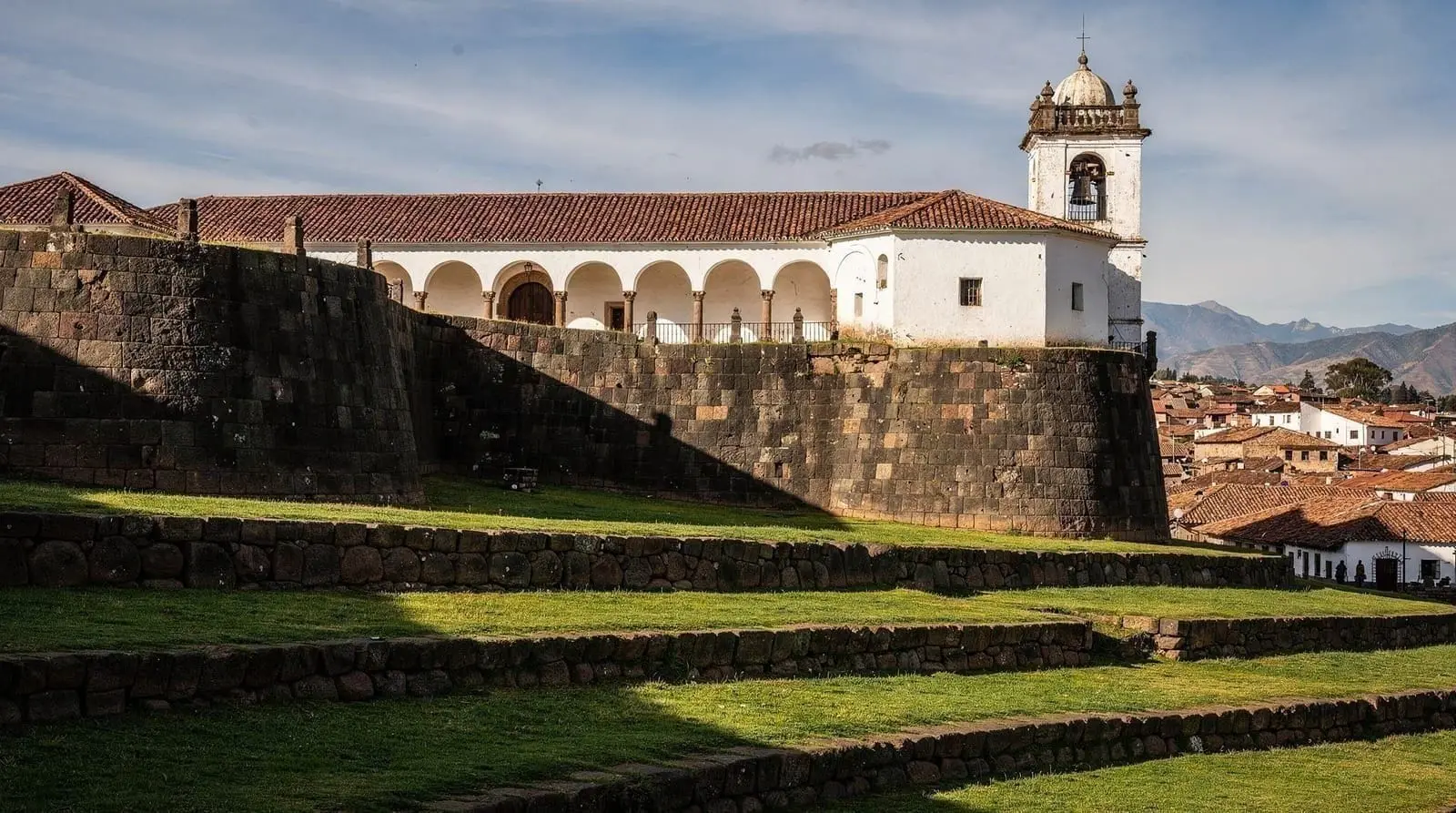
If you visit only one thing in central Cusco for what it tells you about Peru’s history, make it Qorikancha. On the surface it is a handsome colonial church and convent, Santo Domingo, on Avenida El Sol. But Santo Domingo is built directly on top of — and partly out of — the single most sacred building of the entire Inca empire: the Temple of the Sun, whose walls were once covered in sheets of gold. Walk inside and you move between two worlds in a few steps: baroque colonial arches above, mortarless Inca masonry below, the one literally standing on the other.
That layering is the story of Cusco in miniature, and Qorikancha is where you can read it most clearly. This guide covers what the temple was, what happened to it, what actually survives, and how to visit without falling for the most common ticketing trap in the city. For the broader context of Inca religion and empire, the Inca empire for travelers guide is a good companion, and the Cusco archaeological sites guide places Qorikancha alongside Sacsayhuamán and the other city sites.
| Where | Avenida El Sol, ~10 min walk from Plaza de Armas |
| Cost | Around S/15, separate from the boleto turístico |
| Time needed | 45-90 minutes |
| Best time | Mornings, for quieter light on the curved wall |
| Combine with | Sacsayhuamán, historic-centre walk |
What Qorikancha was
The name means “golden enclosure” in Quechua — qori (gold), kancha (enclosure). It was the religious heart of Tawantinsuyu, the Inca empire, the most important of all Inca temples and the symbolic centre from which the empire’s network of sacred lines, the ceques, radiated out across the land.
It was dedicated above all to Inti, the sun god, but it also held shrines to the moon, the stars, thunder, and the rainbow — the full Inca cosmology under one roof. The descriptions left by Spanish chroniclers are almost unbelievable: walls sheathed in plates of beaten gold, a large golden disc representing the sun, the mummified bodies of past emperors seated in the temple, and a garden in the courtyard filled with life-size gold and silver replicas of maize, llamas, shepherds, and other plants and animals — an entire artificial garden in precious metal. Whether every detail is literal or embellished, the temple was unquestionably the richest building in the Americas.
What happened to the gold
The gold did not survive, and the way it disappeared is part of the story.
In 1532 the Spanish, led by Francisco Pizarro, captured the Inca emperor Atahualpa and demanded a ransom — a room filled once with gold and twice with silver. To meet it, the Inca stripped sacred sites across the empire of their precious metal, Qorikancha included. Much of the temple’s golden cladding came down at Inca hands to fill the ransom room. The Spanish executed Atahualpa anyway in 1533, then took Cusco and seized whatever remained.
Almost all of it was melted into ingots — easier to ship and to divide among the conquistadors — and sent to Spain or carried off. The fabled golden garden, the sun disc, the wall plates: gone, reduced to bullion. This is why Qorikancha today contains essentially no gold and why what you go to see is not treasure but stone.
What you actually see today
After the conquest, the Dominican order took the site and built the church and convent of Santo Domingo on the Inca foundations, reusing and building over the temple structures through the 16th and 17th centuries. Earthquakes — notably the major quakes of 1650 and 1950 — repeatedly cracked and partly toppled the colonial building, while the Inca walls beneath stood firm, a fact every guide here points out, and rightly. The 1950 earthquake exposed so much Inca masonry that later restoration deliberately revealed it rather than hiding it again.
So what you walk through is a deliberate juxtaposition:
- The great curved wall. The most famous single feature is a smoothly curving exterior wall of perfectly fitted stone, one of the few curved walls the Inca built and a showcase of their masonry at its finest. It is visible from the garden on the El Sol side.
- The temple chambers. Inside, several original Inca rooms survive with their trapezoidal doorways and niches — the tapering shape the Inca used for openings, thought to be both aesthetic and earthquake-resistant. The fit of the blocks is so tight you cannot slide paper between them.
- The colonial cloister. Above and around the Inca core runs the Dominican cloister, with its arches and religious paintings, so you constantly see the two architectures framing each other.
- The gardens. The terraced gardens below the building, facing Avenida El Sol, give the classic photograph of the curved Inca wall topped by the colonial church.
It is not a large site — a single building — and it is not spectacular in the way a mountaintop citadel is. Its power is in the clarity of the layering and the quality of the stone, which is the best you will see in central Cusco.
Tickets: do not assume the boleto covers it
Here is the practical point that catches the most people: Qorikancha is NOT on the boleto turístico.
Many visitors buy the boleto turístico expecting it to cover the major Cusco sites, then turn up at Qorikancha and find a separate entrance fee of around S/15. The adjoining Santo Domingo church is sometimes free to enter, but the ticketed temple-museum complex — the part with the Inca rooms and the cloister — has its own charge. Bring a little cash in soles. For the full picture of what the boleto does and does not include, the boleto turístico explained guide is essential reading before you start buying tickets in Cusco — Qorikancha and the cathedral are the two big sites travellers wrongly assume are bundled.
The site is open daily with a midday closure in some seasons; mornings are quieter and the light on the curved wall is best then. Allow 45–90 minutes.
How to visit, and what to combine it with
Qorikancha sits on Avenida El Sol, about a 10-minute, mostly downhill walk from the Plaza de Armas. That central position makes it easy to fold into a day in the historic centre of Cusco, and it is a natural early stop on an acclimatisation-friendly walking day since it involves no climbing.
Because the site has limited signage and its significance is not obvious from the stones alone, a guide adds a lot here — the gold, the ceque system, the earthquake history, and the conquest narrative are what make the place, and none of it is written on the walls. Most guided city tours include Qorikancha.
The Cusco city tour covering Qorikancha and Sacsayhuamán pairs the Temple of the Sun with the great fortress-temple above town, which is the logical combination — the sacred centre and the monumental edge of the Inca city in one outing. A broader half-day option, the half-day Cusco city tour with Sacsayhuamán and Q’enqo, covers the ruins above town for travellers who want the upper sites with transport included.
For self-guided visitors, combine Qorikancha with a wander up into the artisan quarter — see the broader Cusco archaeological sites guide for a route that links the city’s main Inca and colonial sights, and browse /itineraries/ for how Cusco fits a full Peru trip.
The honest verdict
The astronomy and the ceque system
One reason Qorikancha was the literal centre of the Inca world is worth a paragraph, because it changes how you read the building. The Inca organised the sacred geography of the Cusco region around the ceque system — a set of roughly forty-one notional lines radiating outward from Qorikancha like spokes from a hub, each strung with huacas (sacred places: springs, stones, hills, shrines) and each tended by a particular kin group on a calendar of offerings. Qorikancha was the point from which this entire web of sacred space and ritual time was measured.
The temple was also an astronomical instrument: alignments connected it to the rising and setting sun at solstices and to the agricultural calendar, the sun god Inti being the imperial deity above all others. So the building you walk through was not just a treasury of gold — it was the surveying point and clock for an empire’s relationship with the sky and the land. The Inca empire for travelers guide expands on how this cosmology shaped Inca rule.
The earthquakes that proved the Inca right
Cusco sits in active seismic country, and Qorikancha has become the standard exhibit for a point guides make across the city: Inca masonry outlasts what was built on top of it. The major earthquakes of 1650 and 1950 badly damaged the colonial Santo Domingo above — toppling sections, cracking walls, forcing repeated rebuilding — while the mortarless Inca walls beneath shrugged them off.
The Inca technique of cutting blocks to fit with extreme precision and no mortar, often with subtly inward-leaning walls and trapezoidal openings, lets the stones shift and resettle under seismic stress rather than shattering. The 1950 quake actually did the modern visitor a favour: by stripping away colonial plaster and structure it exposed Inca walls that had been hidden, and restorers chose to leave them revealed. The result is that the building now displays its own lesson openly — ancient engineering standing intact inside the cracks of the architecture that replaced it.
What to look for, room by room
Because the site is small, it rewards a slow pass rather than a quick lap. A few details are easy to miss without knowing to look for them: the niches in several chambers are subtly trapezoidal and slightly tilted inward, an intentional Inca technique rather than a construction flaw. Look closely at the joints between blocks — the fit is so precise that a knife blade will not slide between them, achieved without mortar or metal tools, using stone hammers and immense patience.
In the courtyard, note where colonial arches spring directly from Inca foundation walls, a visible seam between the two building campaigns. Museum-style panels around the cloister explain some of the Dominican-era history, though the deepest layer of meaning — the ceque system and the astronomy — is rarely signposted and is best understood beforehand or with a guide.
Practical visiting tips
A few small things make the visit smoother. Arrive at opening time if you want the curved wall to yourself for photos, since tour groups build up through mid-morning. Wear comfortable shoes — the floors mix uneven Inca stone with smoother colonial tile. Photography is generally permitted in the exterior gardens and courtyard; check current signage for any restrictions inside the chambers, as these do shift. If you are visiting the historic centre of Cusco on foot, Qorikancha’s downhill position from the Plaza de Armas makes it a sensible last stop before returning uphill, or a first stop if you save the climbing for later in the day when you are warmed up.
Frequently asked questions about Qorikancha: the Inca Temple of the Sun
What does Qorikancha mean?
Is Qorikancha on the boleto turístico?
What happened to the gold of Qorikancha?
How long do you need at Qorikancha?
Is Qorikancha worth visiting?
Where is Qorikancha?
Do I need a guide to appreciate Qorikancha?
Can I visit Qorikancha and Sacsayhuamán on the same day?
Top experiences
Bookable activities with verified prices and instant confirmation on GetYourGuide.

