Nazca Lines
How to see the Nazca Lines — overflight prices and safety, the viewing tower, where to fly from (Nazca, Ica or Pisco) and avoiding airsickness.
From Nazca: 30-Minute Flight over Nazca Lines
Quick facts
- Location
- Nazca desert, south coast of Peru
- Best viewing
- Light-aircraft overflight (~30 min)
- Flight price
- From ~$80–120 plus airport tax
- Alternative
- Roadside Mirador viewing tower (S/4)
- Best for
- Geoglyphs, archaeology, desert landscapes
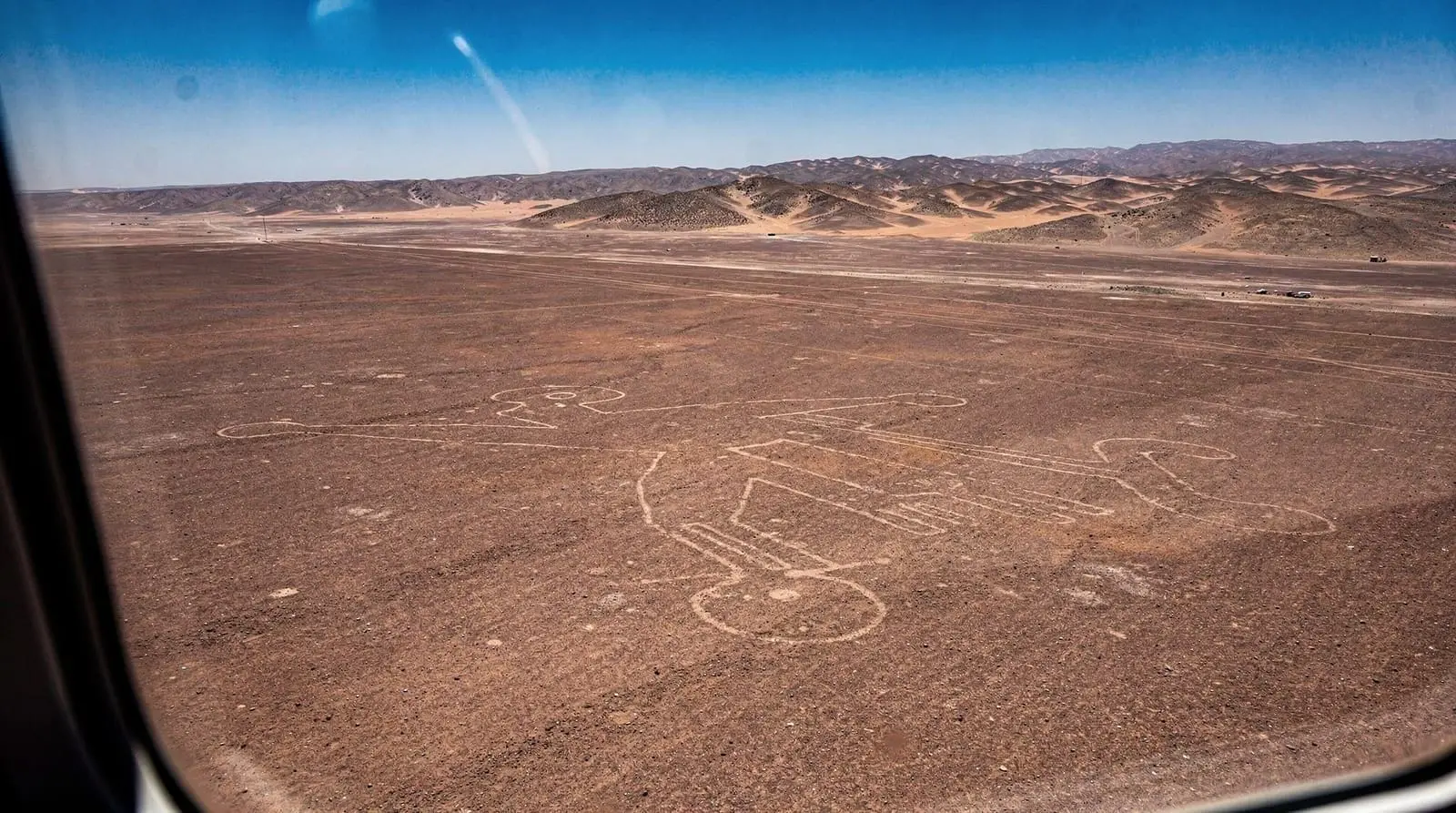
The Nazca Lines are a set of more than 800 straight lines, 300 geometric figures and around 70 animal and plant designs scratched into a 450-square-kilometre stretch of desert south of the town of Nazca. They were made between roughly 500 BCE and 500 CE by the Nasca culture, who removed the dark, oxidised surface stones to reveal the paler ground beneath, and they have survived two thousand years because almost no rain falls here and there is almost no wind at ground level to disturb them.
The famous figures — the hummingbird, the monkey with its spiralling tail, the condor, the spider, the strange humanoid known as the astronaut — are only legible from the air, which is why the geoglyphs were not widely understood until aircraft began flying over the pampa in the 1920s and 30s. Seeing them properly means getting off the ground, and that single fact shapes everything about a visit.
| Where | Nazca desert, around 450 km south of Lima |
| Cost | Flight around $80–120 plus ~S/30 airport tax; Mirador tower ~S/4 |
| Time needed | Half day for the flight alone, a full day with Chauchilla and Cantalloc |
| Getting there | Fly from Nazca, Ica or Pisco airports; bus or car to reach any of the three |
| Best time | April to November, book the earliest morning slot |
Why you have to fly
From the desert floor the lines are essentially invisible: you are too low and too close to read the shapes. The Nasca laid them out to be seen from above, whether by their gods, in ritual processions along the lines, or for reasons still debated, and the only way a modern visitor can take in the full figures is from a small plane. The standard overflight is a 25–35 minute loop in a single-engine Cessna carrying six to twelve passengers, banking left then right over each figure so both sides of the cabin get a look. It is the defining experience of a Nazca visit, and for many people the whole reason to come this far south.
There is a cheaper, ground-level alternative — the Mirador viewing tower (see below) — but it shows you only two or three figures and partial ones at that. If your budget stretches to a flight, take the flight.
Overflight prices, operators and safety
A flight from Nazca’s María Reiche airport costs roughly $80–120 USD depending on season and how you book, plus a fixed airport departure tax of around S/30 paid at the terminal. Prices climb during Peruvian holidays and the European summer.
From Nazca: 30-Minute Flight over Nazca LinesSafety is the part travellers rightly worry about. The Nazca overflight industry had a poor record in the 2000s, with several fatal crashes that prompted a regulatory overhaul. Standards have improved considerably since: aircraft and pilots are more tightly regulated, and the established operators flying out of María Reiche maintain modern Cessna fleets with two pilots on many routes. The remaining risk is ordinary general-aviation risk rather than the systemic problems of two decades ago. To stack the odds in your favour, book a flight with two pilots, fly in the early morning when the air is stable, and do not chase the cheapest possible fare from a dock tout — a $5 saving is not worth an under-maintained plane.
Where to fly from: Nazca, Ica or Pisco
You do not have to be in Nazca town to take the flight. Three departure airports serve the geoglyphs, and choosing the right one can save you hours of backtracking.
- From Nazca (María Reiche airport). The shortest flight, closest to the figures, cheapest fares, most operators. Best if you have made the trip all the way down to Nazca.
- From Ica. A longer flight that begins from the Ica area, convenient if you are based at the Huacachina oasis and want to see the lines without the extra three-hour bus ride south.
- From Pisco (San Andrés airport). The most northerly departure, ideal if you are staying in Paracas or Pisco and want to combine the Ballestas Islands and the Nazca Lines without going all the way down the coast.
The trade-off is simple: the further north you fly from, the more flying time you pay for and the more it costs, but the less ground you have to cover by bus. For travellers short on time who are already on the northern part of the south coast, a Pisco or Ica departure can be the smarter logistics call even at a higher price.
| Departure | Flight length | Typical cost | Best for |
|---|---|---|---|
| Nazca (María Reiche) | Shortest, closest to the figures | Cheapest of the three | Travellers already staying in Nazca |
| Ica | Longer, extra flying time south | Moderately higher | Those based at Huacachina who want to skip the bus |
| Pisco (San Andrés) | Longest, most flying distance | Highest | Those staying in Paracas combining Ballestas and Nazca |
For a deeper breakdown of whether the flight lives up to the cost and the queasiness, see the dedicated is the Nazca flight worth it guide, and read the flight safety guide in full before you book if crash headlines from the 2000s are on your mind.
The Mirador viewing tower (budget option)
If a flight is out of budget or you cannot fly for medical reasons, the Mirador is a metal observation tower on the Panamericana Sur about 20 km north of Nazca town. For an entrance fee of around S/4 you climb the tower and look out over two figures — the Hands (or Frog) and the Tree — plus a partial Lizard that the highway sliced through before anyone understood what was there. It is a thin substitute for the flight, but it is honest about what it is, and it makes a sensible stop if you are passing through by bus anyway. A short walk away, the Maria Reiche viewpoint on a natural hill offers a wider but more distant view.
María Reiche, the woman who saved the lines
No account of the Nazca Lines is complete without María Reiche, the German-born mathematician who spent over half a century measuring, mapping and protecting them. From the 1940s she lived in spartan conditions on the edge of the pampa, sweeping the lines clean with a broom, surveying the figures by hand, and fighting off plans to run irrigation channels and highways across the desert.
Her advocacy was central to the lines being recognised and eventually inscribed as a UNESCO World Heritage Site in 1994. The town’s airport bears her name, and a small museum in her former house, the Casa-Museo María Reiche outside town, preserves her tools, notes and the camp where she worked. It is a modest but genuinely moving stop for anyone curious about how the lines came to be understood and saved.
Beyond the lines: Chauchilla and Cantalloc
The geoglyphs are the headline, but the Nasca left more in this desert. The Chauchilla cemetery, about 30 km south of Nazca, is an open-air pre-Columbian burial ground where mummies sit in their tombs, still wrapped in textiles with their hair and bones preserved by the dry climate. It is one of the few places in Peru where you can see ancient remains in the position they were buried.
Nazca: Chauchilla Cemetery Archaeological TourCloser to town, the Cantalloc aqueducts (puquios) are a still-functioning network of spiral stone wells the Nasca dug to tap underground water — a feat of engineering that helps explain how a civilisation thrived in one of the driest places on earth. Both make good half-day add-ons once you have flown.
Practical planning
When to fly. Go in the morning, ideally the first flights of the day, when the desert air is cool and stable. By midday thermal turbulence builds and the ride gets bumpier — which matters a lot if you are prone to motion sickness.
Avoiding airsickness. The constant banking is what gets people. Eat a light breakfast (not none, not a feast), take motion-sickness medication 30–45 minutes before, choose a morning slot, and keep your eyes on the horizon and the ground rather than on a screen or camera viewfinder. A surprising number of passengers spend the flight feeling queasy, so plan for it rather than assuming you are immune.
Delays. Flights run on desert weather and aircraft turnaround, so departures slip. Build slack into your day and do not book a tight onward bus.
Best months. April to November is the prime window for clear, calm mornings; the desert is dry year-round, but visibility and air stability are best in this stretch.
What to pack and wear
Dress for a small, unpressurised cabin rather than a commercial jet: light layers, closed shoes, and sunglasses against the glare off the pampa. Bring your ID or passport, since it is checked against the manifest before boarding. Cameras are welcome, but a phone or a compact camera with a wrist strap is easier to manage than a bulky lens while the plane banks steeply — you will not have room or time to change settings. Skip a heavy breakfast and a strong coffee; a light meal and plenty of water beforehand sit better through the turns. If you are prone to motion sickness, buy tablets in Lima or Nazca town rather than relying on finding a pharmacy near the airstrip on the morning of your flight.
Booking, rescheduling and refunds
Book at least a day ahead in high season (April to November, and especially around Peruvian and European holidays), since morning slots — the ones with the calmest air — sell out first. Operators typically allow free rescheduling if fog or high wind grounds the morning flights, which happens more often than visitors expect; build a buffer day into your south-coast itinerary if the Nazca flight is a must-do rather than a nice-to-have.
Refunds for cancelled flights are standard practice among the established operators, but budget the extra half-day rather than assuming you can simply fly out on schedule. For the fuller planning picture, including how to sequence it with Paracas and Ica, the Lima–Paracas–Nazca 4-day itinerary lays out a realistic schedule.
How Nazca fits a south-coast trip
The lines are the southern anchor of the classic desert-coast circuit that starts in Lima and threads through Paracas and the Ballestas Islands, the Ica wine valley and the Huacachina oasis, before reaching Nazca itself. Many travellers fly the lines from Ica or Pisco precisely to avoid the long haul to Nazca town, while those continuing south to Arequipa make the full trip and stay overnight.
For routing the whole circuit, see the itineraries hub and the south-coast guides. To weigh up the different overflight departures and combined packages, the tours hub sets out the options side by side, and the complete Nazca Lines guide covers the history and figures in more depth than fits here.
Frequently asked questions about the Nazca Lines
Can you see the Nazca Lines without flying?
Partly. The roadside Mirador tower (entry around S/4) gives you a view of two and a half figures from ground level, and there is a nearby natural viewpoint. But the full animal and plant designs are only legible from the air, so a flight remains the only way to actually experience the geoglyphs.
How much does a Nazca Lines flight cost?
Roughly $80–120 USD from Nazca’s María Reiche airport, plus a fixed airport tax of about S/30. Flights from Ica or Pisco cost more because they cover more flying distance. Prices rise during Peruvian holidays and the summer high season.
Are the Nazca Lines flights safe?
The industry had a troubled safety record in the 2000s but has been substantially reformed since, with tighter regulation and modern fleets among established operators. Reduce remaining risk by choosing a reputable operator, ideally with two pilots, flying early morning, and not booking purely on lowest price.
Where is the best place to fly from?
From Nazca itself the flight is shortest and cheapest. If you are based further north at Ica or Paracas, flying from Ica or Pisco airport costs more but saves you a long bus journey south — often the better choice for time-pressed travellers.
Will I get airsick on the flight?
It is common because the plane banks sharply over each figure. Fly in the morning when the air is stable, take motion-sickness medication beforehand, eat a light breakfast, and keep your eyes on the horizon. Plan for the possibility rather than assuming you will be fine.
How long is the overflight?
The standard loop is about 25–35 minutes in the air over the figures, plus check-in and the airport tax payment beforehand. Allow a couple of hours in total once delays are factored in.
What else is worth seeing around Nazca?
The Chauchilla cemetery with its preserved mummies, the Cantalloc spiral aqueducts still carrying water, and the Casa-Museo María Reiche dedicated to the scholar who saved the lines all make worthwhile half-day additions to the flight.
Top experiences
Bookable activities with verified prices and instant confirmation on GetYourGuide.
