Chinchero weaving: the cooperatives, the craft, and fair prices
Cusco: Pisac, Ollantaytambo & Chinchero Sacred Valley Tour
Is the weaving demonstration in Chinchero worth it, and what should textiles cost?
Yes, at a genuine cooperative it is one of the Sacred Valley's most honest cultural stops — you see the full natural-dye and backstrap-loom process. Expect to pay S/40-80 (about $11-22) for a small handwoven piece and S/250-600 for a large, finely worked manta or table runner. The trap is fast tour-bus stops that demonstrate, then hard-sell mass-made goods.
A village that still weaves the old way
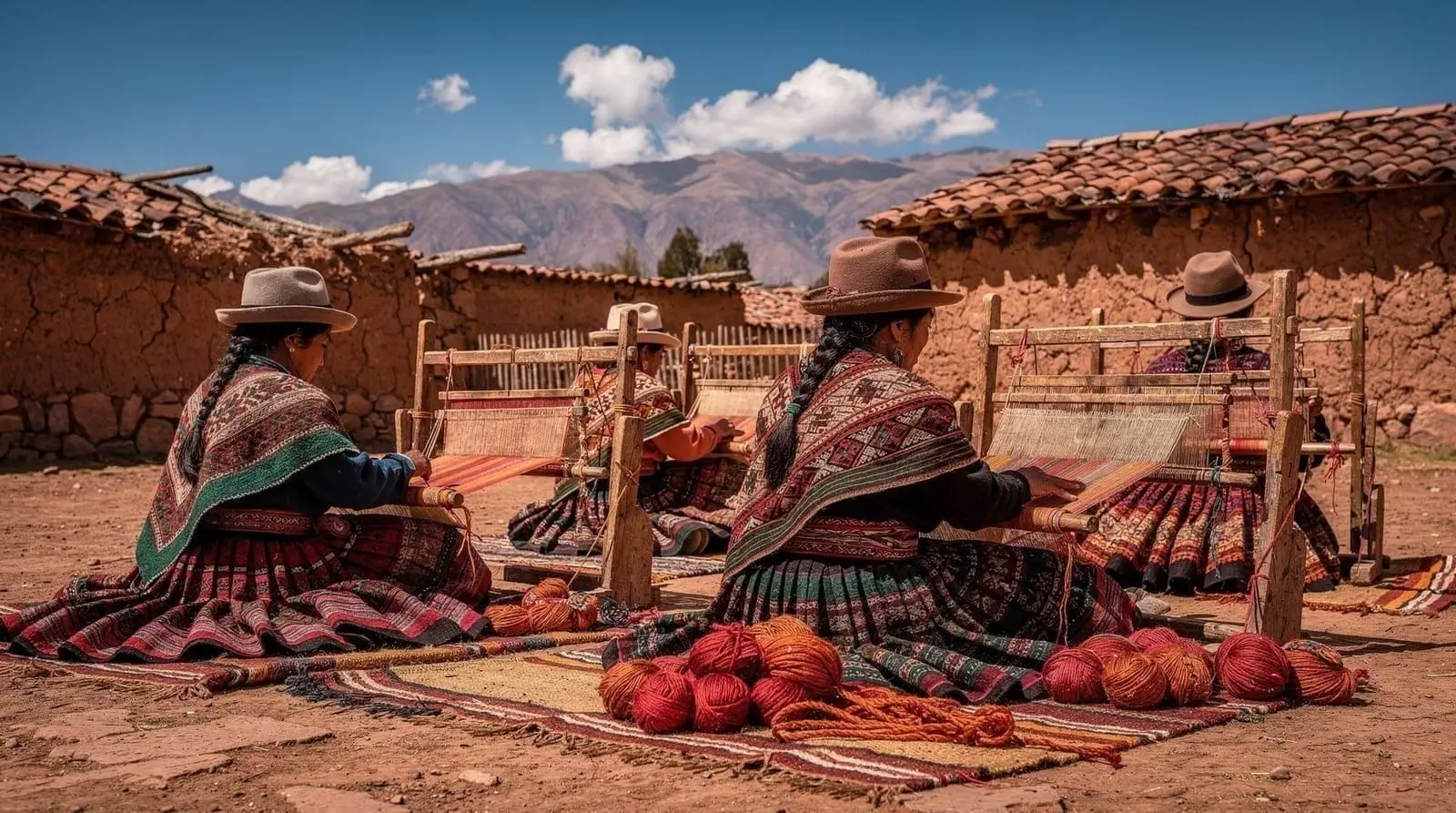
Most Sacred Valley stops sell you a finished object. Chinchero sells you the process. At 3,760 m, higher even than Cusco, this windswept Andean village is the region’s living centre of backstrap-loom weaving, where women still spin, dye, and weave by methods that predate the Inca state. A good visit here is not a shopping trip with a craft theme; it is a forty-minute lesson in chemistry, botany, and patience, with the chance to buy directly from the person who made the piece.
It is also, frankly, a place where the experience varies wildly depending on where your tour stops. Some cooperatives are genuine community ventures run by and for the weavers; others are slick roadside operations that perform a quick dye demo and then steer you toward racks of machine-made acrylic at “Inca” prices. This guide explains how the real craft works, what authentic textiles should cost, and how to tell the two kinds of stop apart. For the broader context of Andean weaving traditions across the region, pair it with our Andean textiles guide.
| Where | Chinchero, 45 min from Cusco on the Urubamba road |
| Cost | S/40-80 small piece; S/250-600+ large manta |
| Time needed | 45 min-1 hr for an unhurried visit |
| Getting there | Colectivo from Calle Pavitos, or on a Sacred Valley tour |
| Best time | Weekday mid-morning, before tour-bus crowds |
How the weaving actually works
The backstrap loom is the heart of it. One end is tied to a post or door; the other is strapped around the weaver’s lower back, so her own body tension controls the warp. She leans back to tighten, forward to release, and the entire fabric is built thread by thread by hand. A complex manta — a large carrying cloth — can take a skilled weaver weeks of work. Once you have watched the process, the prices stop looking high.
Before any weaving happens, the wool has to be prepared and coloured, and this is the part the demonstrations dwell on because it is genuinely fascinating:
- Washing: raw alpaca or sheep wool is scrubbed with saqta, a root that foams like natural soap, stripping the grease so dye will take.
- Dyeing: the colours come entirely from plants, insects, and minerals. Cochineal — a tiny insect that lives on prickly-pear cactus — is crushed to make deep crimson; add lime and it shifts to orange, add a mineral salt and it goes purple. Indigo and the tara pod give blues and browns; chilca leaves and other plants give greens and yellows.
- Fixing: mineral mordants set the colour so it does not bleed.
The demonstrators usually show the cochineal trick live — crushing the insect on a palm, then changing the colour with a squeeze of lime — and it is the moment most visitors remember. None of it is theatre; it is the actual working method.
Telling a genuine cooperative from a tourist trap
This is the practical heart of the visit. A genuine cooperative and a sales-funnel roadside stop can look similar for the first five minutes. The differences:
Signs of the real thing:
- The demonstration is thorough and unhurried, and you can ask questions about specific dyes and patterns.
- The textiles for sale are two-sided, slightly irregular, and clearly handmade, with prices that reflect the labour.
- Nobody pressures you to buy; a tip or small purchase is welcomed but not demanded.
- The weavers are present and selling their own work, often with their names attached.
Signs of a trap:
- A rushed five-minute demo followed by heavy steering toward large racks.
- Suspiciously cheap “alpaca” that feels slippery and uniform — almost always acrylic.
- Identical mass-produced items, the same patterns you see in every Cusco market stall.
- Pressure, guilt, or a “special price just for you” pitch.
The single best authenticity test is to turn a textile over. Real backstrap weaving has a readable pattern on both sides and no loose machine threads; real alpaca is warm and faintly grippy, not silky-slick, and natural dyes are rich but never neon. If something is both perfectly uniform and very cheap, it is not what it claims to be.
What textiles really cost
Fair pricing is the question everyone has and few stops answer honestly. As a rough guide for genuinely handwoven, naturally dyed pieces in 2026:
- Small items — coin purses, headbands, narrow belts: S/20-60 (about $5-16).
- Medium pieces — scarves, table runners, chuspas (small bags): S/60-180.
- Large, finely worked pieces — a full manta or an intricate table cloth representing weeks of work: S/250-600 or more.
These are not flea-market prices, and they should not be. A finely woven manta is the equivalent of a month’s craftsmanship. Mild, respectful bargaining is normal, but grinding a weaver down to acrylic prices for hand labour misses the point of coming here. If a piece costs the same as a machine-made scarf in a Cusco tourist shop, be suspicious of the cooperative, not pleased with the deal.
The fibres: alpaca, sheep, and the difference that matters
Not all the wool in Chinchero is the same, and knowing the difference protects both your money and your expectations. Three fibres dominate, and they sit at very different price and quality points:
- Sheep’s wool is the everyday workhorse — durable, cheaper, slightly coarse, and used for most utility weaving. There is nothing wrong with it; it is simply the budget fibre.
- Alpaca is the prized one: warm, light, soft, and naturally available in a spectrum of undyed browns, greys, and creams. Most of what visitors want — scarves, shawls, finer mantas — is alpaca.
- Baby alpaca is not from young animals but from the finest first-shearing fleece; it is softer and pricier still, and the term is widely (and loosely) applied in sales pitches.
The honest caution is that “alpaca” is the most abused word in the Andean textile trade. Acrylic blends are routinely sold as pure alpaca, and even genuine alpaca is sometimes cut with sheep’s wool or synthetic to lower the cost. At a real cooperative the weavers will tell you straight which fibre a piece uses; in a tourist shop the label means little. The touch test stands: real alpaca is warm, slightly grippy, and holds its shape, while acrylic feels cool, slick, and faintly squeaky when rubbed. Our Andean textiles guide goes deeper on fibre grading if you want to buy seriously.
Reading the patterns
Once you can tell a real piece from a fake, the next layer is learning to read it. Chinchero weaving is not abstract decoration; the motifs (pallay) are a coded vocabulary built up over centuries. A few of the recurring ones:
- Hook and diamond bands representing lakes, rivers, and the cultivated terraces of the valley.
- Stepped motifs echoing the Andean cross (chakana) and the layered worlds of Andean cosmology.
- Animal and bird figures — condors, llamas, vizcachas — tied to specific stories and seasons.
Patterns also signal origin. A trained eye can often place a textile to a particular community or even a family by its colour palette and motif combinations, the way a tartan signals a clan. When a weaver explains what a band means, she is not improvising a sales story; she is reading a script she learned from her mother. That is the real souvenir — not the cloth, but understanding what the cloth says.
Visiting: with a tour or on your own
Chinchero sits on the Cusco–Urubamba road, about 45 minutes from the city, and most Sacred Valley tours pass through it. Two ways to do it:
As part of a Sacred Valley tour. This is how most people see Chinchero, bundled with Pisac, Ollantaytambo, and often Moray. The trade-off is pace: a group tour controls which cooperative you stop at and how long you linger, and the chosen stop may lean commercial.
The Pisac, Ollantaytambo and Chinchero Sacred Valley tour covers the classic circuit with the village included, and the broader full-day Sacred Valley tour works if you want the headline ruins with the weaving stop folded in. Either way, see our best day trips from Cusco for how Chinchero fits a valley day.
Independently. A colectivo (shared minivan) from Cusco’s Calle Pavitos costs a few soles and drops you in Chinchero, where several cooperatives along the entrance road welcome walk-ins. This is slower and less polished but lets you choose your own cooperative, stay as long as you like, and avoid the bus-tour funnel entirely. It pairs well with the village’s own archaeological complex and adobe church, one of the most beautiful in the valley — that part needs the boleto turístico.
Practicalities: timing, weather, and what to bring
Chinchero rewards a little planning. At 3,760 m it is higher and colder than Cusco, exposed on a high plain where wind and sun are both fierce. The practical notes:
- Time of day. Independent visitors do best arriving mid-morning, after the cooperatives open and before the lunchtime tour-bus wave. The famous Sunday market adds bustle and produce stalls but also crowds; a weekday visit is calmer for actually watching the weaving.
- Weather. Sun protection is non-negotiable — high-altitude UV is brutal — and a layer for the wind even on bright days. The November-to-March wet season brings sharp afternoon downpours that can shut an outdoor demo.
- Cash. Bring soles in small and mid-size notes. Cooperatives rarely take cards, and large notes are hard to change. Carry what you might realistically spend rather than assuming an ATM is nearby.
- Acclimatise first. Because Chinchero is higher than Cusco, save it for after you have a day or two of adjustment behind you; it is a poor choice for arrival day. See the Cusco acclimatisation context.
A genuine cooperative visit takes 45 minutes to over an hour if you linger, ask questions, and browse properly. Do not let a tour rush you through in fifteen.
The textiles as a window into Andean culture
What makes Chinchero more than a craft stop is that the weaving is not decorative — it is a language. Patterns encode rivers, mountains, lakes, crops, and community identity, and a woven motif can mark which village or even which family a piece comes from. The iconography reaches back through the Inca period to far older Andean cultures, and the colours, until synthetic dyes arrived, were the only ones available — which is why the natural-dye revival here is also a cultural revival.
Seen that way, buying a genuine piece is not souvenir shopping; it is keeping a knowledge system economically alive. The cooperatives exist precisely because cheap acrylic imports nearly killed hand-weaving as a living, and tourism — done at the real cooperatives, at fair prices — is now part of what sustains it. For the festivals where these textiles are worn at their finest, see our Cusco festivals calendar, and for routing it all together, the trip tools at /tools/ and tour options at /tours/ help.
Chinchero vs. other weaving stops in the valley
Chinchero is not the only village where weaving cooperatives operate, and the comparison helps set expectations:
- Chinchero — the most established cooperative network, easiest to combine with the Sacred Valley circuit, busiest with tour buses at midday.
- Smaller Sacred Valley villages — some tours passing through less-visited stops on the way to Pisac offer quieter, less commercial demonstrations, though selection is more down to luck than planning.
- Cusco city shops — convenient but mixed quality; you rarely meet the maker, and machine-made pieces are common at “handmade” prices.
For most visitors without a specific alternative in mind, Chinchero remains the most reliable place to see the authentic process and buy with confidence.
Fitting it into a Sacred Valley day
Chinchero works best as one stop in a fuller day rather than a destination on its own. It pairs naturally with Pisac’s market and ruins earlier in the day and Ollantaytambo or Moray afterward — see the one-day Sacred Valley itinerary for a realistic sequence, or the getting around the Sacred Valley guide if you are routing it independently by colectivo.