Inti Raymi festival guide
City Tour in Cusco: Qorikancha and Sacsayhuaman
What is Inti Raymi and when is it?
Inti Raymi, the Festival of the Sun, is Cusco's biggest celebration, held every 24 June. It re-enacts an Inca winter-solstice ceremony across three stages — Qorikancha, the Plaza de Armas and Sacsayhuamán. The Sacsayhuamán finale needs a paid ticket; the city-centre stages can be watched free if you arrive early.
The Festival of the Sun, in plain terms
Inti Raymi is the largest and most theatrical festival in Cusco, staged every year on 24 June. The name means “Festival of the Sun” in Quechua, and the event re-enacts an Inca winter-solstice ceremony honouring Inti, the sun god — a celebration the Spanish suppressed in the colonial era and which Cusco revived in 1944 as a grand civic pageant. Today it draws hundreds of costumed performers, an “Inca” and his court, and tens of thousands of spectators, making it the centrepiece of a festival-packed June that fills the city with parades, music and crowds.
For travellers, the practical reality is simpler than the spectacle suggests: Inti Raymi unfolds across three locations on the same day, only one of which is ticketed, and the date never moves. Get the timing, the geography and the ticket decision right, and you will see one of South America’s great living festivals without overpaying or getting stuck behind a wall of heads. This guide covers all three.
| Date | Every 24 June (fixed, never moves) |
| Stages | Qorikancha → Plaza de Armas → Sacsayhuamán |
| Free to watch | Qorikancha and Plaza de Armas stages |
| Ticketed | Sacsayhuamán grandstand only |
| Grandstand cost | around USD 80–200 (S/300–750) |
| Book accommodation | Months ahead — peak season |
The three stages of the day
Inti Raymi is not a single performance in one place; it is a moving procession across three sites, each with a distinct character.
- Qorikancha (morning). The day opens at Qorikancha, the former Temple of the Sun, where the “Inca” is carried out and invokes the sun in the first ceremony. The space here is tight and crowds gather early, but it is free to watch from the surrounding streets and terraces.
- Plaza de Armas (late morning). The procession moves to the main square in Cusco’s historic centre, where a second ceremony plays out before the crowds. Again free from the street, though sightlines are best claimed hours ahead.
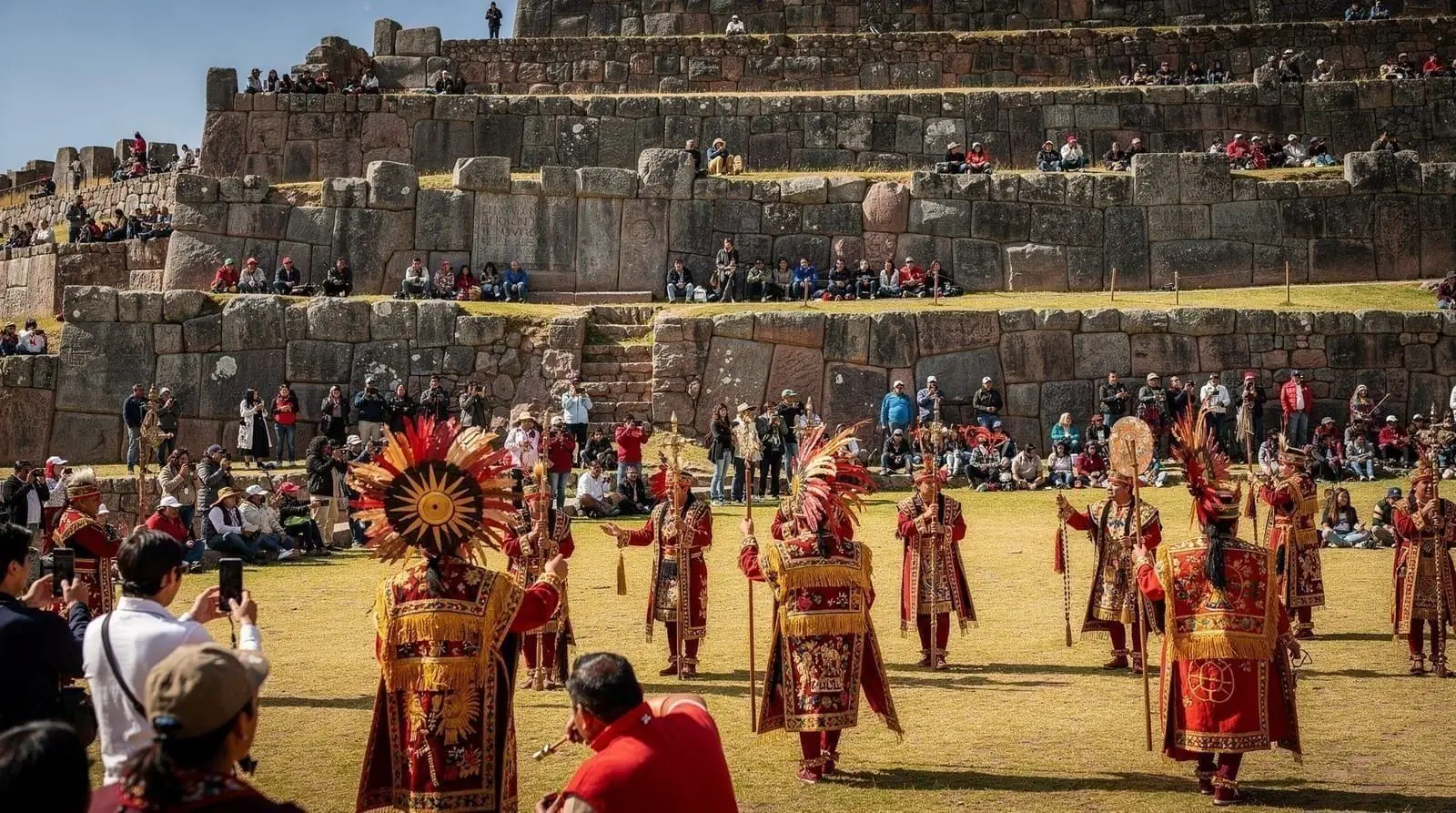
- Sacsayhuamán (afternoon). The grand finale takes place on the esplanade below the Sacsayhuamán fortress, with the largest cast, the most elaborate staging and a symbolic offering ceremony. This is the only ticketed stage, with grandstand seating, though the surrounding hillsides offer free if distant views.
Understanding this sequence is the key to planning your day — you can follow the whole procession on foot, free, through the city, and decide separately whether to pay for a seat at the finale.
Tickets, prices and the honest verdict
The ticket question applies only to the Sacsayhuamán grandstands. Seats are sold in sections, and prices typically run roughly USD 80 to 200 (around S/ 300 to 750) depending on the section, with shaded and front-row areas costing most and uncovered side sections least. Prices climb as 24 June approaches and the best sections sell out, so if you want a guaranteed seat, book weeks ahead through an authorised seller and keep your receipt.
The honest verdict: a grandstand seat buys you a close, comfortable view of the most elaborate part of the day, and for many that is worth it. But it is far from essential. The two free city-centre stages — Qorikancha and the Plaza de Armas — let you watch the same costumed cast and ceremony up close at no cost, and the hillsides around Sacsayhuamán give a free, panoramic if distant view of the finale. Plenty of travellers skip the paid seat entirely and feel they saw the festival fully. Decide based on whether front-row comfort at the finale matters more to you than the savings.
| Grandstand section | Approx. price | What you get |
|---|---|---|
| Uncovered / side | ~USD 80–110 | Furthest from the action, cheapest, no shade |
| Mid-tier covered | ~USD 120–160 | Better sightline, some shade |
| Front / shaded | ~USD 170–200 | Closest seats, shade, sells out first |
Buy only through an authorised ticket seller or a recognised tour agency — touts selling “grandstand tickets” on the street around the festival date circulate fakes and duplicated seats most years. The where to buy tickets in Cusco guide covers legitimate channels for this and other Cusco tickets, and it is worth reading before you hand over cash for anything festival-related.
Watching for free: where to stand and when to arrive
If you skip the grandstands, location and timing are everything.
- For the morning stages, position yourself around Qorikancha and the Plaza de Armas early — two or three hours before the published start times — to claim a kerbside or terrace spot. The centre fills fast.
- For the finale, walk up to the hills around Sacsayhuamán well in advance. The walk from the centre is steep and at altitude, so allow time and pace yourself. The natural slopes overlooking the esplanade give a free vantage, though you will be far from the action and binoculars help.
- Protect yourself from the sun. Late-June days in Cusco are dry and bright, and the high-altitude UV is intense even when the air is cool. Hat, sunscreen, water and layers are non-negotiable; the best time to visit Cusco guide explains the dry-season conditions.
Planning your Cusco trip around 24 June
The fixed date makes planning straightforward, but it also makes late June one of the busiest and priciest windows of the year.
- Book accommodation months ahead. Hotels across Cusco fill and raise prices around Inti Raymi, which sits squarely in peak season. The Cusco trip planning guide for 2026 covers timing the wider trip.
- If you also want the Inca Trail in this window, book the permit even earlier. Late June is exactly when Inca Trail permits sell out fastest — the Inca Trail permits guide explains why four to six months ahead is the minimum.
- Acclimatise before the big day. Standing for hours at 3,400 m, then walking uphill to Sacsayhuamán, is tiring if you have just arrived. Give yourself a couple of days first — the Cusco acclimatization plan helps.
What you will actually see during the ceremony
For all the logistics, it helps to know what the performance involves. The re-enactment is spoken largely in Quechua, the Inca language, with a central figure playing the Sapa Inca carried on a litter, surrounded by a court of priests, nobles, soldiers and women representing the chosen “Virgins of the Sun.” The action moves through a sequence of ritual moments: an invocation to Inti at Qorikancha, a salute and address in the Plaza de Armas, and at Sacsayhuamán the dramatic finale, which traditionally includes a symbolic offering and a reading of omens. Hundreds of costumed performers fill the esplanade in coordinated movement, with music, banners and colour throughout.
It is theatre rather than a religious rite — a 20th-century reconstruction based on chronicles of the original Inca ceremony — but it is staged with real seriousness and on an impressive scale. Knowing the structure in advance helps you follow what is happening, especially if you do not speak Quechua or Spanish, since there is no English narration. The whole sequence, from the morning at Qorikancha to the close at Sacsayhuamán, takes most of the day, so pace yourself, eat beforehand and carry water.
Practical tips for the day
A few hard-won pointers make the day far smoother:
- Eat and hydrate early. Food options near the venues are limited and overpriced once crowds build, and you will be on your feet for hours at altitude. Carry water and snacks from the centre.
- Mind your belongings. Big festival crowds attract pickpockets, so keep valuables zipped away and your daypack in front of you in dense areas. The Cusco taxi and money tips guide covers staying safe with cash around town.
- Plan transport to Sacsayhuamán. Roads near the site are closed or jammed on the day. Walking up from the centre is the most reliable approach, but it is steep and at altitude, so allow plenty of time and go slowly.
- Buy any grandstand ticket from an authorised seller. Touts sell fakes around the date. Book through a recognised channel and keep the receipt.
- Bring sun protection and a rain layer. Late June is dry and bright, but mountain weather can shift, and the UV is fierce all day.
Preparing with a city tour before the festival
If you land in Cusco a day or two before 24 June, a general half-day city tour that takes in Qorikancha and Sacsayhuamán ahead of time pays off on festival day itself. Knowing the layout of both sites in advance — where the entrances sit, how the crowds will likely flow, which streets connect them — makes navigating the real thing far less stressful, especially since roads close and everything gets busier on the day.
Cusco city tour visiting Qorikancha and SacsayhuamánThis also gives you a sense of walking distances and altitude gain at Sacsayhuamán before you attempt the same walk, tired, on the festival’s hot afternoon.
Budget travellers and Inti Raymi
Inti Raymi is one of the few genuinely world-class festivals that costs nothing to watch properly, which makes it a highlight for travellers on a tight budget. Position yourself at the free Qorikancha and Plaza de Armas stages, skip the grandstand entirely, and you still see the full costumed procession and both morning ceremonies at no cost beyond your time. The Cusco on a budget guide has more on stretching a Cusco trip further, including how to manage the accommodation price spike that comes with peak-season, festival-week dates.
June is more than one day
Inti Raymi anchors a whole month of celebration. The Corpus Christi processions, with their carried saints and the famous chiriuchu feast, fall in June too, and the city stages parades and school dances for much of the month. If your dates are flexible, building in a few extra June days lets you catch more than the single 24 June spectacle. The Cusco festivals calendar maps the full month, and the Corpus Christi guide covers the other great June event.
For the rest of your trip — the citadel, the valley and beyond — the itineraries hub and the tools page help you fit Inti Raymi into a wider Peru route.