Sacred Valley vs Cusco as your base: which to choose
From Cusco: Sacred Valley of the Incas Full-Day Tour
Should I base in the Sacred Valley or in Cusco?
Base in the Sacred Valley first for gentler acclimatisation (2,800-3,000 m vs Cusco's 3,400 m) and proximity to the Machu Picchu train, then move up to Cusco for nightlife, museums and day trips. Most well-planned trips use both, in that order.
The decision that shapes your whole Cusco trip
Where you sleep in the Cusco region is not a small logistics detail — it changes how you feel, how you move, and which days work. The two real options are basing in Cusco city or basing down in the Sacred Valley, and travellers agonise over it because both genuinely have a case. Cusco is the cultural capital, the transport hub, and the place with the nightlife and museums. The valley is lower, calmer, closer to the Machu Picchu train, and the smartest place to acclimatise.
The honest answer for most people is “both, in the right order.” But that is a cop-out if you only have a few nights, so this guide breaks the comparison down by the factors that actually matter — altitude, transport, atmosphere, food, cost and what each base is good for — and then gives you concrete recommendations by trip length. If you want the pure altitude argument in isolation, the Cusco altitude versus Sacred Valley guide goes deeper on that one factor.
| Where | Cusco city (3,400 m) vs Sacred Valley floor around Urubamba/Ollantaytambo (2,800-3,000 m) |
| Cost | Cusco cheaper at the budget end; valley skews mid-range/resort |
| Time needed | 2-3 nights per base on a typical 5-6 night stay |
| Getting there | 60-90 min drive or colectivo between Cusco and the valley towns |
| Best time | either base year-round; dry season (May-Sept) for both |
| Factor | Sacred Valley |
| Altitude | Lower, gentler (2,800-3,000 m) |
| Machu Picchu train | Next to the platform (Ollantaytambo) |
| Nightlife & dining | Quiet, hotel-led |
| Day-trip access | Valley sites (Pisac, Maras-Moray) |
| Budget range | Fewer cheap hostels, more resort-style |
Altitude: the valley’s strongest card
This is where the valley wins clearly. Cusco sits at about 3,400 m (11,150 ft). The Sacred Valley floor around Urubamba and Ollantaytambo sits at 2,800–3,000 m (9,200–9,800 ft). Those few hundred metres are not trivial: at altitude, the difference shows up in how well you sleep, how your stomach handles food, and how your head feels on day one.
The most common mistake on a Peru trip is flying into Cusco from sea level and trying to sightsee at 3,400 m immediately. That is the recipe for the headache, nausea and breathlessness of mild altitude sickness. Seasoned planners now invert the old order: transfer straight from Cusco airport down to the valley, sleep low for the first two or three nights, then go up to Cusco once your body has adjusted. By the time you reach the city you handle it far better.
One caveat: not all of “the valley” is low. Chinchero, up on the plateau at 3,760 m, is actually higher than Cusco. The low-altitude advantage applies to the valley floor, not the rim. The full acclimatisation strategy is in the Cusco acclimatisation plan.
Transport and access
Cusco is the regional hub. The airport is here, almost all day tours (Rainbow Mountain, Humantay, the Cusco city ruins, the long-distance buses to Puno and Arequipa) depart from here, and you can walk to most of the historic centre. If your trip involves a lot of day trips that start in Cusco, basing in the city saves you a daily drive in and out.
The Sacred Valley wins on one specific, high-value route: the train to Machu Picchu leaves from Ollantaytambo, in the valley. If you base in Cusco, you still have to drive 90 minutes down to Ollantaytambo to catch that train. If you are already sleeping in the valley, you are next to the platform. For the Machu Picchu leg, the valley is simply closer.
The valley is more spread out internally, though. Sites are far apart and public minivans connect them poorly, so you will rely on colectivos, a private driver, or tours to get between towns. The getting around the Sacred Valley guide covers the connections and fares.
Atmosphere and what each is like to stay in
Cusco is a proper city: cobbled colonial streets over Inca foundations, the grand Plaza de Armas, the bohemian San Blas quarter, lively bars, good museums, and the buzz (and hawkers, and traffic) that comes with being the tourism capital of the Andes. It is wonderful and it is busy. If you want energy, dining choice and things to do after dark, Cusco delivers.
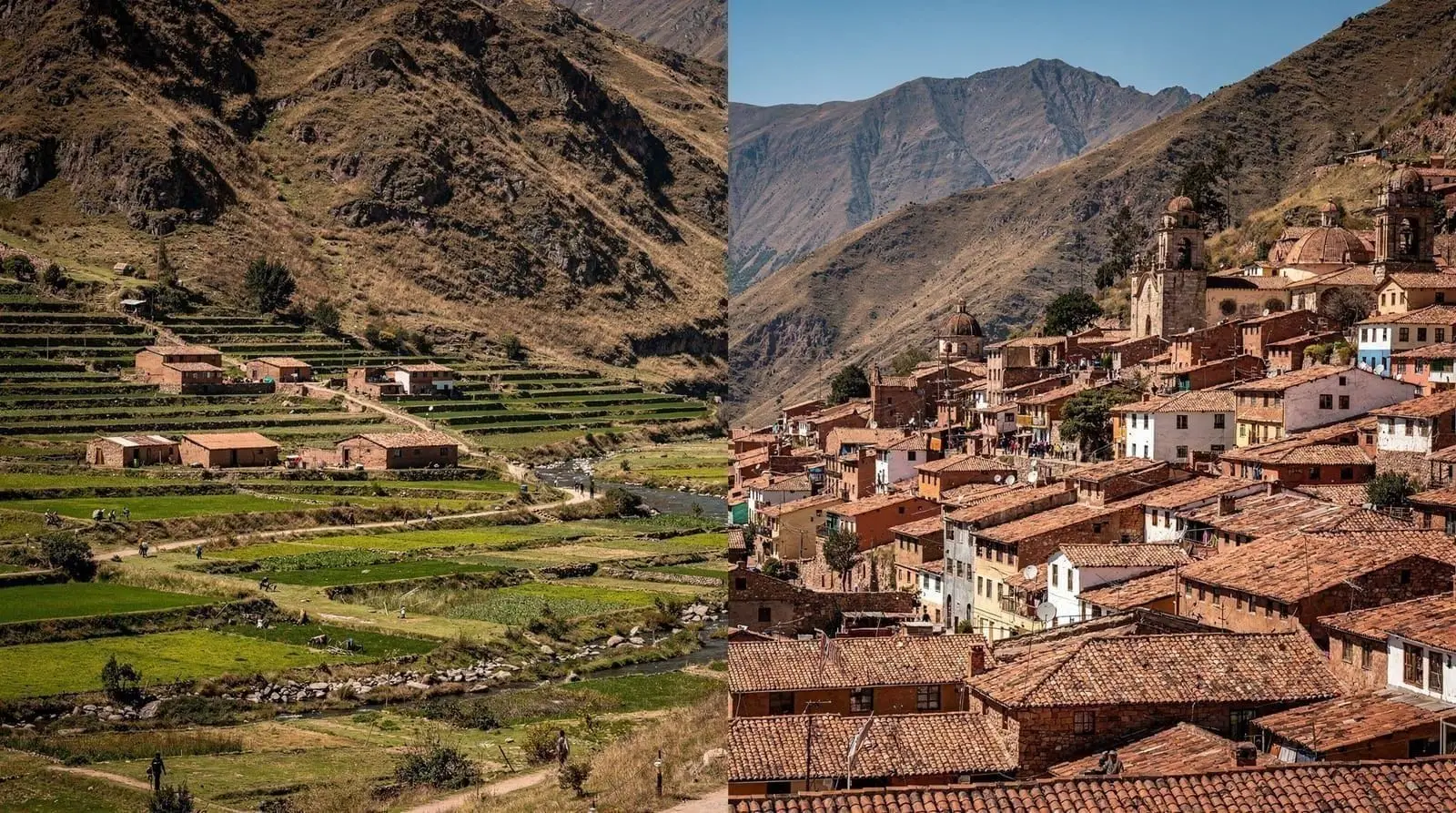
The Sacred Valley is rural and calm. You wake to mountains and farmland, the pace is slower, and the evenings are quiet. Ollantaytambo is a living Inca town where people still inhabit the original street grid; Urubamba is the practical service hub; Pisac has a bohemian village feel. The trade-off for the serenity is that there is far less to do in the evening — this is somewhere to rest, not to party.
Food and dining
Cusco has the deeper restaurant scene by a wide margin: from the famous fine-dining rooms to the cheap menú del día spots and the San Pedro Market food stalls. If eating well and having choice matters, the city wins. The best restaurants in Cusco guide maps the scene.
The valley has fewer but increasingly excellent options, including some destination farm-to-table restaurants around Urubamba. But variety and price both favour Cusco. In the valley, your hotel restaurant will do more of the heavy lifting.
Cost
For comparable quality, the valley tends to run slightly higher at the mid and upper range — many of its hotels are resort-style properties with grounds, and there are fewer rock-bottom hostels than in Cusco. Cusco has the broader budget spread, from cheap backpacker hostels to luxury, so if you are travelling on a tight budget, the city gives you more cheap options. At the high end the gap narrows, and the valley has some of the best luxury hotels in the region.
What each base is good for
Base in the Sacred Valley if you want to acclimatise gently, you are heading to Machu Picchu by train, you value calm and scenery, or you simply prefer a rural retreat. The valley is also better for visiting Pisac, Ollantaytambo, Maras and Moray without a daily commute from the city.
Base in Cusco if you want nightlife, museums, restaurant choice and easy access to the day trips that start in the city — Rainbow Mountain, Humantay Lake, Sacsayhuamán and the other Cusco-city ruins, and the long-distance buses. A guided valley day from the city, such as the full-day Sacred Valley tour from Cusco, lets you see the valley without moving hotels — handy if your nights are locked in the city.
Practical day: a sample two-base trip
To make the abstract concrete, here is how a balanced six-night Cusco-region trip actually flows when you use both bases in the recommended order.
Nights 1–3 — Sacred Valley. Transfer straight from Cusco airport down to Urubamba or Ollantaytambo (about 90 minutes), skipping the city’s altitude entirely on arrival day. Keep the first afternoon gentle — a short walk, an early night, plenty of water and coca tea. Day two: the valley sites at your own pace, Pisac ruins and market or Maras and Moray. Day three: board the morning train from Ollantaytambo straight to Machu Picchu — no pre-dawn drive from the city — and sleep that night in Aguas Calientes or back in the valley.
Nights 4–6 — Cusco. Now acclimatised, move up to Cusco for the city itself: the Plaza de Armas, Qorikancha, Sacsayhuamán, the museums and the San Pedro Market food stalls. Use the city as a launchpad for a Rainbow Mountain or Humantay Lake day, and enjoy the restaurants and nightlife in the evenings — easy when you are sleeping in town rather than 90 minutes away.
This sequence gives you the valley’s altitude advantage exactly when you need it (the first days and the Machu Picchu morning) and the city’s amenities exactly when you can enjoy them (once you have adjusted). Reversing it — Cusco first, then the valley — is the more common and more uncomfortable pattern.
Weather and seasonal notes for each base
Both bases share the region’s two-season climate, but the experience differs. In the dry season (May to September), the valley floor is warm and sunny by day and can drop close to freezing at night, while Cusco’s nights are colder still given the higher altitude. The valley’s lower elevation makes for more comfortable sleeping year-round.
In the rainy season (November to March), the valley turns lush and green, Cusco’s cobbles get slick, and both bases see clear mornings followed by afternoon showers — plan energetic activity before lunch from either. The shoulder months of April and October are pleasant at both. Whatever the season and base, the altitude makes the UV fierce: serious sun protection matters as much in Cusco as in the valley.
Recommendations by trip length
3–4 nights total. Pick one base. If Machu Picchu is your priority and you are altitude-sensitive, base in the valley and do a city day in Cusco. If nightlife and day trips matter more and you handle altitude well, base in Cusco and do a valley day tour — the Sacred Valley VIP full-day group tour is the comfortable small-group version if you go that route.
5–6 nights. Split: two or three nights in the valley first (acclimatise, do the valley sites and Machu Picchu), then two or three in Cusco (city, museums, day trips). This is the sweet spot most planners recommend.
7+ nights. Same split with more breathing room — add a Rainbow Mountain or Humantay day from Cusco, and a slow market morning in the valley. There is no need to choose.
Common mistakes when choosing a base
A few patterns trip up first-time visitors, and they are easy to avoid once flagged.
Basing entirely in Cusco when Machu Picchu is the priority. You can still reach Machu Picchu from the city, but you trade a 90-minute pre-train drive and a harder first-night altitude experience for the convenience of one hotel. If the citadel is the centrepiece of your trip, at least one valley night usually pays off.
Trying to “do” the valley as a single day trip from Cusco and calling it a base decision. A day trip sees the valley; it does not give you the acclimatisation or the unhurried mornings that basing there does. Do not confuse visiting the valley with basing in it.
Booking too many hotel changes. Two bases is the sweet spot. Three or four moves in a short trip — valley, Aguas Calientes, Cusco, then somewhere else — eats your time in packing and transfers. Keep it to the valley-then-city split unless your trip is genuinely long.
Underestimating the valley’s quiet evenings. Travellers who love nightlife and dining variety sometimes feel stranded in the valley after dark. If that is you, weight your nights toward Cusco and treat the valley as a daytime and acclimatisation phase.
Assuming the valley is uniformly low. Chinchero on the plateau is higher than Cusco. The low-altitude benefit applies to the valley floor around Urubamba and Ollantaytambo, not the whole region.
Frequently asked questions about Sacred Valley vs Cusco
Is it better to stay in the Sacred Valley or Cusco for the first night?
The Sacred Valley, if Machu Picchu is on your itinerary and you are arriving from sea level. Sleeping low at 2,800–3,000 m on your first nights is gentler on your body than Cusco’s 3,400 m, and it cuts your odds of altitude sickness. Move up to Cusco afterwards once you have adjusted.
Can I see Cusco’s main sights if I base in the Sacred Valley?
Yes, on a day trip. Cusco’s historic centre, Sacsayhuamán and the city ruins are an easy day from the valley by car or tour. But the city’s nightlife and evening dining are harder to enjoy if you are sleeping 90 minutes away, so most people spend at least a couple of nights in Cusco itself.
Which is cheaper, the Sacred Valley or Cusco?
Cusco, generally, especially at the budget end — it has far more cheap hostels and menú del día restaurants. The valley skews toward mid-range and resort-style hotels, so comparable quality often costs a little more. At the luxury level the two are similar.
Is the Sacred Valley closer to Machu Picchu than Cusco?
Yes. The train to Machu Picchu departs from Ollantaytambo in the valley. From Cusco you must drive about 90 minutes down to Ollantaytambo first, so basing in the valley puts you next to the train rather than an hour and a half away.
How many nights should I split between the valley and Cusco?
On a 5–6 night Cusco-region stay, two or three nights in the valley first (for acclimatisation and Machu Picchu) and two or three in Cusco afterwards (for the city and day trips) is the most balanced split. With fewer nights, pick one base based on whether Machu Picchu or city life matters more.
What if I only have one night before a trek?
If you are heading straight into Salkantay, a Rainbow Mountain day, or any strenuous altitude activity with only one buffer night, spend it in the Sacred Valley rather than Cusco. The few hundred metres of lower elevation genuinely matter on the first night, and the Cusco acclimatisation plan lays out exactly how to use a single night well — light activity only, hydration, and an early bedtime, wherever you sleep.
Does the base decision matter less for a short weekend trip?
Somewhat, yes. On a two- or three-night trip there simply is not enough time to split bases sensibly, so pick the one that serves your single main goal — Machu Picchu points to the valley, city sightseeing and nightlife point to Cusco — and treat the other as a day trip rather than trying to force a split that only adds packing time.
Reading recommendations before you book
Two more resources round this decision out. The blog diary on Sacred Valley slow travel gives a first-person feel for what a relaxed valley base actually looks like day to day, useful if the comparison tables above feel abstract. And if your itinerary already includes a Rainbow Mountain or Humantay Lake day departing from Cusco, weigh that against the getting around the Sacred Valley guide, which shows how much daily transit a valley base adds if most of your day trips actually start in the city.
Top experiences
Bookable activities with verified prices and instant confirmation on GetYourGuide.
