Sacred Valley day trip from Cusco: the honest plan
From Cusco: Sacred Valley of the Incas Full-Day Tour
Is the Sacred Valley worth doing as a day trip from Cusco?
Yes, the standard loop covers Pisac, Ollantaytambo and a lunch stop in roughly nine to eleven hours. It is a long, full day with limited time inside each site, and you lose the altitude benefit of sleeping low. Worth it if your schedule is tight; sleep over if you can.
What a single day actually buys you
The Sacred Valley day trip is the most-sold excursion in the Cusco region, and for good reason: it is cheap, it is convenient, and it lets you tick the valley off without rearranging your hotel nights. But the marketing photos hide an honest truth. A day trip is a compression. You are squeezing a corridor that deserves two or three days into roughly nine to eleven hours, most of which you spend in a minivan or at a lunch table rather than standing among Inca stonework. That is not a reason to skip it — plenty of travellers have a fixed Cusco base and no room to move. It is a reason to go in with clear expectations and to pick the right version of the tour.
This guide lays out what a realistic day looks like, which sites are worth the limited time, where the operators cut corners, and how to judge whether you would be better off sleeping a night in Urubamba or Ollantaytambo instead. If you want the deeper background on the valley itself, the Sacred Valley overview covers the geography and the case for staying over.
| Where | Pisac, Ollantaytambo and optionally Chinchero or Maras-Moray |
| Cost | tour price plus boleto (S/70 partial) and lunch if not included |
| Time needed | 9-11 hours door to door from Cusco |
| Getting there | organised tour, private driver, or colectivos between towns |
| Best time | early pick-up (07:30-08:30) to maximise site time before the buffet stop |
The standard loop, hour by hour
Most full-day tours follow a near-identical clockwise or counter-clockwise loop. The classic version runs Pisac, then a buffet lunch around Urubamba, then Ollantaytambo, with Chinchero bolted on at the start or end. Here is the realistic shape of the day, ignoring the brochure optimism.
07:30–08:30 — Pick-up and the drive out. Tours collect you from your Cusco hotel or from the Plaza de Armas in a window, not at a fixed minute. Latecomers and a full van mean you rarely leave before 08:30. The drive to the first stop is 60–90 minutes.
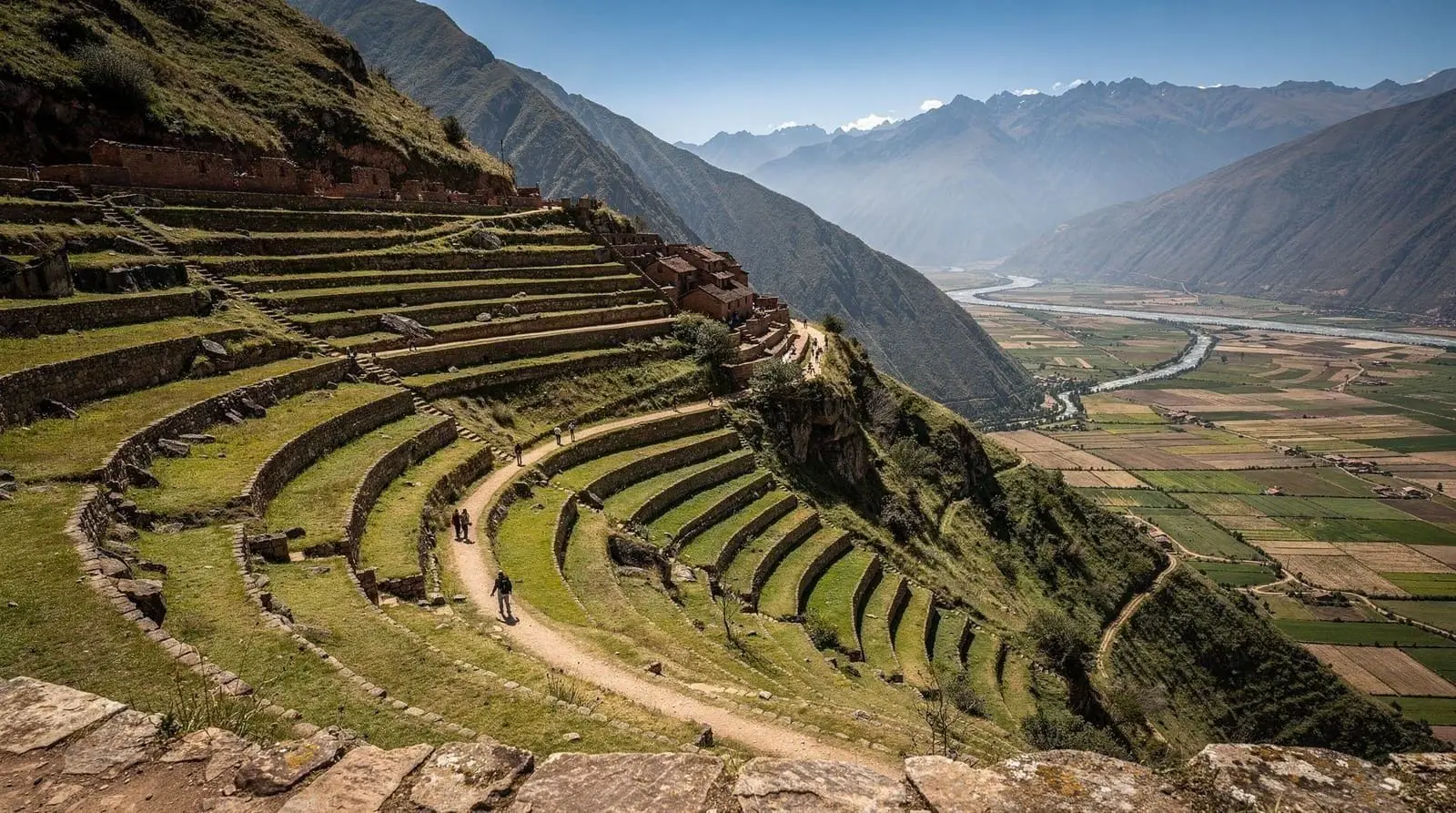
09:00–10:30 — Pisac. The hillside ruins above Pisac are the most photogenic in the valley: terraces fanning down a spur, a ceremonial sector, and an Inca cemetery pocked with looted tomb holes. You typically get 60–75 minutes here with a guide, which is enough for the main viewpoints but not for the full hike down through the terraces. Some cheaper tours stop only at the Pisac market in the town below, not the ruins on the ridge — read the itinerary.
11:00–12:00 — A textile or jewellery sales stop. Almost every budget tour wedges in a “demonstration” at an alpaca-textile workshop or a silver showroom. The weaving itself can be genuinely interesting; the hard-sell that follows is the point of the stop for the operator. You are free to buy nothing.
12:30–13:45 — Buffet lunch. Usually a fixed-menu Andean buffet near Urubamba, often not included in the headline price (budget another S/45–70, around $12–19). The food is fine, rarely memorable. This is the single biggest time-sink of the day.
14:30–16:00 — Ollantaytambo. If you only stand on one set of terraces, make it here. The fortress-temple above the town saw one of the few Inca victories over the Spanish, and the giant pink rhyolite blocks of the unfinished Temple of the Sun still puzzle engineers. You usually get around 75–90 minutes — the best-value stop of the day. See the Ollantaytambo ruins guide for what to look for.
16:30–17:30 — Chinchero (if included). Highest and coldest of the sites at about 3,760 m, Chinchero adds a weaving cooperative, an adobe colonial church on Inca foundations, and a market. Tacked onto a long day it can feel like one stop too many, and the light is fading.
18:30–19:30 — Back in Cusco. Allow for traffic on the climb back up.
A guided loop handles the entry logistics and the driving between sites that public minivans connect poorly. The full-day Sacred Valley tour from Cusco is the standard version of this circuit with transport and a guide included.
Two route variations worth knowing
Not every “Sacred Valley day tour” covers the same ground, and the difference matters more than the price.
The classic ruins loop (Pisac + Ollantaytambo + Chinchero). This is the traditional circuit above. Best if you care most about Inca archaeology and want the headline terraced sites.
The Maras–Moray version (Pisac + Moray + Salineras + Ollantaytambo). This swaps Chinchero for Moray, the concentric circular agricultural terraces, and the Maras salt pans — thousands of salt evaporation ponds worked by hand since before the Inca. If you have seen enough ruins and want variety, this is the more visually striking loop. The Pisac, Maras, Moray and Ollantaytambo small-group tour covers this spread-out combination, which is genuinely hard to do without a vehicle. Note that the salt pans charge a separate entry of about S/18 (around $5) that is not on the Boleto Turístico.
A small-group or VIP tier exists for travellers who do not want to be herded in a full coach. The Sacred Valley VIP full-day group tour runs smaller groups at a slower pace, which is worth the premium if a packed minivan would ruin your day.
| Loop | Sites | Best for |
|---|---|---|
| Classic ruins loop | Pisac, Ollantaytambo, Chinchero | Maximum Inca archaeology |
| Maras-Moray loop | Pisac, Moray, Salineras, Ollantaytambo | Visual variety, salt pans and circular terraces |
| VIP small-group | Either loop, smaller vehicle | Travellers who dislike a packed minivan |
The boleto you need for a day trip
You cannot pay individually at the gate for the valley ruins. Pisac, Ollantaytambo, Chinchero and Moray are all covered only by the Boleto Turístico del Cusco, and there is no single-site ticket.
For a one-day visit, the Boleto Parcial Circuito III (S/70, about $19, valid 2 days) covers exactly the four valley sites and nothing else — the right choice if you have already seen or will skip the Cusco-city ruins. If you also want Sacsayhuamán or the Qorikancha museum, the full Boleto General (S/130, about $35, valid 10 days) is better value. Most organised tours do not include the boleto in the price; you buy it at the first site or at the COSITUC office in Cusco. Bring cash. The full breakdown is in the Boleto Turístico explained guide and the dedicated Cusco tourist ticket guide.
Doing it independently
A day trip does not have to mean a tour. If you prefer your own pace, two independent options work.
Hire a private driver for the day. Roughly S/180–280 (about $48–75) gets you a car and driver who will follow whatever route you choose and wait while you explore. Agree the itinerary and price before you set off. This is the most efficient way to control your own timing and skip the sales stops.
Colectivos (shared minivans). The cheapest route. Colectivos to Pisac leave Cusco from Calle Puputi (S/5–7). From Pisac you change at Urubamba for Ollantaytambo. It is doable for two sites in a day but slow, and chaining all four in daylight is a stretch. The getting around the Sacred Valley guide breaks down every connection and fare.
For a hour-by-hour self-guided plan, the one-day Sacred Valley itinerary maps out the most efficient independent route.
Group tour vs private driver vs colectivos, side by side
Which of the three independent-versus-guided options suits you comes down mostly to your budget and your tolerance for logistics. A group tour is the least effort: fixed pick-up, a set route, a guide included, and no decisions to make beyond which loop to book. A private driver costs more but removes the sales stops and the fixed schedule — you decide how long to linger at Ollantaytambo and skip the textile demonstration entirely if you want. Colectivos are the cheapest by a wide margin but demand the most patience: you are at the mercy of departure times, connections between towns, and a slower overall pace that makes seeing all four valley sites in a single day a stretch rather than a given.
For most first-time visitors with average Spanish and no strong opinion about the sales stops, the group tour remains the simplest choice. Travellers who have done Cusco before, or who specifically dislike being herded, tend to prefer the private driver despite the higher cost. Solo budget travellers with a flexible schedule and decent Spanish are the group best served by colectivos, since the savings are largest when split across nobody but yourself.
When you should sleep over instead
A day trip costs you two things money cannot buy back: time at each site, and altitude acclimatisation. The valley floor sits at 2,800–3,000 m, several hundred metres lower than Cusco at 3,400 m. If your trip includes Machu Picchu, Rainbow Mountain, or a trek, sleeping low in the valley for your first nights is the single best move against altitude sickness — far better than gasping through your first days in Cusco. The Cusco altitude versus Sacred Valley guide makes the full case.
Sleep over if any of these apply: you are continuing to Machu Picchu by train (which leaves from Ollantaytambo anyway), you want to time a market morning properly, you are sensitive to altitude, or you simply dislike rushed group days. Do the day trip if your Cusco hotel nights are locked, your schedule is short, and you accept seeing the highlights rather than savouring them.
What to pack for the day
A Sacred Valley day starts cool, gets hot in the open sun, and ends cold once the light drops behind the mountains, so pack for the full range even though it is “just a day trip.”
- Layers. A warm top for the early start and the higher, colder Chinchero stop, plus light clothing for the midday sun at lower Pisac and Ollantaytambo.
- Serious sun protection. High-SPF sunscreen, a brimmed hat and sunglasses — the altitude makes the UV punishing regardless of temperature.
- Comfortable shoes with grip. The ruins involve uneven Inca steps and terraces; this is light hiking, not a stroll on flat ground.
- Cash in soles. For the boleto if not included, lunch if not included, the Maras salt pans entry, photo tips and market shopping. Card acceptance is patchy.
- Water and a snack. Useful on the long drives, especially if lunch runs late.
- A light rain layer in the wet season, when afternoon downpours are likely.
- A power bank. Photos and navigation apps drain a phone fast over a nine-hour day with limited charging opportunities on the bus.
Is the day trip right for your trip?
Step back and look at the day trip in the context of your whole Peru plan rather than in isolation. The valley day works best as a self-contained sightseeing day for travellers who are firmly based in Cusco, handle altitude well, and have already built acclimatisation in somewhere else (or are not doing anything strenuous afterward). It works poorly as your introduction to altitude or as a rushed prelude to a trek the next morning, because a long bus day at 3,000–3,400 m is tiring and does nothing to prepare your body for height.
If your itinerary includes a trek — the Inca Trail, Salkantay, or even Rainbow Mountain — the smarter use of the same days is to base in the valley for two nights, see the sites at a relaxed pace, and let the lower altitude do its work before you go high. The day trip saves a hotel change but costs you that benefit. Weigh which matters more for your specific plan; there is no universally right answer, only the right answer for your schedule and how your body handles altitude.
A middle path some travellers miss entirely: do the day trip early in your Cusco stay, before a trek rather than the night before one. Used this way, the day trip still gives you a look at Pisac and Ollantaytambo, and because it is not immediately followed by strenuous exertion, the missed acclimatisation matters less. It is a reasonable compromise if you genuinely cannot spare an extra hotel night but still want the valley on your itinerary somewhere.
Tourist traps to watch on the day tour
The “ruins” tour that only visits the market. Some budget Pisac stops never climb to the ruins on the ridge — they drop you at the souvenir market below. Confirm the ruins are included.
The buffet that eats your afternoon. A 75-minute lunch on a 10-hour day is a lot of your daylight gone. Tours that rush lunch usually give you more time at Ollantaytambo, which is the trade you want.
The undisclosed sales stop. The textile or silver “demonstration” is a commission stop. It is fine to watch the weaving and walk out empty-handed.
Boleto confusion. Sellers sometimes imply the tourist ticket covers everything. It does not cover the Maras salt pans, which are a separate cash entry.
Photo tips at viewpoints. Women and children with llamas at the Pisac and Chinchero overlooks expect a small tip (S/2–5) for photos. Agree before you shoot.
Frequently asked questions about the Sacred Valley day trip
How long is a Sacred Valley day trip from Cusco?
Plan for nine to eleven hours door to door. Pick-up is usually in a 07:30–08:30 window, and most tours return to Cusco between 18:30 and 19:30. The driving alone accounts for three to four hours of that.
How much does a Sacred Valley day trip cost?
The tour itself is typically modest, but budget separately for the Boleto Turístico (S/70 partial, about $19), lunch if not included (S/45–70), and the Maras salt pans entry (S/18) if your route includes them. A private driver for the day runs S/180–280 (about $48–75).
Does the Sacred Valley day trip include Machu Picchu?
No. Machu Picchu is a separate trip reached by train from Ollantaytambo, requiring its own ticket and at least a full day. A few multi-day tours combine the valley with Machu Picchu, but the standard one-day valley loop does not. See the Machu Picchu circuits explained guide for that side of the trip.
Can I visit the Sacred Valley without a tour?
Yes. Hire a private driver for the day (S/180–280) for full flexibility, or use colectivos from Cusco for the cheapest route. Independent travel suits two sites comfortably; chaining all four in a day is easier with a driver or a tour.
Should I do the classic loop or the Maras–Moray loop?
Choose the classic loop (Pisac, Ollantaytambo, Chinchero) if you want maximum Inca archaeology. Choose the Maras–Moray version if you want more visual variety — the salt pans and circular terraces are unlike anything else in the valley. You cannot comfortably do both well in one day.
Is one day enough for the Sacred Valley?
It is enough to see the headline sites, not enough to enjoy them. One day gives you 60–90 minutes at each ruin and a long day in the van. Two days lets you slow down and gain the altitude benefit of sleeping low. If you can spare a night, do.
Top experiences
Bookable activities with verified prices and instant confirmation on GetYourGuide.

