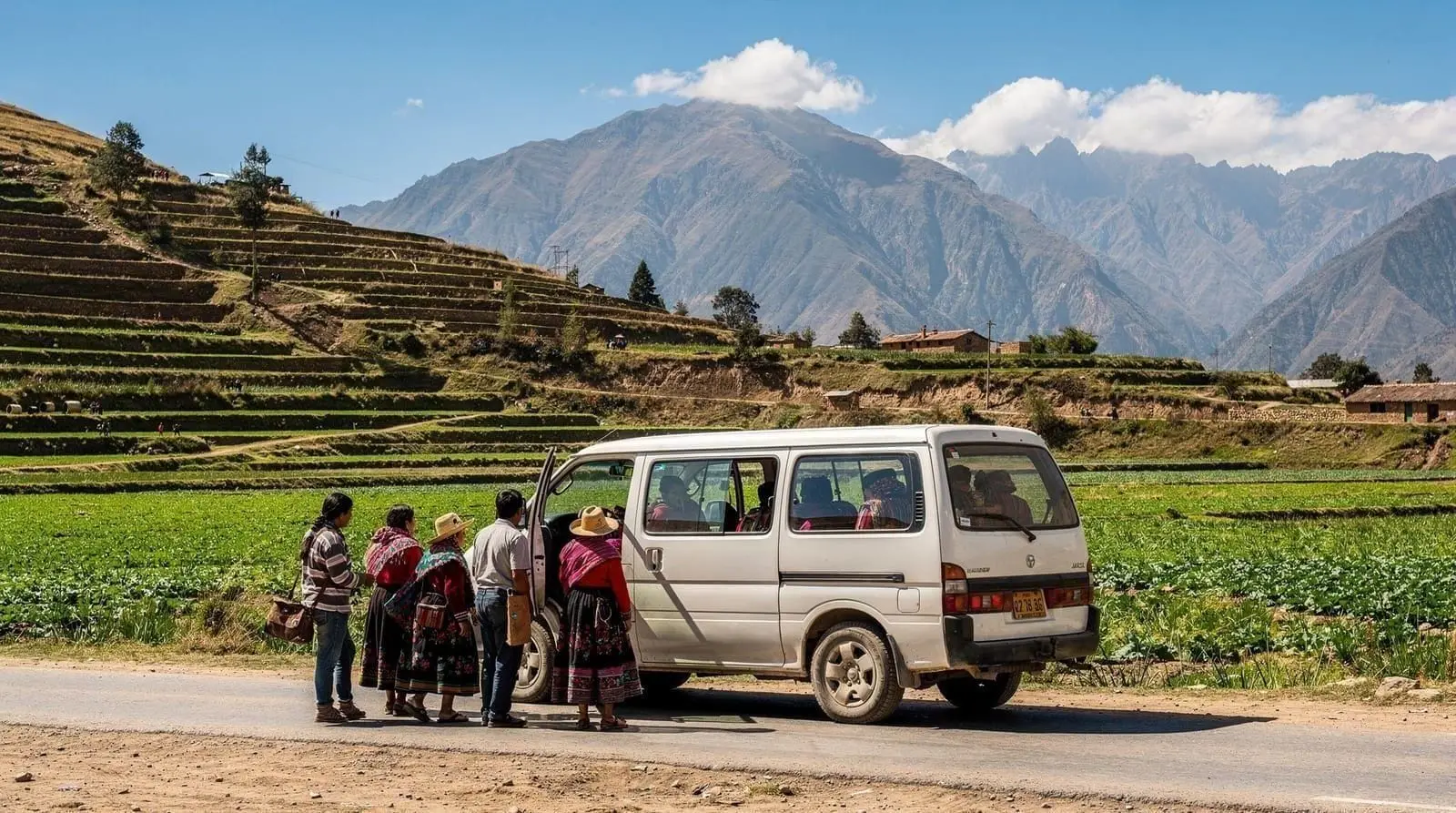
Getting around the Sacred Valley: colectivos, taxis, and tours
Cusco: Pisac, Maras, Moray, Ollantaytambo Small Group Tour
What is the cheapest way to get around the Sacred Valley?
Shared colectivos (minivans) connect Cusco, Pisac, Urubamba, and Ollantaytambo for S/5–15 (about $1.50–4) per leg. They are frequent, local, and the backbone of valley travel. Taxis and private drivers cost more but save time when you want to combine several sites in a day.
Reading the valley as a single road
The Sacred Valley confuses first-timers because it looks scattered on a map, but on the ground it is mostly one long line. The Urubamba river carves a corridor through the Andes, and the main towns — Pisac at the upper end, Urubamba in the middle, Ollantaytambo at the lower, train-station end — sit strung along it like beads. Once you picture it as a single road with a handful of stops, the transport stops being mysterious.
The exceptions are the sites that climb off that road: Chinchero on the high plateau between Cusco and the valley, and the Maras salt pans and Moray terraces up a side branch above Urubamba. Those off-road detours are exactly where do-it-yourself transport gets fiddly and where a tour or a hired driver starts to make sense.
This guide walks through every realistic way to move — the cheap and frequent colectivos, the shared and private taxis, the organised tours — with real soles fares and honest notes on when each one is worth it.
| Cheapest option | Colectivo, S/5–15 per leg |
| Most flexible | Private driver, ~S/180–350/day (car, not per person) |
| Easiest for Maras/Moray | Organised tour (poorly served by colectivos) |
| Cash needed | Yes — every fare is cash-only |
| Machu Picchu train | Leaves from Ollantaytambo, not Cusco |
Colectivos: the backbone of the valley
What a colectivo actually is
A colectivo is a shared minivan (sometimes a small bus or a shared car) that runs a fixed route, leaving when it fills rather than on a timetable. They are the everyday transport of the valley: locals use them for everything, and they are entirely fine for travellers. Expect them crowded, basic, and cheap. You flag them on the route, pay the cobrador (the conductor hanging out the door calling the destination), and get off where you like.
The fares that matter
All prices are cash, in soles, paid on board:
- Cusco to Pisac: about S/5–8 (around $1.50–2), 45–60 minutes. Colectivos leave from Calle Puputi in Cusco.
- Cusco to Urubamba: about S/8–10 ($2–3), roughly 1 hour 20 minutes, via Chinchero. From around Calle Pavitos.
- Urubamba to Ollantaytambo: about S/2–3, 30 minutes. Constant departures from Urubamba’s terminal.
- Cusco to Ollantaytambo: about S/12–15 ($3–4), around 1 hour 40 minutes, usually changing at Urubamba.
- Pisac to Urubamba: about S/3–5, 40 minutes, running down the valley floor.
- Urubamba to Chinchero: about S/3–5, 25 minutes, on the Cusco road.
Two honest notes. First, foreigners are sometimes quoted a slightly higher fare; the amounts are tiny, but watch what locals pay and hand over close to it. Second, departures thin out in the late afternoon and stop by early evening on the quieter legs, so do not rely on a colectivo to get you home after dark from a small town.
Are colectivos safe?
For daytime travel on the main routes, yes — comfortably. They are crowded and informal rather than dangerous. The sensible precautions are the universal ones: keep your daypack on your lap rather than in the back, carry small notes so you are not flashing cash, and avoid the very last departures on lonely routes. For a fuller picture of road travel across the country, the Peru bus travel guide covers intercity coaches and the safety landscape.
Taxis and private drivers
Shared and street taxis
Within and between the valley towns, taxis are plentiful and cheap by Western standards. A short hop inside Ollantaytambo or Urubamba runs S/5–10. A taxi between towns — say Urubamba to Ollantaytambo — runs S/30–50 if you take the whole car rather than waiting for a colectivo, which is worth it when you are carrying luggage to catch a train.
There are no meters; agree the fare before you get in. App-based options (InDriver, Cabify) work in and around Cusco and the upper valley, removing the haggle, though coverage thins in the smaller towns.
Hiring a private driver for the day
This is the sweet spot for many independent travellers. A driver for a full day — picking you up in Cusco or your valley hotel, waiting at each site while you explore, and looping you through several towns at your own pace — runs roughly S/180–350 ($48–93) for the car, not per person. Split between three or four people it rivals a group tour, and it buys you flexibility a tour cannot: linger at Moray, skip a market you dislike, time Ollantaytambo’s ruins for the late-afternoon light when the day groups have left.
The catch is that a driver is not a guide. You get transport and local knowledge of the roads, not interpretation of the sites. If understanding what you are looking at matters to you, either hire a site guide at each entrance (S/30–60 each) or take a guided tour instead.
When a tour is the smart choice
The Maras–Moray problem
The single best argument for an organised tour is the off-road cluster. Maras and Moray sit up a side road above the valley floor, poorly served by colectivos — you would ride to a junction, then negotiate a taxi up and arrange the wait, repeated twice. Doing this independently in a day, alongside Pisac and Ollantaytambo, is genuinely awkward. A tour solves it in one sweep.
The standard full-day circuit covers Pisac, Maras, Moray, and Ollantaytambo with transport and a guide. The small-group Sacred Valley tour covering Pisac, Maras, Moray and Ollantaytambo stitches the whole loop together, which is exactly the combination that public transport handles poorly. For a more classic route focused on the valley-floor towns and the markets, the full-day Sacred Valley of the Incas tour sticks to Pisac, Urubamba, and Ollantaytambo without the salt-and-terraces detour.
What tours skip — and what that costs you
Be honest with yourself about the tradeoff. A group tour moves on its own clock: it tends to arrive at Pisac during the busy mid-morning, allots a fixed and often rushed window at each stop, and may slot in a buffet lunch and an “artisan” or jewellery stop that doubles as a sales pitch. You trade flexibility and quiet for solved logistics.
If your priority is one or two sites done well and at your own pace — say a slow morning at Ollantaytambo and an afternoon train — then colectivos plus an on-site guide beat any tour. If your priority is seeing the whole circuit in a single efficient day without planning, the tour wins. Knowing which traveller you are is the whole decision.
Connectivity and staying reachable on the move
Mobile coverage along the main valley road is generally solid with Claro and Movistar, which makes it easy to check colectivo departure times or coordinate with a driver, but signal drops in stretches between towns and disappears entirely up the Maras–Moray side road and in pockets of the higher terrain. Download offline maps before you set out, and if you are travelling independently, tell your accommodation roughly when to expect you back, since a delayed colectivo or a slow taxi negotiation is common enough that nobody will worry, but it helps to have set expectations in a valley where plans shift with the transport.
Getting to the Machu Picchu train
A specific transport problem deserves its own note: the trains to Machu Picchu leave mainly from Ollantaytambo, not from Cusco. If you are basing yourself in the city, factor a 1.5–2 hour transfer down the valley to catch your train, and build in a generous buffer — missing the train means missing your timed Machu Picchu entry. Many travellers solve this by sleeping in Ollantaytambo the night before an early train. Colectivos run the Cusco–Ollantaytambo leg cheaply, but with luggage and a fixed train time, a private taxi (S/120–180 from Cusco) removes the risk. The Sacred Valley complete guide maps out how to sequence valley time around a Machu Picchu visit.
Practical planning notes
- Carry cash in small notes. Every form of valley transport is cash-only and change can be scarce. Break large bills in Cusco before you set out.
- The boleto turístico is for sites, not transport. You still pay every fare separately. Buy the boleto only for the ruins you intend to enter; the boleto turístico explained guide breaks down which sites it covers.
- Mind the altitude on transfers. The valley floor is lower than Cusco, which is why many people sleep here first to acclimatise. Chinchero, at 3,760 m, is higher than Cusco, so a stop there is more tiring than its short distance suggests.
- Start early. Colectivos run all day, but the sites are quietest and the light best early. The valley fills with Cusco day-trippers from mid-morning.
A sample independent valley day
To make the choices concrete, here is how a confident independent traveller might do a self-guided valley day without a tour. Catch an early colectivo from Cusco’s Calle Puputi to Pisac (S/5–8, under an hour), arriving before the market and the ruins fill with day-trippers. Take a taxi or walk up to the Pisac ruins, spend the morning, then drop back into town for an early lunch.
From Pisac, ride a colectivo down the valley floor to Urubamba (S/3–5), the valley’s transport hub, where everything connects. From Urubamba, a short colectivo (S/2–3) carries you on to Ollantaytambo for the late-afternoon light on the fortress, when the group tours have largely cleared out.
If you are continuing to Machu Picchu, you simply stay in Ollantaytambo for the night and catch your morning train. If you are returning to Cusco, a direct colectivo runs back (S/12–15, about 1 hour 40 minutes) — but check the time, because the last comfortable departures thin out by early evening. The whole day costs a fraction of a tour in transport, but it skips Maras and Moray, which is the trade you make for doing the valley floor under your own steam. Slotting those two in is the moment to add a half-day driver or accept that they belong on a separate outing.
Altitude, weather, and timing notes
The valley floor is lower and warmer than Cusco, which is exactly why so many travellers choose to sleep here while acclimatising — but the transport still crosses high ground. The Cusco–Urubamba colectivo climbs over the Chinchero plateau at 3,760 m, higher than Cusco itself, so a stop there is more tiring than its short distance implies; treat it as a real altitude point, not a quick photo halt.
Weather shapes the day too. In the November–March wet season, afternoon downpours are routine, roads can be slick, and a late-day colectivo back to Cusco is less appealing in heavy rain. Aim your travel for the mornings in the wet months. In the dry season (May–September), the days are reliably clear but the nights and early starts are cold, so a layer for the open-windowed colectivos and the pre-dawn waits is worth packing. Whatever the season, the golden rule holds: start early, both for the light and because the transport network winds down well before you would expect a European or North American one to.
How valley transport fits your trip
Most travellers base in Cusco and treat the Sacred Valley as a string of day trips and a staging point for Machu Picchu. The honest planning move is to match the transport to the day: colectivos for one or two valley-floor towns at your own pace, a hired driver when you are a small group wanting flexibility, and a tour for the awkward Maras–Moray loop. For how the valley slots into a longer route, see the Peru 2-week itinerary guide.
Side-by-side: which option for which traveller
| Option | Cost | Best for |
|---|---|---|
| Colectivo | S/5–15 per leg | Budget travellers, one or two valley-floor towns |
| Taxi (point to point) | S/30–50 between towns | Short hops, luggage days, catching a fixed train |
| Private driver (full day) | S/180–350 for the car | Small groups wanting flexibility and the Maras–Moray loop |
| Group tour | Varies, per person | First-timers, solo travellers, no logistics to arrange |
Arriving with a rental car
A small minority of travellers self-drive the valley, and it is workable if you have Andean driving experience — narrow roads, unmarked speed bumps, and aggressive local drivers are the main hazards, not the road surfaces themselves, which are generally decent on the main valley road. Parking is easy in Urubamba and Ollantaytambo but tighter in central Pisac during market hours. The honest advice for most visitors: a rental car buys you little that a hired driver does not already provide, while adding the stress of navigating and parking in unfamiliar towns, so it suits confident, experienced self-drivers more than first-time visitors to Peru.