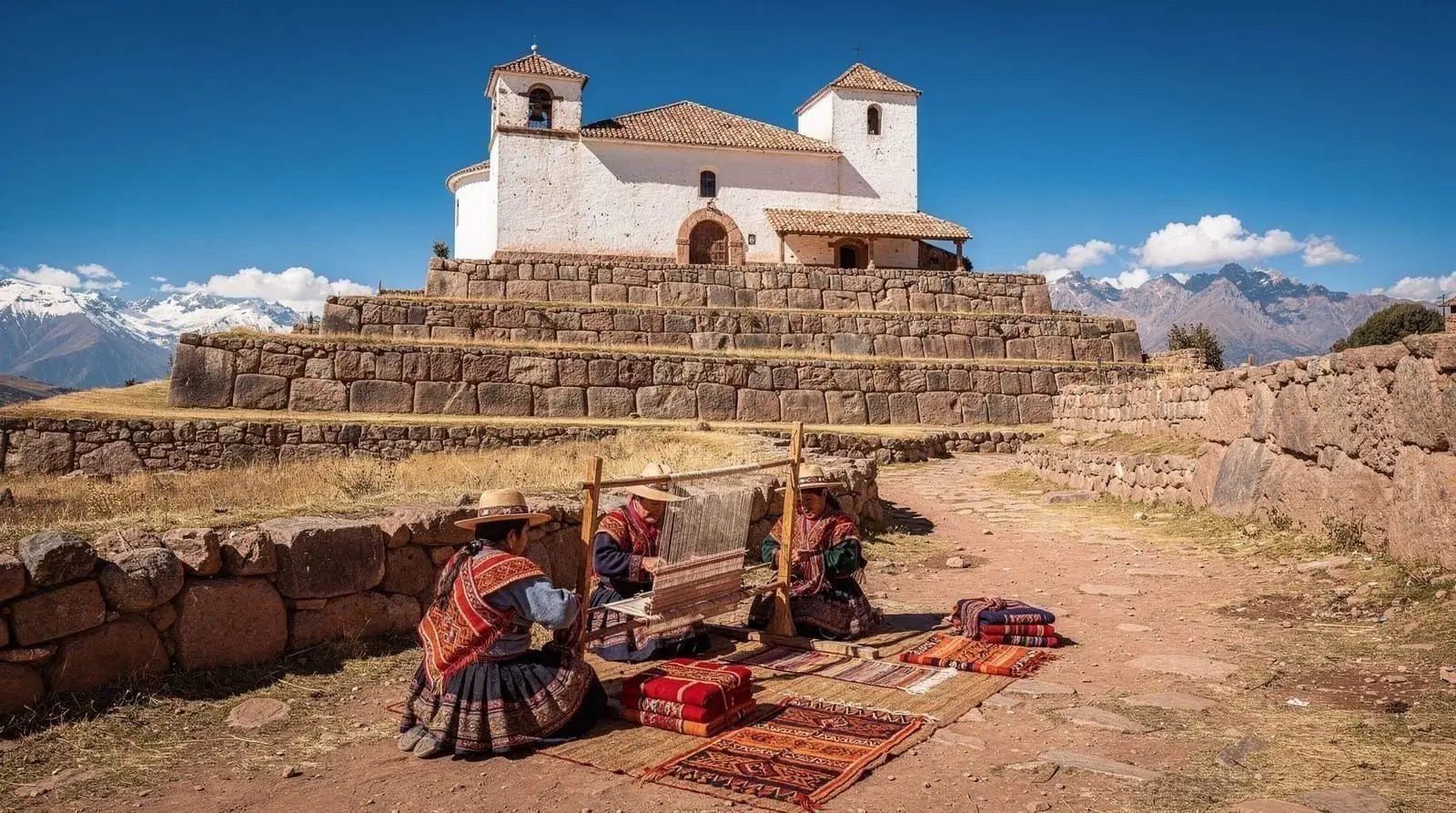
Chinchero
Chinchero done right: the Sunday market, real weaving cooperatives vs sales-stops, the colonial church on Inca walls, altitude and boleto facts.
Cusco: Pisac, Ollantaytambo & Chinchero Sacred Valley Tour
Quick facts
- Region
- Sacred Valley plateau, Cusco Department
- Altitude
- 3,762 m / 12,343 ft (higher than Cusco)
- Entry (ruins/church)
- Boleto Turístico (Circuit III S/70 or General S/130)
- Market day
- Sunday (main); smaller daily handicraft market
- Best for
- Andean weaving, market shopping, colonial church, valley views
The weaving village on the cold high plateau
Chinchero sits on a windswept plateau between Cusco and the Sacred Valley floor, and the first thing to know is that it is high — 3,762 m (12,343 ft), higher than Cusco and far higher than the valley towns below. The air is thin and the wind has a bite to it even on sunny days. Pack a layer you would not bother with down in Urubamba or Ollantaytambo.
| Where | Sacred Valley plateau, 30 km / ~45 min from Cusco |
| Time needed | Half day, often combined with Maras and Moray |
| Cost | Boleto Turístico Circuit III S/70 or General S/130 |
| Getting there | Colectivo S/5–8, taxi S/50–70, or guided tour |
| Best time | Sunday for the market; May–September for dry weather |
What draws people up here is textiles. Chinchero is the spiritual home of Andean weaving in the Cusco region, and the village’s cooperatives keep alive the full traditional process — shearing alpaca and sheep, washing the wool with a root-soap called saqta, spinning by drop-spindle, dyeing with cochineal, indigo and plant materials, and weaving on a backstrap loom. A good demonstration here is one of the genuinely educational experiences in the valley, not just a shopping stop.
The village is usually visited as a half-day, combined with the salt pans and circular terraces of Maras and Moray nearby, or as a final stop on the way back up to Cusco from the valley.
The market and the weaving cooperatives
Sunday is Chinchero’s main market day, and the most traditional in the region. Highland families from surrounding communities come down to trade, and the upper part of the market still functions as a genuine produce and barter exchange among locals — a different world from the souvenir stalls below. The handicraft market runs in a smaller form on other days too, but Sunday is when the village comes alive.
The weaving is the real reason to come. A few honest pointers on telling a genuine cooperative from a sales-stop:
- Real cooperatives demonstrate the whole process — the wool washing with saqta root, the natural dyes (watch them squash cochineal beetles to get crimson), the spinning, and the backstrap weaving — before any selling. The women explain what the patterns mean.
- Sales-stops skip straight to a quick “demo” and a hard push to buy. Some tour operators have commercial deals with specific shops; you are not obliged to buy.
- Prices for genuine hand-woven pieces are higher than machine-made, and fairly so — a full table runner can take weeks. Compare the tightness of the weave and the feel of the alpaca. Haggling is acceptable but be reasonable on real handwork.
Cooperatives such as those run by the Centro de Textiles Tradicionales network are reputable. If you only buy one piece of textile on your whole trip, Chinchero is a good place to do it knowing where it came from.
Beyond textiles, the produce side of the Sunday market is worth a slow walk even if you buy nothing: mountains of native potato varieties, giant Andean corn, herbs used in traditional medicine, and highland cheeses traded between communities much as they would have been generations ago. Arriving by mid-morning gives you the best of both the produce trading and the handicraft stalls before tour buses fill the square around midday.
Cash is essential — card machines are rare to nonexistent among the market stalls and smaller cooperatives, so bring small soles notes from Cusco rather than expecting to change money or use a card locally.
The church and the ruins
On the main square stands one of the most beautiful colonial churches in the region, Nuestra Señora de la Natividad, built around 1607 directly on Inca foundations — the original Inca walls of the palace of the Inca Túpac Yupanqui form the base. The interior is covered in floor-to-ceiling religious murals and gilded woodwork. Photography inside is usually restricted; respect the signs.
Around and below the church spread Inca agricultural terraces and the remains of Túpac Yupanqui’s royal estate, with finely cut walls and carved stone seats. The whole archaeological-and-church complex is covered by the Boleto Turístico — there is no separate gate ticket. The Circuit III partial (S/70, valid 2 days) covers Chinchero plus Písac, Ollantaytambo and Moray; the General (S/130) adds the Cusco sites. Bring cash.
A guided day links Chinchero with the other valley headliners. The Písac, Ollantaytambo and Chinchero Sacred Valley tour covers the three towns with transport and a guide, which is the practical way to chain sites that public minivans do not connect smoothly.
Eating in Chinchero
Chinchero is a small village without a big restaurant scene. Around the market and the main road you will find simple local eateries serving set lunches (almuerzo) for S/12-20 — soup, a main, and a drink — and stalls selling chicharrón, choclo con queso (giant Andean corn with fresh cheese), and humitas. Several weaving cooperatives also offer a traditional lunch as part of a visit. Do not expect upmarket dining; come hungry for honest highland food or eat properly down in Urubamba.
If you are travelling with a group and want a sit-down meal built into the day, several full-valley tours schedule lunch at a buffet restaurant in Urubamba rather than in Chinchero itself, which tends to have more variety and a warmer dining room than the village’s simple almuerzo spots — worth asking about when comparing tour operators.
Understanding what you are buying — a textile primer
Because weaving is the whole point of Chinchero, it helps to know what separates a piece worth its price from a tourist-grade one. A few honest markers:
Natural versus synthetic dye. Genuine cooperative pieces use natural colourants — cochineal (a beetle that yields crimson and, with lime, orange and purple), indigo for blue, and plant materials for yellows and greens. The colours are rich but slightly muted, and they will not bleed dramatically. Aniline-dyed mass pieces are often unnaturally bright.
Alpaca, “alpaca”, and acrylic. True baby alpaca is soft, light and warm with no scratch; “alpaca blend” mixes in sheep wool or synthetic; and a lot of cheap market goods are pure acrylic regardless of the label. Rub it against your neck — acrylic feels plasticky and does not breathe. Real alpaca at a fair price is never the cheapest thing on the table.
The weave itself. Turn the piece over. Hand-woven backstrap textiles have a tight, even reverse with the pattern legible on both sides; machine pieces have a messy or glued back. Intricate traditional motifs — rivers, lakes, the Inca cross, agricultural symbols — take a skilled weaver days to weeks, which is why they cost what they cost.
None of this means you must buy. But if you are going to invest in one good Andean textile on your trip, a genuine Chinchero cooperative is the place to do it with your eyes open, and the women are usually happy to explain exactly what you are looking at.
A rough sense of pricing helps set expectations: a small woven coin purse or bracelet might run S/15–30, a table runner or scarf S/60–150 depending on size and dye complexity, and a large, intricately patterned blanket or wall hanging can run into several hundred soles given the weeks of work involved. None of this is negotiable down to nothing — a fair haggle on genuine handwork might shave 10–15%, not half.
A note on altitude
This is the catch with Chinchero. The rest of the Sacred Valley is celebrated for being lower than Cusco and therefore gentler on arrival — but Chinchero is the exception, sitting nearly 400 metres above Cusco. Do not assume “the valley” means easy altitude everywhere.
Practical implications: do not make Chinchero your first stop straight off the plane. It is fine once you have a couple of nights of acclimatisation behind you, but on day one the thin air and cold can hit hard. Many itineraries sensibly leave Chinchero for the end of the valley loop, when you are heading back up to Cusco anyway and have already adjusted. For a full acclimatisation strategy that accounts for Chinchero’s altitude quirk, see the Cusco altitude vs Sacred Valley guide and the wider altitude sickness guide.
The legend and the history
Chinchero carries a particular weight in Inca lore. It was developed as a royal estate of Túpac Yupanqui, the tenth Inca, in the 15th century, and local tradition holds it as a place associated with the rainbow — the village is sometimes called the “birthplace of the rainbow,” fitting for a spot perched on a plateau where weather rolls dramatically across the sky. The fine terraces and the carved stone walls and seats scattered around the church are the surviving bones of that estate.
When the Spanish arrived they did what they did across the Andes: built their church directly on top of the most sacred Inca structure, physically and symbolically planting the new religion on the old. The result, Nuestra Señora de la Natividad, is one of the more striking expressions of that layering — Inca foundations supporting a colonial nave whose every interior surface is painted with religious scenes. Standing in the plaza, you are reading two empires stacked on one another.
The weaving tradition runs even deeper than the Inca, stretching back to pre-Columbian Andean textile cultures for whom cloth was wealth, currency and sacred offering all at once — finer cloth than gold in the Inca value system. That Chinchero’s women still spin, dye and weave by the same methods is not a tourist re-enactment but an unbroken thread, which is what makes a genuine cooperative visit here more than a shopping trip.
Getting to and from Chinchero
Colectivo: Shared vans from Cusco to Chinchero (and on to Urubamba) leave from the Grau / Pavitos area; the ride is about 45 minutes and costs S/5-8. Convenient because Chinchero is on the main Cusco-Urubamba road. Vans leave when full rather than on a fixed schedule, so expect a short wait, and confirm with the driver that Chinchero is on the route before boarding, since some vans run express to Urubamba without stopping.
Taxi: A private taxi from Cusco is about S/50-70 one way. Agree the fare before setting off, and ask the driver to wait if you plan a short round trip rather than trying to flag a return colectivo from the roadside, which can involve a wait.
Tour: Chinchero is a standard stop on the longer valley loops and on Maras-Moray combinations. The Sacred Valley tour with Písac, Ollantaytambo and Chinchero with lunch bundles Chinchero with the other key sites and a meal, handling the transport between the scattered plateau and valley-floor stops.
The airport question
Worth knowing for trip planning: a new international airport for the Cusco region is under construction at Chinchero. It has been delayed repeatedly and is not yet operating commercial flights as of 2026, but when it opens it will significantly change access to the valley — and there is local controversy about its impact on the village and its traditions. For now, Cusco’s Velasco Astete airport remains the gateway.
Construction has already reshaped parts of the plateau near the village, and locals are divided on the project: some expect an economic boost from direct international arrivals, others worry about the impact on farmland and the weaving communities that have worked this plateau for centuries. It is a live local issue, and a respectful question to a cooperative weaver about it often opens an unexpectedly candid conversation about how the village is changing.
How Chinchero fits your Sacred Valley days
Chinchero works best bolted onto a plateau-and-valley loop rather than visited alone. Pair it with Maras and Moray for a half day on the plateau, or fold it into a full valley circuit that also takes in Pisac and Ollantaytambo — the full-day Sacred Valley tour is a practical way to cover the scattered stops without arranging your own transport between them. If ruins are your priority and time is short, Pisac and Ollantaytambo’s fortress terraces are the stronger picks; if weaving and markets matter more, Chinchero moves up the list.
Frequently asked questions about Chinchero
What day is Chinchero market?
Sunday is the main market day and the most traditional in the region, with genuine produce trading among highland families alongside the handicraft stalls. A smaller handicraft market operates on other days, but Sunday is the day to plan around.
Is Chinchero higher or lower than Cusco?
Higher. Chinchero sits at 3,762 m, nearly 400 metres above Cusco’s 3,400 m, and is the highest of the Sacred Valley sites. Despite the valley’s reputation for lower altitude, Chinchero is the exception, so do not make it your first stop off the plane.
Are the Chinchero weaving cooperatives worth it?
Yes, if you choose a genuine one. Real cooperatives demonstrate the full process — wool washing, natural dyeing with cochineal and plants, spinning and backstrap weaving — and explain the patterns, which is genuinely educational. Avoid sales-stops that skip to a hard sell. You are never obliged to buy.
Do I need the Boleto Turístico for Chinchero?
Yes, to enter the church-and-ruins complex. The Circuit III partial ticket (S/70, valid 2 days) covers Chinchero plus Písac, Ollantaytambo and Moray; the General (S/130) adds the Cusco sites. Bring cash. The market itself is free to wander.
How do I combine Chinchero with the rest of the valley?
Chinchero pairs naturally with the Maras salt pans and Moray terraces on the plateau, or works as a final stop on the way back up to Cusco from the valley floor. Most full-day valley tours include it. Independently, colectivos on the Cusco-Urubamba road pass through it.
Is Chinchero worth visiting if I am short on time?
If textiles or markets interest you, yes — it is the best place in the region to understand Andean weaving. If you only have one valley day and ruins are your priority, Písac and Ollantaytambo are the stronger choices, and you can skip Chinchero.
How do I tell a real cooperative from a tourist sales-stop?
A genuine cooperative demonstrates the whole process — washing wool with saqta root, making natural dyes from cochineal and plants, spinning and backstrap weaving — and explains the patterns before any selling, with no pressure to buy. A sales-stop rushes through a token demo straight to a hard sell. If the focus is the demonstration rather than the cash register, you are in the right place.
What should I wear in Chinchero?
Layers, including something genuinely warm and windproof. At 3,762 m on an exposed plateau, Chinchero is colder and windier than the valley floor or even Cusco, and the wind bites even on sunny days. Add sun protection — the high-altitude sun is fierce despite the chill.
Is the Chinchero airport open?
Not for commercial flights as of 2026. A new international airport for the Cusco region is under construction at Chinchero but has been repeatedly delayed and is locally controversial. For now, Cusco’s Velasco Astete airport remains the gateway to the region.
Top experiences
Bookable activities with verified prices and instant confirmation on GetYourGuide.

