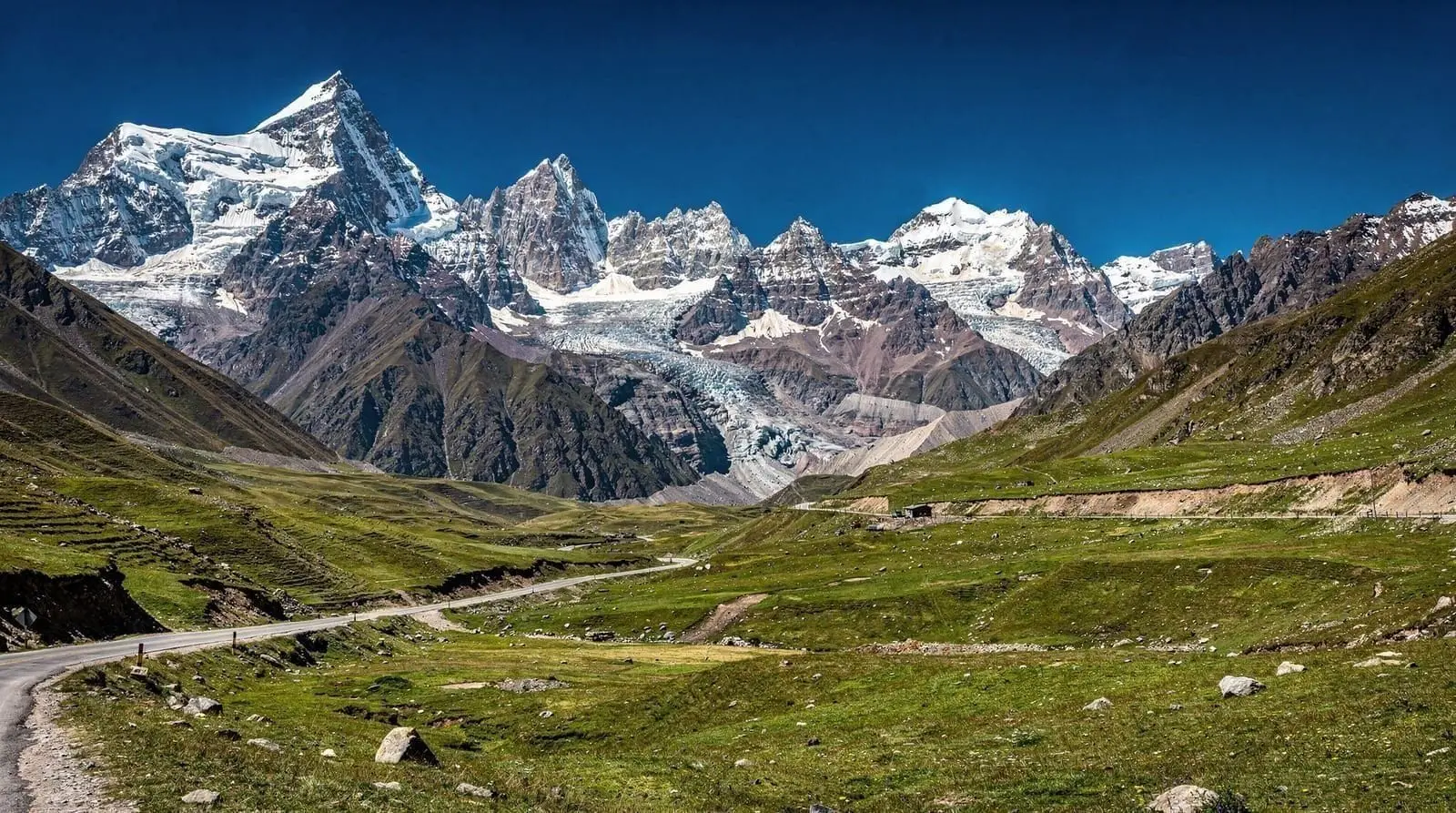
Huaraz complete guide: planning the Cordillera Blanca
From Huaraz: Full-Day Laguna 69 in Cordillera Blanca
How many days do you need in Huaraz?
Plan five to seven days minimum. Two are eaten by acclimatisation before you can safely hike high, then one or two for Laguna 69 and Llanganuco, one for Pastoruri or Parón, and one for Chavín de Huántar. Trekkers doing Santa Cruz should add four more.
Why people come here, and what they get wrong
Huaraz is the kind of place that rewards a certain type of traveller and quietly punishes the unprepared. People come for the Cordillera Blanca, the white range that runs roughly 180 km through Peru’s Ancash region and holds 27 peaks above 6,000 m, including Huascarán at 6,768 m, the highest mountain in the country. They come for glacial lakes the colour of antifreeze, for multi-day treks that rank among the finest in South America, and for pre-Inca ruins older than the pyramids of Giza by some reckonings.
What they get wrong, almost universally, is the altitude. The town sits at 3,050 m. The famous day hike to Laguna 69 finishes at 4,600 m. Pastoruri Glacier involves walking above 5,000 m. The gap between arriving from sea-level Lima and standing at one of these lakes is measured in days, not hours, and ignoring that gap is how the headaches, vomiting, and occasional medical evacuations happen. This guide is built around that reality. Everything else here, the costs, the tours, the logistics, is downstream of getting the altitude right.
If you treat Huaraz as a checklist of lakes to bag in 48 hours, you will have a bad and possibly dangerous trip. If you treat it as a week-long base camp, pacing yourself upward, it is one of the great mountain destinations on earth.
| Where | Callejón de Huaylas valley, Ancash region, 400 km north of Lima |
| Getting there | Overnight bus from Lima, 8–9 hrs, around S/70–130 ($19–35) |
| Time needed | 5–7 days minimum (2 for acclimatisation) |
| Cost/day | Around S/120–180 ($32–48) budget; S/350+ for private/guided treks |
| Best time | Dry season, May–September |
Getting to Huaraz
Huaraz lies about 400 km north of Lima, and for practical purposes the only way in is by road. The standard approach is an overnight bus. The reputable operators are Cruz del Sur, Movil Tours, and Oltursa, departing from Lima’s main terminals in the evening and arriving at dawn. The journey takes eight to nine hours and costs roughly S/70 to S/130 (about $19 to $35 USD) depending on whether you take a standard seat, a reclining semi-cama, or a near-flat cama bed. For a first trip to altitude, the extra S/40 for a cama is money well spent: you arrive more rested, which helps your body cope.
There is no commercial airport in Huaraz. A small airstrip at Anta, 20 km north, occasionally sees charter flights but nothing scheduled and nothing you can rely on. Day buses also run from Lima if you would rather see the scenery on the climb up the Callejón de Huaylas valley, though most travellers prefer the overnight to save a day.
Once you are in Huaraz, getting around to the trailheads is straightforward. Tour agencies cluster along Jirón Luzuriaga and run daily vans to the main sites. Shared combis (minibuses) to the Llanganuco valley cost around S/10 to S/15 each way and are far cheaper than a tour, but they leave you to sort out park fees and timing yourself.
The acclimatisation problem, explained properly
Let me be blunt, because the agencies in town will not be. If you step off the overnight bus, eat breakfast, and board a van to Laguna 69 the same morning, you are gambling with acute mountain sickness at 4,600 m, where it can stop being a headache and become an emergency. The operators do not screen you. They will sell the trip to anyone with cash. The responsibility to say “I arrived yesterday, I should wait” is entirely yours.
The honest minimum is two full nights in Huaraz before any high hike, and three is meaningfully safer. Spend those days active but gentle. On your first full day, walk up to the mirador above town at around 3,400 m for a preview of the peaks. On day two, do something at the 3,800 m to 4,000 m band, the Llanganuco Lakes or the Laguna Churup hike. Each step nudges your body upward without the brutal jump straight to 4,600 m. By day three or four, a healthy adult is usually ready for Laguna 69.
Acetazolamide, sold as Diamox, is available over the counter at Huaraz pharmacies and helps many people acclimatise faster; if you have any history of altitude trouble, consider starting it the day before you arrive. Coca tea is everywhere and mildly helpful. Drink far more water than feels natural, skip alcohol the first few nights, and learn the warning signs: a headache that painkillers will not touch, repeated vomiting, confusion, or loss of coordination all mean descend now. For the full protocol, read the Huaraz acclimatisation guide before you book anything.
The day hikes, ranked by what they ask of you
Huaraz offers a natural ladder of hikes, and climbing it in order is also the smart acclimatisation strategy.
The gentlest entry is the Llanganuco Lakes, Chinancocha and Orconcocha, at around 3,850 m. You can walk the lakeshore with almost no ascent, which makes this the ideal day-two outing. See the Llanganuco Lakes guide for the full picture.
Llanganuco Lakes full-day tour from HuarazA step up is Laguna Churup, a steeper half-day climb to about 4,450 m that includes a short scramble with a fixed rope near the top. It is a genuine acclimatisation hike and far quieter than the headline lakes.
The signature outing is Laguna 69, a 14 km round trip with roughly 700 m of gain, finishing at 4,600 m. It is demanding but not technical, a relentless walk rather than a climb. Do not attempt it until you are properly acclimatised; the Laguna 69 complete guide and the day-hike tips cover the difficulty and logistics in detail.
Full-day Laguna 69 tour from HuarazHigher still is the Pastoruri Glacier, reached by vehicle to a car park near 5,000 m with a short walk to the ice at around 5,200 m. The altitude here is unforgiving, so save it for late in your stay. The route doubles as a sobering climate-change lesson, covered in the Pastoruri glacier guide.
The most photogenic lake, and the quietest of the big three, is Laguna Parón above Caraz at 4,185 m, the largest in the range. The Laguna Parón guide explains why it is worth the rough access road.
For travellers who want more than a day hike, the guided climb of Nevado Mateo in the Cordillera Blanca is a genuine technical peak ascent, not a walk — go with a certified mountain guide and only after several acclimatisation days.
The multi-day treks
If you have the time and the legs, the multi-day treks are the real reason serious hikers come to Huaraz. The classic is the Santa Cruz trek, a four-day circuit through the Llanganuco valley that crosses the Punta Unión pass at 4,750 m beneath a wall of glaciated peaks. It is achievable for fit, well-acclimatised hikers but is not a beginner route, and hiring a guide with arrieros (mule handlers) is both sensible and supports local communities.
Santa Cruz trek 4-day guided tourA far harder undertaking is the Huayhuash circuit in the neighbouring range to the south, an eight-to-ten-day loop that is one of the most spectacular high-altitude treks anywhere and demands real experience and fitness. Both routes need solid prior acclimatisation, which is another argument for doing the day hikes first.
Costs: what a week actually adds up to
Huaraz is inexpensive by Peruvian standards. A bed in a guesthouse around Jirón Sucre or Jirón José de la Mar runs S/40 to S/80 (about $11 to $22 USD) a night; better-equipped hotels start around S/200. Hearty Andean meals near the Mercado Central, trout, chicharrón, soups, cost S/10 to S/20. A group day tour to the lakes is roughly S/50 to S/80 per person, plus the Huascarán National Park fee of S/30 per day, or S/150 for a multi-day pass if you are hitting several park sectors.
Add it up and a careful budget traveller can run on S/120 to S/180 a day (about $32 to $48 USD). Private transport, mid-range hotels, and guided multi-day treks push that well above S/350 a day. Bring cash: ATMs exist in town but the trailheads and small Andean towns do not take cards.
A realistic week-long plan
Two days is the bare minimum and barely scratches the surface. A more honest plan looks like this. Day one: arrive, rest, walk the town and the central market, sleep early. Day two: mirador hike and the Museo Regional Ancash. Day three: Llanganuco Lakes or Laguna Churup as a graded step up. Day four: Laguna 69, now that you are acclimatised. Day five: Pastoruri Glacier or Laguna Parón. Day six: Chavín de Huántar, the pre-Inca ceremonial centre across the range. Day seven: a slow day, gear shopping, or a buffer for weather.
Laguna Parón full-day tour from HuarazTrekkers should slot the four-day Santa Cruz circuit in after the day hikes, treating Laguna 69 and Churup as warm-ups. For how Huaraz fits into a wider route, see the north vs south Peru comparison and the 2-week Peru itinerary. Huaraz also pairs naturally with Trujillo on the north coast for a combined mountains-and-coast loop, and you can browse bookable trips on the tours page.
Where to base yourself, and where to eat
Huaraz town is the default base and the most practical one: it has the widest choice of accommodation, the most tour agencies, the gear-rental shops, and the bus connections. The budget and mid-range zone clusters around Jirón Sucre and Jirón José de la Mar in the centre, within walking distance of the agencies on Jirón Luzuriaga and the Plaza de Armas. Guesthouses run S/40 to S/80 (about $11 to $22 USD) a night, with better-equipped hotels from S/200. If you want quieter nights and a slightly lower-altitude base for acclimatisation, Caraz, 67 km north at 2,250 m, is an increasingly popular alternative, calmer and warmer, and closer to the northern attractions like Laguna Parón.
On food, Huaraz punches above its plain appearance. For cheap, authentic Andean cooking, head to the area around the Mercado Central, where local restaurants serve trout (trucha) from the nearby rivers, chicharrón, and hearty soups for S/10 to S/20 a plate. For the trekker-oriented scene, the streets near the Plaza de Armas have cafés and restaurants doing everything from proper espresso and banana pancakes to pizza and craft beer, a welcome change after days of trail food. Cafe Andino, a long-running travellers’ hub, is a reliable spot for information, book-swapping, and a decent breakfast. Wherever you eat, drink bottled or purified water and ease into the rich local food gently while you are still adjusting to the altitude.
Practical odds and ends
Gear rental. Agencies around Jirón Luzuriaga rent poles, sleeping bags, crampons, and tents. Quality is uneven, so inspect everything before paying. A basic bag and mat run S/20 to S/30 a day.
Eating well. Beyond the cheap market food, the streets near the Plaza de Armas have cafés geared to the trekking crowd, with the predictable banana pancakes and decent coffee. Try the local trout (trucha) at least once.
Health. The regional hospital in Huaraz has real experience with altitude emergencies, which is reassuring. Travel insurance that covers high-altitude trekking and emergency evacuation is genuinely worth it here, not a box-ticking exercise.
Seasonality. Huaraz hosts the Semana del Andinismo, an international mountaineering festival, in late June, a lively time to be in town if the climbing culture interests you, though accommodation tightens.
Choosing an agency: how to tell serious from sketchy
Huaraz has dozens of trekking and tour agencies, and their quality ranges from genuinely professional outfits with certified mountain guides to fly-by-night operations that subcontract everything and cut corners on safety. For a flat day trip to the lakes, the stakes are low and the cheapest reputable option is fine; the scenery does the work and the trails are well-marked. For multi-day treks, technical climbs, or anything involving high passes and overnight camping, the choice of operator matters enormously.
A few markers separate the serious from the sketchy. Established agencies will employ guides certified by the relevant Peruvian or international mountain-guiding associations and will be able to tell you so by name; vague answers are a red flag. Ask concrete questions: what is the group size, who is the actual guide, what is the emergency plan, and is there acclimatisation built into the itinerary? An operator that promises to take you up Laguna 69 on your arrival day, or that brushes off altitude concerns, is telling you it prioritises sales over safety, and you should walk away.
For treks, confirm that the price includes the park fees, the arrieros and mules, and proper food, because the rock-bottom quotes often quietly omit these. Reading recent independent reviews and talking to other travellers in town, at places like Cafe Andino, is worth more than any glossy office front. The cheapest tour is sometimes a false economy paid for in misery or, on the high routes, in genuine risk.
Month by month: when to go
The dry season is not a soft suggestion in Huaraz, it is the difference between a hike that happens and a road that is closed by a landslide. Here is how the year breaks down.
| Months | Conditions | Verdict |
|---|---|---|
| May–June | Clear skies settling in, trails drying out, fewer crowds than peak | Excellent, slightly quieter than July–August |
| July–August | Peak dry season, best visibility, busiest trails and agencies | Best for photos and reliable weather, book ahead |
| September | Dry season tailing off, still mostly clear | Very good, thinner crowds |
| October–November | Transition, afternoon cloud building, occasional rain | Workable for day hikes, riskier for multi-day treks |
| December–March | Wet season, cloud cover, mud, landslide risk on access roads | Avoid multi-day treks; day hikes possible but unreliable |
| April | Trails drying, weather improving | Good gamble for an early-season visit |
If your dates are fixed and fall in the wet season, do not plan the Santa Cruz or Huayhuash treks around them; stick to the shorter day hikes near town and treat the trip as a scaled-back preview rather than the full Cordillera Blanca experience. The best day hikes in Huaraz guide ranks which outings still make sense outside the dry months.
Santa Cruz and the multi-day treks in more depth
The Santa Cruz trek guide covers logistics day by day, but the shape of it is this: four days, roughly 50 km, camping each night with mules carrying the heavy gear, crossing Punta Unión at 4,750 m on day two or three depending on the direction you walk it. Most agencies run it counter-clockwise from Cashapampa, which front-loads the climbing and saves the gentler descent through Santa Cruz valley for tired legs. Expect to pay considerably more than a day tour, since the price covers camping equipment, a cook, arrieros, mules, and multiple park-fee days; budget operators that undercut everyone else on this trek are the ones most likely to skimp on food quality or guide experience.
For those with two weeks and serious fitness, the Huayhuash circuit is the step up: eight to ten days, higher passes, more remote terrain, and a real commitment in gear and conditioning. It is not a natural extension of a Huaraz week trip, it is closer to a dedicated expedition, and first-time high-altitude trekkers should do at least one shorter Cordillera Blanca trek before attempting it.
How Huaraz compares to Cusco, and where it fits in Peru
Many travellers planning a Peru trip find themselves choosing between Huaraz and the Cusco region as their main mountain experience, and the honest answer is that they serve different appetites. Cusco and the Sacred Valley offer Inca history, accessible scenery, the world-famous Machu Picchu, and a deep tourist infrastructure that makes everything easy.
Huaraz offers raw, high-altitude mountain wilderness, the best trekking in the country, and a fraction of the crowds, but with rougher edges and a steeper acclimatisation curve. If your priority is ruins, culture, and a smooth experience, Cusco wins. If it is mountains, lakes, glaciers, and serious hiking, Huaraz is unmatched in Peru. Travellers with time do both, treating them as complementary rather than competing, though they sit at opposite ends of the country and a connection runs through Lima.
Within a broader route, Huaraz pairs most logically with the north rather than the south. From Huaraz you can continue to the north coast, Trujillo with Chan Chan and the Moche pyramids, and Chiclayo, forming a northern Peru circuit that sees a fraction of the gringo-trail traffic. The north vs south Peru guide weighs this trade-off in full, and the 2-week Peru itinerary shows how to thread Huaraz into a wider trip without backtracking endlessly through Lima.
For a head-to-head on the hiking itself, the Huaraz vs Cusco for hiking guide goes further than this section can. If you want a ready-made week that sequences the acclimatisation and the treks for you, the Cordillera Blanca week itinerary lays out day by day where this guide only summarises. And for a first-person account of what the Laguna 69 day actually feels like at altitude, the Laguna 69 diary is worth reading before you book.
Frequently asked questions about Huaraz complete guide: planning the Cordillera Blanca
Is Huaraz worth visiting?
How do I get from Lima to Huaraz?
Do I need to acclimatise before hiking in Huaraz?
Is Huaraz safe for tourists?
How much does a week in Huaraz cost?
When is the best time to visit Huaraz?
Do I need a guide to hike to Laguna 69?
Is Huaraz better than Cusco for trekking?
Top experiences
Bookable activities with verified prices and instant confirmation on GetYourGuide.

