Huaraz vs Cusco for hiking: which base should you choose?
Huaraz: Santa Cruz Trek 4-Day Guided Tour
Is Huaraz or Cusco better for hiking?
Huaraz offers higher, wilder, less crowded mountain trekking with no permit caps and lower costs, but no world-famous ruin at the end. Cusco offers the Inca Trail and Salkantay routes that finish at Machu Picchu, with more infrastructure but heavier crowds, permit limits, and higher prices. Pick Huaraz for pure mountain scenery, Cusco for history-plus-hiking.
The question almost every Peru hiker eventually asks
If you are coming to Peru to hike, and you do not have unlimited time, you will probably have to choose between two regions: the Cordillera Blanca around Huaraz in the north-central highlands, and the Inca heartland around Cusco in the south. Both are world-class. They are also genuinely different experiences, and the marketing rarely tells you so honestly because Cusco’s tourism machine is vastly larger and louder.
The short version: Huaraz is for people who come for the mountains themselves — glacial lakes, 6,000 m peaks, big remote treks, fewer crowds, lower prices. Cusco is for people who want hiking and the historical payoff of arriving at Machu Picchu on foot, with the trade-offs of permit caps, crowds, and higher cost. Neither is “better”; they suit different travellers. This guide compares them across the factors that actually decide it.
| Factor | Huaraz | Cusco |
|---|---|---|
| Signature trek | Santa Cruz (4 days) / Huayhuash (8–10 days) | Inca Trail (4 days) / Salkantay (4–5 days) |
| Permit cap | None | Inca Trail: strict daily cap, months ahead |
| Guided 4-day trek cost | Around S/650–1,000 ($175–270) | $600–900+ (Inca Trail), $250–500 (Salkantay) |
| Access | Overnight bus from Lima, no airport | Direct flights from Lima (~1h20) |
| Crowds | Light to moderate | Heavy, especially the Inca Trail |
| Payoff at the end | Glacial lake or high pass | Machu Picchu |
Scenery: alpine drama vs Inca landscape
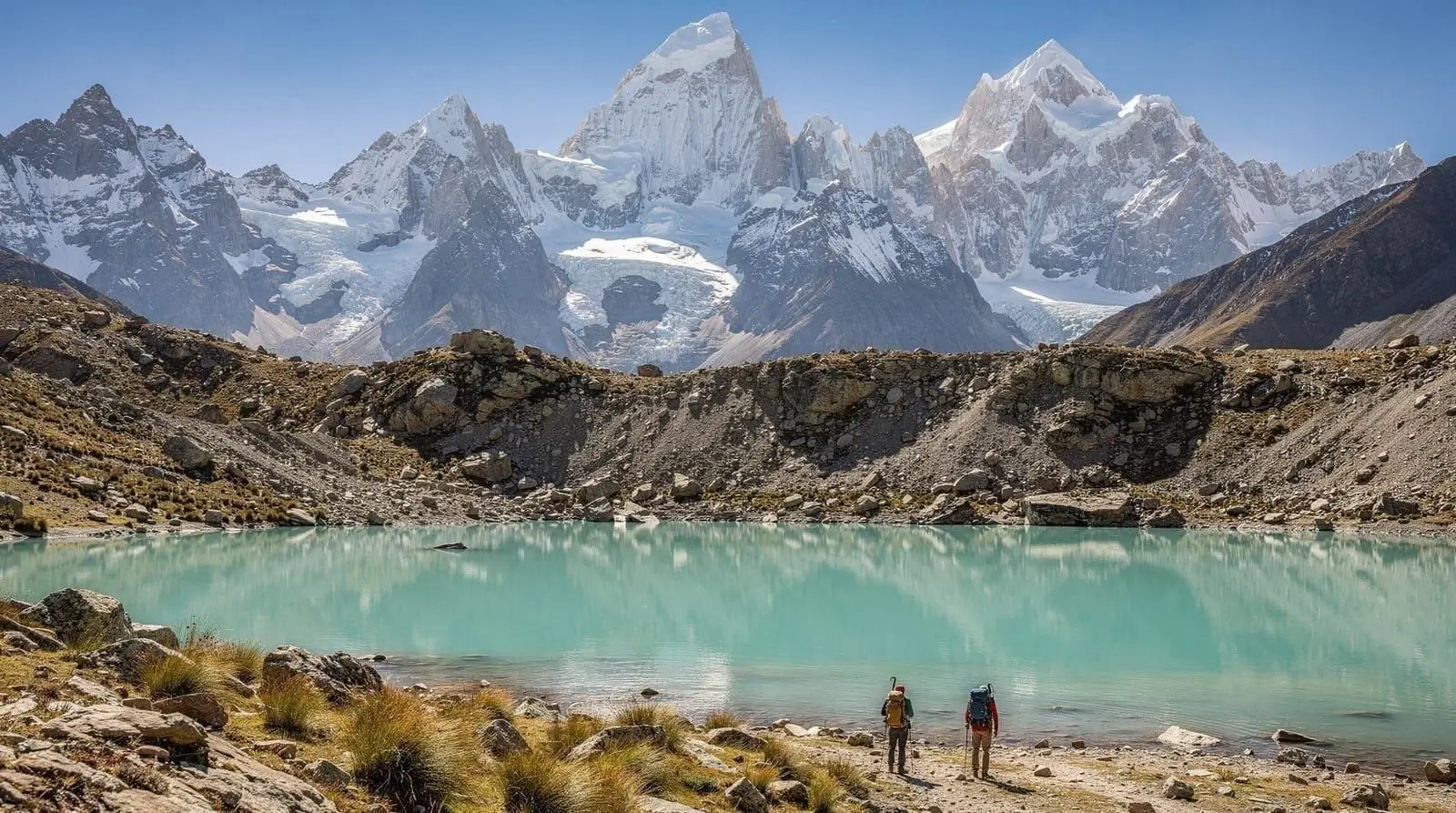
Huaraz / Cordillera Blanca. This is the more spectacular range in pure mountaineering terms. You are surrounded by a wall of glaciated 6,000 m peaks — Huascarán (6,768 m, Peru’s highest), Alpamayo, Artesonraju, Chacraraju — and the valleys hold turquoise glacial lakes of almost unreal colour. The scenery is alpine, raw, and immense. Treks like Santa Cruz and Huayhuash walk you straight into the heart of it. If your idea of a great trek is high peaks and glacial lakes, Huaraz wins decisively.
Cusco / Inca heartland. The landscape is gentler in the high valleys but punctuated by something Huaraz cannot offer: Inca ruins woven into the terrain, culminating in Machu Picchu. The Salkantay route adds a genuine high-mountain section beneath the Salkantay peak (6,271 m), so it is not all gentle. But the defining quality is the marriage of landscape and archaeology. The reward at the end is not just a view — it is one of the most famous sites on earth.
The marquee treks compared
Around Huaraz
- Santa Cruz trek — 4 days, ~50 km, one pass at 4,750 m. The classic Cordillera Blanca trek. Non-technical, demanding mainly because of altitude. No permit cap.
- Huayhuash circuit — 8–10 days, 110–130 km, multiple passes near or above 4,800 m. One of the hardest non-technical treks anywhere; remote and committing. See the Huayhuash circuit guide.
- Day hikes — Laguna 69 (4,600 m), Laguna Churup, Llanganuco, Laguna Parón. World-class single days. See the best day hikes near Huaraz.
Around Cusco
- Inca Trail — 4 days, ~43 km, Dead Woman’s Pass at 4,215 m, finishing through the Sun Gate to Machu Picchu. Strictly permit-limited (a daily cap, sold out months ahead) and guide-mandatory. See the Inca Trail complete guide for full logistics.
- Salkantay trek — 4–5 days, Salkantay pass at ~4,650 m, ending at Machu Picchu. No permit cap, more rugged, increasingly popular as the Inca Trail alternative; the Inca Trail vs Salkantay guide compares them directly.
- Shorter routes and day options around the Sacred Valley, plus Rainbow Mountain as a single spectacular day hike rather than a multi-day trek.
The structural difference: Huaraz treks have no permit cap and you can usually book a few days ahead, while the Inca Trail requires a permit booked months in advance and is capped daily. Salkantay sits in between — no cap, but very popular.
Crowds
This is one of the starkest contrasts. Cusco’s trails are busy, the Inca Trail intensely so in peak season, and the whole region channels enormous tourist volume toward Machu Picchu. Even Salkantay, the “alternative,” sees heavy traffic now.
Huaraz is far quieter. Laguna 69 gets busy on peak-season weekends, but the multi-day treks — especially Huayhuash — can feel genuinely remote, with whole days passing few other groups. If solitude and wildness matter to you, Huaraz is the clear choice.
Difficulty and altitude
Both regions are high, but Huaraz is consistently higher. Huaraz town is 3,050 m; Cusco is 3,400 m, so Cusco actually starts higher and is itself a real acclimatisation challenge. But the trekking altitude tilts toward Huaraz: the Cordillera Blanca treks sleep above 4,000 m repeatedly and cross passes up to 4,750 m, while Huayhuash strings together passes near 4,800 m for days. The Inca Trail’s high point (4,215 m) is lower than any major Huaraz trek pass.
Practically: both demand serious acclimatisation. In Cusco, many travellers acclimatise while sightseeing the city and Sacred Valley before trekking. In Huaraz, you acclimatise with progressive day hikes — see the Huaraz acclimatisation guide. The Huayhuash circuit is the most physically demanding option in either region by a wide margin.
Access and logistics
Cusco has a major airport with frequent flights from Lima (about 1h20). It is the better-connected, more infrastructure-rich base, with abundant English-speaking agencies, gear shops, and comforts. Reaching the trailheads is straightforward.
Huaraz has no commercial airport. The standard approach is an overnight bus from Lima (8–9 hours), covered in the Peru bus travel guide. The town has plenty of trekking agencies and gear rental but less polish and fewer comforts than Cusco. For some travellers the harder access is a feature — it filters out casual crowds.
Cost
Huaraz is cheaper across the board. Guided day hikes, multi-day treks, accommodation, food, and gear rental all cost less than their Cusco equivalents.
- Huaraz Santa Cruz trek (guided, 4 days): roughly S/650–1,000 ($175–270 USD).
- Cusco Inca Trail (guided, 4 days): typically $600–900+ USD, far more, driven by permits, mandatory guides, and porters.
- Cusco Salkantay (guided, 4–5 days): roughly $250–500 USD, cheaper than the Inca Trail but still above Huaraz prices.
Day hikes near Huaraz commonly run S/50–110 ($14–30 USD); Cusco’s equivalents and the Machu Picchu logistics push costs higher.
Booking and lead time: a practical difference
The way you book each region differs enough to affect your trip planning. The Inca Trail near Cusco is the strictest: the government caps the number of trekkers who can start each day, and permits — which include your mandatory guide — routinely sell out three to six months ahead, more for peak-season dates. If your heart is set on the classic Inca Trail, you essentially have to plan your whole trip around securing a permit early. The Salkantay alternative has no permit cap, so it can be booked closer to your travel dates, though good operators fill up in high season.
Huaraz is far more relaxed. There is no daily cap on any of the treks, and you can arrive in town and book a Santa Cruz trek to leave in a couple of days, or a Huayhuash circuit with a week’s notice. That flexibility suits travellers who like to keep plans loose or wait for a good weather window. The trade-off is that vetting an operator on the ground takes effort, whereas booking ahead online lets you compare credentials calmly. Either way, Huaraz rewards the spontaneous traveller in a way the Inca Trail never will.
Who should choose which
Choose Huaraz if you:
- Come primarily for mountain scenery, glacial lakes, and big-range trekking
- Want fewer crowds and a wilder feel
- Are on a tighter budget
- Want the flexibility to book treks a few days ahead
- Are an experienced or ambitious hiker eyeing Huayhuash
- Don’t mind skipping a world-famous ruin at the end
Choose Cusco if you:
- Want to combine hiking with the historical climax of Machu Picchu
- Prefer better infrastructure, flights, and comforts
- Are happy to book the Inca Trail months ahead (or take Salkantay instead)
- Want one region that also delivers Sacred Valley sights, food, and culture
- Don’t mind the crowds and higher prices that come with all of the above
Or do both. Many travellers with three weeks combine them. The north vs south Peru comparison and the Peru 2-week itinerary guide help you decide whether to combine or focus, given your time.
Weather and season: the windows overlap but differ
Both regions share the broad Andean pattern of a dry season (roughly May–September) and a wet season (October–April), and both are best hiked in the dry months. But the details differ. The Cordillera Blanca has a sharply defined dry season with very reliable clear weather from June to August — the trade-off is that the headline trails get their heaviest crowds then.
Around Cusco, the dry season is similarly the prime window, but the climate is a touch milder and the shoulder months can be more forgiving for sightseeing even when trekking is riskier. In both regions the wet season brings real hazards: cloud that erases the views, rain that turns trails to mud, and landslides that close access roads. If your trip falls in the shoulder months, Cusco’s lower-altitude sights remain enjoyable in marginal weather, whereas a Huaraz trip that is all about the mountains can be largely wasted by a bad-weather week.
Wildlife and landscape character
The two regions also differ in what you see along the way. The Cordillera Blanca is high alpine: glaciers, moraine, turquoise lakes, hardy puna grassland, the occasional viscacha (a rabbit-like rodent) on the rocks, soaring caracaras, and the surreal giant Puya raimondii bromeliads on the Pastoruri route. It is a landscape of rock, ice, and water.
The Cusco routes pass through more varied terrain — high passes, but also cloud-forest sections on the lower Inca Trail and Salkantay, with orchids, hummingbirds, and lusher vegetation as you descend toward Machu Picchu, plus the ever-present Inca stonework. If you want stark high-mountain grandeur, Huaraz; if you want a landscape that shifts from alpine to cloud forest with archaeology threaded through it, Cusco.
A note on honesty
If you read forum threads, you will see seasoned trekkers say the Cordillera Blanca is more beautiful than anything around Cusco — and on raw mountain grandeur, that view is hard to argue with. But “more beautiful mountains” is not the only metric. The Inca Trail’s value is the experience of walking an ancient stone road to Machu Picchu, and no amount of Cordillera Blanca scenery replaces that if history is what moves you. Be honest with yourself about why you came to Peru, and the choice usually becomes obvious.
Beyond the trails: what each base offers off the trail
Hiking is rarely the whole trip, so it is worth weighing what each base gives you between or instead of treks.
Cusco is a destination in its own right — a beautiful colonial city built on Inca foundations, with the Sacred Valley (Pisac, Ollantaytambo, the salt pans of Maras), strong restaurant and café scenes, abundant nightlife, and a deep well of cultural sights. If your companions are not all keen hikers, Cusco keeps everyone occupied. It is also the springboard for Rainbow Mountain, the Amazon at Puerto Maldonado, and Lake Titicaca. Even non-hikers in your group will want the full Machu Picchu complete guide to plan the visit itself, separate from whichever trek gets you there.
Huaraz, by contrast, is functional rather than charming — rebuilt after the 1970 earthquake, it is a trekking town first and a tourist town a distant second. Off the trail there is the regional Ancash museum, the markets, and day trips to Chavín de Huántar, but the city itself is not why you come. If non-hikers are in your group, Huaraz offers them less. The flip side is authenticity: it feels like a working Andean town, not a place reshaped around tourism.
Combining the two without burning out
If you decide to do both regions, sequencing matters. Acclimatising in one set of highlands carries over partially to the other, so you save adaptation time by not dropping to sea level for long in between — though the only way between them is via Lima, which is sea level. A common pattern is to start in Cusco (flying in, acclimatising while sightseeing, then trekking to Machu Picchu), return through Lima, and continue by overnight bus to Huaraz for a Cordillera Blanca trek, treating the few low-altitude days in Lima as rest rather than full de-acclimatisation.
Build a buffer day or two for the long transits and for weather. The Peru 2-week itinerary guide lays out workable combinations, and the north vs south Peru comparison frames the wider regional choice if your trip extends beyond hiking.
Frequently asked questions about Huaraz vs Cusco for hiking
Is Huaraz or Cusco better for trekking?
Huaraz offers higher, wilder, less crowded treks through glaciated mountains with no permit caps and lower costs, but no famous ruin at the end. Cusco offers the Inca Trail and Salkantay finishing at Machu Picchu, with more infrastructure but heavier crowds, permit limits, and higher prices. Choose based on whether you prioritise mountain scenery or history-plus-hiking.
Which region has better mountain scenery, Huaraz or Cusco?
For pure alpine grandeur — glaciated 6,000 m peaks and turquoise glacial lakes — the Cordillera Blanca around Huaraz is widely considered more spectacular. Cusco’s strength is the combination of landscape with Inca ruins and the Machu Picchu finish rather than raw mountain drama.
Is Huaraz cheaper than Cusco for hiking?
Yes, across the board. A guided 4-day Santa Cruz trek from Huaraz runs roughly S/650–1,000 ($175–270 USD), while the Cusco Inca Trail typically costs $600–900+ USD. Accommodation, food, day hikes, and gear rental are all cheaper in Huaraz.
Do I need permits to hike near Huaraz?
No daily permit cap applies to Huaraz treks; you pay the Huascarán National Park entry fee (around S/150 for a multi-day pass) and some Huayhuash village fees, but there is no advance-booking lottery. The Inca Trail near Cusco, by contrast, has a strict daily cap that sells out months ahead.
Which is higher, Huaraz or Cusco?
Cusco town (3,400 m) is slightly higher than Huaraz town (3,050 m), so Cusco is itself a real acclimatisation challenge. However, the trekking around Huaraz reaches higher — passes up to 4,750 m and Huayhuash near 4,800 m — than the Inca Trail’s high point of 4,215 m.
Can I hike both Huaraz and Cusco in one trip?
Yes, if you have around three weeks. Many travellers combine a Cordillera Blanca trek from Huaraz with the Inca heartland around Cusco. With only two weeks, it is usually better to focus on one region; see the Peru 2-week itinerary guide to plan.
Which is better for first-time high-altitude hikers?
Both demand acclimatisation, but Cusco’s infrastructure and the option of acclimatising while sightseeing make it slightly gentler for newcomers, with the moderate Inca Trail as a goal. Huaraz suits hikers comfortable with a more self-directed acclimatisation routine and higher trekking altitudes.
Can I do Rainbow Mountain instead of a multi-day trek?
Yes. Rainbow Mountain near Cusco is a single demanding day hike rather than a multi-day commitment, reaching over 5,000 m without camping. It suits travellers who want a high-altitude highlight without the time or gear investment of Santa Cruz, Huayhuash, the Inca Trail, or Salkantay.
Does Lake Titicaca fit into either trekking trip?
Lake Titicaca sits south of Cusco and is usually added on rather than combined with serious trekking days, since it involves its own overland or flight leg to Puno. Most travellers treat Lake Titicaca as a separate stop before or after a Cusco-based trek, not a hiking destination itself.