Best day hikes near Huaraz: a graded guide to the Cordillera Blanca
From Huaraz: Full-Day Laguna 69 in Cordillera Blanca
What are the best day hikes from Huaraz?
The standout day hikes near Huaraz are Laguna 69 (4,600 m, the signature climb), Laguna Churup (4,450 m, steep), the Llanganuco Lakes (3,850 m, easy), Laguna Parón (4,185 m, dramatic and quieter), and Pastoruri Glacier (5,000 m+, minimal walking). Acclimatise before tackling the higher ones.
How to use this guide
Huaraz is one of the great day-hiking bases in the world: from a single town you can reach turquoise glacial lakes, a retreating glacier, and dramatic high valleys, all as out-and-back day trips. But these hikes are not interchangeable. They range from a near-flat lakeshore stroll to a lung-busting climb to 4,600 m, and doing them in the wrong order — or before you have acclimatised — is how people end up sick on the trail.
This guide grades the best day hikes by difficulty and altitude, so you can sequence them sensibly. The cardinal rule: acclimatise first. Huaraz sits at 3,050 m and most of these hikes go well above 4,000 m. Spend at least two to three days adapting before the hard ones, and read the Huaraz acclimatisation guide before you book. A logical progression is to start with the easy lake valleys, build up over a couple of days, and save Laguna 69 or Laguna Churup for once you feel strong.
Almost all of these are done as organised day trips from Huaraz, because the trailheads are an hour or more away by road and the early starts are hard to arrange independently. Where relevant, note that access to several runs through Huascarán National Park, which charges an entry fee of around S/30 per day or S/150 for a multi-day pass — usually not included in tour prices, so budget for it.
| Where | Huascarán National Park, Cordillera Blanca, near Huaraz |
| Cost | S/40–110 per tour, plus S/30/day or S/150 multi-day park fee |
| Time needed | 4–10 hours per hike, most as full-day trips |
| Getting there | Organised van tour (default) or combi/colectivo for some |
| Best time | Dry season, May–September |
At a glance: all the hikes compared
| Hike | Altitude | Distance | Difficulty | Best for |
|---|---|---|---|---|
| Laguna Wilcacocha | ~3,725 m | ~5 km | Easy | First day, gentle warm-up |
| Llanganuco Lakes | ~3,850 m | Minimal | Easy | Second day, families |
| Laguna Parón | ~4,185 m | Varies | Easy–moderate | Drama without crowds |
| Laguna Churup | ~4,450 m | ~6–8 km | Hard (steep) | Trek-training, quieter route |
| Laguna 69 | ~4,600 m | 14 km | Hard (altitude) | The headline experience |
| Pastoruri Glacier | 5,000 m+ | 1–2 km | Easy underfoot, hard on altitude | Late in your stay |
Easy: build your altitude base
Llanganuco Lakes (Chinancocha and Orconcocha) — ~3,850 m
The gentlest of the headline excursions and an ideal early-acclimatisation day. The two lakes sit in a glacial valley flanked by the Huascarán massif, and you can walk the lakeshore boardwalk and short trails with almost no elevation gain. The water is a deep emerald, and on a clear day the views up to Huascarán and Huandoy are extraordinary.
- Walking: minimal — a flat lakeshore stroll, optional short trails.
- Difficulty: easy.
- Best for: acclimatisation day, families, anyone not yet adapted.
- Cost: day tours run roughly S/40–80 ($11–22 USD) plus the park fee.
The Llanganuco valley is also the road head for the Santa Cruz trek, so the drive doubles as a preview of the trekking country. See the Llanganuco Lakes destination page for more.
Pastoruri Glacier — car park ~5,000 m, glacier viewpoint higher
This is an odd one to grade: the walking is short and easy (a gentle 1–2 km path from the car park to the glacier viewpoint), but the altitude is the highest of any day trip here, topping 5,000 m. That makes it deceptively hard — short distance, thin air. It should not be your first or second day despite the easy walking. The glacier has retreated dramatically — by roughly half since the 1980s — so the trip doubles as a stark climate lesson. The drive also passes stands of the giant Puya raimondii bromeliad.
- Walking: short and gentle, but at extreme altitude.
- Difficulty: easy underfoot, demanding because of altitude.
- Best for: later in your stay, once acclimatised; those wanting a high glacier with little hiking.
- Cost: day tours roughly S/50–90 ($14–24 USD) plus park fee.
Moderate: stepping up
Laguna Parón — ~4,185 m
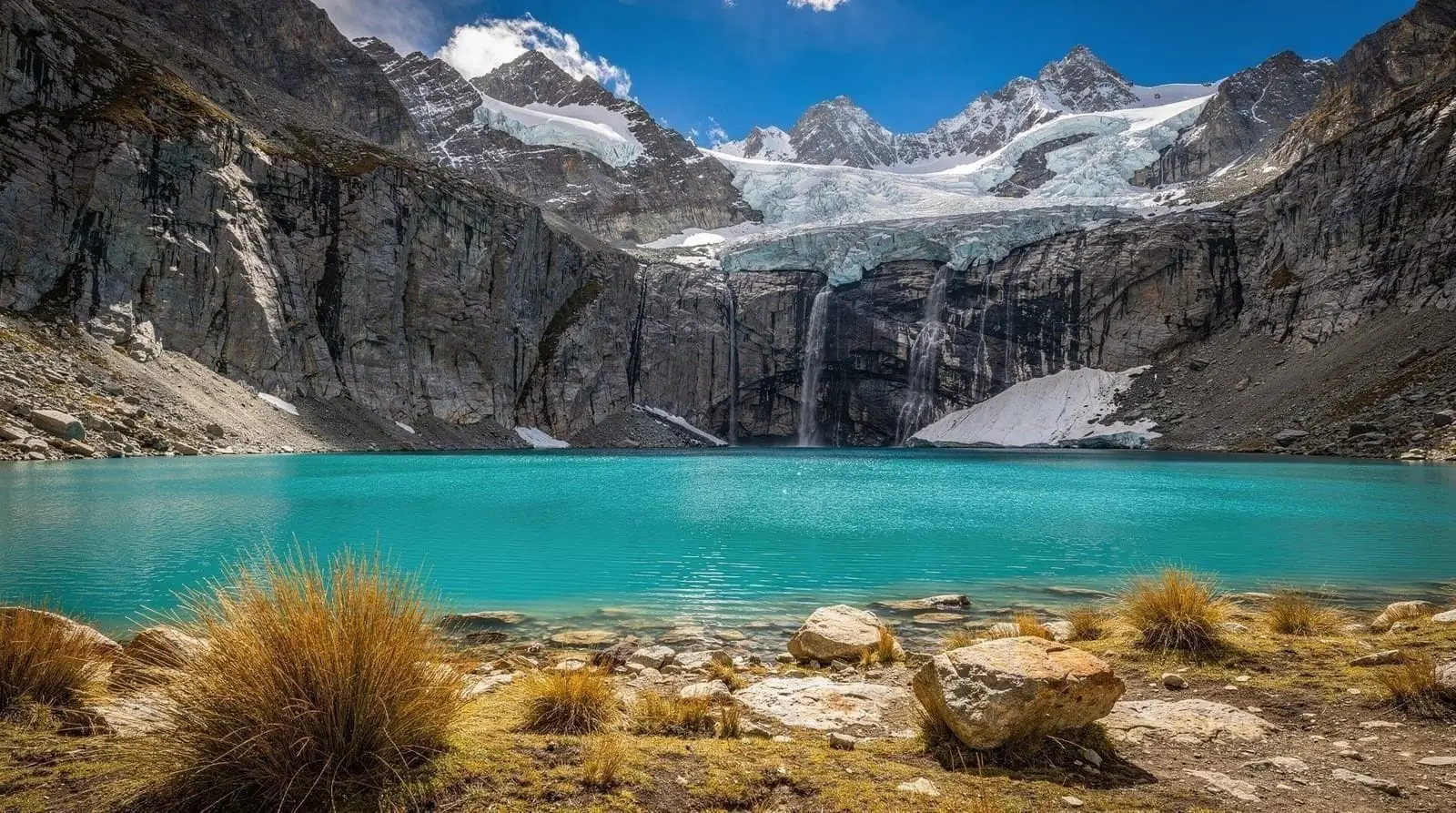
The largest lake in the Cordillera Blanca and, for many, more beautiful than Laguna 69 — and considerably quieter. A semicircle of glaciated peaks, including Artesonraju (said to have inspired the Paramount Pictures logo), rings the deep-blue water. From the car park you can simply enjoy the lakeshore, or climb the Mirador de Parón trail for the classic elevated view — a steepish hour or so up.
- Walking: lakeshore is easy; the mirador climb is a moderate 1–1.5 hour ascent.
- Difficulty: easy to moderate depending on whether you do the viewpoint.
- Best for: travellers wanting drama without Laguna 69’s crowds.
- Cost: day tours roughly S/60–100 ($16–27 USD); the lake is above Caraz, about 67 km north of Huaraz.
Hard: the signature climbs
Laguna 69 — ~4,600 m
The most famous day hike in the region and, for many, the visual highlight of a Peru trip. The trail from the Cebollapampa car park is 14 km round trip with about 600 m of gain, finishing at the impossibly turquoise lake beneath the north face of Chacraraju. There is nothing technical about it — the path is well-marked — but the altitude makes the final climb genuinely hard. Allow five to six hours at altitude pace.
- Walking: 14 km round trip, ~600 m gain, well-marked.
- Difficulty: hard, mainly due to altitude. Do not attempt unacclimatised.
- Best for: acclimatised hikers; the headline experience.
- Cost: day tours roughly S/50–110 ($14–30 USD) plus park fee.
Go early to beat the peak-season weekend crowds, carry plenty of water and sun protection, and pace yourself on the steep final section. See the Laguna 69 destination page for more detail.
Laguna Churup — ~4,450 m
The connoisseur’s choice and a superb acclimatisation hike for trekkers preparing for Santa Cruz or Huayhuash. Churup is shorter than Laguna 69 but steeper, with a scrambly section near the top where a fixed rope and rock steps help you up to the lake basin. It is closer to Huaraz (the trailhead at Pitec is about an hour away), so it makes a flexible day. The reward is a jewel-like lake cupped beneath glaciated walls, usually with far fewer people than Laguna 69.
- Walking: ~6–8 km round trip, steep, with a brief scramble (fixed rope).
- Difficulty: hard — short but steep, with mild scrambling at altitude.
- Best for: acclimatisation before a big trek; hikers who like a steeper, quieter route.
- Cost: day tours roughly S/50–90 ($14–24 USD) plus park fee.
Laguna Wilcacocha — ~3,725 m (the perfect acclimatisation warm-up)
Often overlooked, Laguna Wilcacocha is the ideal first hike in Huaraz — a short, gentle climb on the western (Cordillera Negra) side of the valley, opposite the big peaks. It tops out around 3,725 m, just enough to start your body adapting, and rewards you with one of the best panoramic views of the entire Cordillera Blanca skyline laid out across the valley. The trailhead is a short colectivo ride from Huaraz, the walk up takes one to two hours, and it requires no special fitness. Do this on day two, before anything higher.
- Walking: ~5 km round trip, gentle.
- Difficulty: easy — the gentlest acclimatisation hike.
- Best for: your first or second day; testing how you handle mild altitude.
- Cost: essentially just the colectivo fare (a few soles each way); guided versions are inexpensive.
A suggested sequence
Putting it together, a sensible week of day hikes that respects acclimatisation might look like this:
- Day 1–2: rest in Huaraz; gentle walk to the town mirador (~3,400 m).
- Day 3: Llanganuco Lakes (3,850 m) — easy, builds your base.
- Day 4: Laguna Parón (4,185 m) with the mirador climb.
- Day 5: Laguna 69 (4,600 m) or Laguna Churup (4,450 m).
- Day 6: the other of Laguna 69 / Churup, or Pastoruri (5,000 m+).
This is also the ideal warm-up for the multi-day routes — see the Santa Cruz trek guide and the Huayhuash circuit guide. If you also want the region’s archaeology, slot in a low-strain day to Chavín de Huántar early in the week, as it involves little walking.
Practical tips and honest warnings
- Acclimatise before the hard hikes. Laguna 69, Churup, and Pastoruri all punish unacclimatised visitors. Two to three days minimum in Huaraz first.
- Budget the park fee separately. Most tour prices exclude the Huascarán National Park entry (S/30/day or S/150 multi-day). Carry cash.
- Start early. The headline trails get busy and the weather can deteriorate in the afternoon even in dry season.
- Sun and cold both. UV is fierce at altitude and temperatures swing — bring sunscreen, a hat, sunglasses, and a warm layer plus a rain shell.
- Water and snacks. Carry 2+ litres; there are no reliable supplies on the trails.
- Choose operators with care. The cheapest tours from touts near the bus terminals sometimes cram too many stops into a day or use tired vehicles. A reputable operator and a sensible group size make a real difference.
- Season: the dry months of May to September are the reliable window. The wet season (October–April) brings cloud, rain, and trail and road risks.
- Altitude over distance. None of these hikes is long by lowland standards, but every kilometre at 4,500 m costs far more than at home. Judge difficulty by altitude, not just distance, and pace accordingly.
- Weekends are busiest. Peruvian and regional visitors swell the popular trails, especially Laguna 69, on Saturdays and Sundays in season. Go midweek for emptier paths and car parks.
Independent vs guided: how to actually reach the trailheads
Almost all these hikes are sold as organised day tours, and for most travellers that is the sensible choice — the trailheads sit one to two hours from Huaraz down rough roads, the starts are early, and the shared van removes the logistics. But you do have options.
Organised tour is the default: a van picks you up around dawn, drives to the trailhead, and a guide accompanies the group. You pay a modest premium over raw transport for the convenience and the company. Quality varies, so favour established operators over the cheapest tout.
Combi and colectivo (shared minibus) connections reach some valleys — the Llanganuco area and Caraz (for Laguna Parón) are doable independently — but timing the return can be stressful, and for Laguna 69 the early-start logistics are genuinely hard without a vehicle. This route saves money for confident, flexible travellers.
Private taxi or hire gives you control over timing and pace, useful if you want to start before the tour crowds or linger at a viewpoint. It costs more but split between three or four people can be reasonable, especially for Laguna Parón where an early arrival beats the tour buses.
Whatever you choose, carry cash in soles for the park fee and any local community charges — card payment is not an option at these gates.
What to pack for a Huaraz day hike
Even a single day at altitude demands proper kit. A sensible daypack contains: 2–3 litres of water (there is no reliable resupply on the trails); high-energy snacks; sun protection — high-factor sunscreen, SPF lip balm, a brimmed hat, and proper sunglasses, because UV at 4,500 m is punishing; layers, including a warm mid-layer and a windproof, waterproof shell, since temperatures swing sharply and weather changes fast; trekking poles, which genuinely ease the steep descents on Laguna 69 and Churup; basic first aid and any personal medication, including painkillers for an altitude headache; and cash for fees.
Broken-in boots with grip matter more than fancy gear — the trails are rocky and, on Churup, briefly scrambly.
A note on responsible hiking
The Cordillera Blanca is a fragile high-altitude environment and the lakes draw growing crowds. Carry out all your rubbish — including organic waste, which decomposes painfully slowly at altitude — stay on the established trails to avoid eroding the fragile puna grassland, and never wash or swim in the glacial lakes, which are both sacred to local communities and ecologically delicate. Your park fee funds the upkeep of Huascarán National Park, so paying it properly rather than dodging the gate genuinely matters. Choosing operators who pay fair wages to drivers and guides, and buying food and gear locally in Huaraz, keeps tourism money in the Ancash region that hosts you.
Frequently asked questions about day hikes near Huaraz
What is the best day hike from Huaraz?
Laguna 69 (4,600 m) is the signature day hike and the visual highlight for many visitors, but it is hard and requires acclimatisation. For quieter drama, Laguna Parón is superb; for an easy first day, the Llanganuco Lakes; and for a steeper, less crowded climb, Laguna Churup.
How hard is the Laguna 69 hike?
It is 14 km round trip with about 600 m of elevation gain, finishing at 4,600 m. There is nothing technical, but the altitude makes the final ascent genuinely demanding. Allow five to six hours at a slow pace, and only attempt it once acclimatised.
Which Huaraz day hike is best for acclimatisation?
The Llanganuco Lakes (3,850 m) are ideal early on because the walking is minimal. The next step up is Laguna Parón (4,185 m). Laguna Churup (4,450 m) is a popular harder acclimatisation hike for those preparing for a multi-day trek.
Do I need to acclimatise before hiking near Huaraz?
Yes, for almost all of these. Huaraz sits at 3,050 m and the hikes climb well above 4,000 m. Spend at least two to three days adapting before tackling Laguna 69, Churup, or Pastoruri. See the Huaraz acclimatisation guide for a day-by-day plan.
How much do day hikes from Huaraz cost?
Organised day tours typically run S/40–110 (about $11–30 USD) depending on the destination, plus the Huascarán National Park entry fee of around S/30 per day or S/150 for a multi-day pass, which is usually not included.
Is Pastoruri Glacier worth it?
Yes, if you are acclimatised — the walking is short and easy, but it tops 5,000 m, the highest of the day trips, so it should not be an early-stay outing. The glacier has retreated sharply, making the visit both scenic and a sobering climate lesson, and the drive passes giant Puya raimondii plants.
When is the best time for day hikes near Huaraz?
The dry season from May to September is the reliable window, with clear trails and dependable views; June to August are busiest. The wet season (October to April) brings cloud, rain, and risks of trail closures and landslides on access roads.
Altitude sickness on these hikes
Every hike on this list goes above 3,700 m, and several top 4,500 m — high enough that altitude sickness is a real risk, not a theoretical one. Headache, nausea, and breathlessness beyond what the exertion explains are the warning signs; if they appear, descend rather than push on.
The Huaraz acclimatisation guide covers the day-by-day adaptation plan, and the wider altitude sickness guide, written for Cusco but medically identical at these elevations, explains prevention and treatment in more depth. Be cautious with unregulated “altitude pills” sold by touts — see the altitude medicine scams guide for what is worth buying and what is not.
Huaraz vs Cusco for hiking
Travellers planning a wider Peru trip often ask whether to prioritise Huaraz or the Cusco region for hiking. They are different experiences: Huaraz offers glacial lakes and genuine mountaineering terrain with fewer crowds, while Cusco pairs trekking with Inca ruins and a much larger tourism infrastructure. The Huaraz vs Cusco for hiking guide breaks down the trade-offs in full, and the Huaraz complete guide covers the town itself — where to stay, eat, and arrange tours. If you are building a full week around these hikes, the Huaraz and Cordillera Blanca week itinerary sequences them with rest days already built in.
Multi-day treks these hikes prepare you for
Several of the day hikes on this list double as ideal training for the region’s multi-day treks. Laguna Churup and the higher day hikes are the standard warm-up for the Santa Cruz trek, a 4-day route that passes near Llanganuco, and for the tougher Huayhuash circuit, widely considered one of the best long-distance treks in the Americas. If a day hike leaves you comfortably strong at 4,500 m, you are in reasonable shape to consider the multi-day options; if it leaves you badly winded, spend more days acclimatising before committing to a trek that cannot be shortened once you are out on the trail.
Guides, porters, and going it alone
Most of these hikes can technically be walked without a guide — the trails to Laguna 69, Churup, and the Llanganuco lakes are well-marked and busy enough in season that getting lost is unlikely. That said, a guide adds real value beyond navigation: altitude experience, knowledge of which trailhead access roads are currently passable, and help if someone in your group develops symptoms. For Pastoruri and Laguna Parón specifically, the drive itself is long enough that joining an organised tour is usually simpler and barely costs more than arranging independent transport. Porters and horses are widely available on the steeper hikes for anyone who wants the scenery without carrying a heavy daypack the whole way.
Top experiences
Bookable activities with verified prices and instant confirmation on GetYourGuide.


