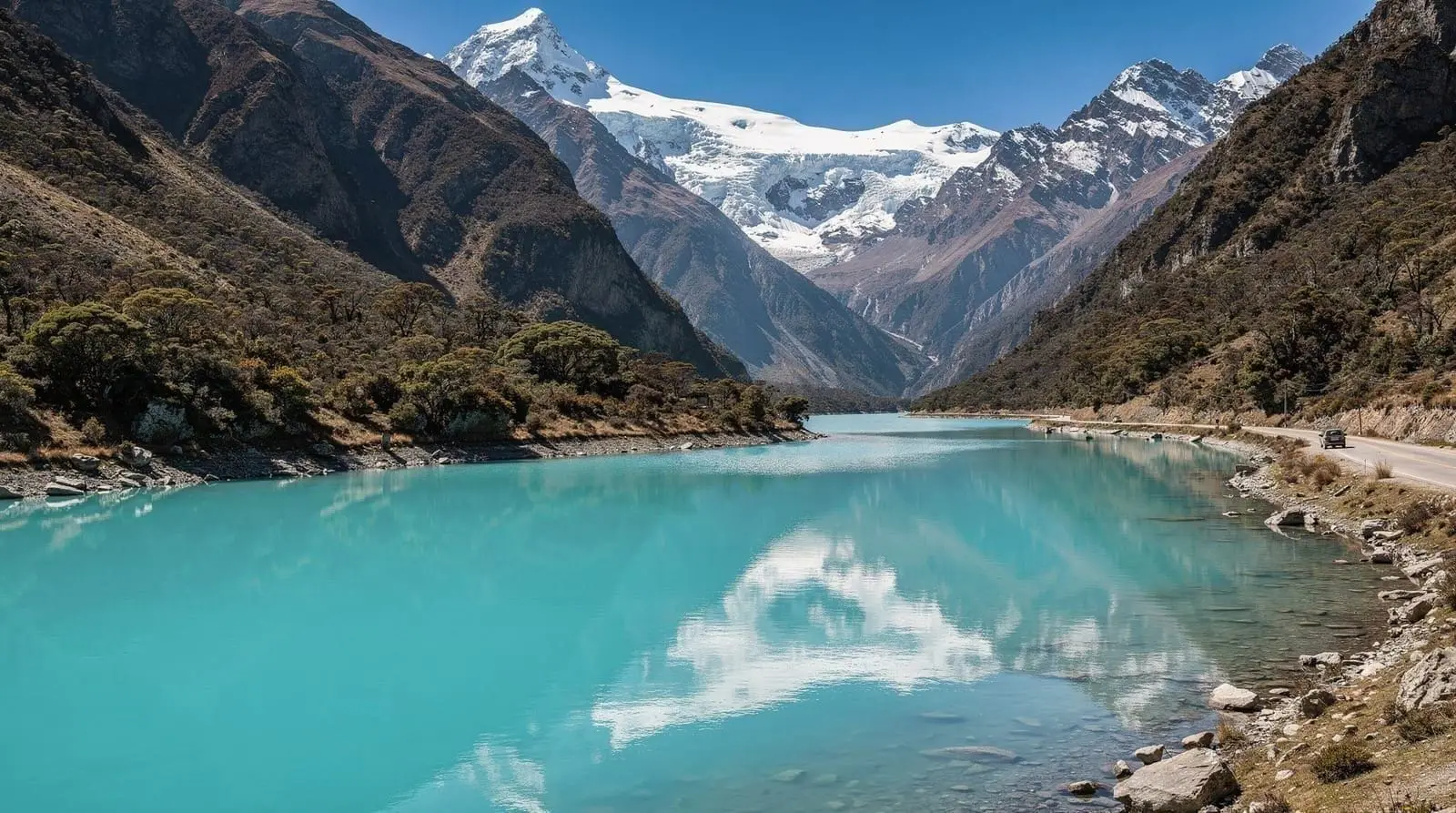
Llanganuco Lakes guide: the gentle Cordillera Blanca day
From Huaraz: Llanganuco Lakes Full-Day Tour
Are the Llanganuco Lakes worth visiting?
Yes, especially as an acclimatisation day. At 3,850 m they offer spectacular Cordillera Blanca scenery, two turquoise lakes beneath the Huascarán massif, with almost no hard hiking. They are the gentlest big-scenery day from Huaraz and a smart step up before Laguna 69.
The easy day that doubles as your altitude insurance
In a region defined by punishing high hikes, the Llanganuco Lakes are the rare Cordillera Blanca outing that almost anyone can do, and that fact is precisely what makes them so useful. Two turquoise lakes, Chinancocha and Orconcocha, lie at around 3,850 m in a steep glacial valley directly beneath the Huascarán massif, Peru’s highest mountain at 6,768 m. The setting is genuinely spectacular: sheer rock walls, hanging glaciers, queñua woodland fringing the water, and that distinctive Cordillera Blanca colour, a milky turquoise from suspended glacial silt.
What sets Llanganuco apart from the headline attractions is that you can experience all of this without a brutal climb. The classic visit is a stroll along the shore of Chinancocha on flat, well-made paths, with optional short trails and boat rides. For most travellers, that is the entire point: a beautiful day that asks almost nothing of the lungs.
And because it sits at 3,850 m, it is the perfect altitude builder, a step up from Huaraz at 3,050 m that prepares your body for the far harder Laguna 69 hike at 4,600 m without overreaching. Doing Llanganuco early in your trip is not just a nice day out; it is sensible acclimatisation strategy, as the Huaraz acclimatisation guide explains.
| Where | Cordillera Blanca, ~2.5-3 hrs from Huaraz via Yungay |
| Altitude | ~3,850 m |
| Cost | Tour S/40-70 + park fee S/30/day |
| Difficulty | Easy — flat lakeshore walk |
| Best time | Dry season, May-September |
Where the lakes are and how to get there
The Llanganuco valley sits north-east of Huaraz, accessed through the town of Yungay in the Callejón de Huaylas. Yungay itself carries a sombre history: the original town was buried by a debris avalanche triggered by the 1970 earthquake, and the memorial site, Campo Santo, lies on the way up, a stark reminder of how alive these mountains are.
From Huaraz, most visitors join an organised day tour. The drive takes about two-and-a-half to three hours each way via Yungay, the operator handles the Huascarán National Park entry, and you get several hours at the lakes. It is the simplest option and the one most people choose.
Llanganuco Lakes full-day tour from HuarazDoing it independently is possible and cheaper. Take an early combi from Huaraz to Yungay (around S/8 to S/12), then arrange onward transport up the valley, either a shared colectivo when one fills or a hired taxi. The catch is timing and uncertainty: onward connections are not frequent, and you sort out the park fee yourself at the control post. For most travellers without their own vehicle, the modest cost of a tour buys away that hassle.
Llanganuco Lake day trip from HuarazWhat you actually do at the lakes
The centrepiece is Chinancocha, the lower and more visited of the two lakes. A flat, well-maintained shoreline path runs along part of its edge, threading through queñua trees (a high-altitude woodland that grows higher than almost any tree on earth) with interpretive signs and constant views up to the glaciated peaks. Walking the accessible stretch and back is gentle and takes as little or as long as you like.
Small rowing boats operate on Chinancocha, and a short paddle out onto the water, roughly S/10 to S/20 per person, is a pleasant way to sit in the middle of the amphitheatre of mountains. It is touristy but harmless, and the perspective from the water is worth the modest fare.
Above and beyond Chinancocha lies Orconcocha, the upper lake, smaller and quieter, reached by continuing up the valley road. Many tours pause at viewpoints along the climb rather than spending much time at Orconcocha itself. For those wanting more exertion, the María Josefa viewpoint hike climbs the valley side for a higher panorama over both lakes, a steeper option that turns the gentle day into a moderate one and adds useful acclimatisation.
The scenery and the science behind the colour
It is worth understanding what you are looking at, because the Llanganuco valley is a textbook of glacial geology written at full scale. The valley itself is a classic U-shape, carved by an enormous glacier that ground down the rock over millennia and then retreated, leaving the steep parallel walls that now frame the lakes. The two lakes are dammed behind moraines, ridges of debris bulldozed and dumped by the ice as it advanced and withdrew. Chinancocha and Orconcocha are, in effect, meltwater trapped behind these natural rubble dams.
That distinctive milky turquoise is not a trick of the light or, despite what some guides claim, a mineral dye. It comes from glacial flour: rock pulverised into an ultra-fine powder by the grinding glaciers above, washed into the lakes by meltwater, and held in suspension. The particles scatter light in a way that produces the surreal blue-green, a colour shared by glacial lakes from Patagonia to the Himalayas. On a still, sunny morning the effect is at its most intense; under cloud the lakes turn a flatter grey-green. This is the same phenomenon, incidentally, that gives Laguna 69 its famous colour, so a visit to Llanganuco is a useful preview of what to expect higher up.
The peaks ringing the valley are the headline act. Huascarán, at 6,768 m the highest mountain in Peru, dominates one side, with its twin summits and hanging glaciers. Across the valley rise Huandoy (6,395 m) and Chacraraju, the same peak that towers over Laguna 69. The combination of the deep glacial valley, the turquoise water, the queñua woodland, and the wall of ice-clad giants is what makes Llanganuco one of the most photographed valleys in the Cordillera Blanca, despite asking so little of those who come to see it.
Costs and practicalities
Budget straightforwardly. A group day tour from Huaraz runs roughly S/40 to S/70 (about $11 to $19 USD) for transport and a guide. On top of that, the Huascarán National Park fee is S/30 per day, or covered by the S/150 multi-day pass if you are doing several park sectors across your stay. The optional boat ride is a few soles more. Bring cash; there is nowhere to pay by card up the valley.
Practical notes. The altitude, while moderate, is still real, so move at an easy pace and drink water, especially if this is one of your first days at height. Bring layers and a windproof shell, since the valley can be sunny and warm one moment and cold and breezy the next. Sun protection matters at 3,850 m even when it feels cool. There are basic facilities and a few stalls selling snacks and drinks near the main lake, but do not count on a proper meal; pack your own or eat in Yungay.
A word on what the tours actually deliver, because expectations matter. The cheap group tours are genuinely good value for Llanganuco specifically: the scenery does most of the work, the walking is gentle, and you do not need an expert guide to enjoy a flat lakeshore. Where they sometimes fall short is time, with a rushed schedule that gives you only an hour or so at the lake before herding everyone back to the van. If you want to linger, take photos in changing light, or attempt the viewpoint hike, ask about the time allowance before booking, or consider a private arrangement from Caraz. The difference between a hurried stop and an unhurried morning at Llanganuco is large, and it is one of the few things about the day within your control.
Yungay and the 1970 disaster: the human backdrop
It would be a mistake to drive through Yungay on the way to the lakes and not understand what you are passing. On 31 May 1970, a magnitude 7.9 earthquake off the Peruvian coast shook loose a colossal slab of rock and ice from the north face of Huascarán. The resulting avalanche of mud, rock, and ice, travelling at enormous speed down the valley, buried the town of Yungay almost completely in a matter of minutes, killing an estimated 20,000 of its roughly 25,000 inhabitants. It remains one of the deadliest avalanche disasters in recorded history.
The site of the old town is preserved as Campo Santo, a memorial garden built over the buried settlement. A handful of survivors lived because they happened to be in the cemetery on a small hill, or at the stadium, during the disaster. Today the memorial is marked by the toppled remains of the old church, the tops of four palm trees from the original Plaza de Armas protruding from the debris, and a large white statue of Christ that looks down over the field where the town once stood.
Many Llanganuco tours include or pass the memorial, and it is worth the pause. It reframes the whole valley: the same glaciers that produce the beautiful turquoise water are the source of a constant, real hazard, and the people who live beneath them do so with that knowledge. The Cordillera Blanca is not a static postcard; it is an actively moving, sometimes deadly mountain range, and Yungay is the proof.
Wildlife and the queñua woodland
The Llanganuco valley is not just rock and water; it shelters some of the most distinctive high-altitude life in the Andes, and a slow walk along the shore rewards anyone who looks. The most striking feature is the queñua (Polylepis) woodland fringing Chinancocha. Polylepis trees, with their shaggy, peeling reddish bark, are remarkable for growing higher than almost any other tree on the planet, forming patches of genuine forest at altitudes where trees have no business existing. These woodlands are a threatened habitat, slow-growing and much reduced by centuries of cutting for firewood, and the protected stands at Llanganuco are among the more accessible places to walk through them.
The forest and lakeshore support a quietly rich birdlife. Patient observers may spot hummingbirds working the flowers, including high-altitude specialists adapted to the thin cold air, along with various Andean finches and, with luck, larger birds soaring the valley walls. The lakes themselves attract waterfowl. None of this requires a birding expedition; it simply rewards walking slowly and looking, rather than treating the lake as a single photo stop. For travellers more interested in nature than in bagging summits, the gentle pace and biodiversity of Llanganuco make it one of the more quietly rewarding days in the whole Cordillera Blanca, and a reminder that the range is a living ecosystem, not just a backdrop for hikers.
How Llanganuco fits the bigger trip
The smartest use of Llanganuco is as the second step on the Cordillera Blanca acclimatisation ladder. A sensible sequence from Huaraz: rest on arrival, walk the mirador above town on day one, do Llanganuco on day two, then tackle Laguna 69 once your body has adjusted, with the Laguna 69 complete guide and day-hike tips to prepare you.
Because the Llanganuco valley is the gateway to Cebollapampa, the Laguna 69 trailhead, some operators bundle a Llanganuco viewpoint into the Laguna 69 day itself, giving you both in one go.
Laguna 69 full day with Llanganuco viewsFrom here you can build toward the higher and wilder corners of the range: the Pastoruri Glacier above 5,000 m, the quieter Laguna Parón covered in the Laguna Parón guide, and the pre-Inca site of Chavín de Huántar. The valley is also the trailhead for the multi-day Santa Cruz trek. For the full overview of how to structure a Cordillera Blanca stay, see the Huaraz complete guide, and for fitting Huaraz into a wider route, the north vs south Peru comparison and the tours hub.
Photography tips for the lakes
Llanganuco rewards a little planning if photography matters to you. Morning light (before around 11 am) is consistently better than afternoon, since cloud tends to build over Huascarán as the day warms — this is another reason the earliest available tour departure is worth choosing, beyond the crowd factor. A polarising filter, if you carry one, cuts glare off the water’s surface and deepens the turquoise considerably; without one, shooting at a slight angle to the sun reduces the same glare.
The classic composition places Chinancocha in the foreground with Huascarán’s twin peaks centred behind, best captured from the small rise near the boat dock rather than at the water’s edge. Because the boats disturb the water’s stillness, the calmest reflection shots come either before the first boats launch or from the quieter far end of the accessible shoreline path. Bring a lens cloth — the wind picks up spray and dust in equal measure.
Facilities, toilets, and what not to expect
Manage your expectations around infrastructure. There are basic pit toilets near the main Chinancocha car park and a handful of stalls selling bottled drinks, snacks, and simple hot food (usually soup or a plate of rice and eggs) run by local families — a welcome, unglamorous convenience rather than a proper restaurant. There is no mobile signal reliability once you are up the valley, and no ATM, so bring all the cash you need from Huaraz or Yungay.
Rubbish bins are sparse; the general rule across the Huascarán National Park is to carry out anything you carry in. None of this should be a surprise if you have visited other Peruvian national parks, but first-time Andes travellers sometimes expect more built infrastructure than a relatively remote glacial valley actually offers.
Comparing Llanganuco with the region’s other lakes
Travellers often ask how Llanganuco stacks up against the famous lakes higher in the range, and the honest framing is that it is a different kind of day rather than a lesser one. Laguna 69 is the trophy: a hard 4,600 m hike to a small, intensely turquoise lake, with the crowds and the effort that fame brings. Laguna Parón is the quiet giant, the largest lake in the range, reached with little effort but a rough road, covered in the Laguna Parón guide. Llanganuco is the gentle, accessible scenery day, two lakes you can reach without strenuous hiking, set beneath the highest mountain in Peru.
If you only have time for one and you want the iconic image and the achievement, choose Laguna 69. If you want the most scenery for the least effort, or you are not yet acclimatised, Llanganuco is the clear pick, and it doubles as preparation for the harder hikes. The smartest itinerary, for those with the days, treats them as a sequence rather than a competition: Llanganuco first as acclimatisation and gentle introduction, Laguna 69 once your body is ready, and Parón as a quieter high-mountain day, each adding something the others do not. Seen that way, Llanganuco is not the consolation prize; it is the foundation the rest of your Cordillera Blanca trip is built on.
Frequently asked questions about Llanganuco Lakes guide: the gentle Cordillera Blanca day
How high are the Llanganuco Lakes?
How do I get to the Llanganuco Lakes from Huaraz?
How much does it cost to visit the Llanganuco Lakes?
Is the Llanganuco visit hard or strenuous?
Can I combine Llanganuco with Laguna 69?
When is the best time to visit the Llanganuco Lakes?
Are there toilets or food at Llanganuco?
Top experiences
Bookable activities with verified prices and instant confirmation on GetYourGuide.

