Pastoruri Glacier
Pastoruri Glacier near Huaraz reaches 5,250 m and is melting fast. What the short walk is really like, the altitude risks, Puya raimondii, and costs.
Huaraz: Pastoruri Glacier Day Trip
Quick facts
- Altitude (car park)
- ~5,000 m; glacier viewpoint ~5,250 m
- Distance from Huaraz
- ~70 km, 2.5-3 hours by road
- Walk to glacier
- ~2 km each way, gentle but very high
- Park fee
- S/30 per day (Huascarán National Park)
- Best for
- Reaching 5,000 m without a trek; climate-change context
A glacier you can almost drive to, while it lasts
Pastoruri is the Cordillera Blanca outing for people who want to reach a glacier without the multi-day commitment or technical skill that most ice usually demands. A paved-then-gravel road climbs to a car park at around 5,000 m, from which a gentle two-kilometre walk brings you to the foot of the glacier at roughly 5,250 m. There is no rope work, no crampons, no camping — just a short, slow walk at extraordinary altitude to stand near a wall of ice.
| Where | Huascarán National Park, ~70 km south of Huaraz |
| Cost | Tour ~S/40–70 plus S/30 park fee (or S/150 multi-day pass) |
| Time needed | Full day from Huaraz, ~45–60 min at the glacier itself |
| Getting there | Group tour from Huaraz, 2.5–3hrs each way |
| Best time | May–September dry season, late in your acclimatisation |
That ease is also the source of the visit’s most honest framing. Pastoruri is dying. It has lost more than half its surface area since the 1980s, the meltwater lakes at its base grow visibly year on year, and the Peruvian authorities long ago stopped allowing visitors to walk on or climb the ice as they once did. The regional tourism board rebranded the area as part of the “Ruta del Cambio Climático” — the Climate Change Route — which is unusually candid marketing and exactly right. You don’t come to Pastoruri for a pristine alpine spectacle; you come to see, at first hand, what a retreating tropical glacier looks like, and to do it while there is still ice to see.
For visitors based in Huaraz, it’s a popular full-day trip that pairs high-mountain scenery with two genuinely unusual roadside sights: ancient stands of giant bromeliads and bubbling mineral springs.
Getting there and how the day unfolds
Pastoruri lies about 70 km south of Huaraz in the southern sector of Huascarán National Park, near the village of Catac. The drive takes roughly two-and-a-half to three hours each way, climbing steadily out of the Callejón de Huaylas into the high puna grassland.
The standard day is run as a group tour from Huaraz, leaving around 7 to 8 am — later than the Laguna 69 departures, since the walk itself is short — and returning by early evening. Tours handle the transport, the park fee, and a guide, and they build in stops on the way up.
Pastoruri Glacier day trip from HuarazThe route to the glacier passes through the Pumapampa valley, and most tours stop at two highlights. The first is the Puya raimondii forest: stands of the world’s largest bromeliad, sometimes called the Queen of the Andes, which can grow over 10 m tall and flowers just once in a lifetime of 80 to 100 years before dying. The Pumapampa stands are among the most accessible anywhere, and if your visit coincides with a flowering individual (typically May to July in good years), it’s a genuinely rare sight. The second stop is at carbonated mineral springs, where naturally gas-charged water bubbles up — locals call it “agua gasificada natural” — and a small sip is part of the standard tour theatre.
Pastoruri Glacier hike with Puya raimondii stopsThe altitude reality: this is the highest easy outing from Huaraz
Do not underestimate Pastoruri because the walk is short. The car park sits around 5,000 m and the glacier viewpoint reaches roughly 5,250 m — higher than Laguna 69, and higher than most visitors will go anywhere else in Peru short of a serious climb. At this altitude there is roughly half the oxygen available at sea level, and even the gentle, near-flat two-kilometre walk to the ice can leave well-acclimatised people breathless and slow.
This makes acclimatisation non-negotiable. Pastoruri should never be your first or second day in the region. The honest sequence is: spend your first days resting in Huaraz at 3,050 m, take a gentle acclimatisation outing such as the Llanganuco Lakes, build up through Laguna 69 at 4,600 m, and only then attempt Pastoruri’s 5,250 m. Going straight to Pastoruri from a low-altitude arrival is a reliable way to feel genuinely ill at 5,000 m, a long way from medical help.
Practical mitigations help but don’t replace acclimatisation: Diamox (acetazolamide), available over the counter in Huaraz, coca tea, plenty of water, and a deliberately slow pace on the walk. For those who find the walk too much, horses are sometimes available for hire near the car park to carry you most of the way to the viewpoint — a reasonable option if the altitude is hitting hard, though it doesn’t remove the underlying exposure to 5,000-plus metres. Watch for the warning signs of altitude sickness — a severe headache, vomiting, confusion, or breathlessness at rest — and descend immediately if they appear.
What the glacier visit is actually like
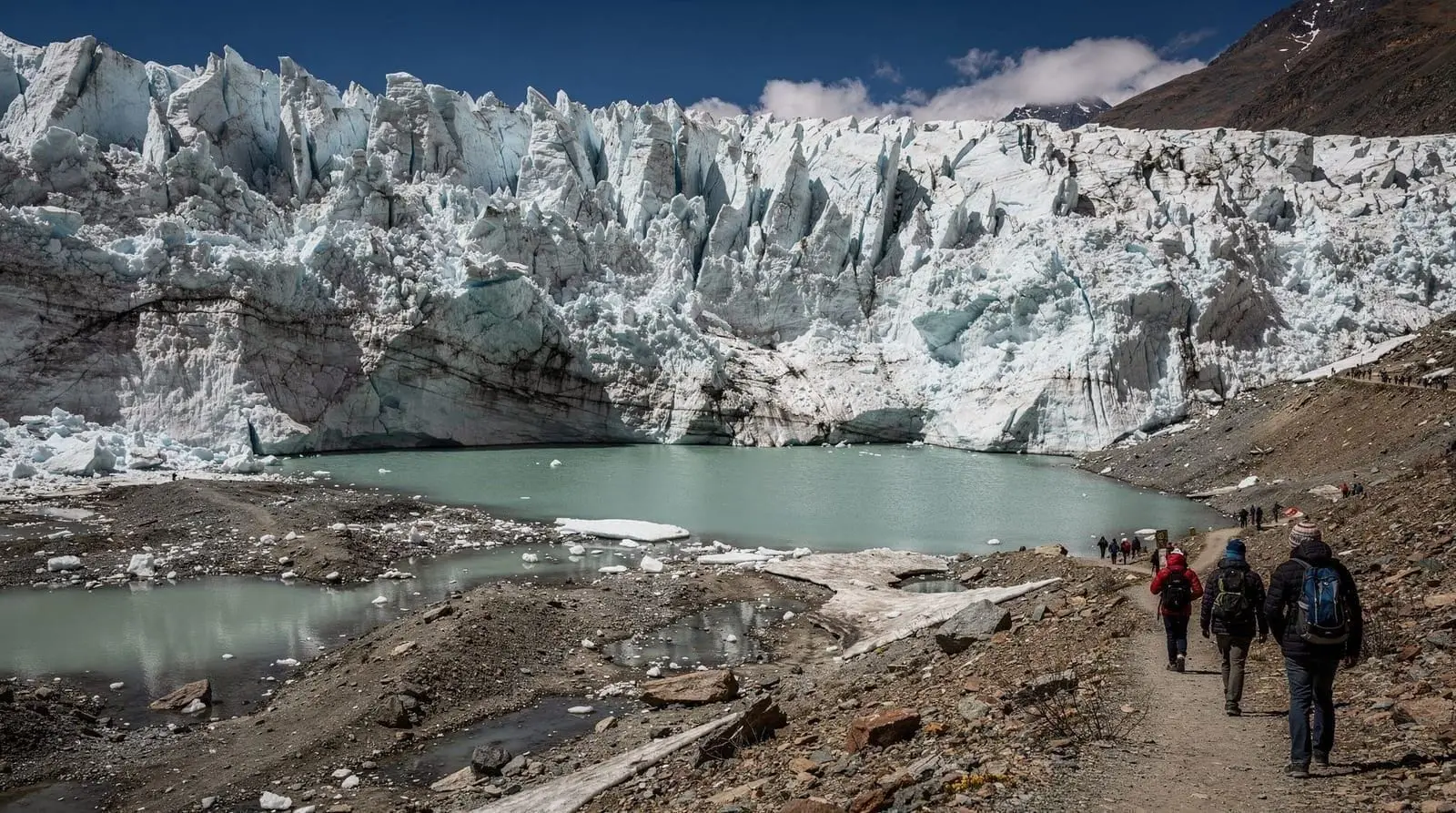
Set your expectations honestly. The walk from the car park is a wide, well-trodden path that climbs gently across rocky high-altitude terrain to a roped-off viewpoint near the glacier’s snout. You’ll see a wall and apron of dirty-white ice, often streaked with rock debris, with a turquoise meltwater lake forming at its base. On a clear day it’s striking; on a cloudy one it can look bleak and grey. You cannot walk onto the ice — that’s been prohibited for years to protect both the glacier and visitors from the unstable, crevassed surface.
What stays with most people is not the postcard quality of the ice but the evidence of retreat all around it: the bare rock recently exposed where ice used to sit, the growing lake, the interpretive signs documenting how far the glacier has pulled back within living memory. As an experience it is part scenery, part field lesson, and the field lesson is the more memorable half.
Allow about 45 minutes to an hour at the glacier including the slow walk each way. Tour groups don’t linger — the cold and altitude see to that.
Costs, what to bring, and when to go
A group day tour from Huaraz typically costs S/40-70 (about $11-19 USD), plus the Huascarán National Park fee of S/30 (or the S/150 multi-day pass if you’re combining park visits). Lunch is usually not included in the cheaper tours; bring food or buy it in Catac on the way. Horse hire near the car park, if you want it, is an extra negotiated on the spot — agree the price before you mount.
Pack seriously for cold. At 5,000 m it can be below freezing with a biting wind even under sun: a warm insulated layer, windproof shell, hat, gloves, sunglasses, and strong sunscreen are all essential. Sturdy shoes are enough for the path. Carry water and high-energy snacks. The dry season (May to September) offers the most reliable weather and the best chance of seeing the Puya raimondii in flower; in the wet season (October to April), cloud, snow, and occasional road closures make the trip unreliable.
One scheduling note: because Pastoruri is the highest outing, it’s poorly suited to combining with another strenuous activity on the same day. Treat it as its own day, near the end of a well-acclimatised Cordillera Blanca stay.
Pastoruri vs Laguna 69 vs Llanganuco Lakes
| Pastoruri | Laguna 69 | Llanganuco Lakes | |
|---|---|---|---|
| Max altitude | ~5,250 m | ~4,600 m | ~3,850 m |
| Walking effort | Short, gentle (2 km) | Long, steep (~7 km round trip) | Minimal, mostly by car |
| Best for | Reaching 5,000 m easily | The classic hard Cordillera hike | Gentle acclimatisation day |
| Sequence | Late in your trip | Mid-trip, once acclimatised | Early, first day or two |
The order matters more than any single outing. The Huaraz acclimatisation guide sets out a full week-by-week sequence, and the best day hikes in Huaraz guide compares all the region’s options side by side if you are trying to pick which two or three to fit into a short stay.
Photographing Pastoruri
The clearest light for photographing the ice wall and the growing meltwater lake is mid-morning, before cloud typically builds over the Cordillera in the early afternoon. A polarising filter cuts glare off both the ice and the lake surface if you shoot with a dedicated camera; on a phone, tapping to expose for the ice rather than the sky avoids blown-out highlights against the intense high-altitude sun. The Puya raimondii stands along the access road are worth a dedicated stop on the way up rather than a drive-by shot from the vehicle — their scale is hard to appreciate without standing next to one.
Where Pastoruri fits in a Huaraz itinerary
Pastoruri is best slotted in late, after your body has adapted to altitude over several days in and around Huaraz. A typical well-paced week might run: arrive and rest, a gentle Llanganuco Lakes day, the hard Laguna 69 hike, a rest or culture day at Chavín de Huántar, and Pastoruri toward the end when you’re at your most acclimatised. That ordering keeps the highest, riskiest outing for last.
For more on routing and timing across the region, see the guides hub and the itineraries page, and browse bookable day trips on the tours page.
Frequently asked questions about Pastoruri Glacier
How high is Pastoruri Glacier and is the altitude dangerous?
The car park sits around 5,000 m and the glacier viewpoint reaches roughly 5,250 m — higher than Laguna 69. At this altitude there’s about half the oxygen of sea level, so the short walk is genuinely taxing and altitude sickness is a real risk. Visit only after several days acclimatising in the Huaraz area.
Can you walk on the Pastoruri glacier?
No. Walking or climbing on the ice has been prohibited for years, both to protect the retreating glacier and because the surface is unstable. You walk to a roped viewpoint near the glacier’s snout, where you can see the ice wall and the meltwater lake forming at its base.
How hard is the walk to the glacier?
The walk itself is short — about two kilometres each way on a gentle, well-trodden path. The difficulty comes entirely from the altitude, not the terrain. Well-acclimatised visitors find it slow but manageable; horses can be hired near the car park if the thin air is too much.
What is the Puya raimondii and will I see it flower?
Puya raimondii, the Queen of the Andes, is the world’s largest bromeliad, growing over 10 m tall and flowering only once in 80-100 years before dying. Stands grow along the route to Pastoruri. Seeing one in flower is rare and seasonal (best chances May to July in a good year), but the giant plants are impressive even when not in bloom.
How much does a Pastoruri tour cost?
A group day tour from Huaraz runs roughly S/40-70 (about $11-19 USD), plus the S/30 Huascarán National Park fee. Lunch is usually separate in the cheaper tours, and any horse hire at the glacier is an extra paid on the spot.
Is Pastoruri worth visiting given how much it has melted?
That depends on what you want. As pristine alpine scenery it has been diminished — it’s a smaller, dirtier glacier than it was decades ago. But as an accessible chance to reach 5,000 m and witness a tropical glacier’s retreat first-hand, it remains a worthwhile and unusually honest outing. Many visitors find the climate-change story the most memorable part.
Top experiences
Bookable activities with verified prices and instant confirmation on GetYourGuide.
