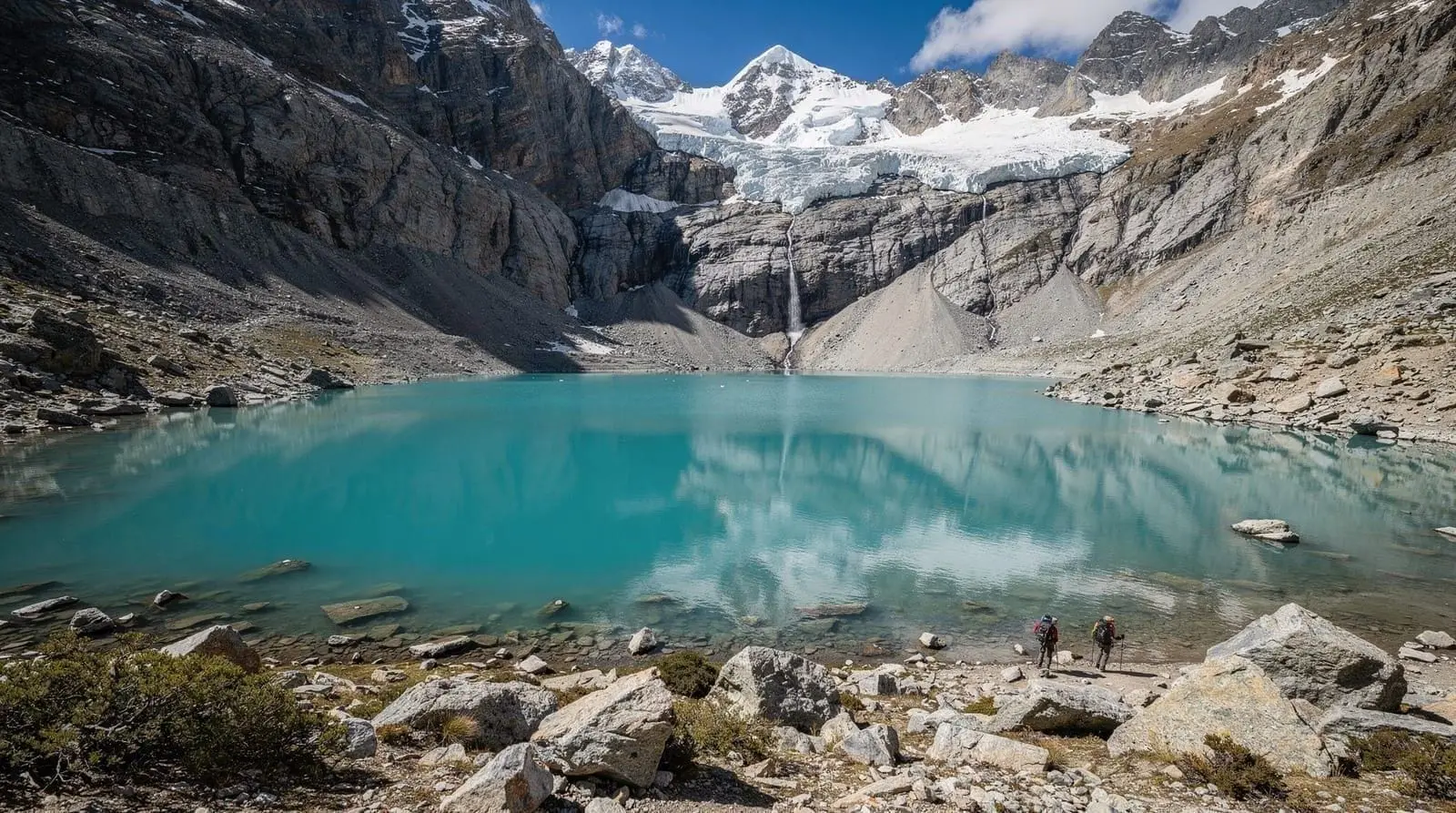
Laguna 69: a diary of the hardest day hike I'd done
The alarm went off at 4am and for a confused few seconds I could not remember why I had agreed to this. Then I remembered: a turquoise lake at 4,600 metres, photographs I had seen a hundred times, and the slightly competitive part of me that wanted to know whether I could actually do it. By 4:20 I was outside in the cold of a Huaraz November morning, waiting for a van, questioning my life choices.
| Distance | ~7km each way, 3,900m to 4,600m |
| Cost | Around S/45 tour + S/30 Huascarán park fee |
| Time needed | Full day (van pickup ~5am, back by early evening) |
| Acclimatise first | 2–3 days in Huaraz minimum before attempting |
| Bring | Trekking poles, layers, snacks, sun protection |
The three days that made it possible
I want to start with the boring part, because it is the part that matters most. I did not arrive in Huaraz and hike Laguna 69 the next day. I gave it three days first, and I am convinced that is the only reason the hike was hard rather than miserable.
Huaraz sits at about 3,050 metres. Laguna 69 finishes at roughly 4,600. That is a serious jump, and the people I saw struggling worst on the trail were almost always the ones who had bussed in from sea-level Lima the previous night and gone straight up. My first day in Huaraz I did almost nothing: walked the Plaza de Armas, drank coca tea, ate, slept badly. Day two I did the Laguna Wilcacocha hike, an easy half-day climb to about 3,700 metres that exists precisely as an acclimatisation warm-up. Day three I rested again. The whole time I drank more water than felt reasonable.
It cost me three extra days and saved my entire trip. I cannot say this loudly enough to anyone reading this in a hurry.
If you’re building your own acclimatisation days rather than winging it like I nearly did, the Huaraz acclimatization guide lays out a proper schedule, and the Huaraz complete guide covers the town itself — where to stay, eat, and rest between hikes.
How Laguna 69 compares to Huaraz’s other big hikes
Laguna 69 isn’t the only serious day hike out of Huaraz, and knowing where it sits helped me decide it was the right first one.
| Hike | Max altitude | Difficulty | Best for |
|---|---|---|---|
| Laguna 69 | ~4,600m | Hard, one long day | The classic turquoise-lake day hike |
| Laguna Paron | ~4,200m | Moderate | Similar views, less crowded |
| Llanganuco Lakes | ~3,850m | Easy | A gentler warm-up or lower-effort day |
| Pastoruri Glacier | ~5,000m | Moderate walk, high altitude | Highest point, shortest walking distance |
The Laguna Paron guide and the Llanganuco lakes guide both cover hikes I did on later trips once Laguna 69 had, frankly, ruined me for anything less spectacular. If you’re deciding between a full trekking circuit and day hikes like this one, the best day hikes in Huaraz guide runs through the full list, and Huaraz vs Cusco for hiking is worth reading if you’re trying to choose a base for your Peru trek time.
The drive in, before the walking starts
The tour van picked me up around 5am. I had booked the standard Laguna 69 day tour the afternoon before from an agency on Avenida Luzuriaga for S/45 (about USD 12), which is the going rate and frankly absurd value for a full day with transport. Breakfast and lunch are not included; I paid a few soles extra at the stops, and you also need S/30 for the Huascarán National Park entry, which the guides collect on the way.
The drive is roughly three hours each way and it is beautiful enough that I forgive it the early start. We stopped at a viewpoint over the Llanganuco lakes, two impossibly blue ribbons of water below the snow peaks, and I took the photos everyone takes. By the time we reached the trailhead at Cebollapampa, around 3,900 metres, the sun was up and I had convinced myself this would be manageable.
The first hour lies to you
The trail starts deceptively. The first section is nearly flat, winding through a green valley with a stream, cows grazing, snow peaks all around. I strode off feeling strong and slightly smug. The guide, who had clearly seen this exact behaviour ten thousand times, just smiled and told us to slow down.
He was right. After about forty-five minutes the trail tilts up into the first set of switchbacks and the altitude arrives like a bill you forgot you owed. My legs were fine. My lungs were not. Every fifteen or twenty steps I had to stop, hands on knees, hauling in air that did not seem to contain enough of whatever I needed. A woman near me sat down on a rock and quietly cried, not from injury, just from the sheer exhausting strangeness of being unable to breathe properly.
This is the part the photos do not show. Laguna 69 is not a long hike, around 7 kilometres each way, but it is brutal in the way that high altitude makes ordinary effort feel like swimming through wet concrete. I am reasonably fit at home. None of that fitness translated. The mountain does not care about your gym membership.
The wall, and getting over it
The second set of switchbacks, the ones that climb the headwall toward the lake, nearly broke my resolve. I had been walking for over two and a half hours. The lake was somewhere above and I could not see it. I counted steps to keep moving, ten at a time, then a pause, then ten more. I ate a chocolate bar that I am pretty sure saved my morale. I drank water I did not want. I kept going mostly because turning back felt like more effort than finishing.
And then the trail crested and the lake was just there.
I will not pretend I had a profound thought. I sat down on the nearest flat rock and breathed for about five minutes before I could even take the camera out. The lake is the colour the photos promise and somehow more so: a glacial turquoise that does not look natural, fed by a waterfall coming straight off the Chacraraju glacier above. The cold rolling off the ice is immediate. People were eating sandwiches, taking jumping photos, sitting in stunned silence. I did a bit of all three.
I lasted maybe forty minutes at the top. It was cold, the wind picked up, and you are at 4,600 metres where lingering is not entirely comfortable. The guide gave us a hard time limit because the afternoon clouds roll in fast and the descent still takes a couple of hours.
Going down is its own challenge
Everyone warns you about the climb. Nobody warned me that the descent would wreck my knees. The same switchbacks that starved my lungs on the way up hammered my joints on the way down, and by the valley floor I was walking like a much older man. Trekking poles, which I had dismissed as unnecessary, would have helped enormously. Borrow or rent a pair. I watched the people who had them descend in comfort while I winced.
We were back at the van by mid-afternoon, back in Huaraz by early evening, and I was asleep before 9pm having eaten an entire pizza by myself without apology.
Was it worth it?
Yes, unreservedly, with one large condition: acclimatise first. The single biggest difference between the people who had a hard-but-rewarding day and the people who turned back vomiting was the number of days they had spent at altitude beforehand. This is not a hike you can shortcut with willpower. Altitude is a physiological reality, not a mindset.
If you give it the respect it deserves, Laguna 69 is the most spectacular single day of hiking I have done in South America, and at S/45 plus the park fee it is also among the cheapest. Bring water, snacks, sun protection, warm layers for the top, and poles for your knees. Start the acclimatisation clock the day you arrive in Huaraz, not the day before the hike. And when you crest that final ridge and the lake appears, the seventy minutes of suffering on the headwall will reorganise themselves, almost instantly, into something you are quietly proud of for a long time afterwards.
If Laguna 69 leaves you wanting more of the Cordillera Blanca, the Laguna 69 complete guide and Laguna 69 day hike tips both go deeper on logistics than a single trip report can, and several multi-day treks in the same range — the Santa Cruz trek among them — string together several days of this kind of scenery for people who want more than one big day.
Laguna 69 guided day hike from Huaraz