Laguna Parón guide: the Cordillera Blanca's biggest lake
From Huaraz: Laguna Parón Full-Day Tour
Is Laguna Parón worth visiting over Laguna 69?
They are different experiences. Parón at 4,185 m is the largest lake in the Cordillera Blanca, deep blue, ringed by glaciated peaks, and far quieter, with an easy lakeshore plus an optional viewpoint hike. Laguna 69 is a harder, higher trek to a smaller turquoise lake. Many people do both.
The big quiet lake everyone overlooks for Laguna 69
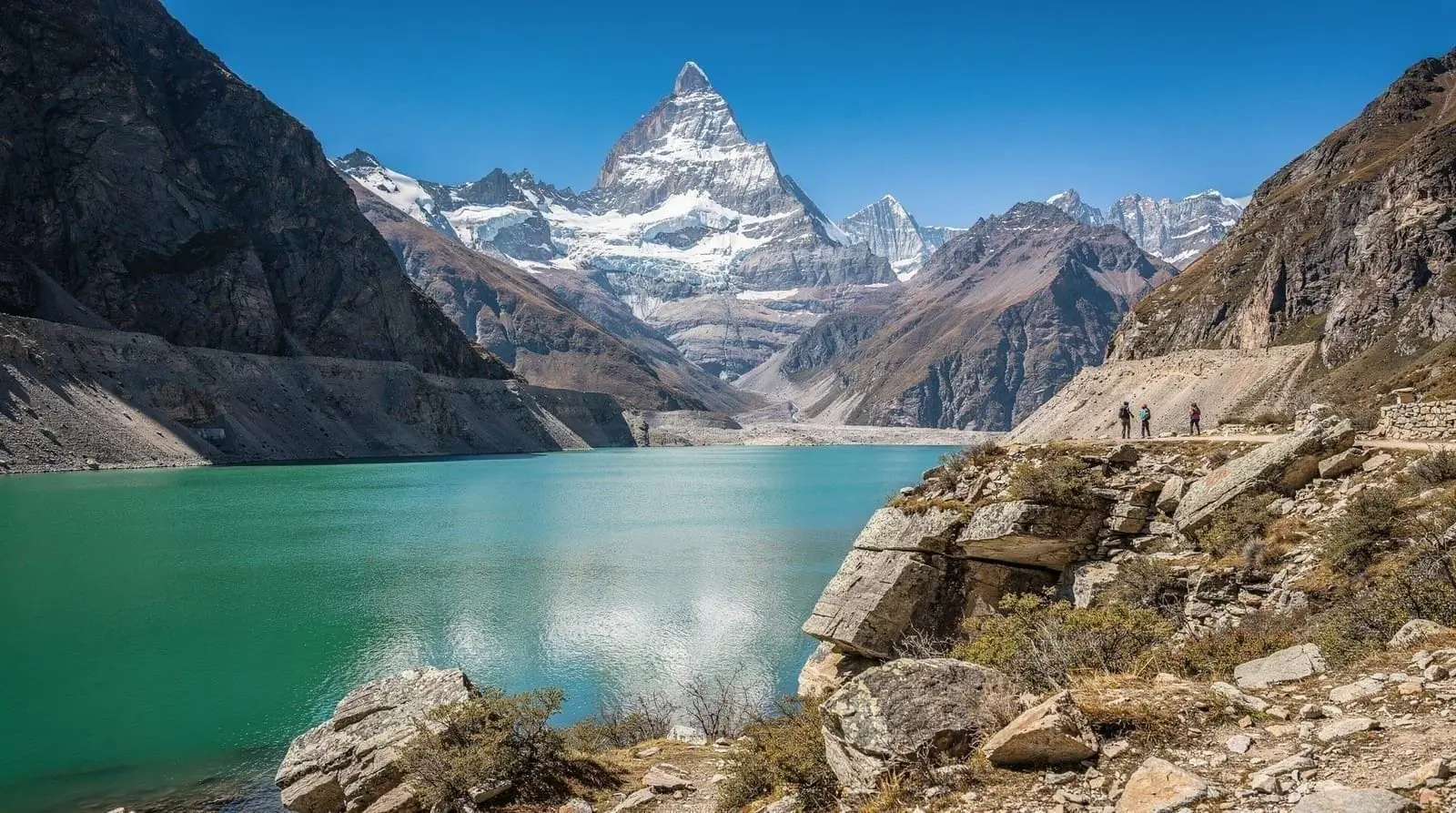
If Laguna 69 is the Cordillera Blanca’s celebrity, Laguna Parón is its underrated heavyweight. At 4,185 m in the valley above Caraz, it is the largest lake in the entire range, a long, deep-blue body of water hemmed in by a semicircle of glaciated peaks. Presiding over the far end is the sharp pyramid of Artesonraju (6,025 m), the mountain widely credited as the inspiration for the Paramount Pictures logo. Whether that story holds up to scrutiny or not, the result is one of the most photogenic mountain scenes anywhere in Peru.
What makes Parón compelling is not just the scale and the backdrop but the contrast with the rest of the region’s headline sights. Where Laguna 69 demands a hard 4,600 m trek and delivers you to a crowded shoreline in peak season, Parón offers comparable drama with far less effort and a fraction of the people. The standard visit is an easy walk along the lakeshore, with a steeper optional viewpoint hike for those who want to earn a higher panorama. The trade-off is the access: a rough road and slightly awkward logistics keep the crowds away precisely because they keep casual visitors away too.
| Where | above Caraz, ~67km/3-3.5hrs from Huaraz |
| Cost | around S/50-90 tour, plus S/5-10 community fee |
| Time needed | half day lakeshore, +1-1.5hrs for the Mirador hike |
| Getting there | Huaraz tour, or Caraz-based taxi-colectivo |
| Best time | dry season, calm early morning for still reflections |
Where it is and how to reach it
Laguna Parón lies in a valley above Caraz, the quieter Callejón de Huaylas town about 67 km north of Huaraz. From the lake, the road descends to Caraz and then on to Huaraz, so most day visitors come from Huaraz with a long drive bookending the day.
The simplest option is an organised tour from Huaraz. The drive is around three to three-and-a-half hours each way, the operator handles the access logistics and the local entry fee, and you get a few hours at the lake. Given the rough final stretch of road, letting someone else drive is no hardship.
Laguna Parón full-day tour from HuarazSome tours add an optional lunch and a more relaxed pace, which suits travellers who would rather linger at the lake than rush back.
Laguna Parón full-day tour with optional lunchDoing it independently means basing in Caraz, a pleasant and underrated acclimatisation town in its own right, and hiring a taxi-colectivo up the valley. There is no public combi running all the way to the lake; the final climb is on a narrow, rough road that gains serious altitude. Drivers in Caraz arrange the trip for a negotiated fare, often shared among a few travellers. This is cheaper than a Huaraz tour and gives you flexibility on timing, but you handle the entry fee and the bargaining yourself.
When to go: season, light, and conditions
As with everything in the Cordillera Blanca, the dry season from May to September is the reliable window. In those months the access road is at its most passable, the skies are most likely clear, and the deep blue of the lake against the white peaks is at its best. June to August are the busiest months, though “busy” at Parón still means a handful of vans rather than the crowds of Laguna 69. The wet season, October to April, brings cloud that can hide Artesonraju and the surrounding summits, and rain that turns the rough access road treacherous; landslides occasionally close it altogether. If the mountains are the reason you are coming, the dry season is non-negotiable.
Within a day, light shapes the experience. Early mornings are often the calmest, with the lake surface still enough to mirror the peaks, before the afternoon wind picks up and ruffles the water. Tours from Huaraz, with their long drive, tend to arrive mid-to-late morning, which is fine but misses the dead-calm dawn that independent visitors based in Caraz can catch. Either way, the high valley is exposed and the temperature swings hard between sun and shade, so the weather you get on the day matters as much as the season. Build in a buffer day in your Huaraz or Caraz plan if you can, so a clouded-out Parón is not your only shot.
At the lake: the easy walk and the viewpoint climb
Arriving at the lake, the first impression is the colour and the scale: a long sheet of deep blue water, often glass-still in the morning, with the glaciated wall of peaks reflected in it. From the car park near the lake’s outflow, a flat, easy path runs along the shoreline. Most visitors simply walk this stretch, take in the views and the reflections, and enjoy how few other people are around. For anyone not feeling fully acclimatised, this gentle option alone justifies the trip.
The more rewarding option for those with the legs and the acclimatisation is the Mirador de Parón hike. The trail climbs the rocky flank above the lake, gaining a few hundred metres to a panoramic ledge that looks down the full length of the water toward Artesonraju. At over 4,000 m the climb is a genuine effort, an hour to ninety minutes up for most people, with some scrambly sections near the top. The reward is the classic postcard angle, the whole lake stretched out below the pyramid peak. If you do this hike, treat it with the same altitude respect as any high Cordillera Blanca outing: go slow, hydrate, and turn back if you feel unwell.
Costs, fees, and what to know
Budget realistically. A group day tour from Huaraz runs roughly S/50 to S/90 (about $13 to $24 USD) for transport and a guide. Note that Parón sits outside the standard Huascarán National Park ticketing in practice: access is managed locally, and there is a community entry fee of around S/5 to S/10 collected at a control point, reflecting a long-running local management of the lake and its water. Confirm exactly what your tour covers before you pay, and carry small cash for any on-site fee.
Practical notes. The altitude at 4,185 m is real, so be acclimatised before you come; this is not a first-day outing, even though the lakeshore walk itself is gentle. Bring layers and a windproof shell, since the valley can swing from warm sun to cold wind quickly. Strong sun protection is essential at this height. Facilities at the lake are minimal, a basic toilet and not much else, so bring your own food and water or buy supplies in Caraz beforehand. The water is glacial-cold; do not plan on swimming.
A note on the lake’s level: Parón has been at the centre of a long-running dispute over water management between local communities and a hydroelectric operator, and the lake level and access arrangements have shifted over the years. Conditions on the ground can change, so it is worth checking current access with your Huaraz or Caraz operator before committing.
Caraz: the underrated base worth a night
Most travellers treat Caraz as a place they drive through on the way to the lake, which is a missed opportunity. Sitting at around 2,250 m in the lower Callejón de Huaylas, Caraz is markedly lower, warmer, and calmer than Huaraz, and it has a relaxed small-town feel that the rebuilt regional capital lacks. Its nickname, Caraz Dulzura (Caraz sweetness), nods to the local honey and the manjar blanco caramel sold around the plaza. For travellers tired of Huaraz’s traffic and trekker bustle, a night or two here is a genuine change of pace.
There is a practical argument for it too. Basing in Caraz puts you much closer to the Parón valley, the northern Cordillera Blanca attractions, and the Cañón del Pato, the dramatic narrow canyon north of town where the river squeezes between the Cordillera Blanca and the Cordillera Negra through a series of road tunnels. The lower altitude also makes Caraz a pleasant place to recover after a string of high-altitude days, or to spend a gentle acclimatisation period before heading up.
The accommodation is simpler and cheaper than in Huaraz, with guesthouses around the plaza, and the dining is unpretentious local fare. If your itinerary allows it, splitting your Cordillera Blanca time between Huaraz and Caraz, rather than basing entirely in Huaraz, gives you better access to the full range and a more rounded sense of the region.
What makes Parón different: a comparison worth understanding
It helps to be clear about how Laguna Parón sits against the region’s other famous water. The defining contrast is effort versus reward. Laguna 69 makes you work hard for a small, intensely turquoise lake and rewards that work with the single most iconic image in the range, but in peak season you share it with hundreds of people. Parón inverts the equation: the basic visit asks little, the lake is vastly larger and a deeper blue rather than turquoise, and you will often have long stretches of shoreline almost to yourself. The colour difference is real and worth setting expectations around; Parón’s deep cobalt blue is beautiful but less electric than the milky turquoise of the higher, more silt-fed lakes.
The other distinction is character. Laguna 69 is a destination you hike to and photograph; Parón is a place you can sit beside. The scale of the lake, the stillness on a calm morning, and the relative solitude make it more contemplative than the busy headline trail. Travellers who value the experience of being somewhere quiet and vast over the achievement of bagging the famous lake often end up preferring Parón, even if they would never admit it on social media. The honest recommendation stands: if your schedule and acclimatisation allow, do both, and let Parón be the unhurried day that balances the effort of Laguna 69.
How Parón fits a Cordillera Blanca itinerary
Laguna Parón pairs naturally with the rest of a Huaraz-based trip, and slots in best once you are acclimatised. A sensible sequence: rest on arrival, do the gentle Llanganuco Lakes at 3,850 m as an early acclimatisation day (see the Llanganuco Lakes guide), then tackle Laguna 69 with the Laguna 69 complete guide to prepare, and use Parón as a quieter, lower-effort high-mountain day, often combined with a night in Caraz.
For travellers who find Laguna 69 too crowded or too strenuous, Parón is the honest alternative: nearly as dramatic, far less busy, and adjustable from an easy stroll to a real viewpoint hike. From here the region’s other high days, the Pastoruri Glacier above 5,000 m and the pre-Inca Chavín de Huántar, round out a full Cordillera Blanca stay. For the master plan, see the Huaraz complete guide, and to fit Huaraz into a country route, the 2-week Peru itinerary and the tours hub.
Photography and the best angles
Laguna Parón is, by common consent, one of the most photogenic spots in the Cordillera Blanca, and a little planning pays off. The signature composition is the long axis of the lake leading the eye toward the pyramid of Artesonraju at the far end, a natural vanishing point that few mountain scenes offer so cleanly. From the car park and the lower shoreline you get this straight on; a wide lens captures the full sweep of water and the semicircle of peaks. A still morning, before the wind rises, gives reflections that double the drama, mirroring the white summits in the deep blue water.
For the elevated, postcard-perfect version, the Mirador de Parón hike is the payoff: from the ledge above the lake you look down its entire length, with the water as a vast blue ribbon below the peaks. This is the angle that sells the lake on social media, and earning it with the climb is part of the satisfaction. A polarising filter or the equivalent phone setting helps cut surface glare and deepen the blue, particularly under the high midday sun.
Whatever angle you choose, the scale of Parón rewards including something for context, a person, a boat, the shoreline rocks, to convey just how large the lake really is. Photographs flatten the sense of size, and Parón’s defining quality, that it is the biggest lake in the range, is the hardest thing to capture without a reference point.
Pairing Parón with the rest of your Cordillera Blanca week
If you are mapping out a full week around Huaraz rather than a single lake, Parón slots in as the calm counterweight to the harder days. Pair it with Laguna 69’s practical tips for the harder trek, the multi-day Santa Cruz trek if you have the time for a longer route through the same range, and a rest day in Caraz between high-altitude outings. A full suggested week-by-week structure is in the Huaraz and Cordillera Blanca itinerary.
Frequently asked questions about Laguna Parón guide: the Cordillera Blanca's biggest lake
How do I get to Laguna Parón?
How high is Laguna Parón?
How much does a Laguna Parón tour cost?
Is the Laguna Parón viewpoint hike hard?
Is Laguna Parón less crowded than Laguna 69?
What is the mountain behind Laguna Parón?
Can I visit both Laguna Parón and Laguna 69 in one Huaraz trip?
Top experiences
Bookable activities with verified prices and instant confirmation on GetYourGuide.

