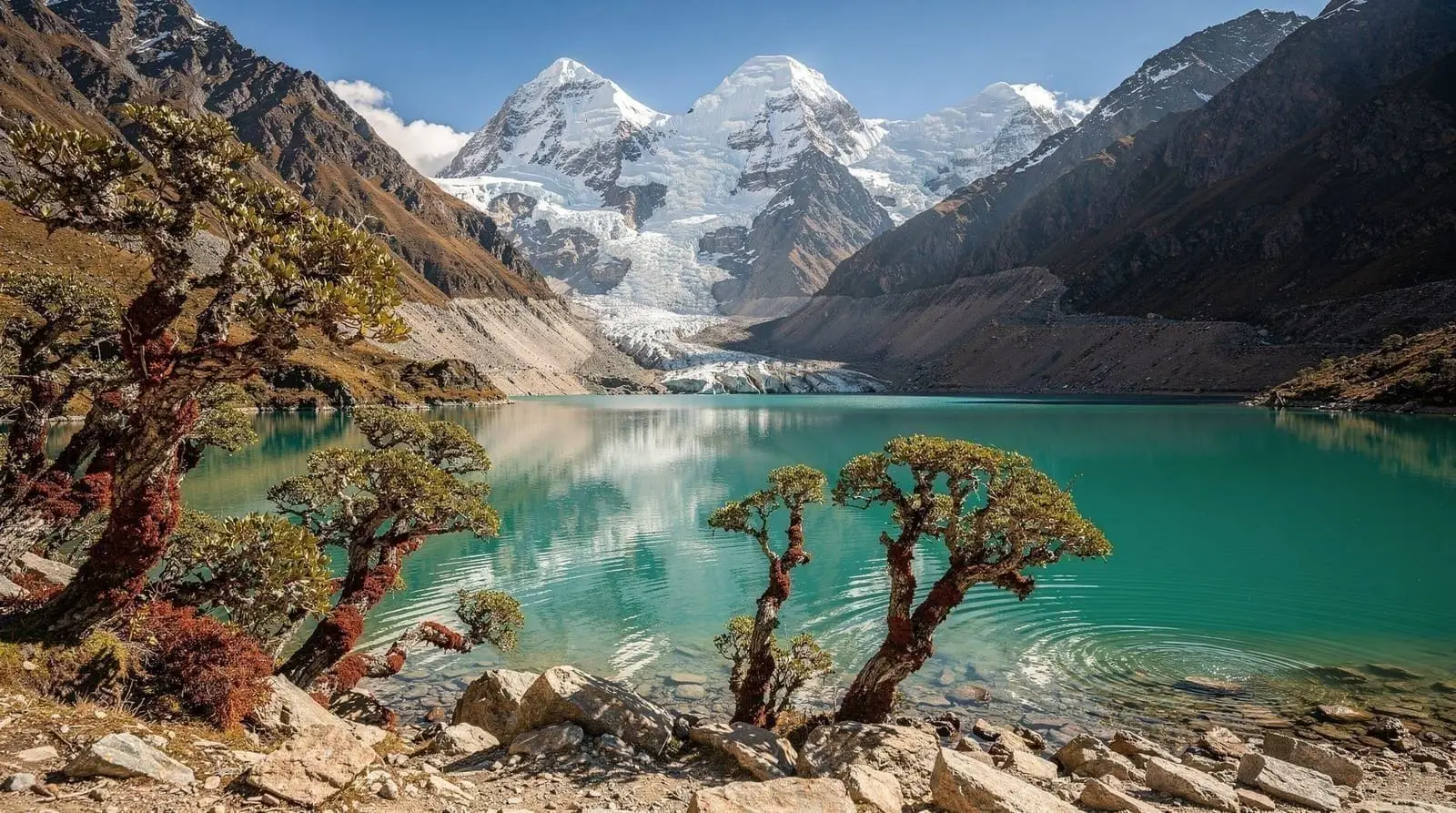
Llanganuco Lakes
Chinancocha and Orconcocha sit at 3,850 m beneath Huascarán. An easy, beautiful day trip from Huaraz and the smartest acclimatisation step before Laguna 69.
From Huaraz: Llanganuco Lakes Full-Day Tour
Quick facts
- Altitude
- 3,850 m (12,630 ft)
- Distance from Huaraz
- ~85 km, 2.5-3 hours by road
- Effort
- Easy — lakeside walking, minimal ascent
- Park fee
- S/30 per day (Huascarán National Park)
- Best for
- Acclimatisation, photography, easy Andean scenery
The smart traveller’s first stop in the Cordillera Blanca
The Llanganuco Lakes are the most accessible piece of the Cordillera Blanca’s spectacular scenery, and that accessibility is precisely what makes them so useful. Two glacial lakes — Chinancocha (the lower, larger one) and Orconcocha (the upper) — fill a steep glacial valley at around 3,850 m, hemmed in on both sides by the towering ice walls of Huascarán (6,768 m, Peru’s highest peak) and Huandoy (6,395 m). The water shifts from emerald to deep blue-green depending on the light and the angle of the sun, and the whole basin has the hushed, enclosed feeling of a place the glaciers carved and then abandoned.
What sets Llanganuco apart from the region’s other lakes is that you barely have to work for it. The road runs right to the shore of Chinancocha, and the only “hiking” required is an optional flat lakeside loop. For most visitors, that combination — extraordinary high-mountain scenery with almost no physical demand — makes Llanganuco the single best acclimatisation outing from Huaraz before the much harder day at Laguna 69.
The valley is also the gateway to bigger adventures. The road past the upper lake climbs to the Portachuelo de Llanganuco pass (4,767 m) and on to the upper Llanganuco valley, where the trailhead for Laguna 69 sits at Cebollapampa, and where the classic multi-day Santa Cruz trek finishes. So you can treat Llanganuco as a destination in itself, or as the lower half of a route that goes much deeper into the range.
| Where | Huascarán National Park, ~85 km north of Huaraz |
| Cost | Around S/40–70 tour + S/30 park fee |
| Time needed | Half to full day |
| Getting there | Organised day tour, shared combi via Yungay, or private taxi |
| Best time | May to September (dry season) for clear Huascarán reflections |
Getting there from Huaraz
Llanganuco lies roughly 85 km north of Huaraz, a drive of about two-and-a-half to three hours via Yungay. The route follows the Callejón de Huaylas valley north — past Carhuaz and Yungay — then turns east and climbs into the glacial valley. The road is paved most of the way and then becomes a well-graded gravel track up to the lakes.
There are three practical ways to go. The easiest is an organised day trip from Huaraz, which handles transport, the national-park fee logistics, and a guide, and usually combines the lakes with a stop in Yungay.
Llanganuco Lakes full-day tour from HuarazA second option is a shared combi or colectivo: minibuses run from Huaraz to Yungay frequently and cheaply (around S/10), and from Yungay you can pick up onward transport or a taxi-colectivo up to the lakes. This is the budget route but requires patience and some Spanish. The third option is hiring a private taxi for the day, which gives you flexibility on timing — useful if you want to be at the lake at dawn before the tour vans arrive.
Llanganuco lake day trip from HuarazWhichever you choose, you’ll pay the Huascarán National Park fee of S/30 per day (or S/150 for a multi-day pass if you’re combining several park visits during your stay).
What there is to do at the lakes
Chinancocha, the lower lake, is where almost everyone stops. A flat, easy interpretive trail loops along part of the shoreline through a small stand of native quenual (Polylepis) trees — gnarled, papery-barked highland trees that grow at improbable altitudes. You can rent a rowboat on Chinancocha for a low fee and paddle out for the classic photograph of Huascarán reflected in the water, though the wind often ruffles the surface by late morning.
Orconcocha, the upper lake, is quieter and less developed; the road passes it on the way up toward the pass. Fewer tour groups stop here, so if you want a few minutes of solitude with the same scenery, ask your driver to pause at the upper lake.
Beyond the lakes, the road continues climbing toward the Portachuelo de Llanganuco pass at 4,767 m, with progressively more dramatic views back down the valley. Some full-day tours include a stop at a high viewpoint or continue to the Cebollapampa meadow. If you have your own transport, the drive up to the pass is one of the most scenic mountain roads in Peru, but be aware that 4,767 m is a serious altitude — don’t make the pass your first high point if you’ve only just arrived.
Why this is the best acclimatisation day
Here is the practical argument for visiting Llanganuco early in your stay. The Cordillera Blanca’s headline attractions — Laguna 69 at 4,600 m and Pastoruri at over 5,000 m — are dangerous to attempt before your body has adapted to altitude. The standard advice is to spend your first day or two in Huaraz resting and then take a gentle step up before the hard hikes. Llanganuco, at 3,850 m with no meaningful climbing, is exactly that step: it gets you sleeping and walking comfortably at altitude, lets you see how your body responds above 3,500 m, and does it in a relaxed day that doubles as genuinely worthwhile sightseeing.
The pattern most experienced visitors follow is: arrive in Huaraz and rest, do Llanganuco on day two or three, then tackle Laguna 69 on day four once you feel solid at altitude. Skipping the acclimatisation step to “save time” is the most common mistake people make in the region, and it routinely ruins the Laguna 69 day with altitude sickness.
Practical details, costs, and what to bring
Budget for the day is modest. A group tour runs roughly S/40-70 (about $11-19 USD), plus the S/30 park fee. The combi-plus-colectivo route can come in under S/40 total but takes longer. Rowboat rental on Chinancocha is a few soles. There are basic food stalls and toilets near the Chinancocha car park, but bring water and snacks; options are limited and prices inflated at the lake.
Pack layers — the valley can be sunny and mild one moment and cold and windy the next — plus a hat, sunglasses, and strong sunscreen, since UV at 3,850 m is fierce. Comfortable walking shoes are enough; you don’t need hiking boots for the lakeside trail. If you’re prone to altitude effects, carry water and take it slow.
The dry season (May to September) gives the most reliable weather and the clearest reflections, with June to August the busiest. In the wet season (October to April), cloud often hides Huascarán and the road can be affected by landslides, though the lakes remain accessible on clearer days.
A sobering stop on the way: Yungay
Most tours pass through, or stop at, the site of old Yungay — and it’s worth understanding what you’re seeing. In 1970, a massive earthquake triggered a debris avalanche off the west face of Huascarán that buried the town of Yungay in seconds, killing an estimated 20,000 people. The site is now a memorial park (Campo Santo); a few palm trees from the old plaza, the tops of the buried cathedral, and a relocated statue of Christ mark the ground. It is a quiet, affecting place, and it grounds the beauty of the surrounding peaks in the real geological violence that shapes this valley. A short visit here adds important context to any Cordillera Blanca trip.
Combining Llanganuco with the wider region
Llanganuco slots naturally into a Cordillera Blanca itinerary based in Huaraz. Pair it early with rest days, then build up to Laguna 69 and the higher Pastoruri Glacier, and set aside a day for the pre-Inca archaeology of Chavín de Huántar. If you want to combine the easy lakes with the famous one in a single long day, some operators run a Laguna 69 trip that takes in the Llanganuco viewpoint as well.
Laguna 69 hike with Llanganuco Lakes viewsFor broader planning on routes and timing across northern Peru, see the guides hub and the itineraries page, or browse bookable excursions on the tours page.
Frequently asked questions about the Llanganuco Lakes
Are the Llanganuco Lakes hard to reach or hike?
No — that’s the appeal. The road runs to the shore of the lower lake (Chinancocha), and the only walking is an optional flat lakeside loop. It’s the easiest major scenery in the Cordillera Blanca, reachable by tour, shared combi, or private taxi from Huaraz in about three hours.
Why are the Llanganuco Lakes good for acclimatisation?
At 3,850 m with almost no climbing, the lakes let you spend a day at altitude and gauge how your body copes before the much harder hike to Laguna 69 (4,600 m) or Pastoruri (over 5,000 m). It’s the smart middle step between resting in Huaraz and attempting the strenuous high hikes.
How much does a Llanganuco day trip cost?
A group tour from Huaraz runs roughly S/40-70 (about $11-19 USD), plus the S/30 Huascarán National Park entrance fee. The budget alternative — a combi to Yungay then a colectivo up to the lakes — can cost under S/40 total but takes longer and needs some Spanish.
Can you swim or take a boat on the lakes?
Swimming is discouraged and the water is glacially cold, but you can rent a rowboat on Chinancocha for a few soles and paddle out for the classic photo of Huascarán reflected in the water. The reflection is clearest in the calm of early morning before the wind picks up.
What’s the difference between Llanganuco and Laguna 69?
The Llanganuco Lakes are low-effort, road-accessible, and at 3,850 m — ideal for acclimatisation and easy sightseeing. Laguna 69 is a demanding 14 km round-trip hike to a single lake at 4,600 m, deeper in the same valley system. Many visitors do Llanganuco first to prepare for Laguna 69.
When is the best time to visit the Llanganuco Lakes?
The dry season (May to September) offers the most reliable clear weather and the best reflections of Huascarán, with June to August the busiest. In the wet season (October to April), cloud frequently hides the peaks and landslides can affect the access road, though the lakes stay reachable on clearer days.
Top experiences
Bookable activities with verified prices and instant confirmation on GetYourGuide.

