Chavín de Huántar
Chavín de Huántar near Huaraz is a UNESCO pre-Inca temple with underground galleries and the carved Lanzón monolith. How to visit, costs, and the long road in.
From Huaraz: Chavín de Huántar Full-Day Tour with Lunch
Quick facts
- Altitude
- 3,180 m (10,433 ft)
- Distance from Huaraz
- ~110 km, ~3 hours each way
- Age
- Ceremonial centre c. 1200-200 BCE
- Admission
- ~S/15 foreign adults (separate museum fee)
- Best for
- Pre-Inca archaeology, underground galleries, a quieter site
A temple older than the Incas, and far less visited
Most travellers come to the Huaraz region for the mountains and the lakes, and Chavín de Huántar gets overlooked as a result. That is a genuine loss, because Chavín is one of the most important archaeological sites in the Americas — a ceremonial centre that flourished roughly 3,000 years ago, more than a millennium before the Incas, and that gave its name to the first widespread artistic and religious tradition in the Andes. UNESCO inscribed it as a World Heritage site in 1985, yet on a typical day you might share the place with a few dozen visitors rather than the thousands who crowd Machu Picchu.
The Chavín culture (roughly 1200-200 BCE) was not an empire in the political sense. It was a religious phenomenon: a powerful cult, centred on this temple complex, whose distinctive iconography — fanged felines, raptors, serpents, and composite supernatural beings — spread across much of what is now northern and central Peru. Chavín de Huántar appears to have functioned as a pilgrimage destination and oracle, where priests staged carefully engineered religious experiences using architecture, acoustics, water channels, and almost certainly hallucinogenic San Pedro cactus to overwhelm and transform the people who travelled there.
Standing in the site today, that intent is still legible. The temple was designed to disorient and awe, and even now, walking its dark underground galleries to confront the carved Lanzón monolith in near-total blackness is a strange, memorable experience that no amount of mountain scenery quite replicates.
| Where | ~110 km from Huaraz, eastern Cordillera Blanca |
| Time needed | Full day (mostly driving) |
| Altitude | 3,180 m at site; road crosses ~4,500 m |
| Cost | ~S/15 site entry, separate museum fee |
| Best time | May–September (dry season) |
What you actually see at the site
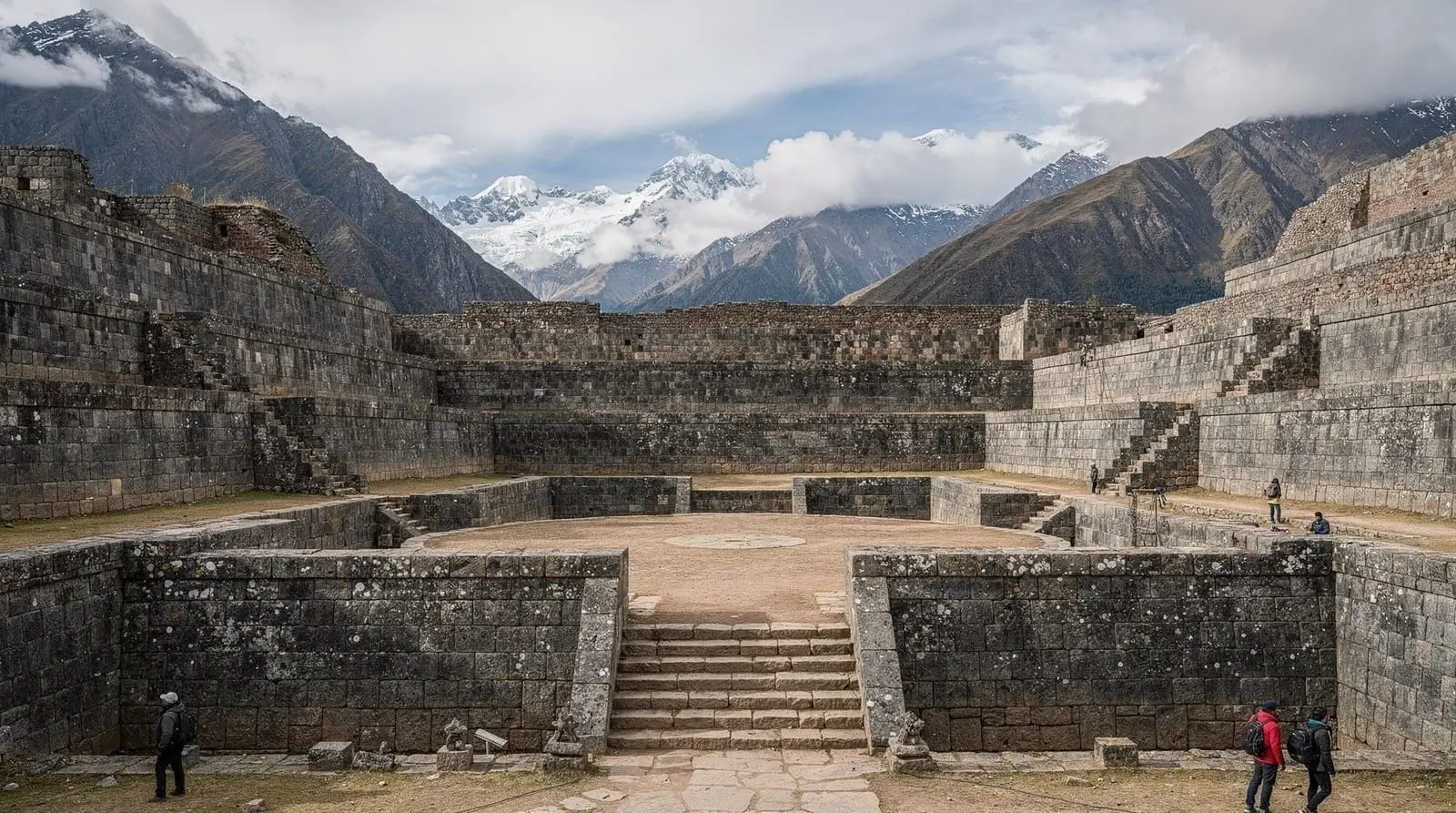
The complex sits at 3,180 m in a narrow valley at the confluence of two rivers, on the eastern side of the Cordillera Blanca. The most visible feature is a series of stepped stone platforms — the Old Temple and the larger New Temple — built and rebuilt over centuries, fronted by sunken plazas. The most photographed elements are the great rectangular sunken plaza and the surviving cabezas clavas: carved stone heads, originally tenoned into the temple’s outer walls, depicting human-feline-serpent transformations. Most originals are now in the on-site museum for protection, with one left in place on the wall.
The real heart of the visit is underground. The temple is honeycombed with narrow stone galleries and passages, ventilated and drained by an ingenious system of channels. At the centre of the oldest gallery stands the Lanzón, a 4.5 m granite shaft carved with a fanged anthropomorphic deity, wedged floor-to-ceiling in a cruciform chamber. It has stood in exactly that spot for around 3,000 years — it was never moved, the temple was built around it — and seeing it in the dim, cramped gallery, lit just enough to read the carving, is the moment that justifies the long trip.
Allow at least two to three hours at the site itself, more if you visit the excellent Museo Nacional de Chavín a short distance away in the town of Chavín, which houses the famous Tello Obelisk, many of the original cabezas clavas, and the elaborately carved conch-shell trumpets (pututus) found in the galleries.
Getting there: the honest version of the journey
There is no quick way to Chavín. It lies about 110 km from Huaraz by road, but “110 km” in this terrain means roughly three hours each way. The route crosses the Cordillera Blanca via the Kahuish tunnel, a single-lane tunnel bored through the range at about 4,500 m, with a high pass approach on either side. The scenery is spectacular — glacial lakes, the turquoise Querococha lagoon, big mountain views — but the road is winding, the altitude on the crossing is significant, and the journey eats most of the day.
Because of that, almost everyone visits on an organised full-day tour from Huaraz, which is genuinely the sensible choice: the operator handles the long drive, a guide explains the site (essential — without interpretation the galleries are baffling), and many tours include lunch in Chavín town and the photo stops at Querococha.
Chavín de Huántar full-day tour with lunch from HuarazIf you’d rather a version that bundles the on-site national museum into the day, some operators run that specifically.
Chavín de Huántar and Chavín Museum day tripIndependent travel is possible but fiddly: combis run from Huaraz toward Chavín (via the village of Catac and the tunnel), taking three to four hours, and you’d need to manage your own timing to see the site and get back before the last return service. For most visitors the tour is both easier and not much more expensive once you factor in the guide.
Excursion to Chavín de HuántarAltitude and practicalities
Chavín town and the site sit at 3,180 m — barely above Huaraz — so the destination itself is not an altitude concern if you’re already based in Huaraz. The catch is the road: the Kahuish tunnel crossing tops out around 4,500 m, and some travellers who feel fine in Huaraz get a headache on the high pass. It’s brief, and you’re back down by the time you reach the site, but it’s another reason to have a few days’ acclimatisation behind you before this trip rather than doing it on arrival.
Admission to the archaeological site is currently around S/15 for foreign adults, with reduced rates for students and nationals; the Museo Nacional de Chavín charges a separate small fee (sometimes free on certain days — check locally). The site is generally open daily from around 8 am to 5 pm. Bring water, sun protection, and a light layer; the galleries are cool and dim, and good footwear helps on the uneven stone. Photography is allowed in most areas, though flash is restricted around the Lanzón. A guide is strongly recommended — the meaning of the place is almost entirely lost without one.
Tourist-trap notes and honest expectations
A couple of honest caveats. First, calibrate your expectations: Chavín is monumentally important and intellectually fascinating, but it is not visually overwhelming in the way Machu Picchu or even Kuélap are. Much of its significance is in what you understand rather than what you photograph, which is exactly why a knowledgeable guide makes or breaks the visit. Travellers expecting a dramatic ruined skyline sometimes leave underwhelmed; those who engage with the story leave fascinated.
Second, the day is long and a large fraction of it is spent in the van. If you’re short on time in the region and have to choose between Chavín and a second mountain day, be honest about which you’ll value more. Chavín rewards people genuinely interested in pre-Columbian history; it can feel like a long drive for a relatively small site to those who aren’t.
Third, in Chavín town there’s a low-key trade in “ancient” souvenirs and replicas of the carvings. Buy them as the modern crafts they are, not as antiquities, and never buy anything claimed to be a genuine artefact — trading in real archaeological objects is illegal and fuels looting.
What the Chavín cult left behind
Chavín’s influence outlasted the site itself. Its iconography — the fanged deity, the serpent and raptor motifs, the composite supernatural beings — spread across a wide swath of the central and northern Andes during what archaeologists call the Early Horizon, well over a thousand years before the Inca. Later Andean cultures, including the Moche on the north coast (whose sites you can see around Chan Chan and Trujillo), inherited motifs and religious concepts traceable back to Chavín. Understanding this lineage is part of what makes the underground galleries feel less like an isolated curiosity and more like the root of a much longer Andean religious tradition — one that eventually fed into Inca cosmology itself.
A balanced Cordillera Blanca week
Chavín slots naturally into a longer Huaraz-based trip as the “culture day” between demanding hikes. A sample week:
| Day | Activity |
|---|---|
| 1–2 | Acclimatise in Huaraz; easy walks around town |
| 3 | Llanganuco Lakes — easy, scenic day trip |
| 4 | Chavín de Huántar — full-day culture day, lower physical demand |
| 5 | Laguna 69 — the demanding hike, done once acclimatised |
| 6 | Pastoruri Glacier or rest day |
Placing Chavín mid-week, after a couple of easier acclimatisation days, works better than doing it first — you’ll appreciate the site more without competing for energy against a big hike the same week.
Combining Chavín with the rest of the region
Chavín works well as a change of pace within a Cordillera Blanca trip based in Huaraz — a culture day slotted between the strenuous high hikes. A balanced week might pair it with the easy Llanganuco Lakes, the demanding Laguna 69, and the high Pastoruri Glacier, giving you a mix of mountains, lakes, ice, and deep history.
For wider routing and timing advice across northern Peru, see the guides hub and the itineraries overview, and browse bookable excursions on the tours page.
Frequently asked questions about Chavín de Huántar
How old is Chavín de Huántar?
The ceremonial centre flourished from roughly 1200 to 200 BCE, predating the Inca Empire by more than a millennium. The Lanzón monolith at its core has stood in place for around 3,000 years. Chavín gave its name to the first major artistic and religious tradition to spread across the Peruvian Andes.
How do you get to Chavín de Huántar from Huaraz?
It’s about 110 km, roughly three hours each way, crossing the Cordillera Blanca through the Kahuish tunnel at around 4,500 m. Almost everyone goes on an organised full-day tour from Huaraz, which handles the long drive, a guide, and usually lunch. Independent combi travel is possible but requires careful timing.
Is Chavín de Huántar worth visiting compared to the mountains?
It’s worth it for travellers interested in pre-Inca history and archaeology. The underground galleries and the Lanzón are genuinely unique, and the site is far quieter than Machu Picchu. If you have limited time and care more about scenery than ancient history, a mountain day may suit you better. A good guide makes the visit far more rewarding.
How much does it cost to enter Chavín de Huántar?
Admission to the archaeological site is around S/15 for foreign adults, with reduced rates for students and Peruvian nationals. The Museo Nacional de Chavín in town charges a separate small fee. Most visitors pay for a tour from Huaraz, which includes transport, a guide, and often lunch on top of the entrance fees.
Is the altitude a problem at Chavín de Huántar?
The site itself sits at 3,180 m, barely higher than Huaraz, so it’s not a concern if you’re already acclimatised. The one altitude factor is the road crossing through the Kahuish tunnel at around 4,500 m, which can give a brief headache on the high pass. Having a few acclimatisation days behind you helps.
Do I need a guide at Chavín de Huántar?
Strongly recommended. The site’s layout, iconography, and the meaning of the galleries and the Lanzón are difficult to grasp without interpretation. Most tours from Huaraz include a guide; if you visit independently, you can usually hire one at the entrance. Without one, much of what makes Chavín extraordinary stays hidden.
Where does Chavín fit in a Cordillera Blanca itinerary?
Best placed mid-week, after a couple of acclimatisation days in Huaraz and before or after the demanding Laguna 69 hike — it makes a genuinely restful, low-altitude-effort day that still delivers a full and worthwhile experience, rather than competing directly with a big hiking day for your energy.
How does Chavín connect to later Andean cultures?
Chavín’s religious iconography — fanged deities, serpent and raptor motifs — spread across the Andes and influenced later cultures including the Moche on the north coast, whose sites cluster around Chan Chan and Trujillo. Visiting both regions gives a genuine sense of how Peru’s pre-Inca religious traditions evolved over more than a thousand years.
Top experiences
Bookable activities with verified prices and instant confirmation on GetYourGuide.
