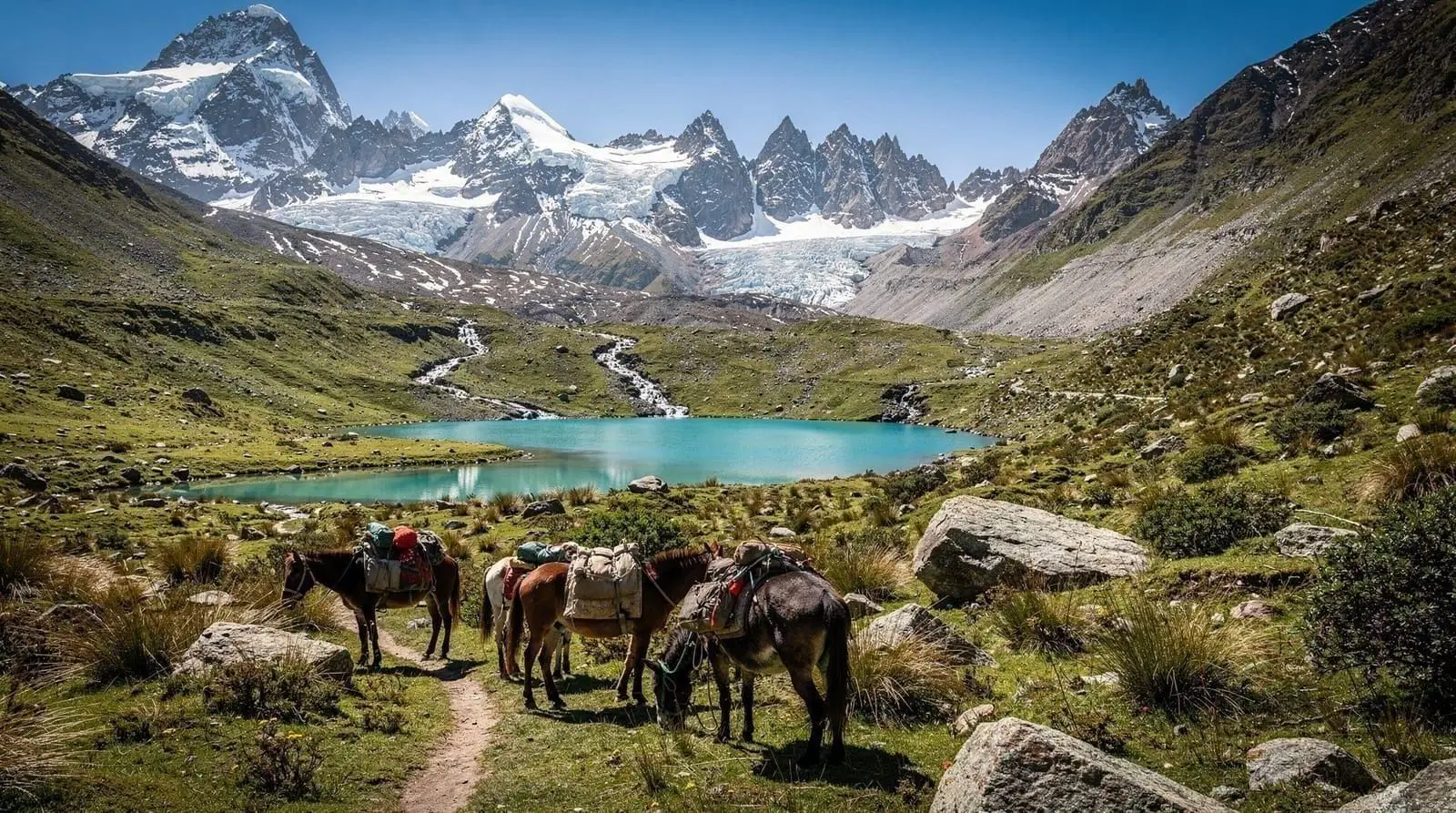
Santa Cruz trek guide: the classic 4-day Cordillera Blanca route
Huaraz: Santa Cruz Trek 4-Day Guided Tour
What is the Santa Cruz trek and how hard is it?
The Santa Cruz trek is a 50 km, 4-day point-to-point route through the Cordillera Blanca near Huaraz, crossing the Punta Unión pass at 4,750 m. It is non-technical but physically demanding, and the single hardest factor is altitude — you must arrive acclimatised.
Why this route earns its reputation
The Santa Cruz trek is the most popular multi-day route in the Cordillera Blanca, and it earned that status honestly. Over roughly 50 km it threads a glacial valley beneath a wall of 6,000 m peaks — Taulliraju, Artesonraju, Alpamayo (often voted the most beautiful mountain in the world) lurking just over the ridge — then climbs to a single high pass before dropping into a second valley. There are no technical sections, no ropes, no glacier travel. What makes it serious is the combination of distance, sustained altitude, and four days of self-sufficiency far from any road.
| Where | Cashapampa to Vaquería (or reverse), Cordillera Blanca near Huaraz |
| Cost | around S/650-1,000 ($175-270) guided, plus S/150 park fee |
| Time needed | 4 days / 3 nights, about 50 km total |
| Getting there | road transfer from Huaraz to the Cashapampa or Vaquería trailhead |
| Best time | May-September dry season; avoid November-March |
Day-by-day at a glance
| Day | Route | Distance | Camp altitude |
|---|---|---|---|
| 1 | Cashapampa to Llamacorral | ~12 km | ~3,760 m |
| 2 | Llamacorral to Taullipampa | ~10 km | ~4,250 m |
| 3 | Taullipampa over Punta Unión to Paria | ~14 km | ~3,800 m |
| 4 | Paria to Vaquería | ~9 km | road head, ~3,700 m |
If you are reading this to decide whether the trek is for you, the honest summary is: it is achievable for a reasonably fit person who has properly acclimatised, and it is miserable or dangerous for someone who shows up off the overnight bus from Lima. The route does not forgive a casual approach to altitude. Read the Huaraz acclimatisation guide and spend three to four days getting your body used to elevation before you start.
The route, day by day
Santa Cruz is a point-to-point trek, which means you finish in a different valley from where you started. Most people walk it in one of two directions, and the direction matters more than first-time trekkers expect.
Cashapampa to Vaquería (south to north) is the classic and more common direction. You start low at around 2,900 m in Cashapampa, near Caraz, and gain altitude gradually over the first two days — which is gentler on the body and lets you keep acclimatising as you walk. The pass comes on day three when you are best adapted.
Vaquería to Cashapampa (north to south) starts higher at around 3,700 m near the Llanganuco lakes and reaches the Punta Unión pass faster, on day two. It is shorter on paper but harder on the lungs because you hit the high point before full adaptation.
Day 1 — Cashapampa to Llamacorral
A long, steady climb up the Santa Cruz valley alongside the river. You start at roughly 2,900 m and camp at Llamacorral around 3,760 m. Distance is about 12 km with a steady 850 m gain. The valley walls close in and you get your first proper views of the high peaks. This is the day that quietly sorts out who acclimatised and who did not — a thumping headache at Llamacorral is a warning, not a rite of passage.
Day 2 — Llamacorral to Taullipampa
A more gradual day past the Jatuncocha and Ichiccocha lakes, with the option of a side trip toward the Alpamayo base camp viewpoint if your group has the energy and time. You camp at Taullipampa, around 4,250 m, beneath the dramatic spire of Taulliraju. Roughly 10 km. The side trip to the Alpamayo mirador adds two to three hours and is the single best optional detour on the route — clear weather permitting.
Day 3 — Taullipampa over Punta Unión to Paria
The crux. From camp you climb steadily to the Punta Unión pass at 4,750 m, the high point of the trek, where a narrow notch in the rock suddenly reveals both valleys and a string of turquoise lakes below. The descent on the far side is long, dropping to the Paria camp at around 3,800 m. About 14 km and a brutal but rewarding day. Start early — afternoon weather on the pass can turn fast even in dry season.
Day 4 — Paria to Vaquería
A relatively easy descent through the Huaripampa valley to the road head at Vaquería (around 3,700 m), where transport picks you up for the long drive back to Huaraz through the Llanganuco valley. Roughly 9 km, mostly downhill. Many groups combine this drive with a stop at the Llanganuco Lakes.
Guided, self-guided, or with arrieros: the real choice
This is where you need to think clearly, because the marketing in Huaraz blurs the options.
Fully guided group trek. An agency provides a guide, cook, arrieros (mule handlers), mules to carry the heavy gear, tents, meals, and transport at both ends. You walk with a daypack only. This is the most comfortable option and the most common. Group prices typically run S/650–1,000 (about $175–270 USD) per person for the four days, depending on group size and agency quality.
Santa Cruz 4-day guided trek from HuarazSelf-guided with arrieros. The Santa Cruz trail is well-established and not hard to follow, so experienced trekkers sometimes skip the guide but still hire an arriero and mules to carry gear. This is cheaper and gives you independence, but you handle your own food, navigation, and emergencies. Arrieros charge roughly S/70–90 per day plus a similar amount per mule; a single arriero can manage two to three mules.
Fully independent. Carrying everything yourself is legal and done by some, but at this altitude a full pack is punishing, and there is no quick exit if something goes wrong. Only consider it if you have solid high-altitude backpacking experience.
A practical middle path many take is a guided trek that runs the Llanganuco-included version, combining the trek with the lake circuit.
Santa Cruz–Llanganuco 4D/3N trek from HuarazPermits, fees, and the honest budget
The trek runs through Huascarán National Park, which charges an entry fee — currently around S/150 (about $40 USD) for a multi-day pass. A guided package usually includes this, but always confirm; some cheaper operators quietly leave it off the quoted price and collect it at the gate. Ask explicitly what is and is not included before you pay.
A realistic all-in budget for a guided four-day trek, including the park fee, tips, and a couple of meals in Huaraz before and after, lands around S/800–1,200 (roughly $215–325 USD). Tips for the guide, cook, and arrieros are customary and genuinely matter to their income — budget around S/100–150 per trekker to split among the crew.
Gear and renting in Huaraz
You can rent almost everything in Huaraz, and for a one-off trek that usually makes more sense than buying. Rental shops cluster around Jirón Luzuriaga. Expect to pay roughly:
- Sleeping bag (rated to at least −10 °C): S/15–25 per day
- Sleeping mat: S/5–10 per day
- Trekking poles: S/10–15 per day
- Tent (if not included): S/20–40 per day
Inspect rented sleeping bags carefully — ask whether the temperature rating is real or optimistic, because nights at Taullipampa drop below freezing. Bring your own broken-in boots; rented footwear is a recipe for blisters. A four-season-warm layer, gloves, hat, and a serious rain shell are non-negotiable even in dry season.
For a full pre-trek checklist and gear advice, see the Huaraz destination guide.
Altitude and safety: the part you cannot skip
The Punta Unión pass at 4,750 m is higher than any point on the standard Inca Trail, and you sleep above 4,000 m. Acute mountain sickness (AMS) is common; its early signs are headache, nausea, fatigue, and disturbed sleep. These usually ease with rest and hydration. The dangerous escalations are HAPE (high-altitude pulmonary oedema — breathlessness at rest, a wet cough) and HACE (cerebral oedema — confusion, loss of coordination, severe headache). Both are medical emergencies and the only reliable treatment is immediate descent.
Practical defences: arrive acclimatised, walk slowly, drink three to four litres of water daily, avoid alcohol, and tell your guide honestly how you feel. Acetazolamide (Diamox) is sold over the counter in Huaraz and can help, but it is not a substitute for acclimatisation. Do not let group momentum or a fixed itinerary push you over the pass if you are deteriorating — a competent guide will turn you around, and a bad one will not, which is one more reason to choose a reputable operator.
Choosing an operator without getting burned
Huaraz has dozens of trekking agencies and the quality range is enormous. Touts near the bus terminals and on Luzuriaga will sell you a trek for almost nothing — and the savings often come out of food quality, gear condition, guide certification, and arriero pay. Warning signs of a low-end operator: a price far below the market, vagueness about whether the park fee is included, no insurance, and a guide without a recognised certification.
Better operators employ certified mountain guides (look for AGMP or UIAGM credentials for technical climbs; for trekking, a qualified guía oficial de turismo with mountain experience is the standard), carry a first-aid kit and ideally a portable altitude chamber or oxygen, and pay their crews fairly. Booking in advance through an established platform removes some of the guesswork about who actually shows up at the trailhead.
How Santa Cruz compares to the alternatives
If you are weighing this against other Peru treks, two comparisons come up constantly. Against the Inca Trail and Salkantay routes near Cusco, Santa Cruz wins on raw mountain scenery and loses on the Machu Picchu payoff — there is no famous ruin at the end, just a road head. Against the Huayhuash circuit, Santa Cruz is far shorter, easier, and more accessible; Huayhuash is the bigger, wilder, harder expedition. If you have only four days and want the essence of the Cordillera Blanca, Santa Cruz is the answer. If you have nine and want the full alpine immersion, see the Huayhuash circuit guide.
For broader trip planning, the Huaraz vs Cusco for hiking comparison and the Peru 2-week itinerary guide help you fit Santa Cruz into a larger route. If you are travelling by bus to reach Huaraz, the Peru bus travel guide covers the overnight services from Lima.
If you want a shorter taste of the range before committing four days, the Llanganuco Lakes are reachable as a day trip from Huaraz and sit right along the route Santa Cruz transport uses on day four — a useful way to preview the scenery. And if the blow-by-blow above still leaves questions about pacing, the Huaraz acclimatisation guide and the best day hikes near Huaraz guide are the natural next reads before you commit to the multi-day trek.
Photography and phone charging on the trail
Santa Cruz is one of the most photogenic treks in South America, and a little planning improves your results. The Punta Unión pass at sunrise or shortly after is the single best light, with the turquoise lakes below catching the early sun before afternoon cloud typically builds. Taullipampa camp, beneath Taulliraju, is the other standout spot — worth setting an alarm for a pre-dawn look if the sky is clear. None of the camps have power, so bring a fully charged power bank; the cold at altitude drains batteries faster than usual, and keeping your phone or camera in an inner jacket pocket overnight helps preserve charge.
Wildlife and what you might see
Beyond the mountain scenery itself, Santa Cruz passes through habitat for a handful of Andean species worth watching for. Andean condors occasionally soar over the higher sections of the route, particularly near the pass, and viscachas (a rabbit-like rodent related to chinchillas) sun themselves on rocks near camp in the mornings. The valley’s lakes attract Andean geese and other waterfowl, and the puna grassland supports grazing llamas and alpacas herded by local families who still use the high pastures much as their ancestors did. None of this wildlife is guaranteed, but keeping binoculars handy adds an extra dimension to the walking.
A note on solo travellers and small groups
Santa Cruz is a genuinely sociable trek to do with a group tour if you are travelling solo — most agencies mix independent trekkers into shared groups of eight to fourteen, and the shared camp routine (meals, the pass-day push, the evening card games) makes it an easy trek to make friends on. If you specifically want a quieter, more private experience, ask agencies about smaller custom groups; they cost more per person but are increasingly common as demand for Santa Cruz grows. Either way, confirm your group size before booking, since a fourteen-person group moves and eats noticeably differently from a group of four.
When to go
The trekking season is firmly May through September, the Andean dry season, with June to August the most reliable and the most crowded. Trails are clear, river crossings are manageable, and the chance of being socked in by cloud at the pass is lowest. The shoulder months of October and April can work but carry a real risk of afternoon storms and snow on the pass. Avoid November through March — the wet season brings persistent rain, mud, low morale, and a genuine landslide hazard on the access roads.
Even within the dry season there are nuances. May and early June often have the clearest air and the best snow on the high peaks, before the trekking herd arrives. Late August into September can be slightly hazier as the dry, dusty season wears on, but it is quieter than the July–August peak. Weekends throughout the season are busier than weekdays because Peruvian and regional visitors hit the trail; if your schedule is flexible, starting on a Monday or Tuesday gives you emptier campsites.
What the camps and food are like
On a guided trek, the camps are simple but functional: a mess tent where the cook serves surprisingly good meals, individual or shared sleeping tents, and a basic toilet tent. Andean trek cooks are genuinely skilled at producing hot, calorie-dense food at altitude — expect soups, rice and potato dishes, pasta, pancakes, and copious coca tea. Tell your operator in advance about dietary needs; vegetarian is easily handled, but specialised diets need warning.
Water along the route comes from glacial streams. Even on a guided trek, confirm whether drinking water is boiled or treated, and carry your own purification (tablets or a filter) as a backup. The camps have no electricity, no signal for most of the route, and no shops — what you forget in Huaraz, you do without. Bring a power bank for your phone and camera; the cold drains batteries fast, so sleep with them in your sleeping bag.
Common mistakes to avoid
A few errors trip up first-time Santa Cruz trekkers again and again. Underestimating the altitude is the big one — people treat it like a long hike at home and pay for it on day one. Booking the cheapest tour from a tout is the second; the savings usually surface as thin food, a leaking tent, or a guide who will not turn a sick client around. Overpacking is the third — even with mules carrying the bulk, you walk with a daypack, and an overloaded one is misery at 4,000 m. Finally, skipping travel insurance that covers high-altitude trekking and evacuation is a gamble that occasionally ends very badly; standard policies often exclude activity above a certain altitude, so check the small print.
Frequently asked questions about the Santa Cruz trek
How fit do I need to be for the Santa Cruz trek?
You need to be comfortable hiking six to eight hours a day on consecutive days with a daypack, on uneven terrain, at altitude. You do not need to be an athlete. The limiting factor for most people is not fitness but acclimatisation — a very fit person who skips acclimatisation will struggle more than an average hiker who took three days to adjust.
Can I do the Santa Cruz trek without a guide?
Yes, legally and practically — the trail is well-trodden and waymarked, and experienced backpackers do it self-guided. Most people hire at least an arriero and mules to carry gear even if they skip the guide. If you have no high-altitude trekking experience, a guided trip is the safer and more sensible choice.
How much does the Santa Cruz trek cost?
A guided four-day trek typically costs S/650–1,000 (about $175–270 USD) per person, before the Huascarán National Park fee of roughly S/150 and crew tips of S/100–150. Self-guided with an arriero is cheaper but you cover your own food, gear, and transport.
How high is the Santa Cruz trek?
The high point is the Punta Unión pass at 4,750 m. You camp between roughly 3,760 m and 4,250 m, and start as low as 2,900 m if walking from Cashapampa. You should be acclimatised to at least 4,000 m before starting.
Which direction should I walk the Santa Cruz trek?
Cashapampa to Vaquería (south to north) is recommended for most people because you gain altitude gradually and reach the pass on day three when best acclimatised. Vaquería to Cashapampa reaches the pass sooner and is harder on the body.
Is the Santa Cruz trek better than the Inca Trail?
For mountain scenery, many trekkers rate Santa Cruz higher — it is wilder, less crowded, and surrounded by 6,000 m peaks. The Inca Trail wins for archaeology and the Machu Picchu finish. They are different experiences; see the Huaraz vs Cusco for hiking comparison to decide.
Do I need to book the Santa Cruz trek in advance?
In peak season (June to August) booking a few days ahead from Huaraz, or in advance online, secures a place and lets you vet the operator. Unlike the Inca Trail, there is no government permit cap, so last-minute spots are usually available — but quality operators fill up faster than the touts.
Top experiences
Bookable activities with verified prices and instant confirmation on GetYourGuide.

