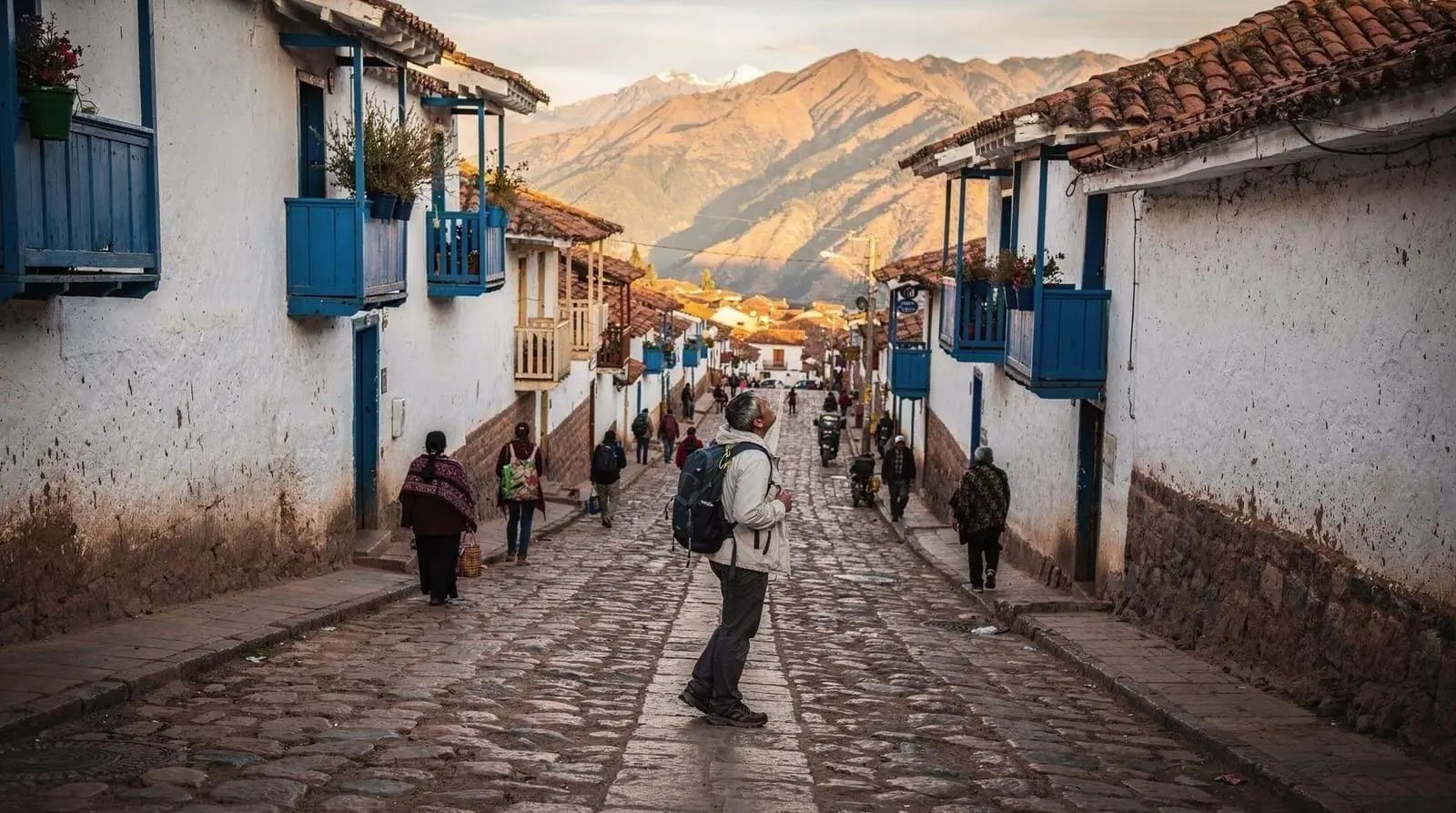
Solo travel in Cusco: safety, budget and logistics
Cusco: Half-Day City Tour with Sacsayhuaman and Q’enco
Is Cusco a good place to travel solo?
Yes. Cusco is one of the easiest solo destinations in South America: a compact, walkable centre, a dense hostel scene that makes meeting people effortless, and a tour market where almost everything runs as a shared group. The main solo-specific challenges are managing altitude with no one to monitor you and the higher per-person cost of anything sold per vehicle or per room.
Why Cusco works so well on your own
Cusco is one of the gentlest places in South America to land as a solo traveller, and that is not an accident of marketing. The old centre is small enough to cross on foot in twenty minutes, the tour economy is built almost entirely around shared groups that price per person, and the city hosts a constant churn of independent travellers passing through on the way to Machu Picchu. You rarely have to engineer company; it finds you in the hostel kitchen and on the minibus to Rainbow Mountain.
That said, travelling alone here carries two specific costs that couples and groups dodge. The first is financial: anything sold per vehicle or per room — a private transfer, a private guide, a hotel double — lands entirely on you. The second is medical: at 3,400 m (11,150 ft), altitude sickness can creep up overnight, and with no one in the room to notice you struggling, you have to be your own monitor. This guide is built around managing both, with real prices in soles (S/) and the dollar equivalents that matter when you are budgeting from home.
| Solo-friendliness | High — dense hostel scene, tours priced per person |
| Daily budget | S/120-170 shoestring, S/300-450 mid-range |
| Solo penalty | Rooms and private transport only, not tours |
| Altitude risk | Same as anyone, but no one to monitor you overnight |
| Best base | San Blas or near the Plaza for social density |
Is Cusco safe for solo travellers?
Cusco is, by the standards of large Latin American cities, comfortably safe for visitors. Violent crime against tourists is uncommon, and the daytime centre is relaxed enough to wander alone without a second thought. The risks that actually catch solo travellers are mundane and avoidable.
Opportunistic theft is the leading problem. Pickpockets work the crush inside San Pedro market, the crowds at plaza festivals, and the loading scramble on long-distance buses. Keep your phone out of sight on the street, carry a day’s cash and leave the rest locked at the hostel, and never put a bag on the back of your chair in a café near the Plaza de Armas.
The nightlife strip along Calle Plateros and Procuradores is where most solo-traveller incidents concentrate. Drink-spiking has been reported in a handful of clubs, and aggressive touts funnel single travellers toward specific bars on commission. Buy your own drinks, watch them poured, and leave with people you actually arrived with rather than a new “friend” met at the bar an hour earlier.
Taxis are the other genuine risk. Cusco has no metered street taxis and a long history of unmarked cars overcharging or, rarely, robbing late-night passengers. The fix is simple: use the InDriver or Cabify apps, which fix the fare and log the driver, especially after dark and to or from the bus terminal and airport.
For solo women specifically, the daytime experience is generally easy; the friction is persistent street attention and the nightlife caveats above. None of this makes Cusco a place to avoid alone — it makes it a place to apply the same instincts you would in any unfamiliar city, plus a phone full of taxi apps. For a fuller breakdown of fares and money, see Cusco taxi and money tips.
Doing the altitude alone
This is the one area where solo travel genuinely raises your risk, and it deserves more attention than the safety question. Altitude sickness — soroche — is unpredictable, unrelated to fitness, and can worsen while you sleep. A couple has a built-in monitor; you have to be your own.
Practical rules for your first 24-36 hours on your own:
- Tell hostel staff you have just flown in from sea level. Front desks in Cusco deal with soroche constantly and will check on you and arrange oxygen if you ask.
- Do nothing strenuous on arrival day. No Sacsayhuamán climb, no hauling a heavy pack uphill. Rest, hydrate, and let your body register the elevation.
- Keep your phone charged and by the bed. If you wake confused, breathless at rest, or with a wet cough, those are red flags for the dangerous forms of altitude illness and you need help and descent, not to tough it out alone.
- Know where oxygen comes from. Pharmacies on Avenida El Sol sell canisters, and several clinics deliver oxygen to hotels on call.
A smarter structural move, if your schedule allows, is to sleep your first night or two lower in the Sacred Valley — Urubamba and Ollantaytambo sit several hundred metres below Cusco — and come up to the city already partly adjusted. The full reasoning is in Cusco vs Sacred Valley for altitude and the altitude sickness guide. Skip the mate de coca myths and over-the-counter “miracle” pills; the altitude medicine scams guide covers what actually helps.
A realistic solo budget in soles
Cusco is cheap by Western standards but the solo premium on rooms is real. Here is what a day actually costs, in soles with USD in parentheses at roughly S/3.70 to the dollar.
Shoestring (S/120-170 / about $32-46 a day):
- Hostel dorm bed: S/35-55. Clusters around San Blas and Calle Saphi are sociable and central.
- Food: S/30-50, eating set-lunch menús (soup, main, drink for S/10-18) and market stalls in San Pedro.
- Activity or transport: S/40-70 for a shared day-trip seat or city tour, spread across days.
Mid-range (S/300-450 / about $81-122 a day):
- Private room in a guesthouse: S/120-220 — this is where the solo supplement bites.
- Food: S/80-150, mixing menús with a sit-down dinner.
- One guided day trip: S/90-180 per person.
The single biggest lever for a solo budget is accommodation. A dorm costs a third of a private room, and the hostels are also where you find people to split a private taxi to Humantay or to share a Sacred Valley car. For deep budget tactics — free walking tours, market eating, which boleto to buy — read Cusco on a budget.
Tours: where solo travellers win and where they lose
Cusco’s tour market is the reason solo travel is so painless here. Almost every popular day trip runs as a shared group at a per-person price, so there is no penalty for being one rather than two.
A licensed half-day city tour is the most efficient solo introduction, bundling the climb to the ruins above town with transport and a guide. The half-day Cusco city tour with Sacsayhuamán and Q’enqo spares your still-acclimatising body the steep walk and the boleto-booth queue, and puts you in a group on day two or three.
For the marquee day trips, shared seats are the default. Rainbow Mountain, Humantay Lake and the Sacred Valley circuit all sell per person, and you will likely recognise faces from your hostel on the bus. The full-day Sacred Valley tour is a typical example — a shared coach, a guide, and no single supplement.
Where solo travel costs more is anything private. A private guide at Machu Picchu, a private transfer from the airport, or a private Sacred Valley car all charge by the vehicle, so you pay what a group of four would split. The workaround is the hostel noticeboard and WhatsApp group: assembling three other travellers to share a private car is a standard Cusco move.
One honesty note: book shared tours through reputable operators rather than the cheapest street-stall flyer. The savings on a too-good-to-be-true price often come from unlicensed, uninsured operators — a real hazard covered in detail in the unlicensed tour agencies guide and the tourist traps guide.
Eating alone, comfortably
Eating solo in Cusco is genuinely easy, because the cheapest and best food is informal. San Pedro market is built for single diners: counter seating at the juice stalls, caldo de gallina for around S/8, and frutado blends for S/6-10, all eaten elbow to elbow with locals. The set-lunch menú in everyday restaurants a block or two off the plaza is the other solo staple — S/10-18 for a full meal, no awkwardness.
For a sit-down dinner alone, the city is forgiving. Cicciolina on Calle Triunfo has a long bar where solo diners are normal; the cooking classes are a sociable alternative if you would rather not eat alone at all. Avoid the balcony restaurants ringing the Plaza de Armas, which charge a view premium and lean hard on passing trade. The best restaurants in Cusco guide names specific spots across budgets.
Building a solo itinerary
A workable solo week treats Cusco as the hub. Acclimatise for a day or two in the city or, better, in the lower Sacred Valley; do a shared city tour and the Sacred Valley; slot in one big-ticket day trip such as Rainbow Mountain; then take the train or trek to Machu Picchu. Solo travellers do the classic Inca Trail and Salkantay treks constantly — both run as guided groups, so you are never genuinely alone on the trail. For ready-made routings you can adapt, browse the itineraries hub, and for the pacing logic see how many days in Cusco.
Where to base yourself as a solo traveller
Where you sleep shapes the whole solo experience here, and Cusco’s neighbourhoods sort cleanly by traveller type. The San Blas quarter, climbing the slope above the centre, is the backpacker and digital-nomad heart: cobbled lanes of hostels, cafés and workshops, sociable and central, though the gradient is a real lungful at this altitude until you acclimatise. The streets around Calle Saphi and Calle Suecia, just off the Plaza de Armas, put you in the thick of the action and the nightlife — convenient and lively, but noisier, with the bar-strip caveats already noted. For a quieter base, the area below Avenida El Sol trades atmosphere for calm and easy taxi access to the bus terminal and airport.
For solo travellers specifically, the calculation is social density versus sleep. A hostel in San Blas or near the plaza maximises the chance of finding people to share a Rainbow Mountain van or a Sacred Valley car, which is both cheaper and safer than going entirely alone. If meeting people is a priority, pick a hostel with a working kitchen and an organised event calendar — those are where the ad hoc travel groups form. If you value rest over socialising, a guesthouse a few blocks out will serve you better, and you can still walk into the social scene whenever you want it.
One altitude-aware tip on accommodation: a room up a steep San Blas lane is a punishing arrival on day one with a heavy pack at 3,400 m. If you are landing straight from sea level, consider a flatter, lower base for the first night or two before moving up the hill — or, as covered above, sleep your first nights in the lower Sacred Valley entirely.
Staying connected and getting help
Travelling alone makes connectivity less of a convenience and more of a safety tool. Buy a local Claro or Entel SIM — sold at the airport and in pharmacies for around S/20-35 with a month of data — so you always have the InDriver and Cabify taxi apps working, a way to share your location, and the means to call for help. Save your accommodation’s address and phone number offline, and note the tourist police (Policía de Turismo) presence around the centre, who deal regularly with travellers’ problems from theft reports to lost documents.
For the genuine emergency — a medical altitude scare or an accident on a trek — know that Cusco has private clinics accustomed to treating tourists, several of which deliver oxygen to hotels, and that travel insurance covering high-altitude activity is not optional for a solo trip built around trekking and 5,000 m day trips. Read the altitude cover clauses before you buy; many basic policies exclude trekking above a certain elevation, which is precisely where you will be. As a solo traveller with no companion to advocate for you, your phone, your insurance and a few saved local numbers are your safety net.
Solo trekking: Inca Trail, Salkantay and Rainbow Mountain
Multi-day treks are one area where “solo” barely matters, because every reputable operator runs them as fixed guided groups. Book the Inca Trail alone and you will still hike with six to fourteen other trekkers, a guide, and a porter team — the same is true of Salkantay.
The practical difference for solo travellers is booking lead time: the Inca Trail needs a government permit reserved months out, while Salkantay can usually be booked within days of arriving in Cusco, which suits travellers who dislike locking in dates before they leave home. For day trips, Rainbow Mountain is an easy solo add-on — vans leave daily from Cusco filled with mixed groups of solo travellers and couples, so you never pay a supplement and rarely go the whole day without company.
Rainbow Mountain day trip from CuscoComparing the two classic treks in detail, including cost and difficulty, is covered in the Inca Trail vs Salkantay guide; for the pacing question of how many days to give the region overall, see how many days in Peru.
A solo-friendly two-day taster before you commit to more
If you are unsure how much solo time in Cusco you actually want, a short, low-commitment taster works well: day one, acclimatise and walk the historic centre and Qorikancha at an easy pace; day two, join a shared half-day tour and decide from there whether to add Machu Picchu, a trek, or more Cusco time. This mirrors the logic in the Cusco trip planning guide, which lays out fuller day-by-day options for both short and long stays, and it avoids the classic solo mistake of over-scheduling before you know how your body is handling the altitude.