Inca Trail vs Salkantay
From Cusco: 4-Day Inca Trail Guided Trek to Machu Picchu
Should I do the Inca Trail or the Salkantay trek?
Choose the Inca Trail if you can book months ahead and want Inca ruins along the path plus the Sun Gate arrival. Choose Salkantay if you booked late, want bigger raw mountain scenery, or your trip falls in February when the Inca Trail closes. Salkantay needs no permit and is usually cheaper; the Inca Trail is more archaeological.
The decision in one breath
Most travellers choosing between these two treks are really deciding between two different things rather than two versions of the same thing. The Inca Trail is an archaeological pilgrimage — you walk on original Inca stone, past ruins you cannot reach any other way, and arrive at Machu Picchu through the Sun Gate. The Salkantay trek is a high-mountain adventure — glaciers, a towering snow peak, a brilliant turquoise lake, and raw scenery on a grander scale, but no Inca ruins en route and a standard citadel entry. Once you see them as different experiences, the choice gets much clearer.
There is also a practical filter that overrides preference for many people: permits and timing. The Inca Trail must be booked months ahead and closes entirely in February; Salkantay needs no permit and runs all year. If you booked late or your trip is in February, the decision may already be made for you. This guide compares the two across every dimension that matters so you can pick with eyes open.
| Inca Trail | Salkantay | |
|---|---|---|
| Permit | Required, capped, sells out | None needed |
| Book by | 4–6 months ahead | Days ahead, even in Cusco |
| Highest point | 4,215 m (Dead Woman’s Pass) | 4,630 m (Salkantay Pass) |
| Cost | ~USD 700–950 | ~USD 400–700 |
| Sun Gate arrival | Yes | No |
| Runs in February | No (closed) | Yes |
Permits and booking timing
This is the most consequential difference. The Inca Trail is capped at roughly 500 people per day — only about 200 of them trekkers — and those permits sell out four to six months ahead, faster in peak season. You cannot hike it independently or last-minute. The Inca Trail permits guide explains the system in full.
Salkantay has no permit at all. You can book it days ahead, sometimes even on arrival in Cusco. For travellers planning late, missing the permit window, or wanting flexibility, this alone is often decisive. It is also why Salkantay is the standard fallback when Inca Trail permits are gone.
Scenery and what you actually see
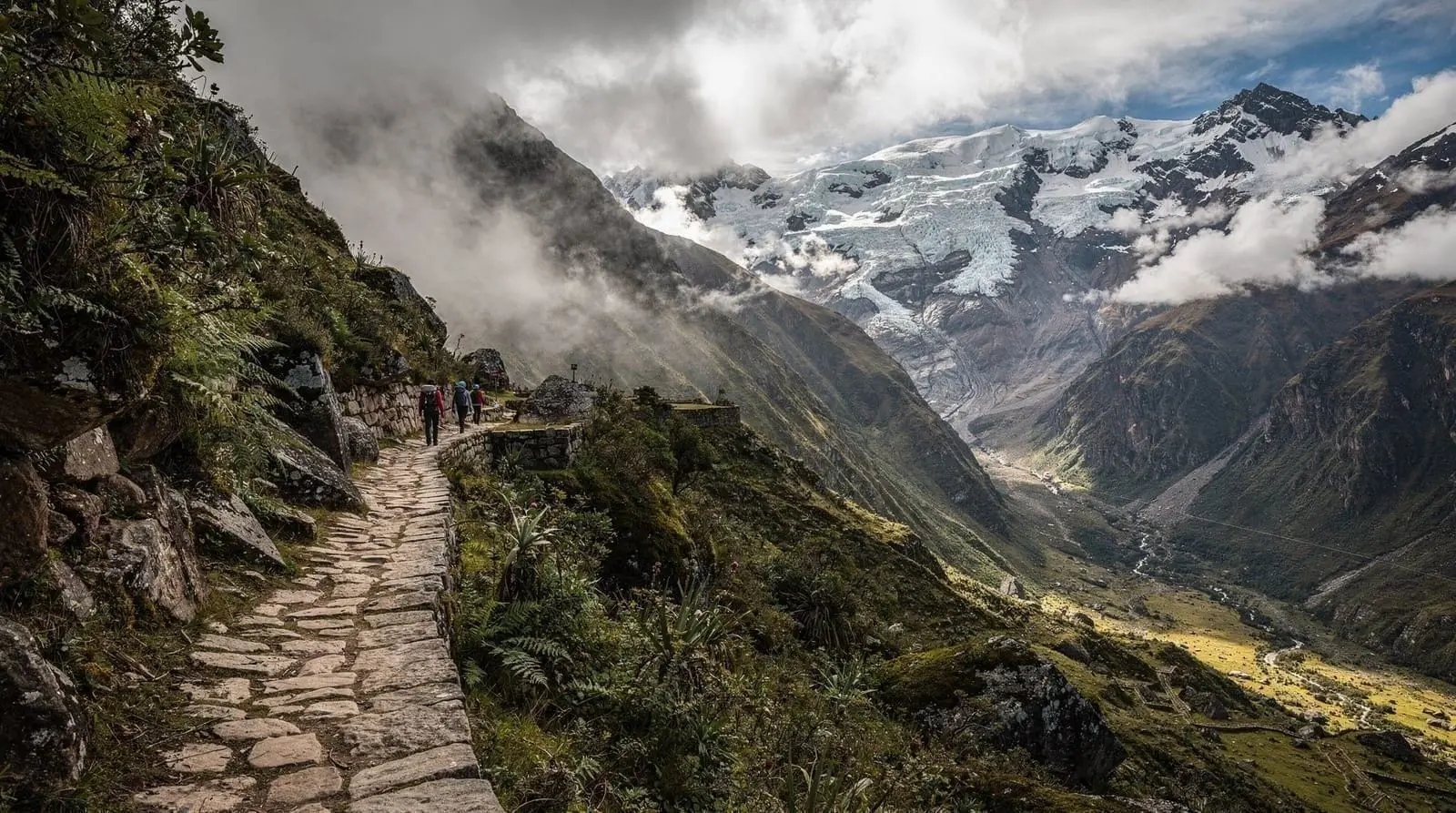
Inca Trail. Cloud forest, three high passes, and — the real draw — a chain of Inca ruins along the path: Llactapata, Runkuraqay, Sayacmarca, Phuyupatamarca and the spectacular Wiñay Wayna, none of which have any other access. The grand finale is walking down to the Sun Gate (Inti Punku) at sunrise and seeing Machu Picchu below you, on foot, the way the Incas approached it.
Salkantay. Bigger, wilder mountain landscapes: the glaciated Salkantay peak (6,271 m) looming over the high pass, the vivid turquoise of Humantay Lake, and a dramatic descent from alpine terrain into cloud forest. What it lacks is archaeology — there are no Inca ruins along the trail, and you reach the citadel by the standard gate, usually after a night in Aguas Calientes.
If your heart is set on Inca history underfoot and the Sun Gate, the Inca Trail wins outright. If you want the biggest raw mountain scenery, Salkantay edges it.
Difficulty and altitude
Both treks are genuinely demanding, but they test you differently.
- Inca Trail. The crux is day two’s climb to Dead Woman’s Pass at 4,215 m, followed by day three’s endless steep Inca stairways through cloud forest — brutal on the knees over consecutive long days.
- Salkantay. Reaches a higher point, the Salkantay Pass at roughly 4,630 m, so the altitude challenge is greater. The terrain is less stair-heavy but the days are long, and the swing from cold high pass to warm cloud forest is dramatic.
Neither needs technical mountaineering skill, but both demand real fitness and, above all, prior acclimatisation. Spend several days at Cusco or Sacred Valley altitude first either way — the Cusco acclimatization plan and the altitude sickness guide apply equally to both routes.
Duration and group experience
The classic Inca Trail is fixed at 4 days / 3 nights, with a short 2-day permit-based variant for those who only want the final Sun Gate stretch. Salkantay is more flexible: the standard route runs 4 days / 3 nights, but 5-day versions spread the distance for a gentler pace, and some operators run condensed alternatives.
Camp culture differs too. The Inca Trail camps three nights in established sites; Salkantay mixes camping with simple lodges, domes or “sky camps” depending on the operator, which some travellers find more comfortable. Salkantay also tends to draw a slightly more budget, backpacker crowd, while Inca Trail groups skew toward those who planned far ahead.
Cost
Salkantay is usually the cheaper trek, often USD 400 to 700 (around S/ 1,500 to 2,600) against the Inca Trail’s USD 700 to 950 (around S/ 2,600 to 3,550). The gap comes mostly from the Inca Trail’s permit fee and the heavier porter-and-camping logistics it requires. Both vary widely with operator quality, group size and inclusions, so compare exactly what each price covers — permit, guide, meals, gear, Machu Picchu entry, train — before judging value. The Peru trip cost guide for 2026 sets either trek against your wider budget.
February and the weather factor
If your trip falls in February, the choice is made: the Inca Trail closes for the entire month, while Salkantay runs year-round. Expect a wet, muddy Salkantay in February with clouds often hiding the peaks — the February closure guide covers the trade-offs. For both treks, the dry season of May to September offers the best conditions, and the best time to visit Cusco breaks down the months.
Comfort, food and crowds
Beyond the headline differences, the day-to-day experience diverges in ways worth weighing. On the Inca Trail, accommodation is camping in fixed, regulated sites; the trail is busy with other groups, especially on day two, and the campsites can feel crowded in peak season. Meals are cooked fresh by the crew and are generally good, though everything has to be carried, which shapes the menu. Toilets at campsites are basic.
Salkantay has evolved a more varied accommodation scene: alongside camping, many operators now offer simple lodges, geodesic domes or “sky camps” with transparent roofs, which appeal to travellers who would rather not sleep on the ground. The route is quieter than the Inca Trail in raw numbers, though Humantay Lake itself draws day-trippers. Food quality varies more by operator, so it pays to ask. Neither trek is luxurious, but Salkantay’s range of sleeping options gives it an edge for comfort-minded hikers, while the Inca Trail’s regulated, all-camping format is more uniform.
Which one is right for you
To cut through the comparison, match the trek to your situation:
- Choose the Inca Trail if: you can commit four to six months ahead, your priority is Inca ruins and walking on original stone, the Sun Gate arrival matters to you, and your dates fall outside February. It is the more historically resonant of the two and the only route with the classic arrival.
- Choose Salkantay if: you booked late or missed the permit window, you want the biggest raw mountain scenery, you would rather not be locked into a rigid permit date, you are travelling in February, or budget is a real factor. It is the more flexible, often cheaper, and arguably more visually dramatic mountain trek.
- Consider a third option if: neither quite fits. The Inca Jungle route adds biking and rafting at lower altitude, while the train suits anyone who would rather skip multi-day hiking entirely. The best treks to Machu Picchu covers the full menu.
The honest summary: there is no universally “better” trek. The Inca Trail is the icon and the archaeological experience; Salkantay is the flexible, scenic, permit-free alternative. Pick based on your timing first and your taste second.
Families, first-timers and solo trekkers
Neither trek is a gentle introduction to hiking — both involve consecutive long days at altitude — but both are regularly completed by fit first-timers who acclimatise properly first. Families travelling with older children who already hike comfortably can manage either route; for younger kids, or anyone nervous about several demanding days in a row, a shorter alternative such as the Lares trek or a Sacred Valley day trip is a gentler way to get a taste of the Andes without committing to four days.
Solo travellers need not worry about either route: both are walked in guided groups where solo trekkers and pairs are pooled together, so you are never hiking alone, and the solo travel in Cusco guide covers the wider practicalities. If you are travelling with kids specifically, the Cusco with kids guide lays out which experiences suit which ages.
Porters, crews and trekking responsibly
Both treks are staffed by porters who carry tents, kitchen equipment and food, and how well those crews are treated depends far more on the operator you choose than on which trail you walk. Reputable companies on either route respect porter weight limits, provide proper boots, insurance and adequate food, and pay fairly; budget operators on both trails have, at times, been criticised for cutting corners here.
Before booking, ask directly what weight limit the company enforces per porter and whether they carry insurance — a company that answers plainly and without hesitation is one worth trusting with your money on either trek. If neither classic route appeals and you want a quieter, less-trodden alternative that still reaches Inca ruins, the Choquequirao trek is a serious multi-day option for experienced hikers with more time to spare.
Booking either one
For the Inca Trail, the 4-day guided Inca Trail trek bundles the permit, licensed guide, porters, meals and citadel entry — the only legal way to walk it. The short Inca Trail 2-day tour is the lighter permit-based option.
For Salkantay, the 4-day Salkantay route to Machu Picchu is the standard trip, while the 5-day Salkantay ultimate trek gives a gentler pace over more days.
To compare these against every route to the citadel, the best treks to Machu Picchu lays them all out, and the itineraries hub helps you build the trip around whichever you choose.
Frequently asked questions about Inca Trail vs Salkantay
Which trek is harder, the Inca Trail or Salkantay?
Which trek is cheaper?
Does Salkantay arrive at the Sun Gate?
Can I book Salkantay last-minute?
Which trek is better for scenery?
What if my trip is in February?
Is either trek suitable for first-time trekkers or families?
How do porter conditions compare on the two treks?
Top experiences
Bookable activities with verified prices and instant confirmation on GetYourGuide.

