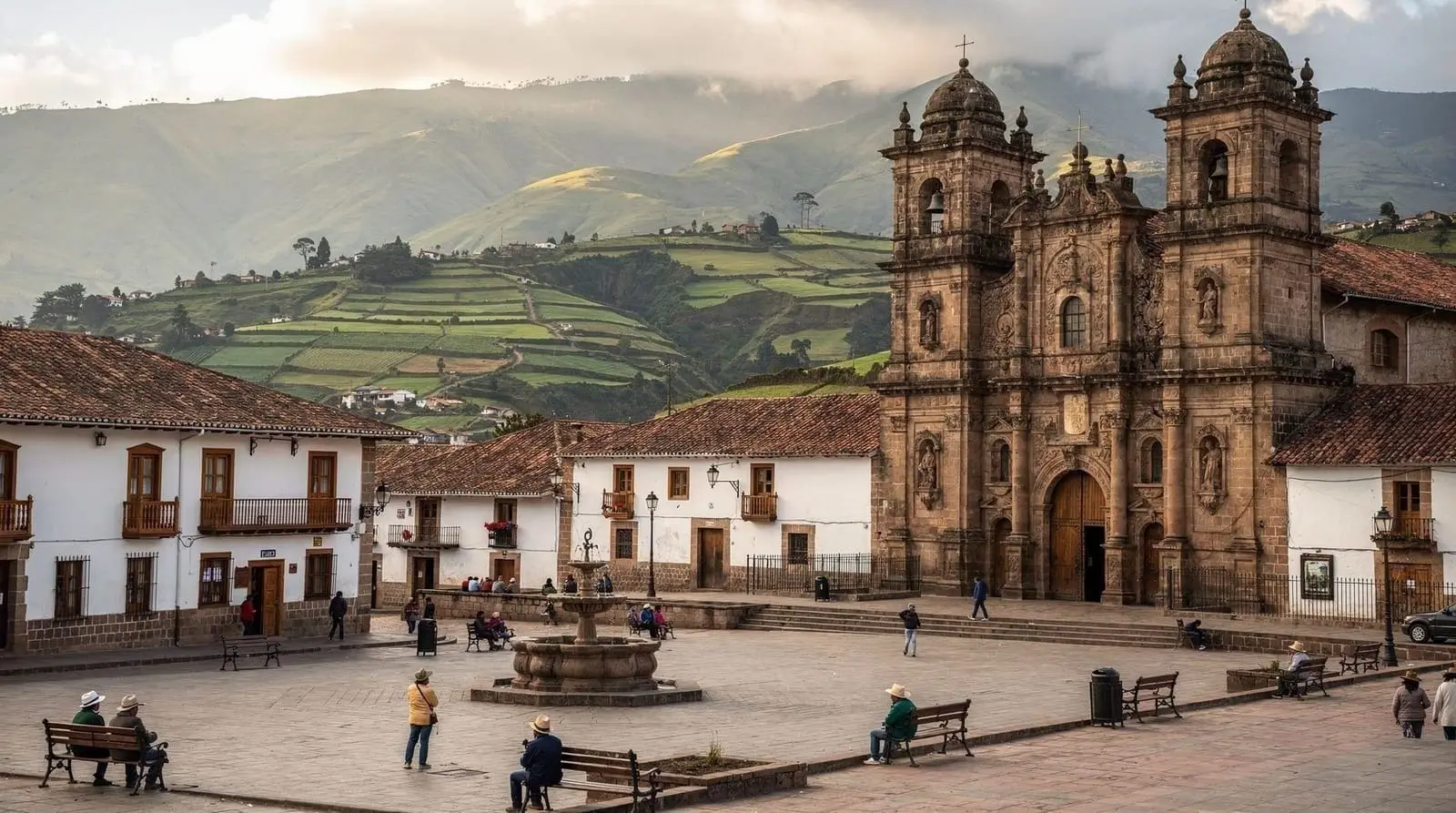
Cajamarca complete guide
Cajamarca: City Tour
How many days do you need in Cajamarca?
Two to three days. One for the city and the Cuarto del Rescate (Atahualpa's ransom room), one for Cumbemayo's pre-Inca aqueduct, and a third for Baños del Inca hot springs, Granja Porcón or the Otuzco window tombs. The city sits at 2,750 m, so allow a day to acclimatise.
The highland city where the Inca empire ended
On 16 November 1532, Francisco Pizarro and fewer than 200 Spaniards ambushed the Inca emperor Atahualpa in the main square of Cajamarca, slaughtered thousands of his unarmed retinue, and took him prisoner. Atahualpa, recognising Spanish greed, offered to fill a room once with gold and twice with silver in exchange for his freedom. The ransom was delivered — and Pizarro executed him anyway in July 1533. With that single act of treachery, the largest empire in the pre-Columbian Americas effectively collapsed. Cajamarca is the place where it happened, and the Cuarto del Rescate, the Ransom Room, still stands.
| Where | Northern highlands, 2,750 m, ~5.5hrs from Chiclayo |
| Cost | S/120-180/day all-in on the ground |
| Time needed | 2-3 days |
| Getting there | Fly from Lima (~1h20) or overnight bus (14-16hrs) |
| Best time | May-September (dry season) |
Today Cajamarca is a handsome colonial city of around 280,000 people set in green highland dairy country at 2,750 metres, ringed by pre-Inca sites, hot springs the Inca themselves used, and the surreal stone forest of Cumbemayo. It receives a fraction of Cusco’s visitors, which means its baroque churches, its Carnival, and its archaeology come without the crowds or the markup. This guide covers how to get there, what to see, the altitude, and how to fit Cajamarca into a wider northern Peru route.
Getting to Cajamarca
By air, LATAM and LATAM-affiliated carriers fly from Lima to Mayor General FAP Armando Revoredo Iglesias Airport (airport code CJA), about 3 km from the centre. Flight time is roughly 1 hour 20 minutes and fares run S/200–350 (USD 54–95) depending on how far ahead you book. A taxi into town is S/10–15.
By bus, the long-distance terminals are a short taxi ride from the centre. From Lima, overnight buses take 14–16 hours (S/100–180 cama class) up a long, winding climb. From Chiclayo the road east through the Andes is 5–6 hours (S/30–50), the classic pairing on a northern loop. From Trujillo allow 6–7 hours. The mountain roads are scenic but slow and prone to occasional protest blockades linked to the region’s mining industry — worth checking before you travel overland.
The honest call: fly if your budget allows, because the bus from Lima eats most of a day and night. From Chiclayo, the bus is reasonable and the mountain scenery is part of the experience.
Acclimatising and the altitude
At 2,750 m, Cajamarca is meaningfully lower than Cusco (3,400 m) or Puno, so altitude hits most visitors only mildly — some breathlessness on stairs, perhaps a light headache the first night. Take it easy on arrival, drink plenty of water, and go gently on alcohol the first evening. Crucially, save Cumbemayo for your second or third day: that excursion climbs to around 3,500 m, and tackling it straight off the plane is asking for a headache. The dedicated Cumbemayo guide covers the trek and its altitude in detail.
The city: Cuarto del Rescate and colonial churches
Start in the historic centre. The Cuarto del Rescate is the only Inca-era structure still standing in Cajamarca — a fine trapezoidal-doored stone room traditionally identified as where Atahualpa was held and where the ransom line was marked on the wall (historians note it was likely his cell rather than the room he filled, but the symbolism endures). Entrance is around S/5–10 and includes access to the small associated complex.
Around the Plaza de Armas, Cajamarca’s churches are among the best baroque architecture in northern Peru: the Cathedral and the Iglesia de San Francisco both have richly carved stone façades, the latter with catacombs and a religious art museum. Climb Cerro Santa Apolonia, the hill overlooking the city, for a panorama and the “Silla del Inca,” a carved stone seat said to have been used by Inca rulers; the climb takes 20–30 minutes from the plaza or a short taxi.
For an efficient orientation, a half-day city tour bundles the Cuarto del Rescate, the churches and Santa Apolonia:
Cajamarca: City Tour, Cuarto del Rescate & City GemsA simpler standard city tour is also available:
Cajamarca: City TourDay excursions around Cajamarca
The countryside is where Cajamarca earns its two-to-three-day stay.
Cumbemayo is the headline excursion: a pre-Inca aqueduct carved into solid rock around 1500 BCE, threading through a forest of eroded volcanic pinnacles called the “frailones” (friars) at about 3,500 m. It is one of the oldest engineered structures in the Americas and deserves a half-day. See the Cumbemayo guide for the full picture.
Baños del Inca are thermal hot springs 6 km east of the city where Atahualpa was reportedly bathing when Pizarro arrived. You can soak in private or public pools; entrance and a private tub run roughly S/10–20. A popular tour combines the springs with the Hacienda La Colpa, a working dairy farm:
Cajamarca: Hacienda La Colpa and Baños del Inca TourGranja Porcón is a Quechua-speaking evangelical cooperative running a pine-forested farm and small wildlife area 30 km north, often paired with the Ventanillas de Otuzco, a cliff face honeycombed with pre-Inca burial niches (“windows”) 8 km from the city. The combined tour is:
Cajamarca: Granja Porcón and Otuzco Farms TourThe conquest, in context
Cajamarca’s defining event deserves more than a sentence, because standing in the Cuarto del Rescate means more once you grasp what happened. In 1532 the Inca empire was emerging from a brutal civil war between two royal brothers, Atahualpa and Huáscar, for the throne. Atahualpa had just won and was resting near Cajamarca with a large army when Pizarro’s tiny Spanish force — fewer than 200 men with horses, steel and a handful of firearms — arrived. Atahualpa, vastly outnumbering them, agreed to meet, confident the strangers posed no threat.
The meeting in Cajamarca’s square on 16 November 1532 was a trap. The Spanish demanded Atahualpa submit to their king and their god; when he refused, they opened fire from concealed positions, panicking the unarmed Inca retinue and killing thousands in a few hours of slaughter. Atahualpa was captured alive — the single hostage who controlled the entire imperial machine.
Recognising Spanish hunger for gold, he offered the famous ransom: to fill a room once with gold and twice with silver. Over months, treasure was stripped from temples across the empire and carried to Cajamarca. Pizarro accepted it, then had Atahualpa executed by garrote in July 1533 on trumped-up charges. The decapitated empire never recovered. To walk into the Cuarto del Rescate is to stand at the hinge point where the Andean world turned.
Food, Carnival and where to stay
Cajamarca is dairy country — Peru’s cheese and manjarblanco (dulce de leche) capital. Try the local fresh and aged cheeses, the cuy (guinea pig) for the adventurous, caldo verde (a herb-and-potato soup), and humitas. Carnival in February is the biggest in Peru, a multi-day waterfight-and-parade spectacle that floods the city and books out hotels months ahead; come for it deliberately or avoid it deliberately, but do not arrive unaware.
For lodging, mid-range colonial hotels near the plaza run S/120–250 (USD 32–68); the area around the Plaza de Armas is the convenient base. Budget hostels start around S/40. Some travellers prefer to stay out at Baños del Inca for the thermal-spa hotels.
Getting around the city and excursions
Cajamarca’s historic centre is compact and walkable — the Plaza de Armas, the cathedral, San Francisco and the Cuarto del Rescate are all within a few blocks, and the Santa Apolonia hill is a 20-minute climb from the square or a short taxi. Within the city, taxis run S/5–10 for most trips and mototaxis less. For the out-of-town sites, public transport is thin and indirect, so the realistic options are guided tours or a hired taxi.
The four main excursions each have their own logic. Cumbemayo and the Ventanillas de Otuzco are archaeological; Granja Porcón is an agricultural-and-nature outing; and the Baños del Inca are pure relaxation. A sensible three-day distribution is: day one for the city centre while you acclimatise, day two for Cumbemayo in the morning and the Baños del Inca in the afternoon, and day three for Granja Porcón with the Otuzco window tombs. Two days means dropping one excursion — usually Porcón, the least essential. Confirm hours and, for Cumbemayo, weather, the day before; highland afternoons cloud over and some sites close earlier in low season.
Cash matters here too: bring soles, as smaller sites and rural stops do not take cards and ATMs cluster only in the centre. English is limited outside booked tours, so request an English-speaking guide in advance if you need one.
How Cajamarca fits a northern route
Cajamarca pairs most naturally with Chiclayo on the coast, five to six hours west, making a logical loop: the Lord of Sipán and Túcume pyramids on the coast, then the highlands and the conquest history at Cajamarca. Some travellers push on to Chachapoyas and the Kuélap fortress, though the roads between are slow.
The north versus south Peru guide helps decide whether this region earns a place against the Cusco circuit. If time is genuinely tight, prioritise the coastal Moche and Chimú sites over the extra highland leg to Cajamarca — they are faster to reach and easier to bolt onto a Lima-based trip, whereas Cajamarca rewards travellers who already have a full northern loop planned.
Honest cautions
A few realities. First, road protests tied to mining (Cajamarca is near the contested Conga and Yanacocha projects) can block regional highways without much warning; check local news before committing to overland travel. Second, do not rush Cumbemayo on arrival day — the altitude jump is real. Third, the Cuarto del Rescate is modest in scale; come for its historical weight, not its size, and a guide makes the difference. Finally, if you visit during Carnival, expect to be soaked — locals throw water at everyone, tourists included, so dress accordingly and keep electronics sealed.
Cajamarca by season
| Months | Conditions | Notes |
|---|---|---|
| May-September | Dry, clearest for Cumbemayo | Best all-round window |
| February | Carnival | Biggest festival in Peru, city books out |
| December-March | Wetter, muddier trails | Cheaper hotels outside Carnival |
Where Cajamarca fits your overall Peru budget and timeline
Cajamarca is one of the cheaper regional stops once you account for the whole trip. Because it sits outside the standard Cusco-Machu Picchu circuit, it adds real travel days rather than fitting neatly into a short loop, so weigh it against your total trip length before committing — the how many days in Peru guide and the Peru trip cost guide both help size a northern add-on realistically.
If you are still deciding when to travel at all, the best time to visit Peru guide confirms that Cajamarca’s May-to-September dry window lines up with the wider country’s high season, so booking flights and Carnival-adjacent hotels early matters if you are chasing good weather on a fixed calendar.
Frequently asked questions about Cajamarca complete
Is Cajamarca worth visiting?
How do I get to Cajamarca?
How high is Cajamarca and will I get altitude sickness?
What is the Cuarto del Rescate?
What is the best time to visit Cajamarca?
Is Cajamarca safe for tourists?
How much does a Cajamarca trip cost per day?
Does Cajamarca fit into a short Peru trip?
Top experiences
Bookable activities with verified prices and instant confirmation on GetYourGuide.
