Túcume pyramids guide
Chiclayo: Túcume Pyramids and Pómac Forest
What is Túcume?
Túcume, the Valley of the Pyramids, is a field of 26 adobe pyramid mounds 33 km north of Chiclayo. Built by the Lambayeque culture around 1000 CE and later used by the Chimú and Inca, it is one of the largest adobe complexes in South America.
A desert filled with man-made mountains
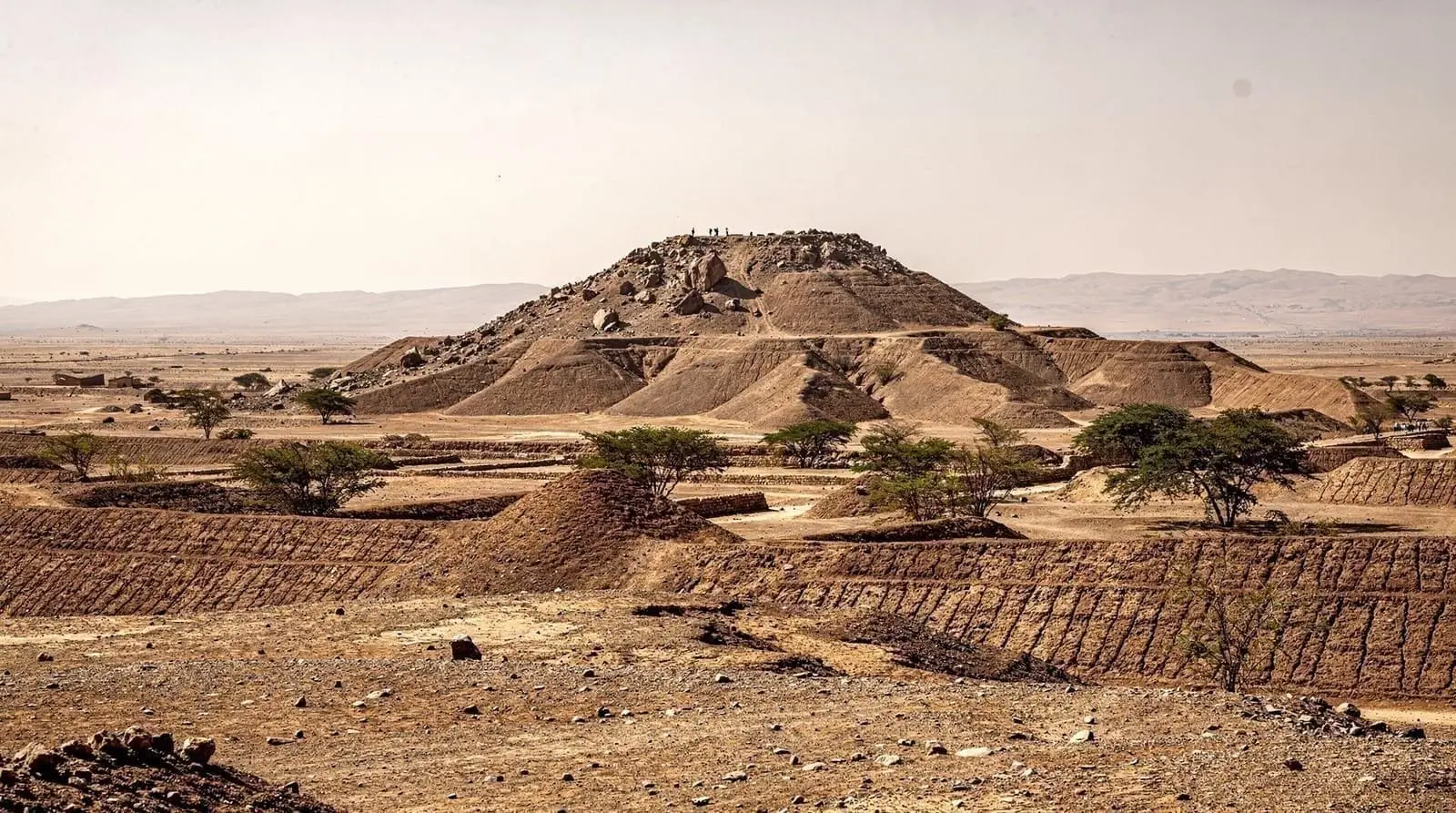
Thirty-three kilometres north of Chiclayo, the flat coastal desert is broken by 26 enormous adobe mounds, some rising 30 metres or more from the valley floor, clustered around a craggy natural hill called Cerro Purgatorio. This is Túcume — the Valley of the Pyramids — one of the largest concentrations of monumental adobe architecture anywhere in the Americas. The complex sprawls across more than 200 hectares, and its single biggest structure, Huaca Larga, runs some 700 metres in length, making it among the longest ancient buildings in South America.
Túcume was founded by the Lambayeque (Sicán) culture around 1000 CE, after the older centre at Batán Grande in the Pómac valley was abandoned. Over the following centuries it was absorbed by the Chimú empire and finally by the Inca, each leaving traces in the architecture. Unlike the polished royal tombs of Sipán or the restored walls of Chan Chan, Túcume is mostly unexcavated and weathered into rounded ridges of mud brick. It rewards visitors who arrive ready to read the landscape rather than expecting tidy ruins.
This guide covers what you actually see, how to get there, what it costs, and how to combine it with the rest of the Chiclayo region. The Chiclayo complete guide places it in the wider two-day circuit.
| Where | 33 km north of Chiclayo, near Lambayeque |
| Cost | Around S/10 entry; guided tours roughly S/80–120 |
| Time needed | 1.5–2 hours on site |
| Getting there | Colectivo via Lambayeque, taxi, or guided tour |
| Best time | Morning, dry season (May–October) |
What you see at Túcume
The site divides into three experiences. First, the walking circuit at ground level loops around the bases of the principal mounds — Huaca Larga, Huaca Las Balsas, Huaca 1 — past interpretive panels and, at Las Balsas, a small sheltered area protecting adobe friezes that depict reed boats and mythological figures. These reliefs, excavated in the 1990s, gave Las Balsas its name and drew the interest of explorer Thor Heyerdahl, whose theories about ancient seafaring made the boat imagery irresistible to him.
Second, the climb up Cerro Purgatorio, the natural rock hill at the centre of the complex. A path with steps and railings leads to the Mirador Natural at the top, from where all 26 mounds spread out across the desert in a single panorama. This view is the highlight — from ground level the mounds read as low hills, but from above the deliberate geometry of the complex snaps into focus. The climb takes 15–20 minutes and is exposed to full sun, so bring water and a hat.
Third, the site museum (Museo de Sitio Túcume), a low building designed with input from Heyerdahl’s team. It displays carved wooden reliefs, metalwork, ceramics and reconstruction models, plus the human story of the local community that still farms around the mounds and maintains pre-Columbian ritual practices. Allow 30–40 minutes.
For the standard guided visit that bundles Túcume with transport from Chiclayo, the most common booking is:
Chiclayo: Túcume Pyramids and Pómac ForestGetting there and what it costs
Entrance is a flat S/10 (about USD 2.70), covering the circuit, the viewpoint and the museum. Opening hours are typically 8am to 4:30pm; aim to arrive by mid-morning at the latest, both to beat the heat and to leave the site comfortably before closing.
Independently, take a combi or colectivo from Chiclayo toward Túcume (often changing at Lambayeque), around S/4–6 and roughly an hour each way. From the town of Túcume it is a short mototaxi ride (S/3–5) to the site entrance. A private taxi from Chiclayo runs S/40–60 each way, or S/120–160 to hire for the round trip with waiting time.
Most visitors, though, come on a guided tour. Túcume signage is sparse and the significance of an unexcavated mound is hard to grasp unaided, so a guide genuinely improves the visit. Tours from Chiclayo run S/80–120 per person and usually pair Túcume with the Pómac forest or the Las Balsas friezes. The Las Balsas-focused option is:
Chiclayo: Túcume Pyramids and Las Balsas HuacaThe history layered into the mounds
What makes Túcume genuinely interesting is that it is not the product of a single culture but a palimpsest of three. The Lambayeque (Sicán) people began the complex around 1000 CE, after abandoning their earlier ceremonial centre at Batán Grande in the Pómac valley to the south — a move some archaeologists link to a catastrophic El Niño event that the elite’s water-control religion failed to prevent. At Túcume they built monumental adobe platforms as administrative and ritual seats of power, the largest of which, Huaca Larga, grew over generations into the 700-metre giant you see today.
Around 1375 CE the Chimú empire, expanding north from its capital at Chan Chan, conquered the Lambayeque and took over Túcume, adding their own architecture and administrative quarters atop the existing mounds. Then in the late 1400s the Inca, sweeping down the coast, absorbed the whole region; excavations at Huaca Larga found an Inca-period structure with the remains of high-status individuals, including a group interpreted as weavers, built directly on the older Lambayeque platform. Each conquest left a stratum, so a single mound at Túcume can hold Lambayeque, Chimú and Inca construction phases stacked one on another — a physical timeline of north-coast power changing hands.
Spanish chronicles and local legend add a final layer. The site’s traditional name, Cerro Purgatorio, and stories of the area as a place of sorcery reflect colonial-era attempts to demonise an enduring sacred landscape. Even today the communities around Túcume maintain folk-healing and ritual practices with deep pre-Columbian roots, a continuity the site museum thoughtfully documents.
How Túcume fits the region
Túcume sits at the northern end of the Chiclayo archaeology circuit, geographically close to the Pómac forest sanctuary and the Ferreñafe Sicán museum, which makes them a natural same-day combination. A typical second day in the region runs Túcume in the cool morning, lunch in the Lambayeque area, then Pómac and the Sicán museum in the afternoon.
Chronologically, Túcume bridges the gap between cultures: it was built by the same Lambayeque people whose royal tombs you see at the Sicán museum, then occupied by the Chimú whose capital was Chan Chan, and finally by the Inca. Visitors who have seen the Moche royal tombs at Sipán and want the full sweep of north-coast civilisations should read the Moche and Chimú civilisations guide to understand how Túcume’s builders fit between them.
Practical planning details
A few specifics that smooth the visit. Bring small cash in soles: the S/10 entrance and any mototaxi or refreshment stops will not take cards, and there are no ATMs at the site. The best light for the Cerro Purgatorio panorama is mid-morning, before the harsh overhead midday sun flattens the desert and before afternoon haze builds. If you are driving yourself or directing a taxi, the entrance is on the edge of Túcume town, signposted from the main road through Lambayeque.
For combining Túcume into a full day, the geography favours pairing it with the Pómac forest and the Sicán museum, all of which sit north and east of Chiclayo. A workable independent sequence is Túcume first thing, lunch in the Lambayeque or Túcume area, then Pómac and Ferreñafe in the afternoon — but only with a hired taxi, since colectivos between these points are slow and indirect. Travellers basing themselves in Chiclayo will find the city has the hotels, food and tour agencies to organise all of this; the dedicated Chiclayo complete guide lays out the two-day split that most archaeology-minded visitors settle on.
When to go and what to bring
Seasonally, the coastal dry season from May to October is the most comfortable window — cooler air and clearer skies for the Cerro Purgatorio panorama. From December to March the desert heat is intense and El Niño years can bring rain that damages the unprotected adobe and occasionally closes the site, so check conditions if you travel then. Whatever the month, come in the morning: the site opens around 8am, the light is best early, and the midday sun on the shadeless circuit is punishing by 11am.
Pack for desert conditions even on a short visit. Carry water, sunscreen, a hat and sunglasses, and wear closed shoes for the dusty, uneven paths and the rocky climb up Cerro Purgatorio. Bring small cash in soles for the S/10 entrance and any mototaxi rides, as there is no card payment or ATM at the site. Allow a little extra time if you want to linger at the Las Balsas friezes or read the museum panels properly rather than rushing through.
If your visit falls on a tour, confirm how long it allocates to Túcume specifically; the better operators give it 90 minutes or more, while the bargain “everything in one day” trips cut it to a token half-hour that does not do the viewpoint justice.
Honest cautions
A few realities. First, manage expectations: Túcume is not a photogenic ruin in the Machu Picchu sense — the mounds are eroded earth, and without the viewpoint and a guide the visit can feel anticlimactic. Climb Cerro Purgatorio first, because that panorama reframes everything you see afterward at ground level. Second, there is almost no shade on the circuit and the coastal desert sun is fierce by late morning; carry water, sunscreen and a hat. Third, avoid the rushed “four sites in one day” tours that give Túcume 30 minutes — it deserves at least 90. Finally, the site can close earlier than posted in low season or bad weather, so do not leave it as a last afternoon stop without confirming hours.
Túcume compared with the region’s other sites
Chiclayo-region archaeology sends visitors to three genuinely different experiences, and it helps to know which is which before you commit a day to any of them.
| Site | What you see | Effort | Best for |
|---|---|---|---|
| Túcume | 26 unexcavated adobe mounds + panoramic viewpoint | Easy walk + short climb | Scale, imagination, aerial views |
| Sicán museum | Restored royal tombs, gold artefacts | Museum, minimal walking | Restored treasures, indoor comfort |
| Lord of Sipán site | Royal tomb excavation + museum | Museum, minimal walking | The single richest unlooted find in the Americas |
Túcume’s distinguishing strength is the Cerro Purgatorio panorama — nowhere else in the region gives you an aerial-style view of an entire ancient city at once. If your time is genuinely limited to one stop, choose Túcume for scale and landscape, or the Sicán museum for artefacts and a shaded, air-conditioned break from the desert sun. Most archaeology-minded travellers with two days do both, pairing Túcume with the Pómac forest and the Sicán museum as described above.
Photographing Túcume well
The site rewards a specific approach to photography that first-timers often miss. Arrive as early as opening allows and climb Cerro Purgatorio immediately — the low, raking morning light picks out the mounds’ contours in a way flat midday sun erases entirely, turning the otherwise muted earth tones into a genuinely striking panorama.
Shoot the Cerro Purgatorio view first, before haze builds later in the morning, then work back down to ground level for closer shots of the Las Balsas friezes, where the sheltered structure gives even, shadow-free light most of the day. A wide-angle lens or phone panorama mode captures the scale of the valley better than a standard shot ever will; a mid-range zoom helps isolate individual mounds from the summit. Dress in earth tones if you want yourself in the frame rather than a bright hiking jacket that fights the desert palette.
Frequently asked questions about Túcume pyramids
How much does Túcume cost to visit?
How do I get to Túcume from Chiclayo?
How long do you need at Túcume?
Can you climb the Túcume pyramids?
Is Túcume worth visiting compared to Chan Chan?
Who was Thor Heyerdahl and why is he linked to Túcume?
Is a half-day enough for Túcume, or do I need a full day?
Should I visit Túcume independently or on a guided tour?
Top experiences
Bookable activities with verified prices and instant confirmation on GetYourGuide.

