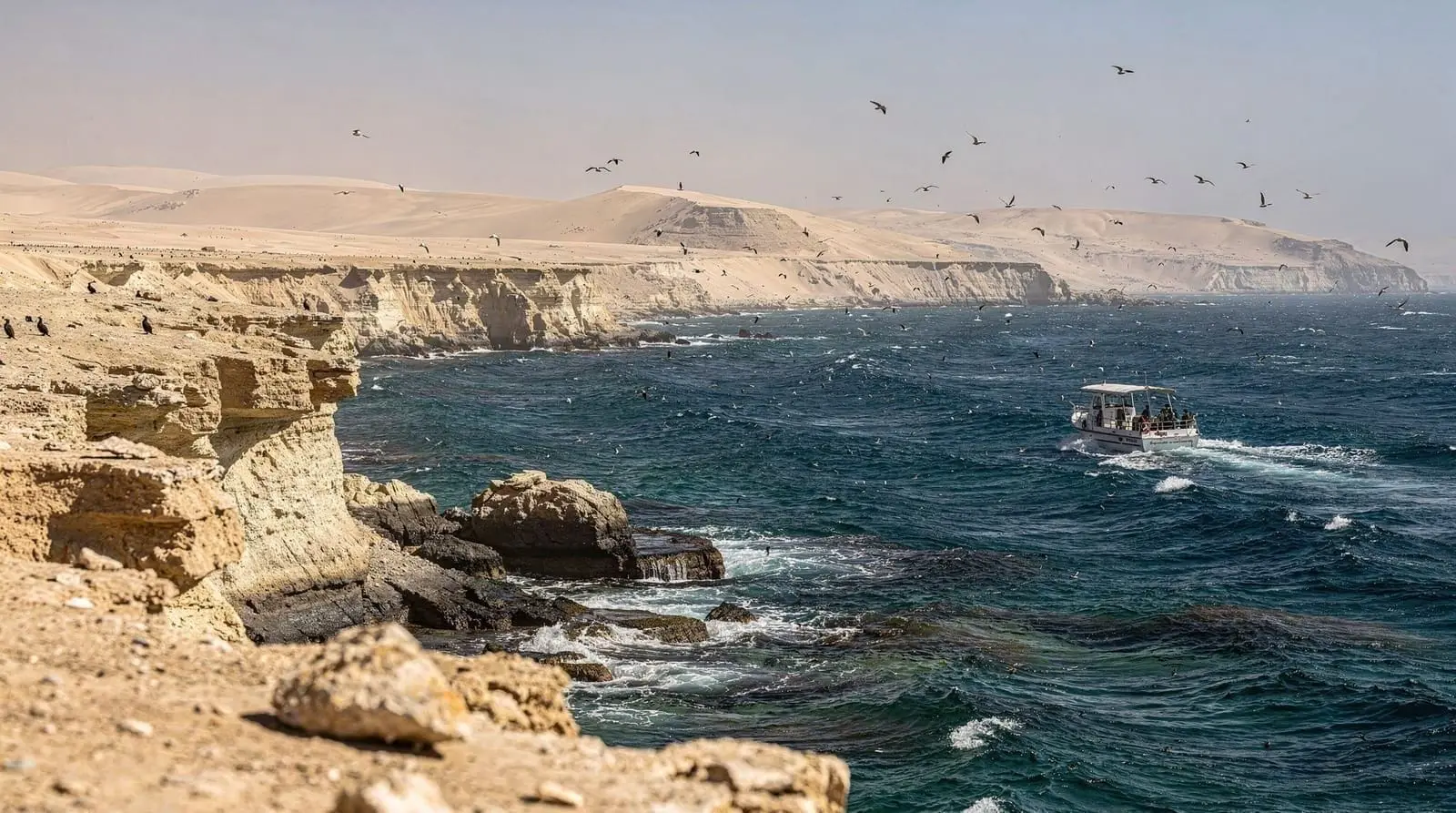
Paracas complete guide
Paracas: Ballestas Islands and National Reserve
How long do you need in Paracas?
One full day covers the Ballestas Islands boat (morning) and the Paracas National Reserve (afternoon). Most travellers arrive from Lima the previous afternoon and continue south to Ica or Huacachina after lunch the next day.
Paracas is the first proper stop on Peru’s south coast, four hours below Lima where the desert runs straight into a cold, fish-rich sea. It exists for two things: the Ballestas Islands, a rock cluster offshore crowded with sea lions, penguins and seabirds, and the Paracas National Reserve, a vast lunar peninsula of ochre cliffs and flamingo lagoons. Almost everything else in town — the hostels, the cevicherías, the buggy-tour agencies fishing for Huacachina bookings — is built around moving travellers through in a day or two.
This guide covers what Paracas actually costs, how the timings work, what to skip, and how to fit it into a longer south-coast or Lima-to-Nazca plan without wasting a day.
| Where | South coast, 4 hours south of Lima on the Panamericana Sur |
| Cost | Around S/200-300 ($55-80) for boat, reserve, lunch and a night |
| Time needed | One full day (boat morning, reserve afternoon) |
| Getting there | Direct bus from Lima (Soyuz, Peru Bus, Cruz del Sur) |
| Best time | April-November for calmer seas and flamingos |
What Paracas is, and what it is not
Paracas is not a beach-holiday town in the Caribbean sense. The water is cold (the Humboldt Current keeps it that way year-round), the in-town beaches are unremarkable, and the appeal is wildlife and desert landscape rather than swimming and sunbathing. People who arrive expecting a tropical resort are disappointed; people who arrive for the boat and the reserve rarely are.
It is also small. The tourist core is essentially one seafront strip — the malecón — plus a back road of hostels and the El Chaco harbour where boats depart. You can walk the whole thing in fifteen minutes. There is no historic centre, no museum-heavy old town, and limited nightlife beyond a handful of bars. This is a stopover, engineered as one, and treating it that way produces a better trip than trying to stretch it into three days.
The town sits next to Pisco (15 minutes north), the larger working city that gives the grape brandy its name. Most long-distance buses actually stop in Pisco rather than Paracas, which catches some travellers out — see the logistics section below.
The two things you came for
Ballestas Islands boat
The Ballestas are about 12 km offshore, reached by open speedboat from the El Chaco harbour. Boats run roughly 07:00 to 11:00, the trip takes about two hours including the 20-to-25-minute crossing each way, and you cannot land — landing is banned to protect the wildlife and the licensed guano harvest, so the boat circles the rock arches while you photograph from the water.
Standard price is S/55 to S/70 per person (about $15 to $19 USD) plus a small dock/embarkation tax of around S/16 paid separately at the pier. Earlier departures generally get calmer seas and better light. Bring a windproof layer, sunscreen and motion-sickness pills if you are prone — the Humboldt swell is present even on bright days. Full detail on what you see and when is in the dedicated Ballestas Islands guide.
Paracas: Ballestas Islands and National ReserveParacas National Reserve
The reserve is the half most travellers skip, and that is a mistake if you have the afternoon. It covers 335,000 hectares of peninsula and sea — Peru’s largest marine reserve — and the landscape is genuinely strange: red sand beaches, fossil beds tens of millions of years old, a flamingo lagoon, and the collapsed rock arch at La Catedral (the original arch fell in the 2007 earthquake; the remnant is still photogenic).
Foreign-visitor entry is S/25 (about $7). You can do the reserve three ways: a hired taxi for a 2-to-3-hour loop (S/60 to S/90, most flexible), a guided tour (adds context at the Julio Tello Museum and flamingo lagoon), or by bicycle if you are fit and start early before the afternoon wind. Driving yourself by taxi is the most common independent choice.
Paracas National Reserve Guided TourMoney: what a Paracas stop actually costs
Per person, a typical one-day Paracas stop breaks down roughly like this:
- Ballestas boat: S/55 to S/70, plus S/16 dock tax
- Reserve entry: S/25
- Reserve transport (shared taxi loop): S/20 to S/30 per head if split between three or four people
- Lunch (ceviche on the malecón): S/35 to S/55
- Budget bed: S/45 to S/80 dorm or simple double; mid-range hotels S/150 to S/350
So a no-frills day in Paracas — boat, reserve, lunch, one night — lands around S/200 to S/300 ($55 to $80) all in. It is one of the cheaper headline experiences in Peru relative to what you see.
A note on pricing honesty: ignore the touts at the bus drop-off who quote inflated combo packages. Buying the Ballestas ticket directly at the harbour kiosks the night before is straightforward and cheaper than the hard-sell street agencies.
A realistic one-day timetable
The mistake most travellers make is leaving the reserve until the afternoon when the wind is at its worst, or trying to squeeze both halves into a half-day. The sequence below is what actually works, built around the boat’s morning-only window and the peninsula’s brutal afternoon gusts.
- 07:30 — Be at the El Chaco harbour for an early Ballestas departure. Pay the dock tax, board, and you are back on the malecón by about 10:00 with calm seas behind you.
- 10:15 — Coffee and a quick breakfast on the seafront. If you have not yet sorted reserve transport, this is the moment to agree a taxi loop with a driver at the harbour rank.
- 10:45 — Head into the Paracas National Reserve while the wind is still manageable. Stop at the Julio Tello Museum at the entrance, then La Catedral, Playa Roja and the flamingo overlook.
- 13:30 — Back in town for ceviche, the freshest meal of your day, before the afternoon gale picks up.
- 15:00 — Either collapse on a terrace, or catch a colectivo east to Ica and Huacachina if you are moving on the same day.
This order keeps you ahead of the weather and avoids the common trap of a windswept, sand-blasted reserve visit at 16:00. If you arrive in Paracas the evening before, the only thing left for arrival day is a sunset ceviche and an early night.
Where to stay in Paracas
Everything sits within the small El Chaco strip, so location barely matters — choose by budget and noise tolerance.
- Budget: Kokopelli Paracas and Backpackers Paracas run dorm beds at S/45 to S/80, social and walkable to the harbour. Light sleepers should ask for a room away from the bar.
- Mid-range: Hotel Paracas Backpacker’s House, Hostal Brisas del Mar and similar seafront-adjacent doubles run S/150 to S/350, usually with breakfast and reliable hot water.
- Higher-end: Hotel Paracas (a Luxury Collection Resort) and DoubleTree by Hilton Paracas sit slightly out of the El Chaco core with private piers, pools and sea views, from roughly S/600 upward — the only properties here that justify a second night purely to relax.
For a one-night stopover, a mid-range double near the malecón is the sensible pick. The resorts make sense only if Paracas is your decompression stop rather than a transit point.
Accessibility and who it suits
The town itself is flat and walkable, which helps travellers with limited mobility moving around El Chaco. The two headline activities are harder. The Ballestas boat requires stepping down into an open speedboat from a floating dock and sitting through a bouncy crossing, which is difficult for wheelchair users and uncomfortable for anyone with significant back problems. The reserve, by contrast, is largely viewed from a vehicle, so a private taxi loop is the most accessible way to experience Paracas — you can see La Catedral, the red beach and the flamingo lagoon from or beside the car. Families with young children manage both activities fine, with the caveats on sun, wind and swell noted in the FAQ.
Eating in Paracas
The seafood here is the freshest on the entire south coast — boats unload corvina, sole, octopus and shellfish at the waterfront and the cevicherías serve it within hours. A full ceviche with choclo (giant corn) and sweet potato runs S/35 to S/55.
El Chorrillo on the malecón is the reliable choice for ceviche and fish; El Chorito and El Refugio are solid alternatives. The honest-planner warning: skip any place displaying menus only in English and quoting prices in USD at the door — these typically charge around 40% more for the same fish off the same boats. Walk one block back from the most touristy stretch of the malecón and prices drop noticeably.
Beyond ceviche, look for chicharrón de pescado (fried fish chunks), arroz con mariscos (a Peruvian seafood rice closer to a wet paella), and tiradito (a sashimi-style cousin of ceviche). Pair any of them with the local Ica pisco sour, since the bodegas that make it are just down the road. A sit-down seafood lunch with a drink runs S/45 to S/70 a head at honest prices; double that at the USD-menu tourist traps.
Tourist traps to sidestep
Paracas is small and friendly, but a handful of predictable squeezes catch unwary travellers:
- Bus-terminal combo touts. The hardest sell happens the moment you step off the bus, with packages bundling boat, reserve, transfers and “free” extras at a marked-up flat rate. You almost always do better buying the boat at a harbour kiosk and arranging the reserve taxi separately.
- USD-priced seafront menus. As above — quoting in dollars at the door is a reliable signal of a 30 to 40 percent markup.
- “Private” Ballestas boats. Some agencies upsell a private or premium boat for double the price. The standard shared boat sees exactly the same wildlife; the only real upgrade is a smaller, earlier departure, which you can often get on a normal ticket by booking the first slot.
- Sandboarding and buggy sales in Paracas. Agencies here aggressively sell Huacachina dune tours. There is no harm buying one, but you will have more operator choice and competitive pricing once you are actually in Ica or Huacachina.
Logistics: getting there and onward
From Lima
Lima to Paracas is 3.5 to 4 hours on the Panamericana Sur. Soyuz and Peru Bus run the cheapest direct services (S/25 to S/40). Cruz del Sur and Oltursa are more comfortable but often terminate in Pisco, 15 minutes north — from Pisco’s terminal a taxi to Paracas is S/15 to S/20. Confirm whether your ticket ends in Paracas (El Chaco) or Pisco before you buy.
Onward south
Ica is 60 km east, about one hour by shared colectivo (S/10 to S/15) from near the main Paracas roundabout. From Ica it is S/8 to S/10 by taxi to the Huacachina oasis. Nazca is 230 km southeast, roughly 3 to 3.5 hours by bus.
There is also a useful shortcut for the Nazca Lines: the overflight departs not only from Nazca and Ica but from Pisco’s San Andrés Airport, right next to Paracas. If you want the Nazca Lines flight without backtracking south, flying from Pisco can save a whole bus leg — weigh that against the longer, more expensive flight from Pisco in the flight-worth-it analysis.
As a guided circuit
If you would rather not chain individual bus tickets, a two-day guided loop from Lima bundles Paracas, the Ballestas, Huacachina and a Nazca Lines flight:
From Lima: Paracas, Huacachina & Nazca Lines 2 Days/1 NightWhen to go
April through November is the better window: drier, calmer seas for the boat, and flamingos in the reserve lagoons (mainly June to November). The December-to-March period brings the paracas wind (the town is named for it — Quechua for “sand rain”), more humidity, and occasionally rough conditions that delay or cancel Ballestas departures. Penguins and sea lions are present year-round regardless.
Afternoon wind on the peninsula is fierce most of the year, so plan the reserve for the morning or early afternoon if you can, and the boat for the calmer early hours.
How Paracas fits a longer trip
Paracas is the natural anchor of the south coast. A clean four-day southern loop runs: arrive Paracas (evening ceviche), Ballestas plus reserve (full day), transfer to Ica/Huacachina for the dune buggy (afternoon), Nazca for the overflight and Chauchilla cemetery (day), return north. For the full sequencing — bus by bus, with timings — see the Lima-to-Paracas-Nazca itinerary and the south coast 2-day guide.
If you are deciding whether the boat or the peninsula deserves your limited time, the Paracas vs Ballestas comparison breaks down the trade-offs. For broader trip-length questions, how many days in Peru and best time to visit Peru put the south coast in context. Browse packaged options on the tours hub and build a route on the itineraries hub.
What surprises first-time visitors
A few things catch travellers off guard on their first visit. The water is genuinely cold year-round thanks to the Humboldt Current, so anyone expecting a warm-water Caribbean-style beach stop will be disappointed — this is a wildlife-and-desert destination, not a swimming one. The town itself is smaller than photos suggest; the whole tourist core is a fifteen-minute walk end to end, so do not budget extra days expecting more to explore. And the guano smell near the Ballestas Islands is real and noticeable on a still day, a byproduct of the seabird colonies that make the boat trip worthwhile in the first place.
Which parts to prioritise if you are truly short on time
Occasionally a traveller passes through Paracas with only a few hours rather than a full day, usually mid-transit between Lima and Nazca. If forced to choose one half, take the Ballestas boat: it is the more reliable, higher-density wildlife experience and fits neatly into a morning window before an onward bus. The Paracas National Reserve guide covers the land-based half in detail if you do have the extra hours, and the reserve rewards a slower pace with genuinely striking desert scenery that the boat cannot offer.
Travellers connecting straight through without stopping overnight should still budget at least three to four hours if humanly possible — enough for the Ballestas boat alone — rather than skipping Paracas entirely on the way to Ica or Nazca. It is a low-cost, high-reward stop relative to the minor detour it requires.
For travellers with a spare half-day after both activities and before an onward bus, a short walk along the malecón in the late afternoon is a pleasant, low-effort way to fill the gap — the light over the bay is good, a handful of stalls sell snacks, and it costs nothing beyond the time. It is a minor addition, but it is a better use of a spare hour than sitting in a hostel common room waiting for a bus.
A word on the wind and why it shapes everything
The paracas wind that gives the town its Quechua name (roughly “sand rain”) is not a minor inconvenience — it is the single biggest scheduling constraint on your day here. Afternoons on the exposed peninsula regularly bring sustained gusts strong enough to sting exposed skin with blown sand and to visibly shorten visibility across the reserve’s flat expanses.
Boat operators also watch it closely: a strengthening afternoon wind can chop up the sea enough to delay or cancel later Ballestas departures, which is the single strongest argument for booking the earliest available boat rather than a leisurely mid-morning slot. Locals plan their entire working day around the morning calm, and visitors who copy that habit get a noticeably better experience than those who sleep in.
Frequently asked questions about Paracas complete
Is Paracas worth visiting?
How do I get from Lima to Paracas?
Do I need to book the Ballestas tour in advance?
Is Paracas safe?
Paracas or Huacachina — which to choose?
Top experiences
Bookable activities with verified prices and instant confirmation on GetYourGuide.


