Huanchaco
Huanchaco fishing village near Trujillo — reed-boat caballitos de totora, a long left-hand surf break, fresh ceviche, prices and how to get there.
Trujillo: Chan Chan and Huanchaco Beach Tour
Quick facts
- Location
- 13 km northwest of Trujillo, on the Pacific coast
- Known for
- Caballitos de totora (reed boats) and surf
- Getting there
- Combi S/2–3 (20 min) or taxi S/15–20
- Best for
- Beach break, ceviche, sunset, easygoing base
A reed-boat fishing village that learned to surf
Huanchaco is the stretch of coast where Trujillo goes to breathe. Thirteen kilometres northwest of the city, it is a long crescent of brown-sand beach backed by a low-key strip of ceviche restaurants, surf hostels, and a pale colonial church on the bluff above town. People come for three things, in roughly this order: the caballitos de totora, the surf, and the seafood. None of them needs a ticket, which is part of the appeal — Huanchaco is one of the few places on a Peru itinerary where there is genuinely nothing you have to pay for.
| Where | 13 km northwest of Trujillo, on the Pacific coast |
| Cost | Effectively free to wander; ceviche lunch around S/20–35 |
| Time needed | Half day for the highlights; overnight to catch dawn and dusk fishermen |
| Getting there | Combi S/2–3 (20–30 min) or taxi S/15–20 (15–20 min) from Trujillo |
| Best time | December to April for sun and warm sea; surf runs year-round |
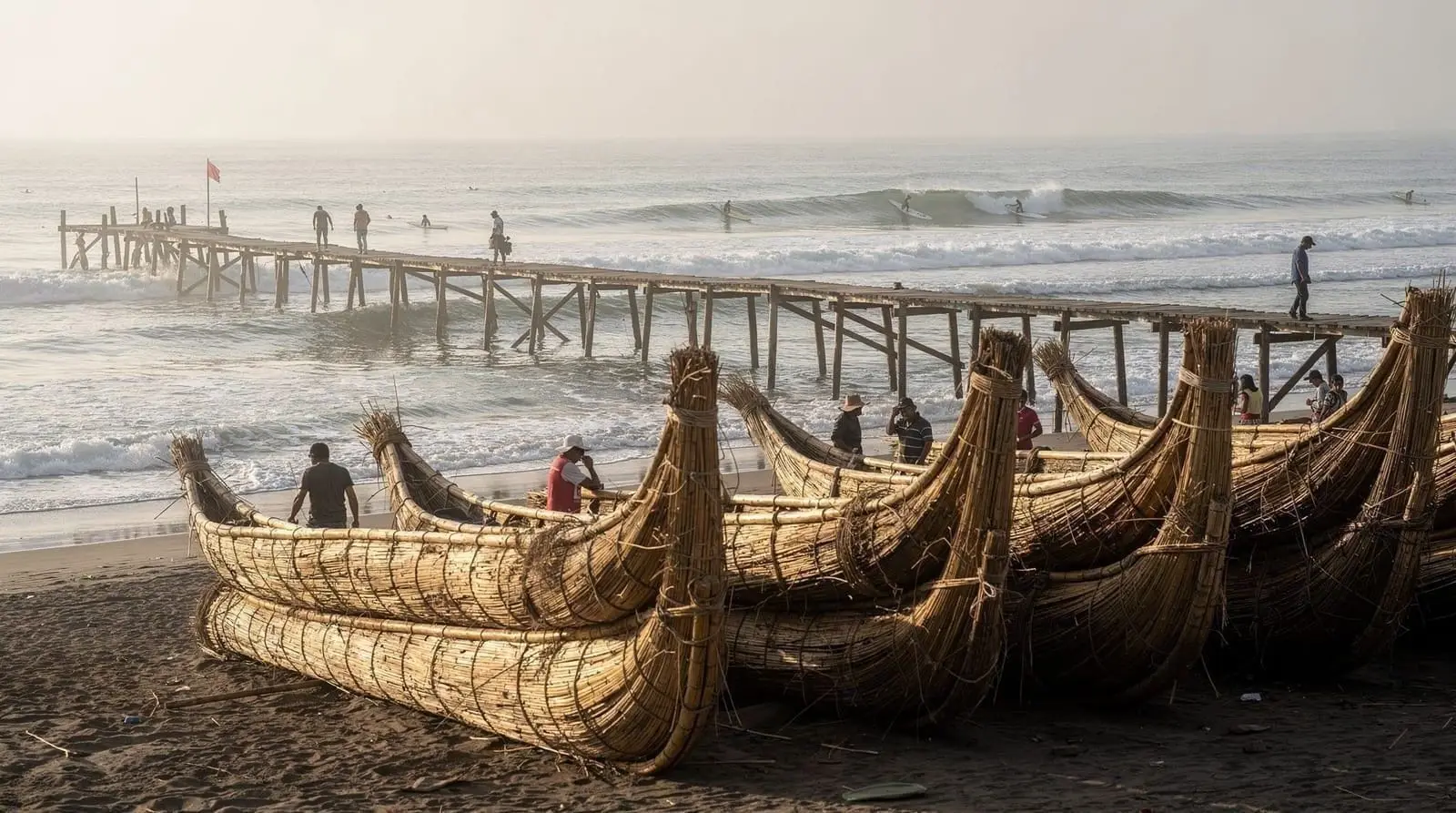
The caballitos are the headline act. These narrow, upturned reed boats — the name means “little reed horses” — are woven from bundles of totora reed grown in walled freshwater pits behind the beach, and fishermen here have used essentially the same design for at least 2,000 years. You can see the same craft painted on Moche ceramics at the Huacas de Moche down the coast. Some scholars argue the caballito is the original surfboard, since fishermen ride the boats back through the breakers by straddling the stern. Whether or not that is true, Huanchaco leans into it: the town is officially recognised as a World Surfing Reserve, the eighth in the world.
This page covers when to visit, how the surf works, where the food is genuinely good, and how Huanchaco fits a Trujillo trip.
The caballitos de totora
Walk the northern end of the beach near the fishermen’s jetty in the early morning and you will see the working caballitos: men paddling out through the surf lying or kneeling on the reed hulls, setting nets for sea bass (corvina) and other coastal fish, then riding the waves back in to unload. This is not a show put on for tourists — it is a living fishery, though a shrinking one, as fewer young people take it up.
Several fishermen will, for a small fee (around S/10–20, USD 3–5), let you sit on a caballito for a short paddle or a photo, and some offer longer rides. Be aware the reeds become waterlogged after a few hours in the sea, which is why each boat is propped vertically to dry on the beach between outings and replaced every couple of months. The drying boats lined up against the sky are the classic Huanchaco photograph, best in the soft light of early morning or late afternoon.
The totora reed beds themselves, the wachaques, sit just inland behind the beach — shallow walled ponds where the reed is cultivated. They are an easy detour on foot and give context to the whole tradition.
It is worth being honest that the caballito tradition is fading. The fishery is less profitable than it once was, the reed beds are squeezed by urban growth, and most young people in Huanchaco now look to surf tourism, hospitality, or the city for work rather than to a craft that demands rising before dawn to ride a waterlogged reed boat through cold surf. A local fishermen’s association keeps it going, partly for income and partly out of pride, and the more visitors who pay a few soles for a ride or a photo, the more reason there is to maintain it. Coming early, when the boats are genuinely working rather than posed, is the most respectful way to experience it — and the most rewarding, because the morning launch is the real thing.
Surfing Huanchaco
Huanchaco has a long, forgiving left-hand point and beach break that peels for a satisfying distance and stays rideable most of the year. It is colder and less glamorous than the warm-water breaks up at Máncora, but it is far less crowded and one of the best places in Peru to learn. The wave is mellow on small days, the bottom is sand and reed rather than rock or coral, and the lineup is friendly.
A clutch of surf schools along the malecón rent boards and wetsuits and run lessons. Reckon on S/30–50 (USD 8–13) for an hour or two of board rental, and S/60–100 (USD 16–27) for a group lesson including gear. A wetsuit is essential year-round — the Humboldt Current keeps the water cold (roughly 16–19°C) even in summer, and you will not last long in shorts. Bigger, cleaner swells tend to arrive in the southern-hemisphere winter (April to October), while the water is marginally warmer December to April.
The pier (muelle) marks the heart of the break, and the point at the northern end of the bay is where the longer, cleaner left forms on a good day. Beginners are usually started on the inside reforms near the centre of the beach, which is forgiving and rarely crowded outside summer weekends. There is a friendly, slightly bohemian surf culture here that contrasts sharply with the louder beach-party scene at Máncora up the coast — Huanchaco is somewhere you come to actually learn or to surf quietly, not to be seen. If you are travelling with a board, note that the airport for the region is in Trujillo (TRU) and board fees on the LATAM domestic flights are reasonable.
Eating in Huanchaco
This is the reason a lot of Trujillo locals make the trip. North-coast ceviche differs from the Lima version — it is typically made with corvina or sole, marinated a touch longer, and served with cancha (toasted corn), sweet potato, and choclo. Huanchaco’s restaurants serve it within sight of the boats that landed the fish.
For honest value, the cluster of family-run cevicherías a block back from the seafront generally beats the pricier glass-fronted places directly on the malecón, where you are paying for the ocean view. Restaurant Big Ben is the long-established upmarket option for a proper seafood lunch; Otra Cosa is a well-known vegetarian and traveller-oriented café for those wanting a break from fried fish. A full ceviche lunch runs S/20–35 (USD 5–9) at a local spot, more at the tourist-facing restaurants. Wash it down with chicha morada (purple-corn drink) or, if you are feeling brave, the cloudy local chicha de jora made from fermented maize.
A word of honesty: the beach is for atmosphere, not swimming. The water is cold, the current can pull, and the sand is grey-brown rather than postcard gold. Come for the boats, the surf, and the food — not for sunbathing.
A note on prices and tourist traps. The seafront restaurants with the best views charge a premium that has little to do with the quality of the ceviche, which is often identical to what you’ll get a block inland for a third less. Menus rarely list prices for “fish of the day,” so ask before ordering. Tap water is not safe to drink anywhere in the region; stick to bottled or boiled. And while Huanchaco is generally safe and easygoing, the usual coastal-Peru sense applies — keep an eye on bags and phones on a busy summer weekend, and use a hotel-called taxi rather than flagging one on the road late at night.
Huanchaco’s church and the wider village
Above the modern seafront strip, on the bluff at the southern end of town, stands the Santuario de la Virgen del Socorro — one of the oldest churches in Peru, with origins reaching back to the 1530s, soon after the Spanish arrival. It is a modest whitewashed building rather than a grand cathedral, but the climb up to it rewards you with the best panorama of the bay, the pier, and the lines of drying caballitos far below. The church remains an active centre of local devotion, and its annual patronal festival in late December is one of the high points of the Huanchaco calendar.
Beyond the beach and the church there is not a great deal to “do” in Huanchaco, and that is rather the point. It is a place to slow down between bouts of archaeology — to drink a cold beer at sunset, watch the surfers, and eat well. Treating it as a rest stop rather than a sightseeing checklist is the way to enjoy it.
Where to stay
Many independent travellers prefer to base themselves in Huanchaco rather than central Trujillo, using it as a calmer launchpad for the ruins. The malecón has a good spread of surf hostels and small guesthouses, with dorm beds from around S/30–40 (USD 8–11) and private rooms from S/80–150 (USD 21–40). It is quiet midweek and out of summer; from December to April, and on Peruvian long weekends, it fills with Lima visitors and prices firm up.
The trade-off is logistics. Staying in Huanchaco adds a 20-minute combi ride at each end of any city or ruins day, but you wake up to the sea and the dawn fishermen, which many travellers consider a fair exchange.
Getting to Huanchaco from Trujillo
Huanchaco is roughly 13 km northwest of central Trujillo and very easy to reach.
- Combi / micro: Minibuses marked “Huanchaco” run constantly from central Trujillo (around the Espana and Industrial corner) for S/2–3, taking about 20–30 minutes depending on traffic. This is the local default.
- Taxi: A direct taxi costs S/15–20 (USD 4–5) and takes 15–20 minutes — worth it if you have luggage or are arriving late.
- On a tour: Most full-day Trujillo tours finish in Huanchaco for a late lunch after visiting Chan Chan and the Huacas de Moche, since the village sits just up the coast from Chan Chan.
If you are combining sites independently, the logical sequence is Huacas de Moche in the morning, then Chan Chan, then Huanchaco for lunch and the late-afternoon light on the reed boats.
Trujillo: Chan Chan and Huanchaco Beach TourCombining Huanchaco with the ruins
Huanchaco rarely justifies a trip on its own — its value is as the relaxed counterweight to a day of adobe and desert dust. A typical north-coast day runs the Huacas de Moche and Chan Chan in the cooler morning hours, then drops into Huanchaco for ceviche and a beach wander as the heat eases. The reed-boat fishermen are most active around dawn and again in the late afternoon, so an overnight in the village lets you catch both.
If your trip continues north, Huanchaco is the southern bookend of Peru’s coastal-beach run that ends at Máncora and the Tumbes mangroves near the Ecuadorian border. For pacing across the whole region, see the northern Peru route guide.
Trujillo & Huanchaco: Classic 2-Day, 1-Night TourFrequently asked questions about Huanchaco
What are the reed boats in Huanchaco?
They are caballitos de totora — narrow, upturned boats woven from bundles of totora reed and used by local fishermen for at least 2,000 years. The same design appears on ancient Moche pottery. Fishermen paddle them out through the surf to set nets and ride them back through the waves, which is why some call the caballito the world’s first surfboard.
Is Huanchaco good for surfing?
Yes, especially for learners. It has a long, mellow left-hand break over a sand-and-reed bottom, and several surf schools rent gear and run lessons (board rental from S/30–50, lessons from S/60–100). A wetsuit is essential year-round because the Humboldt Current keeps the water cold (16–19°C). Bigger swells arrive April to October.
Can you swim at Huanchaco beach?
You can, but most people don’t. The water is cold, the current can be strong, and the sand is grey-brown rather than the warm golden beaches of Máncora. Huanchaco is best enjoyed for its fishing culture, surf, and seafood rather than as a sunbathing beach.
How do I get from Trujillo to Huanchaco?
Combis marked “Huanchaco” run constantly from central Trujillo for S/2–3 and take 20–30 minutes. A taxi costs S/15–20 and takes about 15–20 minutes. Most full-day Trujillo tours also finish in Huanchaco for lunch after visiting Chan Chan and the Huacas de Moche.
When is the best time to visit Huanchaco?
December to April brings the warmest weather, the most sun, and the liveliest atmosphere, but also the most visitors. May to November is cooler and quieter, with grey garúa mornings that usually clear by midday. Surfers find the best swells April to October. The reed-boat fishermen are out year-round, most active at dawn and dusk.
Should I base myself in Huanchaco or Trujillo?
Both work. Huanchaco is calmer, sits on the sea, and has a strong surf-hostel scene, but adds a 20-minute combi ride to reach the city and the ruins. Central Trujillo puts you closer to the colonial centre, museums, and bus terminals. Beach-focused and budget travellers tend to choose Huanchaco; those prioritising the historic centre choose Trujillo.