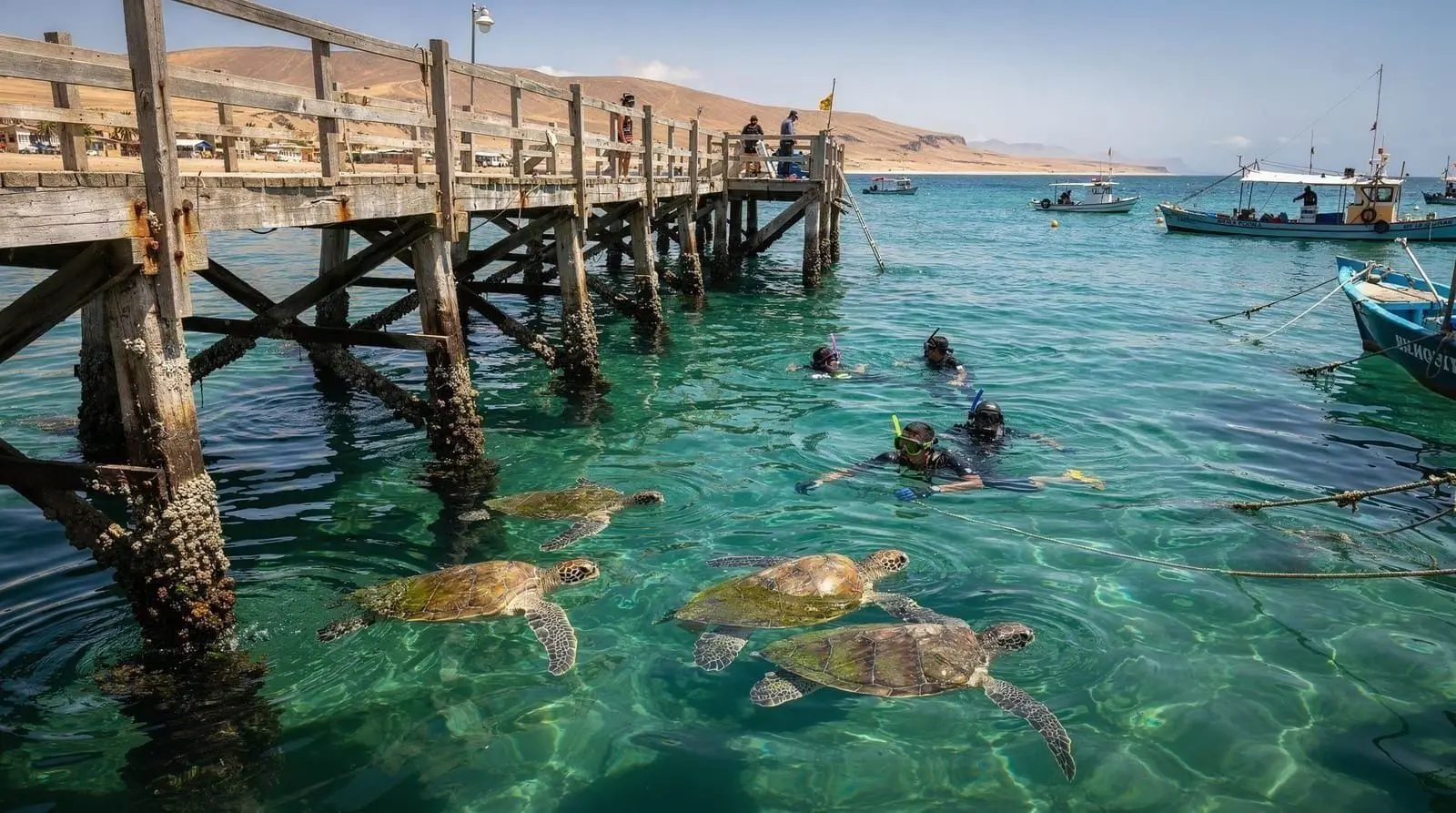
Swimming with turtles in Máncora
Máncora: Swimming with Turtles in Their Natural Habitat
Where do you swim with turtles near Máncora?
At El Ñuro, a fishing village 15 minutes south of Máncora, where wild green sea turtles feed by the wooden pier year-round. Snorkellers swim alongside them in clear, shallow water. Entry to the beach is free; a shared taxi and snorkel rental cost under S/30, or a guided tour S/50–80.
One of South America’s most reliable wild-turtle encounters
Six kilometres south of Máncora, a small fishing village called El Ñuro has quietly become one of the most dependable places on the continent to swim with wild sea turtles. Green sea turtles gather around the village’s old wooden pier, drifting through clear, shallow water two to six metres deep. They are not captive, not fenced and not performing — they congregate here partly because fishermen long cleaned their catch off the pier, and partly because the bay is protected from fishing, so the turtles have learned the spot is safe. The result is an unusually accessible, genuinely wild encounter: you snorkel a few metres off a public beach and turtles the size of a dustbin lid glide past at arm’s length.
It is one of the highlights of the far-north coast, and unlike the humpback whales that only pass July to October, the turtles are here all year. This guide covers how to reach El Ñuro, what it really costs to go independently versus on a tour, the best time of day, and — importantly — how to do it without harming the animals you came to see.
| Where | El Ñuro, 15 min south of Máncora |
| Cost | S/25-35 DIY, or S/50-80 guided tour |
| Time needed | 1.5-3 hours including transport |
| Best time | Mornings, roughly 8-11am, calmer water |
| Season | Year-round (unlike Máncora’s whales) |
What you will see
The stars are green sea turtles (Chelonia mydas), the same species found across the tropical Pacific. Adults reach a metre or more in shell length and feed on algae and seagrass, though here they also scavenge fish scraps near the pier. They move slowly and unbothered, surfacing to breathe and then dropping back to the bottom. On a good calm morning you may share the water with several at once.
They are not the only residents. Pelicans and boobies roost on the pier pilings, sea lions sometimes haul out or pass through, and the bay holds reef fish and rays. Some tours combine the turtle swim with a short catamaran cruise and bird watching, which turns a quick snorkel into a fuller half-day on the water.
From Máncora: Turtles, Catamaran Ride & Bird WatchingGetting to El Ñuro
El Ñuro sits just south of the larger town of Los Órganos, about 15 minutes’ drive from Máncora down the coast road.
Independently. Take a colectivo (shared taxi) from Máncora towards Los Órganos / El Ñuro for S/10–15 per person; the trip is about 15 minutes. From the village it is a short walk down to the pier and beach. Entry to the beach is free, though there may be a small access fee of a few soles to use the pier itself. Snorkel masks and fins rent locally for S/10–20. Total cost going alone is roughly S/25–35 — the cheapest option by a wide margin.
On a guided tour. Half-day tours from Máncora bundle transport, a guide and snorkel equipment for S/50–80 (USD 14–21) per person. The convenience is real if you do not want to arrange the shared taxi and gear yourself, and the guide enforces the no-touching rule and points out the turtles and birds.
Máncora: Swimming with Turtles in Their Natural HabitatTours also run from further afield — including day excursions from Piura that combine the journey to the coast with the turtle swim, useful if you are based inland or arriving by air:
From Piura: Excursion to Máncora & Swimming with TurtlesEl Ñuro on your own vs a guided tour
Both work; the right choice depends on your priorities.
Go independently if you are comfortable arranging a shared taxi, want the lowest cost, and prefer to set your own timing — arriving early for the calmest water and staying as long as you like. This is the budget traveller’s clear choice.
Take a tour if you want everything handled, prefer a guide to brief you on the turtles and the rules, are short on time, or want the combined catamaran-and-birds version. Tours also smooth the logistics if you are travelling with children or a group.
Whichever you choose, the turtle encounter itself is the same wild animals in the same bay. A tour does not buy you better turtles, only easier logistics and a guide.
A note on the combined whale-and-turtle option
In the July–October whale season, a third option opens up: a combined tour that takes in whale watching offshore and turtle snorkelling at El Ñuro in a single morning. This is the most efficient way to see both, and good value if your time is short — you cover the region’s biggest and smallest charismatic marine animals in one trip. Outside the whale season this option is not available, and the standalone turtle swim is the way to go. If you are visiting between July and October and want both, book the combined tour rather than doing them separately.
What the turtle swim is actually like
It helps to know what to expect in the water so you are not surprised. You wade or step off the pier area into warm, calm, waist-to-chest-deep water and float face-down with your snorkel. The turtles are often already there, grazing or resting on the bottom and rising periodically to breathe. They are unbothered by snorkellers and will sometimes pass directly beneath or beside you, close enough to see the pattern on their shells and the barnacles riding on them.
The sensation is less like an adrenaline activity and more like quiet observation — slow, peaceful, and genuinely moving for many people. There is no current to fight and no depth to worry about. The main discipline is restraint: the temptation to reach out and touch is strong, and you must not. Let the animal set the distance.
Best time of day and year
The turtles are present all year and throughout the day, so the real variable is the water. Visibility and comfort are best on calm mornings, before the afternoon wind and swell stir up the bay and reduce clarity. Aim to arrive between roughly 8 and 11 am. Across the year, calm conditions are more common in the dry season (roughly May to November), though the bay is sheltered enough that turtle-swimming is feasible year-round. Avoid going straight after a big swell, when the water turns murky.
This is a useful contrast with Máncora’s other wildlife draw: the whales are strictly seasonal (July–October) while the turtles are not, so a turtle swim is the dependable wildlife activity whenever you visit. Plan around the wider best time to visit Peru calendar if you are combining the coast with the rest of the country.
Doing it responsibly
This is a wild-animal encounter on an unmanaged public beach, which means the ethics are partly in your hands. The turtles are protected, and respectful snorkelling has little impact — but harassment, crowding and bad sunscreen all do harm. The rules are simple and largely enforced by guides:
- Do not touch the turtles. This is the one firm rule. Touching damages the protective layer on their shells and skin and stresses the animal. It is also widely banned at the site.
- Do not chase, corner or ride them. Keep your distance and let curious turtles come to you. Never block a turtle’s path to the surface to breathe.
- Do not feed them. Feeding alters natural behaviour; let them forage as they would anyway.
- Use reef-safe sunscreen, or cover up with a rash vest instead — many common sunscreens contain chemicals harmful to marine life.
- Take your litter away. The bay’s protection is the reason the turtles are here at all.
A responsible operator will brief you on all of this; if you go independently, the responsibility is yours. The encounter stays good only if visitors keep it low-impact.
Why El Ñuro works — and the conservation backstory
The turtles did not always gather here in such numbers. Green sea turtles are endangered across the Pacific, threatened historically by hunting, egg collection, fishing bycatch and habitat loss. El Ñuro’s pier became a turtle hotspot partly by accident — fishermen cleaning their catch drew the animals in — and the encounter could easily have gone the way of so many wildlife sites, degraded by overuse. Instead, local awareness of the turtles’ value as a draw, combined with their protected status, has kept the bay relatively healthy.
The fact that the turtles are wild, free to leave, and not fed for a show is precisely what makes the experience worth defending. Every visitor who keeps their distance and their hands to themselves is part of why the next visitor will still find turtles here. It is one of the better examples on the Peruvian coast of low-impact wildlife tourism working as intended — which is all the more reason not to be the person who spoils it.
El Ñuro beyond the turtles
The bay rewards a longer stay than the snorkel alone. The old wooden pier is photogenic, lined with fishing boats and roosting pelicans, and a pleasant place to watch the turtles surface even without getting in the water. The village is a working fishing community rather than a resort, so a meal of fresh seafood at a simple cevichería is part of the appeal. Some visitors combine El Ñuro with neighbouring Los Órganos, which has its own quieter beach and pier, into a relaxed half-day exploring the coast south of Máncora. Bring cash, as facilities are basic, and do not expect the polish of the main Máncora strip — the rough-around-the-edges quality is much of the charm.
Fitting it into a Máncora trip
The turtle swim is the perfect calm-water activity to balance a more active Máncora stay. It pairs naturally with a surf trip as a flat-water rest day, and during the whale season you can take a combined whale-and-turtle tour that covers both in one morning. For everything else — where to stay, where to eat, how to get to Máncora in the first place — see the Máncora complete guide and the destination page.
Reaching the coast overland is mapped in the northern Peru route guide, which links the journey up from Trujillo and Chiclayo.
What to bring and what to wear
Pack light for El Ñuro: a swimsuit or rash vest, reef-safe sunscreen (or full coverage instead, since many sunscreens harm marine life in a bay this small and enclosed), a towel, water, and cash in small soles notes for the taxi, pier fee and gear rental. Snorkel masks rent locally, but if you have your own and prefer a familiar fit, bring it — rental gear is functional rather than premium. Water shoes or old sandals help on the rocky entry near the pier, though most people go in barefoot. There are basic changing facilities and simple food stalls in the village, but nothing resembling the polish of central Máncora, so treat it as a rustic half-day rather than a resort outing.
How El Ñuro compares to Máncora’s other marine wildlife
Máncora’s coast offers two headline wildlife encounters, and they complement rather than compete with each other. The humpback whales are a strictly seasonal spectacle (July–October) seen from a boat offshore, while the El Ñuro turtles are a year-round, in-the-water encounter a short taxi ride away. Travellers visiting in whale season often do both — a combined tour in the morning, or the two activities on separate days — while those visiting outside July–October have the turtle swim as their reliable wildlife highlight regardless of timing. Neither activity requires much fitness or prior experience, which makes them an easy pair to slot into a relaxed Máncora beach stay.
Frequently asked questions about Swimming with turtles in Máncora
How much does it cost to swim with turtles at El Ñuro?
Are the turtles at El Ñuro wild?
What time of day is best for swimming with turtles?
Is it ethical to swim with the turtles?
Can you see turtles at El Ñuro year-round?
Do I need to know how to swim to do this?
How does El Ñuro compare to other turtle spots in Peru?
Top experiences
Bookable activities with verified prices and instant confirmation on GetYourGuide.
