Tumbes mangroves guide
Tumbes: Puerto Pizarro Mangroves and Islands Tour
What are the Tumbes mangroves and how do you visit?
The Santuario Nacional los Manglares de Tumbes protects Peru's only major tropical mangrove forest, in the far north near Ecuador. You explore the tidal channels by boat from Puerto Pizarro (15 km north of Tumbes city), seeing birds, crabs, a crocodile breeding centre and island sandbars. Tours run S/30–80.
Peru’s one tropical mangrove forest
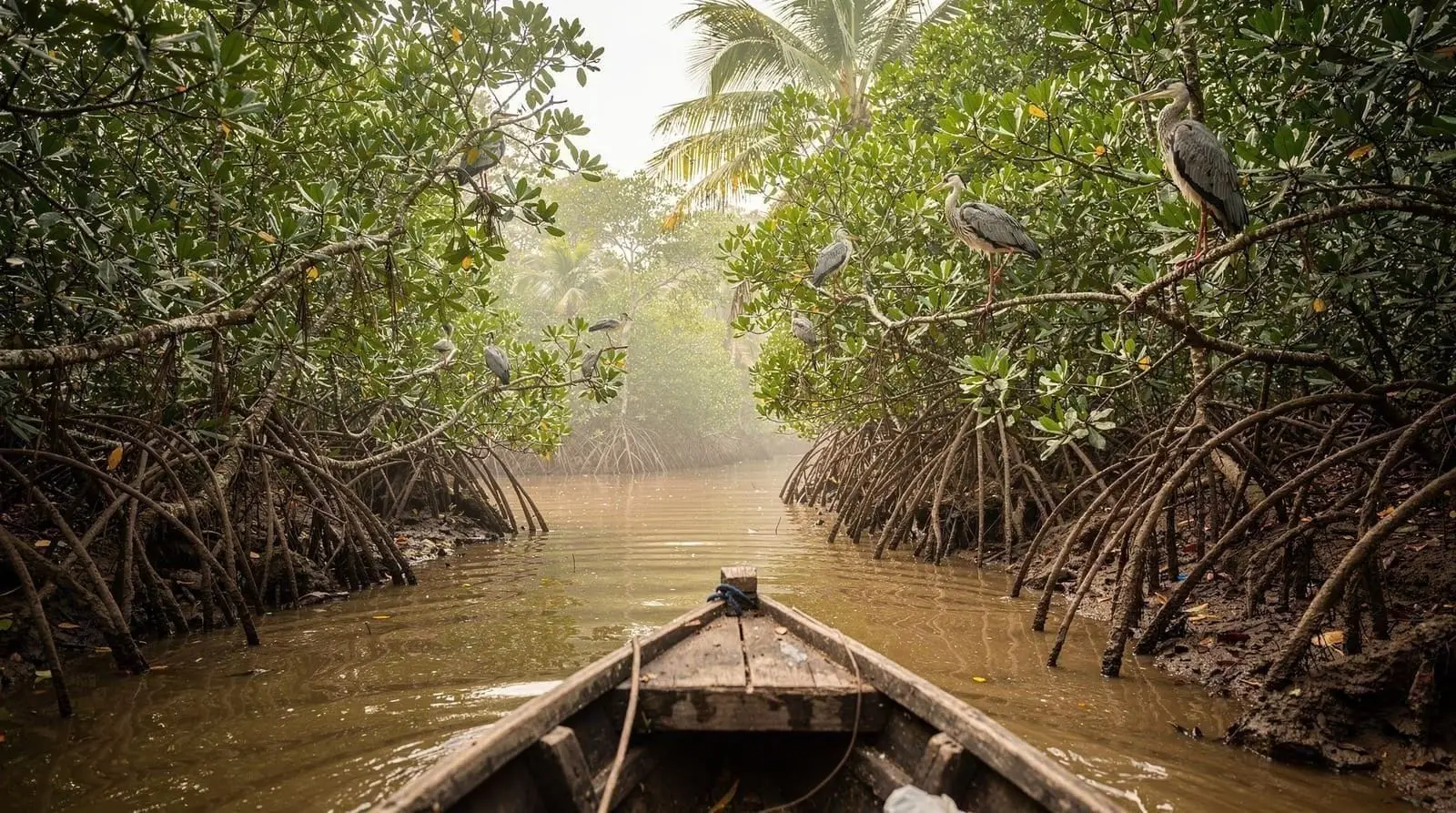
Peru’s coast is, for the most part, desert and surf. The exception sits at the very top of the country, where the Tumbes region meets the Ecuadorian border and the climate finally turns properly tropical. Here, fed by warm equatorial currents and the outflow of rivers, grows the only significant mangrove forest in Peru: a tangle of red, white and black mangroves rooted in tidal mudflats, threaded by saltwater channels and dotted with sandbar islands. The protected heart of it is the Santuario Nacional los Manglares de Tumbes, a national sanctuary established to guard this rare and biologically rich ecosystem.
For travellers, the practical gateway is Puerto Pizarro, a fishing village about 15 km north of Tumbes city, where boatmen run tours through the channels. It is a low-key, ecological outing rather than a marquee attraction — there are no ruins, no dramatic vistas, no crowds. What you get instead is birdlife, a working fishing and oyster-farming community, a crocodile breeding centre, and an hour or two drifting through green tidal corridors. This guide explains exactly what is there, what it costs, how to reach it, and how to set your expectations so you enjoy it for what it is.
| Where | Puerto Pizarro, ~15 km north of Tumbes city |
| Cost | Around S/30–80/person boat tour + small croc-centre fee |
| Time needed | Half-day (1.5–2.5hr boat circuit) |
| Getting there | Colectivo or taxi from Tumbes; long day trip from Máncora |
| Best time | Morning, higher tide, year-round tropical climate |
Why the mangroves matter
Mangroves are among the most productive ecosystems on earth. Their submerged roots are nurseries for fish, crabs and shellfish; their canopies shelter huge numbers of birds; and they buffer the coast against erosion and storms. The Tumbes mangroves are the southern limit of a forest type that runs up the Pacific coast of Central and South America, and their isolation makes them a refuge for species found nowhere else in Peru. The black conch (concha negra), harvested sustainably by local communities, and the American crocodile, once nearly wiped out here and now bred for reintroduction, are the two emblematic species. Understanding this is half the value of a visit: the mangroves reward attention rather than awe.
The three mangroves and how to tell them apart
Part of the quiet pleasure of a tour is learning to read the forest. The Tumbes mangroves are dominated by three species, and a good boatman or guide will point out the differences. The red mangrove is the one in the postcards — its arching prop roots drop from the branches into the water like flying buttresses, and it grows closest to the open channels. The black mangrove grows slightly further back on firmer mud and sends up hundreds of finger-like breathing roots (pneumatophores) that poke vertically out of the sediment around the trunk.
The white mangrove sits furthest from the water and lacks the dramatic root structures. Each is adapted to a different level of salinity and tidal flooding, and together they form a gradient from open water to dry land. Once you can spot the three, the seemingly uniform green wall resolves into a structured, legible ecosystem — which is exactly the shift in attention that makes the trip worthwhile.
What you see on a Puerto Pizarro tour
A standard boat tour from Puerto Pizarro winds through the tidal channels and usually includes several stops:
- The mangrove channels themselves, where the boatman cuts the engine and you drift past the stilt-like prop roots, watching for crabs scuttling on the mud and birds in the branches.
- The crocodile breeding centre (Zoocriadero), a conservation project rearing the endangered American crocodile for release. Entry is a small extra fee of a few soles.
- Island sandbars such as Isla del Amor and Isla de los Pájaros, where boats pull up for a swim in the warm shallows or to watch roosting sea birds.
- Oyster and conch farming areas, part of the working economy of the village, sometimes with a chance to taste fresh oysters.
Birdlife is the consistent highlight: herons, snowy and great egrets, white ibises, frigatebirds, pelicans, and a range of waders working the mudflats at low tide. Bring binoculars if you have them. The whole circuit takes roughly 1.5 to 2.5 hours depending on the route and the tide.
Tumbes: Puerto Pizarro Mangroves and Islands TourGetting there and what it costs
From Tumbes city. Puerto Pizarro is about 15 km north — a 20–30 minute trip by colectivo or taxi. Shared transport is cheap (a few soles); a private taxi will be more. From the Tumbes plaza, combis and colectivos to Puerto Pizarro leave regularly.
From Máncora. Tumbes is roughly an hour north of Máncora by colectivo (S/20–30); from there continue to Puerto Pizarro. It makes a feasible long day trip from Máncora, though it is tighter than visiting from Tumbes itself.
Boat tour prices. A shared boat tour through the channels and islands typically runs S/30–80 (USD 8–21) per person, varying by operator, boat size and route length. Smaller groups and private hire cost more; larger shared boats are cheaper per head. Agree the price, route and stops before you board. The crocodile centre charges a small separate entry fee.
Several operators run the route under slightly different names and itineraries — some emphasise the islands and birdwatching, others a fuller circuit:
Tumbes: Islands and Mangroves of Puerto Pizarro Tumbes: Bewitching Islands & Mangroves of Puerto PizarroBest time to go
The Tumbes climate is tropical and warm year-round, so there is no closed season. December to April is the hottest and sunniest stretch; the rest of the year stays warm with more cloud. Two timing tips matter more than the month:
- Go at higher tide where you can. Low tide can leave channels too shallow for comfortable navigation, though it does expose the mudflats where waders feed. Ask the boatmen about the day’s tide.
- Go in the morning. Birdlife is most active early, the water is calmer, and you avoid the strongest midday heat in an open boat. Bring sun protection regardless — there is little shade on the water.
Set this against the wider best time to visit Peru calendar if you are stitching the far north into a longer trip.
Managing your expectations
This is the honest section. The Tumbes mangroves are ecologically important and a pleasant outing, but they are not a wildlife spectacle on the scale of the Amazon or the Galápagos. You will not see large mammals, the crocodiles are mostly in the breeding centre rather than wild in the channels, and the village of Puerto Pizarro is a workaday fishing port, not a polished resort. The boats are basic. If you arrive expecting a dramatic safari you will be underwhelmed; if you arrive wanting a calm, birdy, low-cost half-day on the water with some ecological substance, it delivers exactly that.
It is at its best as a change of pace — a quiet counterpoint to the surf and party energy of Máncora, or a worthwhile stop if you are crossing to or from Ecuador and have a few hours to spare.
Birdwatching in the mangroves
For birdwatchers specifically, the Tumbes mangroves are the strongest reason to come, and the region punches above its weight. The tidal mudflats and channels draw large numbers of wading and water birds, and the far-north location means a handful of species reach Peru only here, at the edge of their tropical range. On a typical morning you can expect snowy and great egrets stalking the shallows, little blue and tricolored herons, white ibises probing the mud, neotropic cormorants, brown pelicans, magnificent frigatebirds wheeling overhead, and various sandpipers and plovers working the exposed flats at low tide.
Mangrove-specialist species and the occasional rarer heron or kingfisher reward the patient. Go early, bring binoculars, ask your boatman to move slowly and quietly through the narrower channels, and consider a private or small-group boat so you can linger rather than being rushed through. A dedicated birding boatman, arranged in advance, will know where the roosts and feeding flats are at the day’s tide.
A working coastal community
Puerto Pizarro is not a manufactured attraction; it is a living fishing port, and that texture is part of the visit. Boats come and go with the catch, oyster and concha negra (black conch) farming continues in the channels, and the village runs at the unhurried pace of a place that has not reorganised itself around tourism. You will see nets drying, fish being cleaned, and small cevicherías serving the morning’s catch.
For travellers tired of polished tourist towns, this workaday authenticity is refreshing — but it also means infrastructure is basic, prices are negotiated rather than fixed, and a little patience and Spanish go a long way. Treat the village as part of the experience rather than just a boat dock, and a half-day here becomes a genuine slice of far-north coastal life.
Practical tips for the visit
A few specifics smooth the trip. Bring cash in small soles notes — there are no reliable ATMs at the port and prices for boats, the crocodile centre and food are paid in cash. Wear sun protection and a hat; the open boat offers no shade and the equatorial sun is strong even under cloud. Carry water and insect repellent, the latter especially if you go later in the day. Wear footwear you do not mind getting wet for the sandbar-island stops, and bring a swimsuit if you want to use them.
Binoculars transform the birdwatching. Agree the price, route and stops with your boatman before boarding, and clarify whether the crocodile-centre fee is included. Go in the morning at higher tide for the best birdlife, calmest water and easiest navigation of the channels. Finally, keep expectations calibrated to a quiet ecological outing rather than a wildlife spectacle, and you will come away satisfied with what is a genuinely worthwhile, low-key corner of the far north.
Combining the mangroves with the rest of the far north
The mangroves slot naturally into a far-north itinerary. Most travellers pair them with a few days in Máncora for the beach, surf and — in season — whale watching and turtle snorkelling at El Ñuro.
Coming overland from the south, the northern Peru route guide maps the coast up from Trujillo and Chiclayo, and the Tumbes mangroves destination page has the on-the-ground specifics. The Peru bus travel guide covers the long-haul journeys to reach this corner of the country.
If you are crossing into Ecuador, Tumbes is the last Peruvian stop of note, and the mangroves make a fitting final-morning outing before the border.
Seasonality: what actually changes month to month
Unlike most of Peru, Tumbes has no dramatic wet-versus-dry contrast — but a few real seasonal shifts still shape the visit.
| Period | Conditions | Notes |
|---|---|---|
| December–April | Hottest, sunniest, most humid | Best light for photos; bring extra sun protection |
| May–August | Warm with more cloud cover | Slightly cooler boat rides, still comfortable |
| September–November | Transitional, generally mild | Good all-round window, fewer domestic holidaymakers |
| El Niño years (irregular) | Heavier rain, river surges | Can affect channel navigation; check conditions ahead |
The takeaway: book by tide and time of day far more than by month. A morning trip at higher tide beats any calendar consideration, and no single month is a reason to skip the mangroves altogether — this is one of the few Peru excursions where the seasonal calendar genuinely matters less than the hour of the day and the state of the tide.
Is it worth combining with a border crossing?
Because Tumbes sits at Peru’s northern edge, a meaningful share of visitors are here to cross into or from Ecuador rather than on a dedicated Peru holiday. If that describes you, the mangroves are a genuinely good use of a spare morning: Puerto Pizarro is a short hop from Tumbes city, the whole outing fits before an afternoon border crossing, and it beats simply killing time in a transit town. Coordinate timing with your bus or colectivo schedule to Ecuador, since services along this corridor run at set departure windows rather than continuously, and confirm your onward transport before committing to the boat trip so you are not rushing the mangroves to make a bus.
Frequently asked questions about Tumbes mangroves
Where are the Tumbes mangroves?
How much does a Puerto Pizarro mangrove tour cost?
What will I see on a Tumbes mangrove tour?
Is it worth visiting the Tumbes mangroves?
When is the best time to visit the Tumbes mangroves?
How long should I budget for the Tumbes mangroves?
Do I need to book a mangrove tour in advance?
Top experiences
Bookable activities with verified prices and instant confirmation on GetYourGuide.
