Máncora whale watching guide
Máncora: Whale Watching Tour
When can you see whales in Máncora?
Humpback whales migrate past Máncora from early July to late October, with the peak in August and September. This is the only reliable window in Peru. Tours leave the pier in the morning, last 3–4 hours and cost S/80–150 (USD 21–40). Sightings are common but never guaranteed.
Peru’s one great whale-watching window
Most travellers do not associate Peru with whales, and for most of the country they would be right. But for four months a year the warm waters off the far-north coast become one of the better humpback-watching spots on the Pacific seaboard of South America. Between July and October, humpback whales travel north from their cold sub-Antarctic feeding grounds to breed and calve in the warm, sheltered waters off Ecuador and Colombia. Their migration corridor runs close enough to the coast at Máncora — and the water is calm and warm enough — that boat-based whale watching here is both practical and regularly successful.
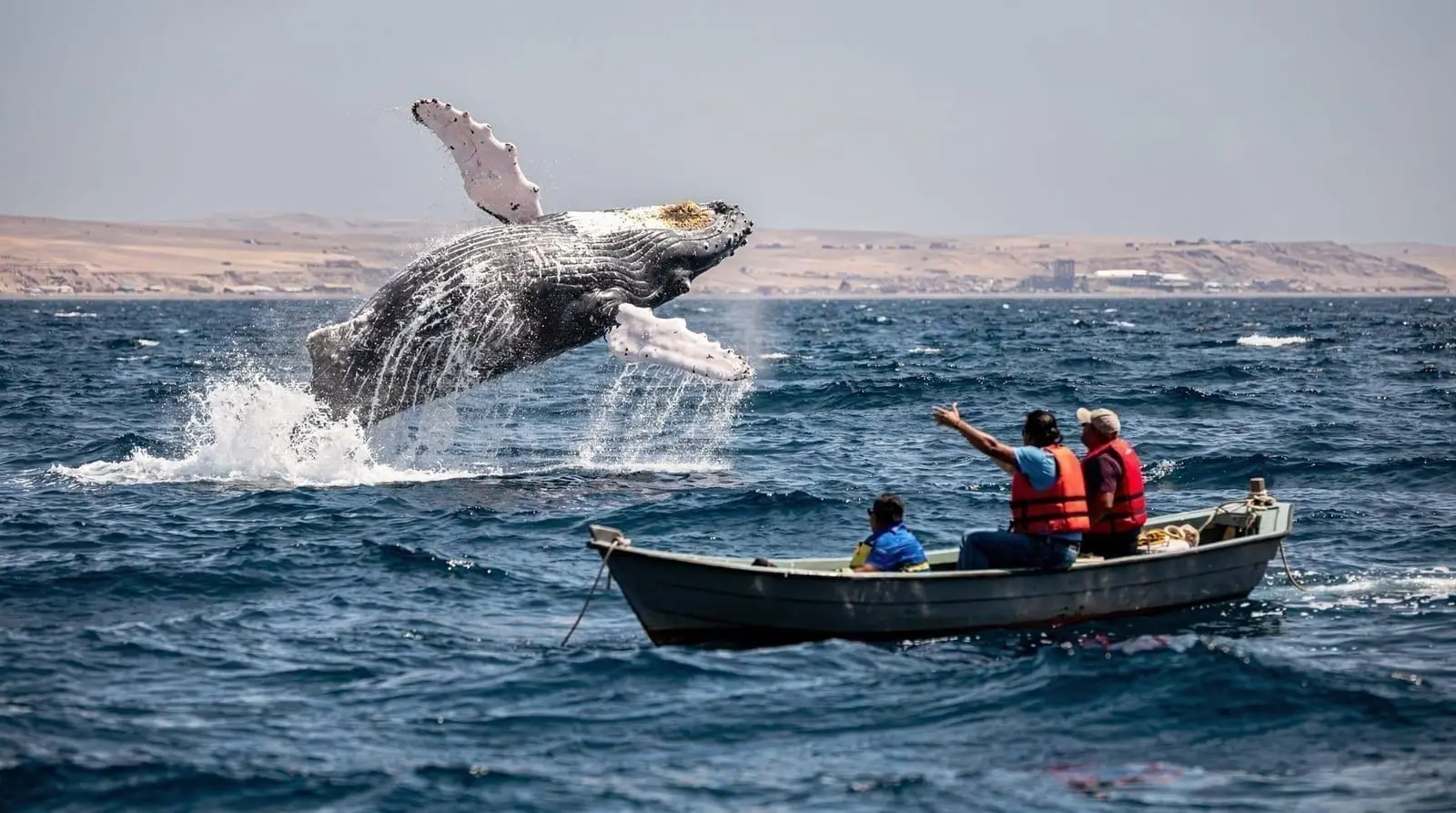
The experience is genuinely good. These are 12–15 metre, 30-tonne animals that breach clear of the water, slap their tails and pectoral fins, and travel in mother-and-calf pairs and small groups. On a good morning you watch this from a boat 10–20 km offshore with a guide pointing out behaviours. On a quieter day you might see a single blow at distance and a fluke as a whale sounds. This guide explains exactly when to come, what tours cost and include, how to choose a responsible operator, and how to avoid being sold a tour outside the real season.
| Season | Early July to late October, peak Aug-Sep |
| Cost | around S/80-150 (USD 21-40) per person |
| Duration | 3-4 hours, departing the pier in the morning |
| Sightings | Common in peak, never guaranteed |
| Combine with | El Ñuro turtle snorkelling, same morning |
The season — and why it is non-negotiable
Whale watching in Máncora runs from approximately early July to late October. The peak of encounters falls in August and September, when the largest numbers of whales are passing and the chances of multiple sightings in a single trip are highest. Early July and late October are the shoulders of the season — whales are around but in smaller numbers.
This is the part where honesty matters most. Outside the July–October window, the whales are simply not here in any numbers, and legitimate sightings are rare to non-existent. Some operators in low season will tell a hopeful tourist that whales are present year-round in order to sell a boat trip. They are not. If a whale tour is the reason you are travelling to Máncora, you must time your visit to the season; there is no flexibility on this. Build it into your planning alongside the wider best time to visit Peru calendar, because the whale window does not overlap with Máncora’s warmest beach weather (December–April).
What a tour involves
Tours depart from the Máncora pier in the morning, when the sea is calmest. A typical trip runs 3–4 hours and covers ocean 10–20 km offshore, where the whales are usually encountered. Boats are small fibreglass speedboats or modest yachts carrying roughly 6–12 passengers; life jackets are provided. The crew watches for blows and surface activity, then approaches at a respectful distance and cuts the engine to let the whales pass.
Expect to pay S/80–150 (USD 21–40) per person. The lower end is a straightforward whale-watching speedboat trip; the higher end usually buys a larger or more comfortable boat, a smaller group, or a combined itinerary that adds turtle snorkelling at El Ñuro on the same morning. Bring sun protection, a hat, water and a light layer — even in the tropics the wind offshore is cool, and the sun reflecting off the sea is fierce.
Máncora: Whale Watching TourFor travellers who want both the whales and the turtles in one efficient half-day, combined tours are the best value and save a separate trip south to El Ñuro:
From Máncora: Whale Watching & Swimming with Sea TurtlesWhat you will actually see
Humpbacks are among the most surface-active of the large whales, which is exactly why they make good watching. During the peak you can reasonably hope for:
- Breaching — the whale launching most of its body clear of the water and crashing back.
- Tail and pectoral slapping — repeated, deliberate, and audible.
- Spy-hopping — the head rising vertically to look around.
- Mother-and-calf pairs, since this is a breeding migration; calves are playful at the surface.
- Blows and flukes as whales surface to breathe and then dive.
Bottlenose dolphins frequently accompany the boats, and the far-north coast is rich in sea birds — boobies, pelicans, frigatebirds — so even a quiet whale day rarely means an empty sea. None of it is guaranteed; this is wildlife, and any operator promising a certain breach is overselling.
Understanding the migration
A little context makes the watching far more rewarding. The humpbacks you see off Máncora belong to a southeastern Pacific population that spends the southern summer feeding in the cold, krill-rich waters off Chile and Antarctica. As the southern winter sets in, they migrate thousands of kilometres north to the warm equatorial waters off Ecuador, Colombia and the very far north of Peru to mate and give birth.
Calves are born without the thick blubber they need to survive cold water, so the warm tropics are essential nurseries. The animals passing Máncora are therefore on a purposeful journey — some heading north to breed, others, later in the season, heading back south with new calves. This is why the season is so fixed: it tracks a migration, not a resident population. Knowing you are watching one leg of a 16,000-kilometre round trip adds weight to the sight of a single distant blow.
Booking direct vs. through your hotel
Most travellers book their whale tour either directly at a pier-side operator’s kiosk the day or two before, or through their hostel or hotel, which usually takes a small commission for the convenience. Both are legitimate. Booking direct at the pier lets you see the boat and ask the crew about their approach and group size before paying, which is useful if operator quality matters to you as much as price.
Booking through your accommodation saves a walk and a negotiation, and most Máncora hostels only work with operators they trust, since a bad experience reflects on them too. The price difference is usually small — a few soles either way — so choose based on how much you want to vet the operator yourself rather than chasing the absolute lowest fare.
Where the tours leave from
Most Máncora whale tours depart the town’s pier, but the wider far-north coast offers several launch points, and a few are worth knowing about:
- Máncora pier — the most convenient if you are staying in town, with the widest choice of operators.
- Los Órganos, 10 km south, has its own small whale-watching fleet and is sometimes closer to the action; some Máncora bookings actually launch from here.
- Piura-based day tours combine the long transfer to the coast with a whale or whale-and-turtle trip, useful if you are based inland.
For most visitors the Máncora pier is the simplest choice, and the short list of reputable operators there fills up fast in the August–September peak.
Choosing a responsible operator
Whale watching done badly stresses the animals. Done well, it is low-impact and educational. Look for operators who:
- Keep their distance and approach slowly, cutting the engine rather than chasing or circling the whales.
- Limit time with any one group of whales and do not crowd them with multiple boats.
- Carry a guide who can identify behaviour and explain the migration, not just a boat driver.
- Have proper life jackets and a sensible passenger limit for the boat size.
- Are honest about the season and about the no-guarantee reality.
Booking ahead in August and September is wise, as the better boats fill up; in early July or late October you can often arrange a trip the day before at the pier. Some operators offer a partial refund or a free second attempt if no whales are seen — worth asking about, since it signals confidence and fairness.
From Máncora: Whale Watching TourSeasickness and comfort
The single most common complaint is seasickness, because the boats are small and the watching grounds are well offshore. Practical defences:
- Take a motion-sickness tablet (Dramamine or similar) about an hour before departure.
- Choose a morning slot, when the sea is calmest; afternoons get choppier as the wind builds.
- Sit mid-boat, where movement is least, and keep your eyes on the horizon rather than down at your phone or camera.
- Eat a light breakfast, not a heavy one, and stay hydrated.
- Ginger tablets or ginger sweets help some people.
If you are badly prone to motion sickness, the combined whale-and-turtle tours include calmer, sheltered water at El Ñuro for part of the trip, which can break up the offshore swell.
What gear actually helps
Beyond the sun protection and layers already mentioned, a few small items make a real difference on the boat. Polarised sunglasses cut the glare off the water enough to spot a blow or a fin at distance well before the guide calls it out. A dry bag or waterproof phone pouch is worth carrying even on a calm-looking morning, since spray comes over the bow more often than first-timers expect.
Binoculars are genuinely useful and rarely brought — most travellers rely on the boat closing distance, but a compact pair lets you follow distant surface activity the boat cannot safely approach. Anti-nausea wristbands (acupressure) are a mild backup for people who prefer not to take tablets, though they are less reliably effective than medication for anyone seriously prone to seasickness. A light waterproof jacket earns its space too — even on a warm morning, the wind chill 15-20 km offshore at boat speed is noticeably cooler than it feels standing on the pier.
What to expect on a quiet day — and how to improve your odds
It is worth being realistic: not every trip delivers breaching whales metres from the boat. On a quiet morning you might see one or two distant blows and a fluke as a whale dives, and that is still a legitimate sighting. You can stack the odds in your favour:
- Go in the August–September peak, not the shoulder weeks, if a strong sighting matters most.
- Choose a morning departure for calm seas and better light.
- Pick a longer trip — a 4-hour tour covers more water than a rushed 2-hour one.
- Build in a second chance by staying a few days, so a blank morning is not your only attempt. Some operators offer a free repeat trip if no whales are seen.
- Manage expectations: the magic of whale watching is partly the patience and the open sea, not just the breach. Treat the dolphins, birds and the offshore experience as part of the value.
Whale watching as part of a bigger wildlife trip
The far-north coast is unusually rich for marine wildlife, and the whale season coincides with several other draws. Bottlenose dolphins are present year-round and frequently join the boats. Sea birds — Peruvian boobies, brown pelicans, frigatebirds and, with luck, a passing flock further offshore — are constant company.
And the green sea turtles at El Ñuro are resident all year, which is exactly why combined whale-and-turtle tours are so popular: one morning can take in the largest animals in the region and an intimate in-the-water encounter with the gentlest. For naturalists, the July–October window is the single best time to visit the coast, even though it is not the warmest beach season. The trade-off — cooler, greyer beach weather in exchange for whales — is laid out in the Máncora complete guide.
Photographing whales from a small boat
Whale photography from a moving boat is hard, and managing expectations saves frustration. The animals surface unpredictably, the boat pitches, and a breach is over in a second. A few practical pointers: use a fast shutter speed (1/1000 or faster) to freeze movement and counter the boat’s motion; a moderate zoom (around 70–200 mm equivalent) is more usable than a long lens, which is almost impossible to hold steady on the swell; and pre-focus on the water where a whale was last seen rather than hunting for focus after it surfaces.
Shoot in bursts. Above all, watch some of it with your own eyes rather than the whole trip through a viewfinder — many travellers regret spending a once-in-a-trip humpback breach fumbling with camera settings. A phone in a waterproof pouch is fine for the experience and for video; serious stills need a proper camera and a tolerance for the many missed shots that come with the territory.
Planning the trip around the whale window
Because the season is fixed and does not overlap with Máncora’s warmest beach weather, whale watching is worth building your entire far-north timing around if it matters to you. Travellers flying in specifically for the peak should also check the wider Peru travel safety guide for coastal basics, and those combining the coast with a broader first trip to the country will find the Peru two-week itinerary useful for slotting a north-coast detour around Cusco and Machu Picchu without overreaching on time.
If a completely different marine environment appeals once you have seen the whales, the Tumbes mangroves, about an hour further north, offer calm-water birdlife boating that makes a good contrast to the open-ocean whale trip — covered in the Tumbes mangroves guide.
Fitting it into a Máncora trip
A whale-watching morning slots neatly into a winter Máncora visit. The July–October season overlaps with the bigger-swell surf season, so a single trip can combine waves and whales. The turtle snorkelling at El Ñuro runs year-round and pairs with whale tours either as a combined trip or a separate flat-water afternoon. For accommodation, food, getting there and the rest of the town, see the Máncora complete guide and the destination page.
If you are reaching the coast overland, the northern Peru route guide covers the journey up from Trujillo and Chiclayo, and travellers weighing the regions should read north vs south Peru.
Frequently asked questions about Máncora whale watching
What months can you see whales in Máncora?
How much does a whale watching tour cost in Máncora?
Are whale sightings guaranteed in Máncora?
What kind of whales do you see in Máncora?
Will I get seasick on a Máncora whale tour?
Top experiences
Bookable activities with verified prices and instant confirmation on GetYourGuide.
