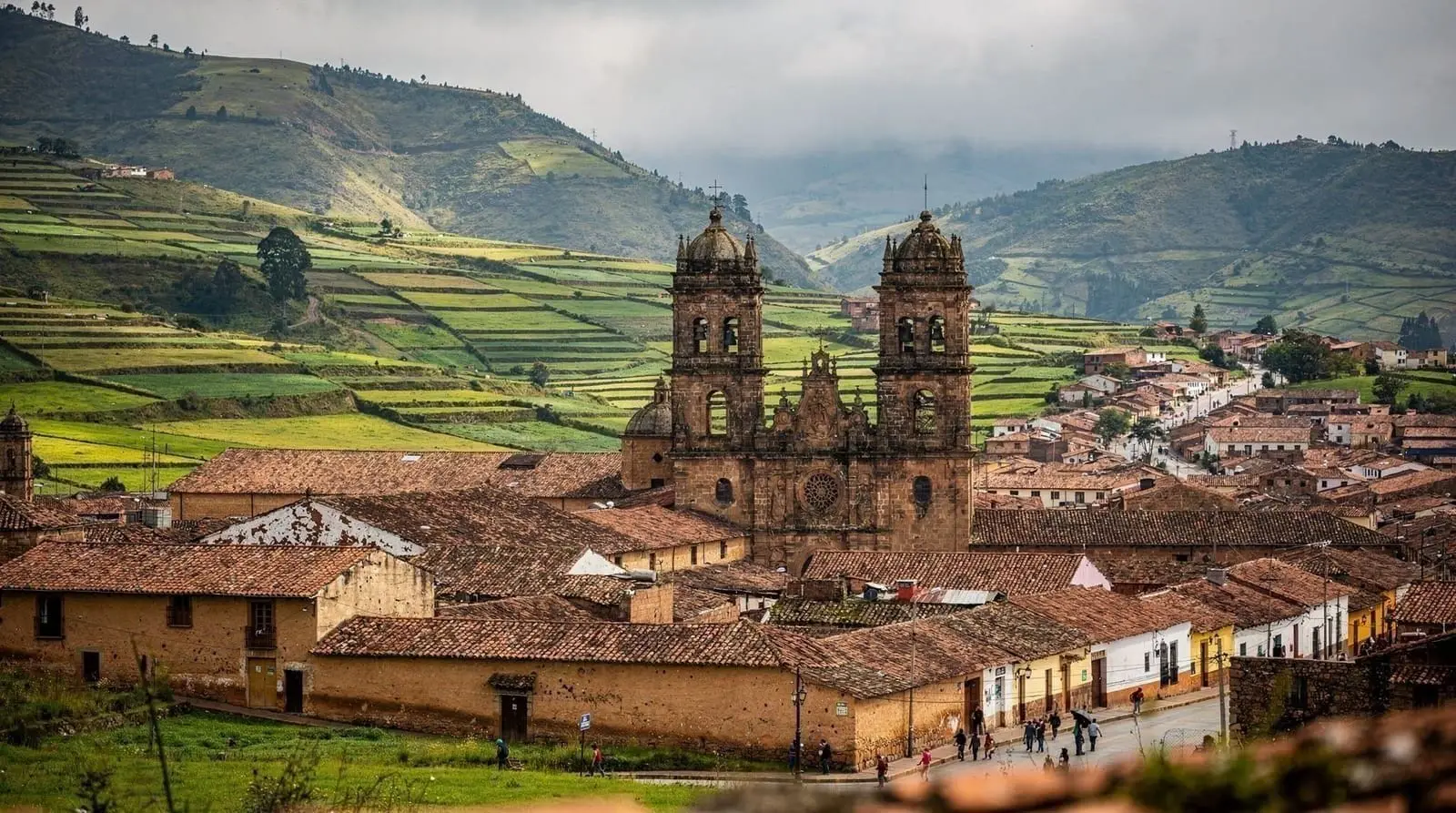
Cajamarca
Cajamarca is where Pizarro captured Atahualpa in 1532. See the Cuarto del Rescate, Cumbemayo's pre-Inca aqueduct, and the Baños del Inca hot springs.
Cajamarca: City Tour
Quick facts
- Country
- Peru
- Altitude
- 2,750 m (9,022 ft)
- Currency
- Peruvian sol (S/) — USD accepted in some hotels
- Best for
- Inca conquest history, pre-Inca sites, hot springs, dairy country
The city where the Inca Empire effectively ended
Few places in the Americas carry the historical weight of Cajamarca, and few are as underappreciated by international visitors. It was here, in November 1532, that Francisco Pizarro and fewer than 200 Spaniards ambushed and captured the Inca emperor Atahualpa, who had arrived to meet them with thousands of unarmed retainers. The Spanish held him in a single room, demanded it be filled once with gold and twice with silver as ransom, accepted the staggering payment over months, and then executed him anyway in 1533. The Inca Empire did not formally collapse that day, but its centre of gravity broke, and the conquest of the Andes accelerated from there. To stand in Cajamarca is to stand at the hinge of South American history.
The modern city is a handsome, low-key colonial highland capital at 2,750 m, set in a broad green valley that is Peru’s most important dairy region — Cajamarca cheese, manjarblanco (dulce de leche), and butter are sold across the country. The historic centre, with its ornate carved-stone churches in the local volcanic tuff, was declared a Historical and Cultural Heritage of the Americas by the OAS.
Yet because it sits off the main Cusco-Machu Picchu circuit and the Lima coastal route, Cajamarca sees a fraction of the foreign visitors its history and surroundings warrant. That neglect is the traveller’s gain: you get genuine highland Peru, a remarkable history, striking nearby sites, and almost none of the tourist-trap pressure that defines the southern circuit.
Two to three days is the right amount of time: one for the city and its conquest history, and one or two for the standout day trips to Cumbemayo and the Baños del Inca.
| Where | Northern highlands, ~850 km north of Lima |
| Time needed | 2–3 days |
| Altitude | 2,750 m (mild; Cumbemayo reaches 3,500 m) |
| Getting there | ~90-min flight from Lima, or 14–16 hr overnight bus |
| Best time | May–September (dry); Carnival in February |
A sample 2-day plan
| Day | Focus |
|---|---|
| Day 1 | Cuarto del Rescate, Plaza de Armas, Belén complex, Cerro Santa Apolonia at sunset |
| Day 2 | Full day out: Cumbemayo aqueduct and stone forest in the morning, Baños del Inca soak in the afternoon |
| Day 3 (optional) | Granja Porcón and the Otuzco funerary niches, or a slower pace at the springs |
Travellers connecting onward to Trujillo or Chachapoyas should build the extra travel days into this plan rather than trying to compress it — see the northern circuit notes below.
Getting to Cajamarca
Cajamarca is well connected by air, which is the easiest approach. Daily flights from Lima take about 90 minutes (LATAM and others), landing at Mayor General FAP Armando Revoredo Iglesias Airport just outside the city. Booking ahead keeps fares reasonable.
By land, Cajamarca is roughly 850 km north of Lima. Comfortable overnight buses (Civa, Línea, and others) make the run in around 14-16 hours; it’s a long but well-served route. From the north coast, Cajamarca connects to Trujillo (about 6-7 hours by bus) and to Chiclayo, which makes a northern Peru loop feasible — many travellers combine Cajamarca with Trujillo’s Chan Chan and Moche sites, or push on toward Chachapoyas and Kuélap, though the Cajamarca-Chachapoyas land link is long and roundabout via Chiclayo or Celendín.
Within the city, the centre is walkable and taxis are cheap (a short ride is S/5-8). Day trips to the surrounding sites are best arranged through local agencies clustered around the Plaza de Armas.
The Cuarto del Rescate: the Ransom Room
The single most significant historical site in Cajamarca is the Cuarto del Rescate — the Ransom Room — the only standing Inca structure in the city and, by tradition, the room where Atahualpa was held captive. It’s a modest, well-built rectangular stone chamber with the characteristic trapezoidal Inca niches and doorway, and a red line painted high on one wall marks the height to which Atahualpa is said to have promised to fill the room with treasure to buy his freedom.
Historians debate the details — this may have been the room where the gold was stored rather than the cell itself — but the place is the tangible anchor for the whole astonishing story. It’s small, takes only 20-30 minutes, and is best understood with a guide or after reading up on the events of 1532-33. Admission is a few soles, and a combined ticket usually covers the Belén complex and the Ethnographic and Archaeological museums nearby.
A city tour ties the Ransom Room together with the Plaza de Armas, the Cathedral, the Iglesia de San Francisco, and the Belén religious complex with its elaborately carved stone, and is the most efficient way to absorb the centre.
Cajamarca city tour with the Cuarto del RescateDon’t miss the Cerro Santa Apolonia, the hill at the edge of the centre topped with a viewpoint, gardens, and carved stones (including the so-called “Inca’s Seat”). It’s a steep but short climb or a quick taxi, and it gives the best overview of the city and valley, especially in late afternoon.
Cumbemayo: a pre-Inca aqueduct in a stone forest
Cumbemayo is the standout day trip and, for many, the highlight of Cajamarca. About 20 km southwest of the city at around 3,500 m, it combines two extraordinary things in one windswept high-altitude site. The first is a finely engineered stone aqueduct, carved into the bedrock roughly 3,000 years ago — making it one of the oldest man-made structures in South America, older than the Inca Empire by millennia. The channel runs for several kilometres with precise gradients, right-angled turns cut to slow the water, and small carvings along its course; the engineering sophistication at such an early date is genuinely startling.
The second is the setting: a “bosque de piedras,” a forest of tall, weathered volcanic rock pillars sculpted by erosion into eerie shapes, scattered across the high grassland. Among them is a cave with petroglyphs. The combination of ancient hydraulic engineering and surreal rock formations, at altitude with big mountain light, makes Cumbemayo unforgettable.
The road up is rough and the altitude (3,500 m) is higher than the city, so a guided tour is the practical way to go.
Cumbemayo archaeological complex tourBring warm layers and rain protection even in dry season — Cumbemayo’s exposed altitude makes it noticeably colder and windier than Cajamarca, and afternoon cloud is common.
The Baños del Inca: where Atahualpa was bathing
Six kilometres east of the centre are the Baños del Inca, natural thermal springs that flow from the ground at over 70°C. Their fame is historical as well as recreational: Atahualpa was reportedly resting and bathing at these very springs with his army when Pizarro’s expedition arrived in 1532, just before the fateful encounter in the city. Today the complex offers private bathing rooms and pools where you can soak in the mineral-rich water, channelled and cooled to a comfortable temperature, along with a public pool and spa facilities.
It’s a relaxing, very local experience and an easy half-day; a private bathing room costs only a few soles per person, and there are restaurants and the pleasant town of Los Baños del Inca around it. Many city tours and combination tours include a stop here.
Hacienda La Colpa and Baños del Inca tourThe Hacienda La Colpa, often paired with the springs, is a working dairy farm in the valley known for a much-touristed routine in which cows come to their stalls when called by name — pleasant enough but firmly in light-entertainment territory rather than essential. Set your expectations accordingly; the springs are the real draw of that combination.
More day trips and the dairy country
Beyond the headline sites, Cajamarca’s green valley offers a couple of worthwhile excursions. Granja Porcón is a Quechua-speaking evangelical cooperative community northwest of the city, set in pine reforestation and managing a small rescue zoo and dairy operation; it’s an unusual window into a self-governing rural cooperative and popular with Peruvian visitors. It’s often combined with the Otuzco “Ventanillas” — a hillside honeycombed with pre-Inca funerary niches carved into the rock face, the windows (“ventanillas”) of which once held the dead.
Granja Porcón and Otuzco farms tourThese are pleasant rather than essential; if your time is limited, prioritise Cumbemayo and the Cuarto del Rescate over the farm circuits.
Practical information and honest notes
Altitude: At 2,750 m, Cajamarca is mild compared with the Cordillera Blanca or Cusco, and most visitors feel little effect. Cumbemayo at 3,500 m is the only place altitude is noticeable, so take that day at a relaxed pace.
Where to stay: Mid-range and budget hotels cluster around the Plaza de Armas and Jirón Dos de Mayo. Expect S/60-120 for comfortable guesthouses and more for the better hotels and the spa resorts out at Los Baños del Inca. The springs make a pleasant alternative base.
Food and drink: Cajamarca is dairy and cheese country — try the local cheeses, manjarblanco, and humitas. Regional dishes include caldo verde (a green herb-and-egg soup) and cuy (guinea pig) for the adventurous. Restaurants around the plaza serve both local and standard Peruvian fare for S/15-35 a main.
Carnival: Cajamarca hosts what is widely regarded as Peru’s most exuberant Carnival, in February — days of music, costumed parades, and city-wide water-and-paint fights. It’s a genuine spectacle, but accommodation books out far in advance and prices spike; come prepared to get soaked, literally, if you visit then.
Honest caveat: The valley around Cajamarca has seen long-running social tension over large-scale gold mining (the Yanacocha and proposed Conga projects), with periodic protests. These rarely affect tourists directly, but occasional road blockades can disrupt regional travel; check current conditions if you’re moving overland.
Where to base yourself: town centre or Los Baños del Inca
Most visitors stay in the historic centre around the Plaza de Armas, which is the practical choice — walkable to the Cuarto del Rescate, restaurants, and the agencies that arrange day trips. An alternative worth knowing about is basing yourself at Los Baños del Inca itself, six kilometres east: several hotels there include access to the thermal pools, and staying there turns the springs into a morning-and-evening routine rather than a single scheduled visit. The trade-off is a short daily taxi ride into town for the historic sights. For a two- or three-night stay focused equally on history and relaxation, splitting a night between each base is a reasonable compromise.
Connecting Cajamarca to the rest of northern Peru
Cajamarca anchors a northern Peru circuit that can take in Trujillo and its coastal archaeology, the cloud-forest fortress of Kuélap from Chachapoyas, and — for those continuing south — even the Cordillera Blanca around Huaraz, though the distances are large and the roads slow. The land links between these places are long, so flying between the coast and Cajamarca, or building in generous travel days, makes the loop far more comfortable.
For suggested routes and timing, see the itineraries page and the guides hub, and browse bookable day trips on the tours page.
Frequently asked questions about Cajamarca
Why is Cajamarca historically important?
It’s where the Spanish conquest of the Inca Empire reached its decisive moment. In 1532 Francisco Pizarro captured the Inca emperor Atahualpa here, held him for a vast ransom of gold and silver, and executed him in 1533. The Cuarto del Rescate (Ransom Room) survives as the city’s main Inca-era monument and the tangible link to those events.
How do you get to Cajamarca?
The easiest way is to fly from Lima — about 90 minutes daily. By land, overnight buses from Lima take 14-16 hours, and buses connect Cajamarca to Trujillo and Chiclayo on the north coast in 6-7 hours. Linking Cajamarca to Chachapoyas by road is long and roundabout, so many travellers fly or build in extra time.
What is Cumbemayo and why visit?
Cumbemayo, about 20 km from the city at 3,500 m, combines a stone aqueduct carved roughly 3,000 years ago — one of South America’s oldest structures — with a surreal “stone forest” of eroded rock pillars. The mix of ancient engineering and dramatic geology makes it Cajamarca’s standout day trip. Go on a guided tour, and bring warm layers.
Can you bathe at the Baños del Inca?
Yes. The Baños del Inca, 6 km from the centre, are natural hot springs (over 70°C at source) channelled into private bathing rooms and pools. A private room costs only a few soles per person. Historically, Atahualpa was bathing at these very springs when Pizarro arrived in 1532, which adds to their appeal.
How many days do you need in Cajamarca?
Two to three days is ideal: one for the colonial centre and the Cuarto del Rescate, and one or two for the day trips to Cumbemayo and the Baños del Inca, with optional time for Granja Porcón and the Otuzco funerary niches. It’s an easy, low-pressure destination compared with Peru’s busier southern circuit.
When is the best time to visit Cajamarca?
The drier months of May to September give the most reliable weather for the outdoor sites like Cumbemayo. February brings Cajamarca’s famous Carnival — Peru’s most boisterous — which is a spectacle but means soaring prices, booked-out hotels, and city-wide water fights. Book far ahead if you want to experience it.
Is Cajamarca worth visiting if I’m not doing the full northern circuit?
Yes — Cajamarca stands on its own as a destination, not just a link in a northern Peru loop. The Cuarto del Rescate, Cumbemayo, and the Baños del Inca form a satisfying two-to-three day visit even as a standalone trip from Lima, without continuing on to Trujillo or Chachapoyas.
Should I stay in the town centre or at Los Baños del Inca?
The town centre is more practical for walking to the historic sights and arranging tours, and is where most visitors base themselves. Los Baños del Inca, six kilometres out, works well if relaxation is your priority — several hotels there give direct access to the thermal pools. Splitting a night between each is a reasonable compromise for a longer stay.
Top experiences
Bookable activities with verified prices and instant confirmation on GetYourGuide.

