Choquequirao trek guide: the demanding alternative to Machu Picchu
How hard is the Choquequirao trek?
Very hard. The standard round trip is a 4 to 5 day, roughly 60 km out-and-back that drops about 1,500 m into the Apurímac canyon and climbs the same back out twice. There is no train, no road and no shortcut, which is exactly why Choquequirao stays uncrowded. It suits fit, well-acclimatised hikers, not casual trekkers.
The Inca city most travellers never reach
Choquequirao is often called the sister city of Machu Picchu, and the comparison is fair on architecture but misleading on access. Both are sprawling Inca complexes perched high above a river; both have ceremonial plazas, terraces and stonework of the first order. The difference is that Machu Picchu receives several thousand visitors a day by train and bus, while Choquequirao sees a few dozen, because the only way in is a punishing trek that filters out everyone unwilling to earn it. If you want an Inca ruin of comparable scale with near-total solitude, this is the trade you make: two or three of the hardest hiking days in southern Peru.
This guide is honest about that difficulty. Choquequirao is not a softer, crowd-free substitute for Machu Picchu that you can slot in casually. It is a demanding 4-to-5-day expedition into the Apurímac canyon, and people who underestimate it suffer. Read it as preparation, not persuasion.
Prices below are 2026 quotes in Peruvian soles (S/) with a US-dollar conversion at roughly S/3.70 to the dollar.
| Where | Cachora, ~4 hrs by road from Cusco |
| Cost | around S/1,300-2,600 ($350-700) guided |
| Time needed | 4-5 days |
| Getting there | Road transfer from Cusco to Cachora, then on foot |
| Best time | May-September (dry season) |
What makes it so hard
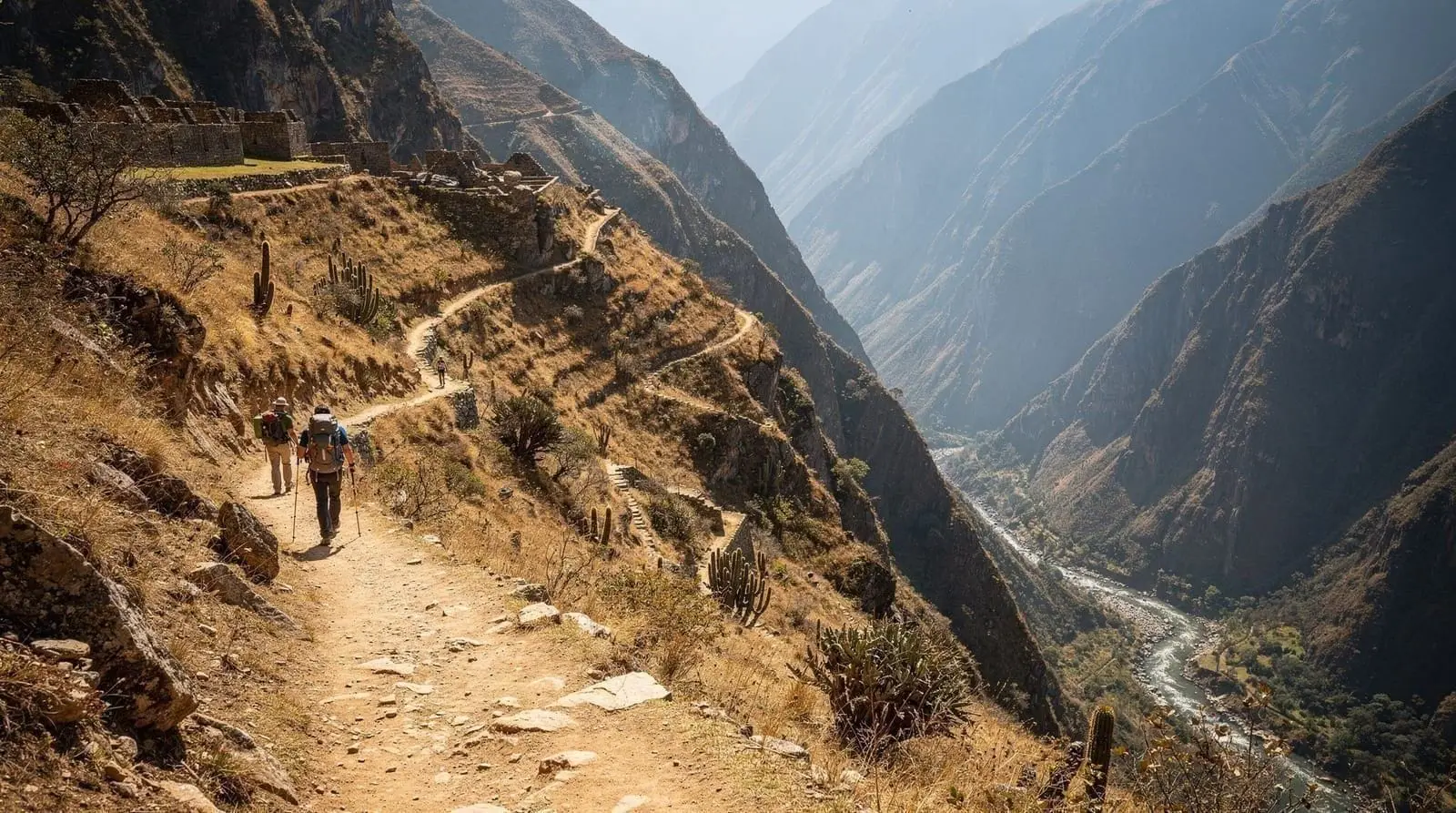
The standard route starts at the village of Cachora, around four hours by road from Cusco. From there the trail is an out-and-back that does something most treks avoid: it loses huge elevation before it gains any. From Cachora at about 2,900 m you walk to a ridge and then descend roughly 1,500 vertical metres to the Apurímac river at around 1,500 m, crossing it on a bridge, then climb back up the far side another 1,500 m to the ruins at about 3,050 m. You then reverse the whole thing to get out.
That means two enormous descents and two enormous ascents over the trip, much of it on exposed switchbacks in a canyon that radiates heat. The distance — roughly 60 km round trip — sounds modest, but the relentless up-and-down and the heat are what break people, not the kilometres. There is no train to bail out on, no road, and limited shade. Mules carry gear, but they cannot carry you.
Compared with the Inca Trail or even the Salkantay, Choquequirao is in a tougher tier. The Inca Trail is well graded with stone steps; Salkantay is high but more steadily paced. Choquequirao’s signature is the canyon yo-yo, and most hikers who have done all three rate it the hardest of the popular Cusco-region treks.
The itinerary, day by day
A typical 4-day out-and-back runs like this. The 5-day version simply adds a slower pace and more time exploring the ruins, which is the version I would book.
Day 1 — Cachora to Chiquisca or Playa Rosalina. A long descent into the canyon, often started early to beat the heat. You drop most of the way to the river and camp partway down. The descent punishes knees; trekking poles are not optional here.
Day 2 — across the river and up to Choquequirao. Cross the Apurímac and begin the grinding climb to Marampata, then on to the ruins. This is the hardest day: a sustained ascent in heat. Most groups reach the campsite near Marampata by afternoon.
Day 3 — exploring Choquequirao, then beginning the return. A morning at the site itself, which is far larger than a single visit suggests — the famous llama terraces, ceremonial plazas and water channels are spread across the mountainside and much is still cloaked in vegetation, only partly excavated. Then you descend back toward the river.
Day 4 — climb out to Cachora. The final grind back up to the rim and out to the village, where transport to Cusco waits.
A more serious variant continues from Choquequirao over high passes and on to Machu Picchu, an 8-to-9-day traverse that is one of the great expedition treks in Peru and should only be attempted by experienced, very fit, fully acclimatised hikers.
The cable car that keeps not arriving
You will read about a cable car planned to span the Apurímac canyon and carry visitors to Choquequirao in minutes. It has been announced, delayed and re-announced for well over a decade. As of 2026 it is not operating, and you should plan as if it never will. If it ever does open, the solitude that makes Choquequirao special will largely vanish — so some would say the trek-only access is a feature, not a bug. For now, treat the cable car as irrelevant to your planning.
Costs and logistics
A guided 4-to-5-day trek typically runs S/1,300–2,600 (about $350–700) per person, varying with group size and what is included. That usually covers a guide, an arriero with mules, tents, meals and the site entry. Smaller groups and English-speaking guides push toward the top of the range.
Independent trekking is possible and cheaper — you pay the modest Choquequirao entrance fee (a few tens of soles), hire a mule and arriero in Cachora, and carry or pack your own food and camping gear. It saves money but adds logistical weight, and the remoteness means a guide’s local knowledge of water sources and weather is genuinely valuable.
Acclimatise first. Although the ruins sit at a moderate 3,050 m, you start and finish around 2,900–3,000 m and the effort is enormous. Spend several days in Cusco or the Sacred Valley beforehand — see the altitude sickness Cusco guide for how to do that well.
There is no GetYourGuide-listed Choquequirao trek in the current catalogue, so this is a page to plan from rather than book through here. Reputable Cusco-based operators run scheduled and private departures; vet them on porter and arriero welfare, group size and emergency procedures before paying.
Who should and should not go
Go if you are a fit, experienced multi-day hiker comfortable with big elevation swings, you have acclimatised properly, and you genuinely value solitude and raw archaeology over comfort. The reward is an Inca city of Machu Picchu’s calibre that you may have almost to yourself, plus a canyon landscape few travellers ever see.
Do not go if you want a relaxed introduction to Inca ruins, you have not trained, or your knees object to long steep descents. For most first-time Peru visitors, the routes in the best treks to Machu Picchu guide are a better fit, and Choquequirao is something to come back for. For where a trek like this sits in a longer trip, see the Peru 2-week itinerary guide and the full routings at /itineraries/.
How it compares to the alternatives
If the difficulty above gave you pause, it is worth weighing Choquequirao against the treks most visitors actually choose:
- Choquequirao — hardest by far, near-total solitude, no train option, best for experienced hikers who have already done a Cusco-region trek.
- Inca Trail — well graded, porter-supported, permits sell out months ahead, ends walking into Machu Picchu.
- Salkantay — high-altitude but steadier pace than Choquequirao’s canyon yo-yo, no permit quota.
For a first Cusco trek, the Inca Trail or Salkantay deliver more reward per effort. Choquequirao is the one to add once you already know you enjoy multi-day trekking at altitude.
Gear and preparation specific to the canyon
Beyond general trek packing, Choquequirao has quirks worth planning for. The canyon floor is genuinely hot — often 30°C-plus at midday even when Cusco is cool — so lightweight, breathable layers for the descent matter as much as warm layers for the exposed camps higher up. Trekking poles are close to mandatory given the repeated steep descents; a taped ankle or a bad knee will make itself known on day one.
Carry more water capacity than a standard trek, since sources are spaced out on the canyon walls, and confirm with your operator exactly how water is treated or resupplied along the route. Sun protection — hat, high-SPF sunscreen, and long sleeves — is essential in the shadeless switchbacks, where there is no tree cover for hours at a stretch.