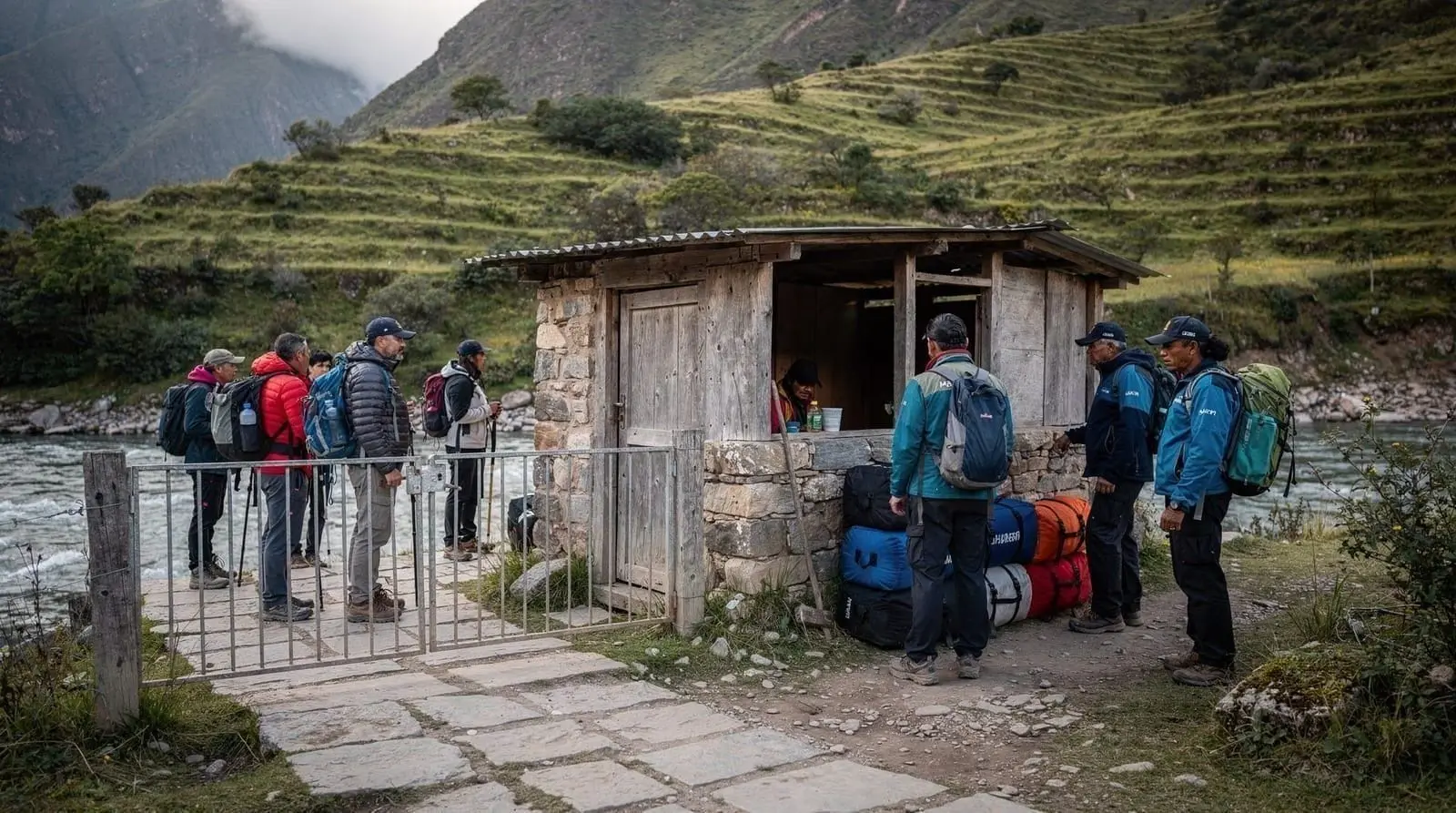
Inca Trail permits guide
From Cusco: 4-Day Inca Trail Guided Trek to Machu Picchu
How do Inca Trail permits work?
The government caps the classic trail at roughly 500 people a day, only about 200 of them trekkers, and permits are sold only through licensed operators against your passport. They are released months ahead, are non-refundable and non-transferable, and sell out four to six months before peak dates.
The cap that decides everything
The classic Inca Trail is the one famous trek to Machu Picchu you cannot improvise. The Peruvian Ministry of Culture limits the route to roughly 500 people entering per day. That number sounds generous until you subtract the porters, cooks and guides who keep each group running — once they are counted, only around 200 of those daily slots go to actual trekkers. That is the entire global supply for a given date. When those 200 are spoken for, the classic trail for that day is full, full stop. No standby, no overflow, no exception for travellers who flew across the world.
Understanding this single fact reshapes how you plan. A permit is not a ticket you pick up on arrival; it is a scarce, dated, passport-locked reservation that has to be claimed months ahead. This guide explains how the system works, when to act, and how to avoid the traps that cost people their place — or their money.
| Daily cap | ~500 total entrants, ~200 of them trekkers |
| Release | Rolling; often opens for the new year around October |
| Book by | 4–6 months ahead; peak-season dates even earlier |
| Cost (permit + 4-day trek) | around USD 700–950 per person |
| Closed | All of February (trail maintenance) |
| Refundable? | No — non-refundable and non-transferable once issued |
How permits are sold and released
Permits are not sold to the public. They are issued only to government-licensed operators, who reserve them in the official system against each trekker’s passport details. There is no counter in Cusco and no government website where an individual can buy a classic-trail permit directly. This is by design: it ties every hiker to a licensed, accountable company and keeps the daily cap enforceable.
Releases happen in batches, typically opening for a new year late in the previous one — often around October — with availability for upcoming months appearing on a rolling basis as the calendar advances. Operators watch the system constantly and book the instant your requested dates become available. That is why, in practice, you commit to a company and pay a deposit before the permit physically exists for your date: you are paying them to grab it the moment it opens. The 4-day Inca Trail guided trek includes the permit reservation as part of the package, which removes the guesswork of trying to time the system yourself.
When permits sell out
The rhythm is predictable enough to plan around.
- Peak season (May to August). The driest, busiest months. Top dates can sell out within days of release, and weeks around graduation season or major holidays fill fastest of all. For these dates, treat the release window as a deadline and have a company lined up before it opens.
- Shoulder months (April, September, October). Drier-edged dates that still sell briskly but last weeks rather than days. Booking three to four months ahead is usually enough.
- Wet season (November to March, minus February). The quietest stretch, when permits can sometimes still be found a month or so out — though rain, mud and slick stone steps are the trade-off. The Cusco rainy season guide covers what trekking in these months really involves.
- February. No permits at all. The classic trail closes for the entire month for maintenance, so plan the Salkantay trek or a train trip to Machu Picchu instead.
The honest rule of thumb: four to six months ahead for most of the year, the day of release for the busiest summer dates.
Passport rules and the booking process
Because the permit is locked to your identity document, the details have to be exact and final.
- What operators need: your full name exactly as printed in your passport, passport number, nationality, date of birth, and sometimes your age on the trek date (relevant for student discounts where offered).
- Use the passport you will travel on. If yours is close to expiry and you plan to renew, sort the renewal first and book on the new document. A permit made out to a passport you no longer carry can cause problems at the trail checkpoints.
- Get the spelling right. Names are checked against passports at control points. A typo your operator made when booking can become your problem on the trail, so confirm your details in writing.
- Pay the deposit promptly. A permit is only secured once the operator has reserved it; a verbal hold means nothing. Reputable companies confirm your permit in your name within days and can show proof.
Non-refundable, non-transferable: what that means for you
Once issued, an Inca Trail permit cannot be refunded, renamed, resold or moved to another date. This is the rule that catches people out most painfully. It means:
- You cannot buy someone else’s spare permit. Listings offering a “transferable” classic-trail permit are not legitimate — the name cannot be changed.
- Travel insurance matters. Because the permit (and often a large slice of the tour cost) is non-refundable, trip-cancellation insurance that covers illness or missed connections is worth having.
- Book only when committed. Do not reserve a permit “to be safe” before your dates and passport are settled, because that deposit and the permit value are gone if you change plans.
Common scams and red flags
The scarcity of permits breeds bad actors. Watch for these:
- Guaranteed last-minute classic-trail permits in peak season. Impossible if the date is genuinely full. A company promising this is either lying or planning to switch you onto a different route without telling you clearly.
- Prices far below the market. A legitimate 4-day trek runs roughly USD 700 to 950. Rock-bottom quotes usually mean unlicensed subcontracting, underpaid porters or extras billed later.
- Vague licensing. A real operator will name its government licence and confirm your permit in your name with proof. If they dodge that question, walk away.
- Pressure to pay only in cash with no receipt. Insist on a written confirmation and a traceable payment.
For wider booking traps around Cusco, the Cusco tourist traps guide is worth a read before you hand over a deposit.
Student and group permit questions
A few specific situations come up often enough to address directly:
- Student discounts. Some operators offer a reduced permit price for university students under a certain age (commonly 25), but the rules are strict: you need a valid ISIC card or a university card with a photo, and the discount must be requested at the time of booking, not claimed later. The age on the trek date is what counts, so a birthday between booking and trekking can disqualify you. Always confirm in writing whether your quoted price already includes a student rate.
- Children and minors. Children can hike the trail with a permit, and a separate child permit category exists. Operators set their own minimum age, often around eight to twelve, given the altitude and the four hard days. Passport details for every minor are required just as for adults.
- Groups and matching dates. If you are booking for a group, everyone must be on permits for the same release window, so a latecomer joining after the date sells out cannot simply be added. Book the whole group at once, with everyone’s passport details ready, to avoid splitting your party across dates or losing some members entirely.
- Solo trekkers. You do not need your own private group; operators pool solo travellers and small parties into guided groups, which keeps the price down. You still need your own permit reserved in your name like everyone else.
What a legitimate permit confirmation looks like
Once your operator secures the permit, they should be able to show you concrete proof, not just a reassuring email. A genuine confirmation reflects:
- Your name and passport number exactly as you supplied them, tied to a specific trek start date.
- The operator’s licence reference, identifying the authorised company that holds the booking.
- A clear inclusions list — permit, guide, porters, meals, camping gear, Machu Picchu entry and the train return — so you know the permit is part of a complete, legal package rather than a standalone purchase.
Keep this confirmation, along with your payment receipt, and bring your physical passport on the trek: it is checked against the permit at the trail’s control points, and a mismatch or a missing document can cost you entry on the day. Carrying the passport you booked with is not optional.
Permit versus the Machu Picchu entrance ticket
A source of real confusion: the Inca Trail permit and the Machu Picchu citadel entrance ticket are two separate authorisations, even though a legitimate trek package always bundles both. The permit only grants you the right to walk the trail and pass its control points; it does not by itself let you inside the citadel gates at the end. Licensed operators buy the entrance ticket — usually a specific circuit within the site — alongside the trail permit, so a complete Inca Trail quote should list both explicitly.
If a quote mentions only “the permit” with no reference to citadel entry, ask directly what circuit you are entering on and get it in writing. The Machu Picchu ticket types compared guide and the circuits explained guide cover what the different citadel tickets actually include, which matters even though the trek operator handles the booking for you.
Comparing what different operator tiers actually deliver
Because the permit fee is fixed, the price spread between operators comes almost entirely from what surrounds it — crew size, equipment quality and how many trekkers share one guide.
| Tier | Typical price (4-day) | What differs |
|---|---|---|
| Rock-bottom / unlicensed | Below ~USD 650 | Often subcontracted permits, underpaid porters, minimal gear — the highest risk of a fake or shared licence |
| Licensed budget | ~USD 700–800 | Genuine permit and licence, simpler tents and meals, larger groups |
| Mid-range | ~USD 800–900 | Better equipment, smaller groups, more experienced guides |
| Premium | USD 950+ | Small groups, higher porter welfare standards, better camps and food |
The permit itself does not change across tiers — what you are really paying for is everything wrapped around it. The Peru trip cost guide for 2026 sets these figures against your wider trip budget.
If permits are gone for your dates
Missing out is common, and the alternatives are genuinely good:
- The 2-day short Inca Trail. Its own, separate permit — also capped, but usually easier to secure than the 4-day. It walks the final scenic stretch to the Sun Gate and sleeps in Aguas Calientes. The short Inca Trail 2-day tour is the standard version.
- The Salkantay trek. No permit needed, so bookable far later, often cheaper, with bigger mountain scenery — at the cost of the Inca ruins and the Sun Gate. The 4-day Salkantay route to Machu Picchu is the usual choice.
The Inca Trail complete guide covers the trek itself once you hold a permit, the Inca Trail vs Salkantay comparison helps you choose between the two, and the best treks to Machu Picchu lays out every route. To slot the permit date into a full trip, see the itineraries hub and the tools page.
Frequently asked questions about Inca Trail permits
When are Inca Trail permits released for 2026?
Can I buy an Inca Trail permit myself?
What passport details do I need to book?
Are Inca Trail permits refundable?
How fast do peak-season permits sell out?
Do the short Inca Trail and Salkantay need permits too?
Does the Inca Trail permit include the Machu Picchu entrance ticket?
What if I renew my passport after booking the permit?
Top experiences
Bookable activities with verified prices and instant confirmation on GetYourGuide.

