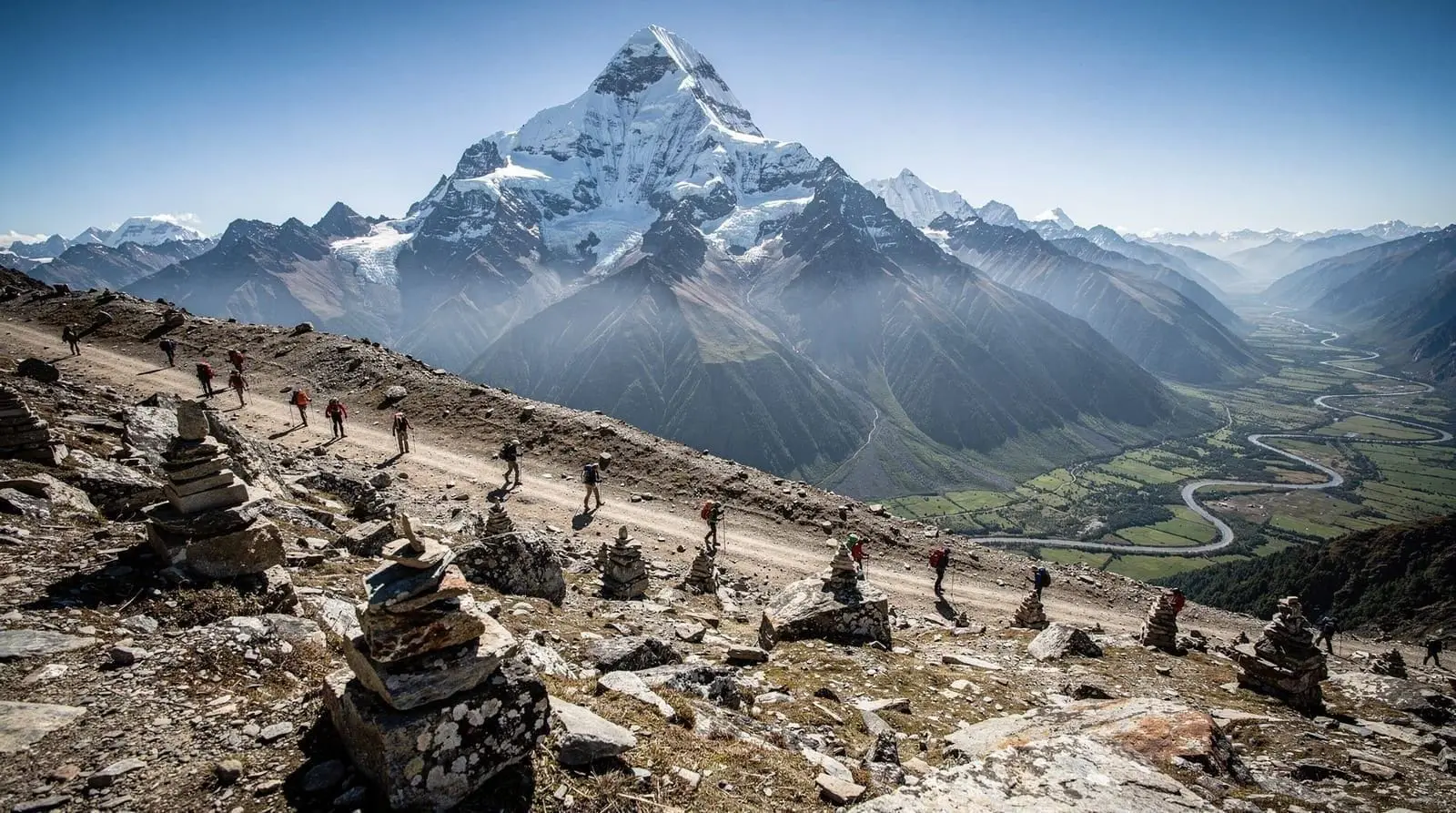
Salkantay trek guide: the 5-day route to Machu Picchu
Cusco: 5-Day Salkantay Ultimate Trek to Machu Picchu
How hard is the Salkantay trek and how long does it take?
The classic Salkantay trek is 4 to 5 days and around 60-70 km, crossing the 4,630 m Salkantay Pass on day two. It needs no permit, costs less than the Inca Trail, and is more about raw mountain scenery than ruins. Fitness and acclimatisation matter more than technical skill.
The trek that needs no permit and earns no shortcuts
The Salkantay trek is the answer to a very specific problem: the classic Inca Trail sells out months ahead, and a lot of travellers find out too late that there are no permits left for their dates. Salkantay is the great alternative — and “alternative” undersells it. This is a tougher, higher, wilder, cheaper route that swaps the Inca Trail’s procession of cliff-edge ruins for raw mountain drama: a snow-draped 6,271 m peak, a turquoise glacial lake, a 4,630 m pass, and a descent through cloud forest into coffee country before you reach Machu Picchu. National Geographic once named it among the world’s best treks, and the hype is, for once, mostly deserved.
| Where | Starts near Mollepata, ends at Machu Picchu via Aguas Calientes |
| Cost | around S/650-1,000 ($175-270) for a guided 5-day group trek |
| Time needed | 5 days / 4 nights classic; 4 days / 3 nights compressed |
| Getting there | 3-4 hour road transfer from Cusco to the trailhead |
| Best time | May-September dry season; open in February when the Inca Trail closes |
Day-by-day at a glance
| Day | Route | High point |
|---|---|---|
| 1 | Cusco to Soraypampa + Humantay Lake detour | ~4,200 m at the lake |
| 2 | Soraypampa over the Salkantay Pass to Chaullay/Collpapampa | 4,630 m pass |
| 3 | Descent through cloud forest to Santa Teresa/Lucmabamba | ~2,900 m |
| 4 | Hidroeléctrica to Aguas Calientes | ~2,000 m |
| 5 | Machu Picchu, then train back to Cusco | 2,430 m (citadel) |
It is also genuinely demanding, and the marketing tends to gloss over that. This guide is the honest version: the day-by-day route, exactly how high and how hard the Salkantay Pass really is, what acclimatisation you need before you start, what to pack, what it costs, the corners cheap operators cut, and how it stacks up against the Inca Trail so you can choose with clear eyes. If you are still deciding between routes, read it alongside the Inca Trail versus Salkantay comparison and the wider best treks to Machu Picchu round-up.
The route in brief
The “Salkantay trek” usually means one of two lengths:
- The 5-day / 4-night version — the fullest classic route, with the most relaxed pacing and an extra night that makes the big pass day less brutal. This is the one most reputable operators run.
- The 4-day / 3-night version — a compressed route that does the same terrain faster, with longer hiking days. Fine for fit, well-acclimatised hikers; harder if you are borderline on fitness.
Total distance is roughly 60–70 km depending on the variant, and the defining feature is the Salkantay Pass (Abra Salkantay) at about 4,630 m / 15,190 ft — the high point, crossed on the second day, in the shadow of Nevado Salkantay itself at 6,271 m. There is no permit and no quota: you can book Salkantay with far less lead time than the Inca Trail, which is a large part of its appeal. Everything is below the snowline and non-technical — no ropes, no crampons — but the combination of altitude, distance and big daily ascents and descents makes it a serious hike.
Day by day: the classic 5-day route
The exact camps vary by operator (and several now use lodges or “sky domes” instead of tents), but the shape of the trek is consistent.
Day 1 — Cusco to Soraypampa, and the Humantay Lake detour
An early transfer from Cusco (3–4 hours by road) to Mollepata and on to the trailhead near Soraypampa (around 3,900 m). After lunch you hike up to Humantay Lake, a startling turquoise glacial lake at about 4,200 m below the Humantay glacier. It is a steep but short acclimatisation hike, and it doubles as the trek’s first scenery payoff. You camp at Soraypampa. This is a deceptively important day: the short climb to the lake helps prime your body for the pass the next morning.
Day 2 — The Salkantay Pass (the big one)
The crux. You climb from roughly 3,900 m to the 4,630 m Salkantay Pass, a long, steady ascent of three to four hours into thinning air, with the glaciated face of Nevado Salkantay looming alongside. The pass itself is a windswept saddle marked by apachetas (stone cairns left by travellers as offerings to the apu, the mountain spirit). Then comes a very long descent — often six or more hours total walking on the day — down into the upper Santa Teresa valley, where the landscape softens from high puna to greenery. You camp around Chaullay or Collpapampa (around 2,900 m). Expect this to be the hardest day by a wide margin.
Day 3 — Cloud forest and coffee country
A gentler day, descending further through humid cloud forest along the Santa Teresa River. The vegetation thickens, the air warms, and you pass small coffee and fruit farms. Many itineraries add a stop at the Santa Teresa hot springs (Cocalmayo) in the evening — a genuine treat for tired legs — and some include an optional zipline. You camp or stay in lodgings near Santa Teresa or Lucmabamba.
Day 4 — Toward Aguas Calientes
The terrain varies here by operator. The classic route hikes along an original Inca path with views over the Llactapata ruins and a first distant glimpse of Machu Picchu across the valley, then descends to the Hidroeléctrica station. From there you walk (or, on budget tours, take a short train) the flat 2–3 hours along the rail line into Aguas Calientes, the town below Machu Picchu, where you sleep in a hostel or hotel — a real bed and a hot shower.
Day 5 — Machu Picchu
An early start up to Machu Picchu, either on the first shuttle bus or on foot up the steep stairs in the dark. You tour the citadel with your guide on a timed circuit, then return to Aguas Calientes and take the train back toward Ollantaytambo and a transfer to Cusco. After four days of mountains, arriving at the citadel on foot rather than off a tour bus is a markedly different experience.
The 4-day version compresses days 3 and 4, giving you longer hiking days and reaching Machu Picchu a day sooner.
Altitude and how hard it really is
Two things make Salkantay harder than people expect: the altitude and the descents.
The pass at 4,630 m is the obvious challenge, and it is where altitude sickness most commonly hits hikers who skipped acclimatisation. The single most important preparation is spending two to three days at altitude in Cusco or, better, the lower Sacred Valley before you start. Arriving in Cusco and starting Salkantay within 24 hours is the classic mistake that ends in a miserable, headache-ridden pass day or an evacuation. The altitude sickness in Cusco guide covers the full prevention strategy; in short: acclimatise, hydrate, go slow, and consider talking to a doctor about acetazolamide before you travel.
The descents are the quiet killer. Day two drops well over 1,500 m, and long downhills hammer your knees far more than the ups. Trekking poles are not optional here — they save your knees and your balance on loose ground.
In fitness terms, you do not need to be an athlete, but you should be comfortable hiking 6–8 hours with some heavy uphill sections, ideally with prior hill-walking under your belt. It is a “fit, determined hiker” trek, not a beginner stroll.
What to pack
Operators handle tents and most gear, but the right personal kit makes or breaks the trip. The essentials:
- Layers for extreme range. The pass is near-freezing and windy; day three in the cloud forest is warm and humid. Bring a warm down or synthetic jacket, fleece, base layers, plus light clothing for the lower days.
- Quality waterproofs. Rain is possible in any season and likely in the wet months.
- Broken-in hiking boots with ankle support — never new boots.
- Trekking poles — essential for the descents.
- A warm sleeping bag if camping (rated to around -5 °C; many operators rent these).
- Sun protection — high-SPF sunscreen, lip balm, sunglasses, a brimmed hat. UV is brutal at altitude.
- A headlamp for the dark camps and the pre-dawn Machu Picchu climb.
- Water purification or refillable bottles plus the means to treat water.
- Cash in soles for tips, snacks, the hot springs and any optional extras.
Most operators offer a duffel and a horse or mule to carry the bulk of your kit between camps, so you hike with a light daypack — confirm this is included before booking.
Costs and choosing an operator
Salkantay is meaningfully cheaper than the Inca Trail because there is no permit fee, but price ranges enormously by operator quality.
- Budget group tours sit at the low end and cut corners: bigger groups, basic food, the train instead of walking the final stretch, and sometimes a Machu Picchu entry on a poorer circuit.
- Mid-range and premium operators offer smaller groups, better guides, proper meals, mule support and upgraded lodging (the glass “sky domes” near Soraypampa, or lodges instead of tents).
What to verify before booking: that your Machu Picchu entrance ticket and a guided citadel circuit are included (some cheap tours leave you to sort the increasingly scarce tickets yourself), that mule or porter support for your main bag is included, the group size, the guide-to-hiker ratio, and whether transport, all meals and the Aguas Calientes accommodation are covered.
The fullest version, with the extra night that makes the pass day kinder, is the 5-day Salkantay ultimate trek to Machu Picchu. If you are fit, acclimatised and want a faster route, the 4-day / 3-night Salkantay route and Machu Picchu tour compresses the same terrain. A second 4-day option is the Salkantay Trek 4 days, 3 nights to Machu Picchu.
Best time to go
The dry season (May to September) is the prime window: clear pass-day views of Nevado Salkantay, firmer trails, and the lowest chance of rain. It is also the busiest. The shoulder months of April and October are a sweet spot — greener, quieter, mostly dry. The wet season (November to March) brings mud, cloud that can hide the peak, and a real chance of washouts on the lower trail; some operators reduce or pause Salkantay departures in the wettest weeks of January and February. Crucially, Salkantay stays open in February when the Inca Trail closes for maintenance, which makes it the go-to Machu Picchu trek for that month — just expect rain.
Lodges, domes and how you’ll sleep
How you spend the nights varies more on Salkantay than on the Inca Trail, and it is worth matching to your budget and comfort tolerance.
Tents. The traditional and cheapest option: the operator’s crew sets up camp at Soraypampa, Chaullay/Collpapampa and so on, and you sleep in a two-person tent on a sleeping pad. Bring or rent a warm bag — the first night near Soraypampa is genuinely cold.
Sky domes / glass igloos. A popular upgrade near Soraypampa: transparent geodesic domes with real beds, letting you look up at the Milky Way over Humantay from your pillow. They cost more and only cover the first night, but for many people they are the trip’s standout night.
Mountain lodges. Premium operators run a chain of fixed lodges along the route, replacing camping entirely with rooms, hot showers and hot meals. This is the comfort tier and is priced accordingly.
The final night, in Aguas Calientes, is always a hostel or hotel with a proper bed and shower regardless of tier — a welcome reset before the Machu Picchu morning.
Training and preparation
You do not need a gym membership to finish Salkantay, but a little targeted preparation transforms the experience from suffering to enjoyment.
Build hiking legs. In the weeks before, do progressively longer day hikes with some real elevation gain, ideally back-to-back on consecutive days to mimic the trek’s cumulative fatigue. Walking downhill on training hikes matters as much as up — the descents are what wreck unprepared knees.
Train with a daypack and your boots. Wear the actual boots and carry the daypack weight you will hike with, so nothing is a surprise on day one. New boots are the most common avoidable mistake.
Acclimatise on arrival. Reiterate because it is the single biggest factor: arrive in Cusco or the Sacred Valley two to three days early and do gentle high-altitude walks (the Cusco ruins, a valley day) before the trek. The altitude sickness in Cusco guide covers medication and symptoms.
Know your own pace. Salkantay rewards a steady, slow rhythm on the pass far more than bursts of speed. “Despacio” — slowly — is the mantra of every good Andean guide.
Salkantay vs the Inca Trail, briefly
Both end at Machu Picchu, but they are different experiences. The Inca Trail is about walking an original Inca highway past a string of cliffside ruins and entering Machu Picchu through the Sun Gate — but it needs a permit booked months ahead, costs more, and tops out lower. Salkantay is about high-mountain scenery — the pass, the peak, Humantay Lake — needs no permit, costs less, but reaches Machu Picchu on the final morning rather than by walking into it through the ruins.
If you want Inca archaeology along the way and can book early, the Inca Trail; if you want bigger mountains, more flexibility and lower cost, Salkantay. The full breakdown is in the Inca Trail versus Salkantay guide, and the Salkantay trek diary blog post gives a first-person account of what the pass day actually feels like.
Where Salkantay sits among the other treks
If neither Salkantay nor the Inca Trail quite fits, it is worth knowing what else is out there before you commit. The best treks to Machu Picchu round-up compares Salkantay against the Lares trek, the Short Inca Trail and the budget Hidroeléctrica route on cost, difficulty and crowd levels. If your trip also includes the Cordillera Blanca near Huaraz, the Huaraz vs Cusco for hiking guide is worth a read before you decide where to spend your trekking days — Salkantay and a Huaraz trek like the Santa Cruz trek are both demanding enough that doing both back-to-back needs real recovery time built in.
Photography and phone-charging on the trek
Salkantay rewards travellers who plan for photos in advance rather than scrambling on the day. The pass itself, Humantay Lake at first light, and the Sun Gate-adjacent views on day four are the three standout opportunities — bring spare batteries or a power bank, since none of the camps have reliable charging and the cold drains batteries faster than usual. A lens cloth is worth packing too; condensation and dust on the pass day ruin more shots than bad weather does. If wildlife interests you, keep an eye out for Andean condors near the pass and hummingbirds once you drop into the cloud forest on day three.
Insurance and emergency evacuation
Because Salkantay reaches higher and stays more remote than most travellers expect, confirm your travel insurance explicitly covers high-altitude trekking above 4,000 m and emergency evacuation by horse or helicopter if needed. Many standard policies exclude activities above a stated altitude threshold by default, and Salkantay’s Punta Unión pass at 4,630 m sits well past that line on plenty of policies.
Reputable operators carry basic first-aid kits and know the fastest descent routes if a client deteriorates, but insurance that actually pays for evacuation is your own responsibility to arrange before you fly to Peru, not something to sort out in Cusco the week before. Keep a printed or photographed copy of your policy number and emergency contact accessible without phone signal, since coverage on the trek is patchy to non-existent for most of the route.
Frequently asked questions about the Salkantay trek
How high is the Salkantay Pass?
The Salkantay Pass (Abra Salkantay) is about 4,630 m / 15,190 ft — the highest point of the trek, crossed on the second day beneath the 6,271 m peak of Nevado Salkantay. The altitude here is why pre-trek acclimatisation in Cusco or the Sacred Valley is essential.
Do I need a permit for the Salkantay trek?
No. Unlike the Inca Trail, Salkantay has no permit and no daily quota, so you can book it with much less lead time. You do still need a Machu Picchu entrance ticket for the final day, which a good tour will arrange for you.
How fit do I need to be for the Salkantay trek?
You need to be comfortable hiking 6–8 hours a day with sustained uphill and long, steep downhills, at altitude. You do not need technical climbing skills, but it is not a beginner trek. Prior hill-walking and a few days of acclimatisation make a large difference.
Is the Salkantay trek harder than the Inca Trail?
Generally yes. Salkantay reaches a higher pass (4,630 m vs the Inca Trail’s 4,215 m Dead Woman’s Pass), covers more distance, and has bigger daily ascents and descents. The Inca Trail is no stroll, but Salkantay is the more physically demanding of the two.
What is the best time of year to do the Salkantay trek?
May to September (dry season) for the clearest views and firmest trails, or April and October for a quieter shoulder-season compromise. February is wet and muddy, but Salkantay remains open then, when the Inca Trail closes for maintenance.
Can I do the Salkantay trek without a guide?
It is technically possible to hike the route independently, and some experienced trekkers do, but a guided tour is strongly recommended for the logistics, the mule support, the food, and especially the increasingly hard-to-secure Machu Picchu entrance and timed circuit. Most travellers go with an operator.
Top experiences
Bookable activities with verified prices and instant confirmation on GetYourGuide.
