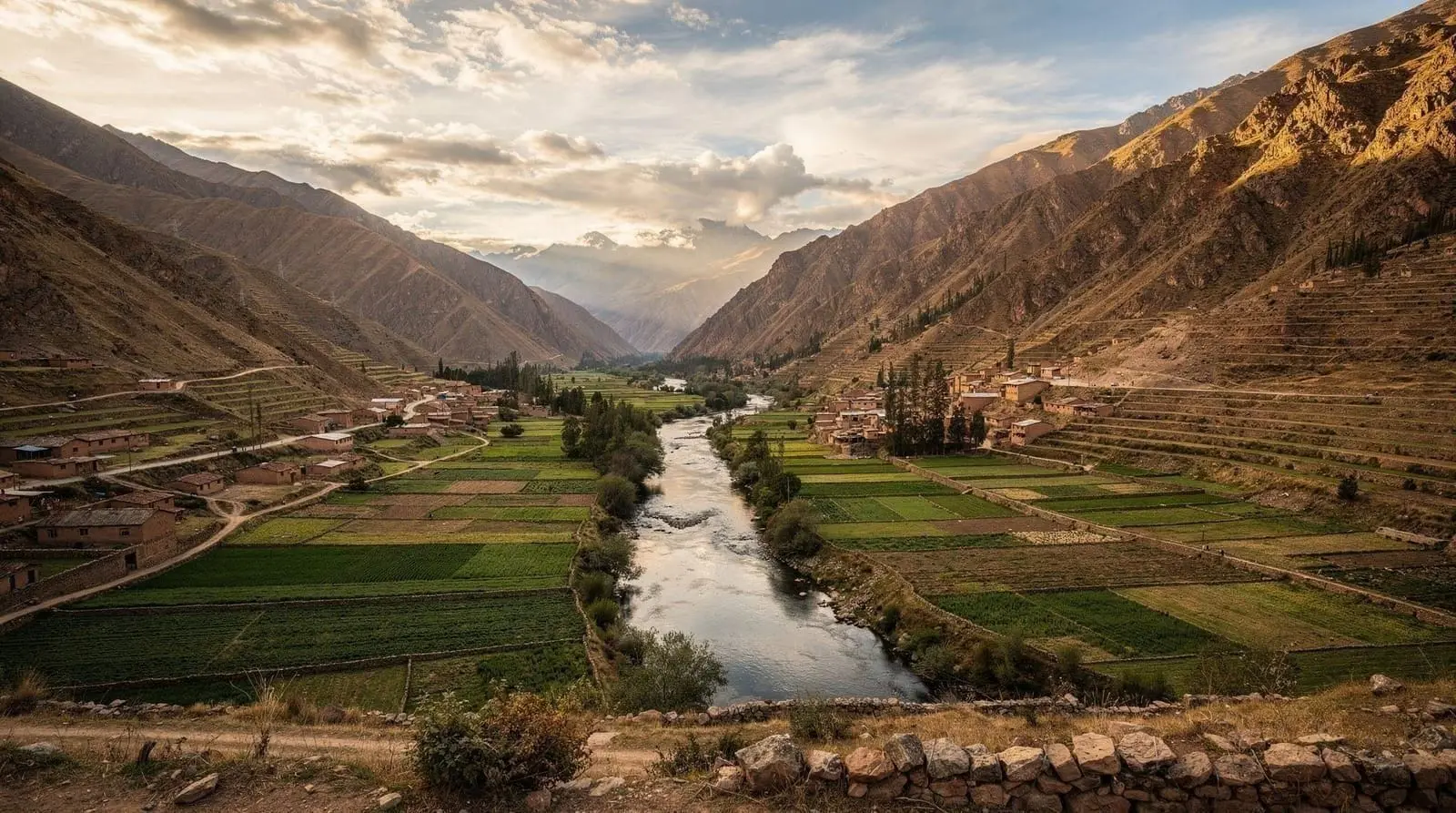
Sacred Valley complete guide
From Cusco: Sacred Valley of the Incas Full-Day Tour
How should I plan the Sacred Valley?
Give the Sacred Valley at least two days, ideally three. Base in Ollantaytambo or Urubamba rather than rushing it as a single Cusco day trip. The valley sits lower than Cusco (around 2,800-2,900 m), so it is the smartest place to acclimatise before Machu Picchu.
Why the Sacred Valley deserves more than a day
Most first-time visitors treat the Sacred Valley of the Incas (Valle Sagrado) as a box to tick on the way to Machu Picchu — a single packed day of ruins between Cusco and the train. That is a mistake on two counts. First, the valley is one of the richest parts of the whole Cusco region, with terraced fortresses, living market towns, salt pans worked since Inca times and circular agricultural terraces unlike anything else in Peru. Second, and more practically, the valley floor sits around 2,800-2,900 m — noticeably lower than Cusco’s 3,400 m — which makes it the single best place to acclimatise before you tackle Machu Picchu or anything higher.
This guide covers the main sites, how many days to give them, where to base yourself, what it all costs, and how to fit the valley into a sensible itinerary that respects altitude. For the geographic overview, the Sacred Valley destination page sets the scene.
| Where | Urubamba River valley, between Cusco and Ollantaytambo |
| Cost | boleto turistico around S/130 (about $35), plus Maras entry separately |
| Time needed | 2-3 days ideally, 1 day possible but rushed |
| Getting there | colectivo, taxi or guided tour from Cusco (60-90 min to Pisac) |
| Best time | May-September for dry trails; April/October for fewer crowds |
The geography in plain terms
The Sacred Valley follows the Urubamba River (the Vilcanota, by its upstream name) as it runs roughly northwest from near Pisac down to Ollantaytambo, dropping in altitude as it goes. Cusco sits on the plateau above the valley’s eastern end; the train to Aguas Calientes and Machu Picchu leaves from Ollantaytambo at the valley’s western end. In between lie the towns and sites that make up a Sacred Valley trip.
Knowing the layout matters for planning: you generally move from the Cusco side toward Ollantaytambo, which means a Sacred Valley itinerary flows naturally into Machu Picchu rather than backtracking. The lower you go, the easier the altitude, which is why so many guides recommend sleeping in the valley before going up to Cusco’s height for sightseeing.
The main sites, one by one
Pisac
Pisac is two things: a hillside Inca site of terraces, temples and a cliff dotted with ancient tombs, and a market town below it famous for its handicraft market (busiest on Sunday, Tuesday and Thursday, but open daily). The ruins are extensive and far quieter than Machu Picchu; give yourself at least two hours up top. The market is touristy but a reasonable place to buy textiles if you bargain politely. Pisac is included in the boleto turistico.
Ollantaytambo
Ollantaytambo is the standout. The town itself is the best-preserved example of Inca urban planning still inhabited, with original walls and water channels lining its narrow lanes. Above it rises the great terraced fortress where the Incas defeated a Spanish cavalry charge in 1537. Climb the terraces early or late to dodge the tour-bus midday crush. Because the train to Machu Picchu departs here, Ollantaytambo is the logical place to spend your last valley night.
Maras and Moray
Maras and Moray are usually visited together. Moray is a set of vast concentric circular terraces that the Incas appear to have used as an agricultural laboratory, with measurable temperature differences between the top and bottom rings. A few kilometres away, the Salineras de Maras are thousands of salt pans cascading down a hillside, fed by a naturally salty spring and worked by local families for centuries. Note that the salt mines charge their own entry fee (around S/10-18) and are not on the boleto turistico, while Moray is.
Chinchero
Chinchero sits highest, at about 3,760 m, on the plateau between Cusco and the valley. It combines Inca terraces, a colonial church built on Inca foundations, and a genuine weaving tradition — the cooperatives here give some of the most honest textile demonstrations in the region. It is often the first or last stop on a valley loop.
How many days you need
- One day: doable but rushed. A standard full-day tour squeezes in Pisac, perhaps Maras-Moray, and Ollantaytambo, with brief stops and a lot of driving. The efficient version is a guided tour like the Sacred Valley full-day tour from Cusco, which handles transport and timing for you.
- Two days: comfortable. Split the valley into a Pisac-and-market day and an Ollantaytambo-Maras-Moray day, sleeping in the valley between them.
- Three days: ideal. Add Chinchero, slow down at each site, and use the lower altitude to acclimatise properly before Machu Picchu.
- Four days or more: once the headline sites are covered, use the extra time for the quieter stops below — Awana Kancha, Calca, Lamay — or simply build in a rest day. The valley rarely punishes a slower pace the way a rushed itinerary elsewhere might.
If you want the highlights with a guide but in a smaller group, the Sacred Valley VIP full-day tour trims the group size; for the classic Pisac-and-Ollantaytambo pairing, the Sacred Valley tour with Pisac and Ollantaytambo covers the two heavyweight ruins.
Lesser-known stops worth your time
Beyond the headline four sites, the valley rewards travellers who slow down. Moray’s neighbour, the village of Maras itself, has a quiet colonial church and a workaday feel far removed from the tour-bus circuit. Urubamba is more than a hotel base — its Sunday market and surrounding farmland give a sense of the valley as a living agricultural region, which is exactly what it was for the Incas.
Near Calca and Lamay, smaller terraced sites and hot springs see almost no foreign visitors. And the drive between Pisac and Calca along the river is itself one of the loveliest stretches of road in the region, worth doing slowly rather than rushing through. If you have a third day, spending it wandering rather than ticking off another big ruin is often the most rewarding choice.
Adventure options exist too, for travellers who want a break from ruins entirely: several operators run ziplining across the valley near Huambutío or Urubamba, strung high above the river with views back over the terraces — a genuinely fun half-day that pairs oddly well with an otherwise history-heavy trip.
Markets, textiles and shopping honestly
The Sacred Valley is one of the best places in Peru to buy textiles, but it pays to know what you are looking at. The Pisac market is large and convenient but heavily geared to tourists, with a mix of genuine handwoven pieces and machine-made imports. The weaving cooperatives at Chinchero and at Awana Kancha (on the road between Cusco and Pisac) give honest demonstrations of natural dyeing and backstrap-loom weaving, and buying directly from them means more of your money reaches the weavers.
As a rule, genuine handwoven alpaca is warm, slightly uneven, and not cheap; if a “baby alpaca” scarf costs a few soles, it is almost certainly acrylic. Bargain politely at markets, but recognise that fair-trade cooperatives sell at fixed, fair prices for good reason.
Where to base yourself
- Ollantaytambo: best for atmosphere and train access. Cobbled lanes, good small hotels, and you are already at the departure point for Machu Picchu. Book a night here even if you base elsewhere for most of your stay — arriving the evening before an early Machu Picchu train removes any risk of a delayed transfer costing you the departure.
- Urubamba: the practical hub. Central in the valley, the widest range of hotels from hostels to high-end lodges, and well placed for day trips in either direction.
- Pisac: relaxed, market-focused, with a slight backpacker-and-wellness scene. Good if you want a calmer base near the Cusco end.
Day-tripping from Cusco is possible, but it wastes the valley’s biggest practical advantage — its lower altitude — and adds hours of daily driving. Spend at least one night down here.
| Base | Best for | Trade-off |
|---|---|---|
| Ollantaytambo | Train access, atmosphere, last night before Machu Picchu | Fewer restaurants than Urubamba |
| Urubamba | Widest hotel choice, central, growing dining scene | Less charming streetscape than Ollantaytambo |
| Pisac | Markets, relaxed wellness scene, closest to Cusco | Furthest from the Ollantaytambo train |
Sample two-day and three-day plans
If you are deciding how to actually divide your time rather than just how many days to allow, here are two realistic shapes.
Two days: Day one, Pisac ruins in the morning followed by the market, then a slow afternoon settling into Urubamba or Ollantaytambo. Day two, Maras and Moray by taxi or colectivo in the morning, Ollantaytambo fortress in the late afternoon when the light is better and the tour buses have thinned. This covers the four headline sites without a single rushed transition.
Three days: Add Chinchero on day three, ideally combined with the ziplining in the Sacred Valley if you want an adrenaline break from ruins, or simply a slower morning at the Chinchero weaving cooperatives before heading up to Cusco or down to the train. Three days also gives you slack for a rained-out afternoon without losing a site entirely, and it is the version most planners genuinely recommend once they understand what the valley offers beyond a single rushed loop.
What it costs
- Boleto turistico (tourist ticket): the full circuit ticket (around S/130 / about $35) covers Pisac, Ollantaytambo, Moray and Chinchero plus Cusco-area sites; a partial valley-only ticket is cheaper. See the boleto turistico explained guide for which version to buy.
- Maras salt mines: separate fee of around S/10-18, cash only.
- Transport: colectivos (shared vans) between valley towns cost a few soles each; a private taxi for a Maras-Moray loop runs roughly S/80-150 for the round trip.
- Guided full-day tour: typically S/90-200 (about $24-54) depending on group size and inclusions.
Carry small-denomination soles. Card acceptance is patchy outside larger hotels and restaurants, and site entries and colectivos are cash-only.
Best time to visit the valley
The Sacred Valley follows the same broad pattern as the rest of the Cusco region. The dry season, roughly May to September, brings clear skies, firm trails and the most reliable weather — and the biggest crowds, especially in June, July and August around the Inti Raymi festival. The shoulder months of April, October and early November often hit the sweet spot: greener landscapes after the rains, fewer people, and generally settled weather.
The rainy season, December to March, turns the valley lush and quiet but brings afternoon downpours and the occasional landslide that can disrupt roads. The valley’s lower altitude makes it more comfortable year-round than Cusco itself, and its sites are rarely as crowded as Machu Picchu, so even peak-season visits are manageable if you start early.
Eating and practicalities
The valley has come a long way gastronomically. Urubamba in particular has become a quiet dining hub, home to some of the region’s most ambitious restaurants alongside simple local spots serving trout from the river and Andean staples. In the towns, look for set-lunch menús at midday for the best value, and try the local trucha (trout) and choclo con queso (Andean corn with cheese).
Beyond food, the practical essentials are simple: carry cash and small change, keep water on you, take altitude gently for the first day or two even though the valley is lower than Cusco, and start your sightseeing early to beat both the tour buses and the afternoon clouds. ATMs exist in Urubamba, Pisac and Calca but can be unreliable, so draw cash in Cusco before you come down.
Fitting the valley into your trip
The cleanest sequence for most travellers is: arrive and rest in Cusco, move down to the Sacred Valley for two or three nights, take the train from Ollantaytambo to Machu Picchu, then return to Cusco. This lets altitude build gradually and avoids backtracking. A guided version that bundles the valley with the train is the Sacred Valley and Machu Picchu 2-day, 1-night tour.
For getting around independently, see getting around the Sacred Valley; for a tight single-day plan, the one-day Sacred Valley itinerary lays out a realistic route. To weigh where to sleep for altitude, Cusco altitude vs the Sacred Valley is worth a read, and the /itineraries/ hub helps you sequence the whole Cusco region.
Common planning mistakes
A few avoidable errors trip up first-time visitors to the valley. The biggest is treating it as a single rushed day on the way to Machu Picchu, which both shortchanges the sites and squanders the valley’s acclimatisation advantage. Another is sleeping in Cusco the whole time and day-tripping down, when sleeping low in the valley would help you adjust to altitude far better.
Travellers also frequently misjudge the tickets — buying the wrong boleto turistico version, or arriving at the Maras salt mines expecting it to be covered when it charges separately. Some try to cram Pisac, Maras, Moray, Ollantaytambo and Chinchero into one day and end up exhausted, having properly enjoyed none of them. And many underestimate how cash-dependent the valley is, arriving with only cards when colectivos, site entries and small restaurants all want soles. Avoid these and the valley becomes one of the most rewarding parts of a Peru trip.
Frequently asked questions about Sacred Valley complete
How many days do you need in the Sacred Valley?
Should I do the Sacred Valley before or after Machu Picchu?
Is the Sacred Valley covered by the boleto turistico?
What is the best base in the Sacred Valley?
Do I need a tour or can I do the Sacred Valley independently?
Is the Sacred Valley high altitude?
Top experiences
Bookable activities with verified prices and instant confirmation on GetYourGuide.


