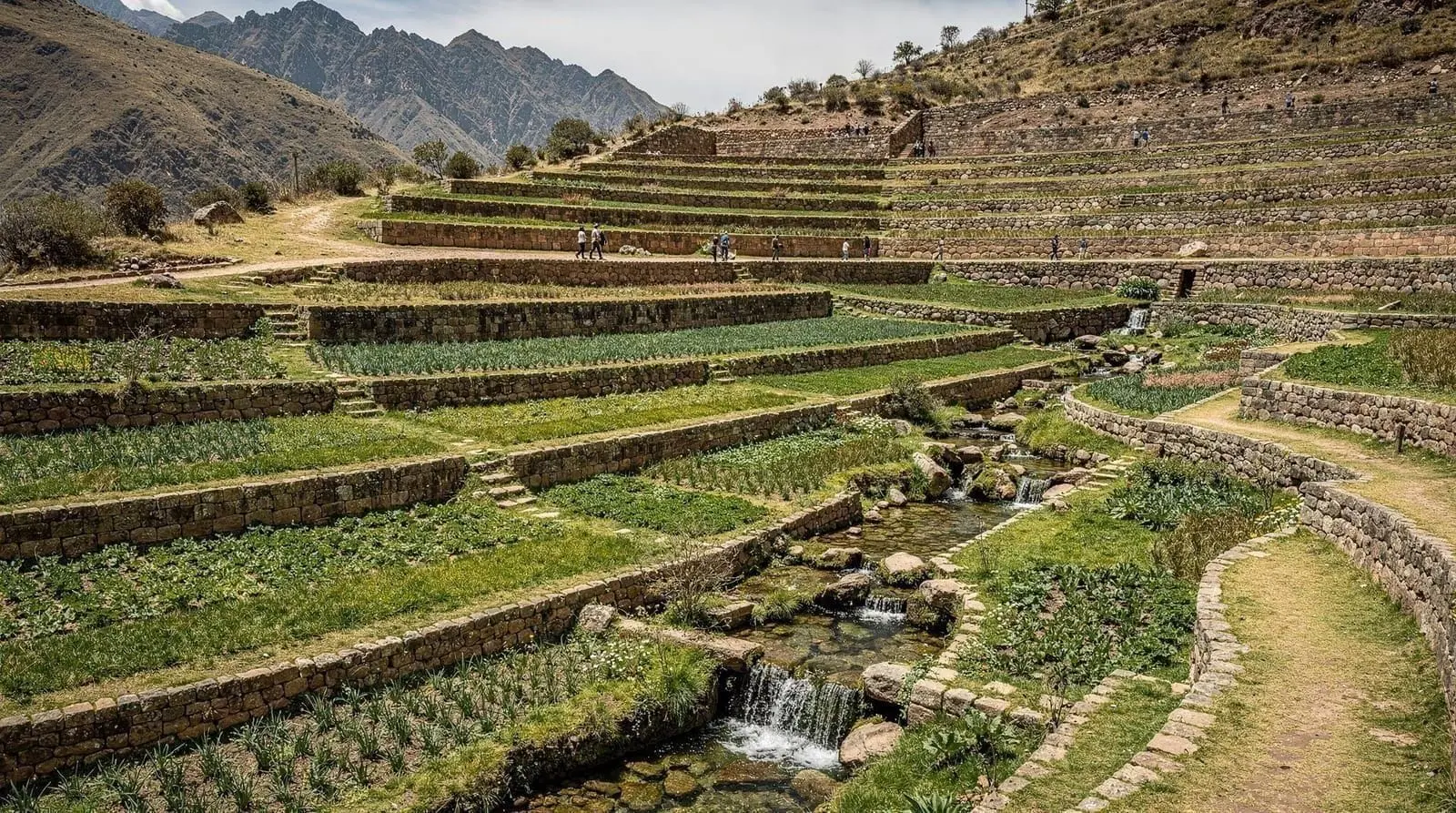
South Valley: Tipón, Pikillacta and Andahuaylillas
Honest guide to Cusco's quiet South Valley: Tipón's Inca water terraces, the Wari city of Pikillacta, and the 'Sistine Chapel of the Andes' at Andahuaylillas.
Quick facts
- Location
- Valle Sur, 20-40 km southeast of Cusco along the Urcos road
- Altitude
- 3,100-3,560 m / 10,170-11,680 ft
- Entry
- Tipón & Pikillacta on the boleto turístico; Andahuaylillas church separate (~S/15)
- Hours
- Sites roughly 7 am-5:30 pm; the church ~8 am-5:30 pm
- Best for
- Inca hydraulics, Wari archaeology, colonial art, crowd-free day trips
The Sacred Valley’s quiet southern twin
Almost everyone who comes to Cusco heads northwest to the Sacred Valley — to Pisac, Ollantaytambo, and the road to Machu Picchu. Far fewer turn southeast, down the Urcos road, into what’s known as the Valle Sur or South Valley. That’s the whole appeal. Within an hour of the city you can stand on the most sophisticated Inca water-engineering terraces in Peru, walk the streets of a 1,400-year-old pre-Inca city built by the Wari, and step into a humble village church so densely painted that it’s nicknamed the “Sistine Chapel of the Andes” — all with a fraction of the crowds you’d meet in the Sacred Valley.
The three anchors are Tipón, Pikillacta, and Andahuaylillas, strung along a single road and easily combined in a half-day to full day from Cusco. None of them is a household name, which is exactly why this corner of the Cusco region rewards travellers who’ve already ticked off the obvious sights or who simply prefer their archaeology without a convoy of buses.
| Where | Valle Sur, 20-40 km southeast of Cusco |
| Cost | Boleto turístico (Tipón & Pikillacta) + ~S/15 church entry |
| Time needed | Half a day to a full day |
| Getting there | Taxi, colectivo toward Urcos, or self-drive |
| Best time | Dry season (May-September); mornings |
For a condensed planning version of this page, see the South Valley day trip guide.
Is the South Valley worth a day?
Yes, for a specific kind of traveller. If you’re on a tight first-time Peru itinerary with only a few Cusco days, the Sacred Valley and Machu Picchu rightly come first. But if you have a spare day, have already done the headline sites, or are genuinely interested in Inca engineering and colonial art, the South Valley is one of the best-value, lowest-stress day trips in the region. It’s close, cheap, uncrowded, and the three sites are genuinely different from one another — hydraulic engineering, a pre-Inca city, and a painted church.
The honest caveat is that the South Valley is a slow-travel pleasure, not a blockbuster. There’s no Machu Picchu moment here. Come for the quiet, the craftsmanship, and the lack of crowds, and you’ll find it deeply satisfying. Come expecting fireworks and you’ll wonder what the fuss is about.
Tipón — the Inca water masterpiece
About 25 km southeast of Cusco (roughly 45 minutes), Tipón is the reason to make the trip. It’s a complex of beautifully built agricultural terraces fed by an Inca irrigation system that still works flawlessly after some five centuries: spring water is channelled through precisely cut stone aqueducts, dropped down ceremonial fountains, and distributed across the terraces in a display of hydraulic control that engineers still come to study. Whether it was a royal estate, an agricultural experiment station, or a water-cult shrine is debated — most likely some combination — but the craftsmanship is unambiguous.
Tipón sits up a steep side road above the village of the same name, at around 3,560 m, so it’s higher and cooler than Cusco. The site is on the boleto turístico (covered by the full ticket or the relevant partial circuit — see the boleto guide). Allow 1 to 2 hours; the upper terraces involve a climb that feels real at this altitude.
A second reason Tipón is famous: the village below is the cuy (guinea pig) capital of the Cusco region. The roadside cuyerías roast whole cuy in clay ovens, and locals drive out from the city specifically to eat here on weekends. If you want to try the Andean delicacy, this is arguably the best and most authentic place in the area to do it — budget around S/45-70 for a whole roast cuy, typically enough for two.
Weekends bring a noticeably livelier atmosphere to the cuyerías, with extended Cusqueño families filling long tables and live music at some venues. If you want the fuller cultural experience rather than just the meal, a Saturday or Sunday visit is worth timing deliberately, even though the archaeological site itself is quieter on weekdays.
Pikillacta — the city before the Inca
A few kilometres further south, Pikillacta is something you won’t find in the Sacred Valley: a major Wari (Huari) city, built roughly between 550 and 1100 CE — centuries before the Inca rose to power. The Wari were the dominant Andean empire of their day, and Pikillacta was one of their largest provincial centres: a rigid grid of hundreds of two- and three-storey rectangular buildings, storehouses, and enclosures spread across a high plain, built of fieldstone and once plastered and whitewashed.
What’s striking is how different it feels from Inca architecture — geometric, repetitive, almost urban-planned in a way the organic Inca sites are not. It’s a rare chance to see that Andean civilisation runs far deeper than the famous final empire. The site is large and largely unrestored, so it takes some imagination, but the scale is impressive and you’ll likely have it nearly to yourself. Pikillacta is on the boleto turístico. Nearby, the Inca gateway of Rumicolca — a massive stone aqueduct-and-gateway the Inca rebuilt over a Wari original — is worth the five-minute stop on the same road.
For context on how the Wari fit into the wider sweep of Andean history before the Inca rose to prominence, the Inca Empire for travelers guide sketches the broader timeline, and the Quechua culture guide is useful background on the language and traditions that outlasted both empires.
Andahuaylillas — the Sistine Chapel of the Andes
The third stop, the village of Andahuaylillas (about 40 km from Cusco, 3,100 m), holds the Church of San Pedro Apóstol — a plain adobe exterior concealing one of the most extravagantly decorated colonial interiors in Peru. Built by the Jesuits in the early 1600s, every surface inside is painted: a gilded ceiling, murals covering the walls, a baroque altar dripping with gold leaf, and a celebrated painted organ. The nickname “Sistine Chapel of the Andes” is tourism shorthand and oversells the comparison, but the interior genuinely is dazzling, and it’s a vivid lesson in how the Catholic Church projected power through art in the colonial Andes.
The church charges a separate entry of around S/15 (about $4) — it’s run by the parish and is not on the boleto turístico. Photography inside is usually restricted to protect the paintings. Allow 30 to 45 minutes. The plaza outside has a few cafés for a coffee before the drive back. Many tours combine San Pedro with two neighbouring colonial churches (Huaro and the Canincunca chapel) on a “Andean baroque route” ticket if you want more of the same.
The contrast with Cusco’s grander cathedral on the Plaza de Armas is worth noting: Andahuaylillas achieves its impact through density and intimacy in a modest village setting, rather than scale, which is arguably why it rewards the detour more than a quick glance at the postcard-famous alternative.
How to do it
Independently: This is an easy self-drive or taxi day. A taxi from Cusco for a half-day circuit of Tipón and Pikillacta runs around S/120-180 (about $32-48) depending on waiting time; adding Andahuaylillas and lunch makes it a full day. Colectivos (shared vans) headed toward Urcos run along the main road from Cusco and can drop you near each turn-off, though you’ll walk the side roads up to Tipón and into the sites — cheaper but slower.
Guided: South Valley tours run out of Cusco but are far less frequent than Sacred Valley ones; ask agencies in town the day before. There’s no need to book one online weeks ahead — this is a destination you can arrange on the ground.
Combining with onward travel: Because the South Valley sits on the road toward Puno and Lake Titicaca, it pairs naturally with the start of an overland journey south. If Lake Titicaca is on your route, see the itineraries for how the Valle Sur fits a Cusco-to-Puno leg, and the Cusco to Puno transport guide for the bus options that pass this way.
If you are choosing between this and the busier northwest side of Cusco, the best day trips from Cusco guide rounds up every option — Sacred Valley, South Valley, and further afield — so you can weigh them against each other before committing a day.
Honest watch-outs
Tickets are split. Tipón and Pikillacta are on the boleto turístico; the Andahuaylillas church is a separate parish ticket (~S/15). Don’t assume one ticket covers everything — bring extra soles.
Altitude and the Tipón climb. Tipón’s upper terraces involve a genuine uphill walk at 3,560 m. If you’re newly arrived in Cusco, take it slowly; this is a fine acclimatisation outing but not a place to push hard.
Limited food and facilities. Beyond Tipón’s cuyerías and a few cafés in Andahuaylillas, services are sparse. Carry water and snacks, and use facilities before you set out.
Manage expectations. These are quiet, scholarly sites, not crowd-pleasers. Pikillacta in particular is largely unrestored and rewards interest in archaeology more than casual sightseeing. The payoff is solitude and substance, not spectacle.
Bring a guide’s context if you can. Because the sites are less signposted than the Sacred Valley’s, the story behind Tipón’s hydraulics or Pikillacta’s Wari grid is easy to miss without someone to explain it. A local guide or a well-read driver adds real value here, more so than at busier, better-labelled sites.
Cuy is an acquired experience. If you try roast guinea pig at Tipón, know it’s served whole, head and all, with little meat for its size. It’s a genuine Andean tradition worth experiencing once, but go in clear-eyed.
Practical information
Getting there: 25-40 km southeast of Cusco on the Urcos road. Taxi for a half-day to full day, or colectivos toward Urcos. Self-driving is straightforward on a paved main road, with clear signage at each turn-off.
Hours: Archaeological sites roughly 7 am to 5:30 pm; the Andahuaylillas church roughly 8 am to 5:30 pm.
Tickets: Tipón and Pikillacta on the boleto turístico (full or partial circuit); Andahuaylillas church separate, about S/15.
Time needed: Half a day for Tipón and Pikillacta; a full, relaxed day if you add Andahuaylillas and a cuy lunch.
What to bring: Water, sun protection, layers, cash in small soles, and decent shoes for the Tipón terraces and the uneven ground at Pikillacta.
Frequently asked questions about the Cusco South Valley
Is the South Valley worth visiting from Cusco?
Yes, if you have a spare day or already enjoy archaeology and colonial art. The Valle Sur — Tipón, Pikillacta, and Andahuaylillas — is close, cheap, and far quieter than the Sacred Valley. It’s a slow-travel pleasure rather than a blockbuster, so prioritise the Sacred Valley and Machu Picchu first if your time is tight, then add the South Valley if you want a crowd-free, substantial day out.
What is Tipón famous for?
Two things: its Inca water engineering and its roast guinea pig. The archaeological site is a complex of agricultural terraces fed by precisely cut stone aqueducts and ceremonial fountains that still channel spring water perfectly after five centuries — one of the finest examples of Inca hydraulics anywhere. The village below is the cuy (guinea pig) capital of the Cusco region, where locals drive out to eat whole roast cuy on weekends.
What is Pikillacta?
Pikillacta is a large pre-Inca city built by the Wari (Huari) civilisation roughly between 550 and 1100 CE — centuries before the Inca. It’s a rigid grid of hundreds of rectangular stone buildings on a high plain, largely unrestored, and one of the best places near Cusco to see that Andean civilisation predates the famous Inca empire. It’s covered by the boleto turístico and usually almost empty of visitors.
Why is Andahuaylillas called the Sistine Chapel of the Andes?
The Church of San Pedro Apóstol in Andahuaylillas has a plain adobe exterior but an interior covered floor to ceiling in early-1600s Jesuit paintings, murals, gold leaf, and a celebrated painted organ. The “Sistine Chapel of the Andes” nickname is tourism shorthand — it oversells the comparison, but the interior genuinely is one of the most dazzling colonial church interiors in Peru. Entry is a separate parish ticket of about S/15, not on the boleto.
Do I need the boleto turístico for the South Valley?
Partly. Tipón and Pikillacta are covered by the boleto turístico (full ticket or the relevant partial circuit). The Andahuaylillas church is run by the parish and charges its own separate entry of about S/15 — it is not on the boleto. Bring extra cash so you’re covered for both.
How do I get to the South Valley without a tour?
It’s an easy independent trip. Take a taxi from Cusco for a half-day to full-day circuit (around S/120-180 with waiting time), or catch a colectivo heading toward Urcos along the main road and walk the short side roads into each site. Self-driving is also straightforward on the paved main highway. Guided South Valley tours exist but are infrequent and easy to arrange in Cusco a day ahead.
How does the South Valley compare to the Sacred Valley?
The Sacred Valley has the bigger-name ruins, the famous markets, and far more visitor infrastructure. The South Valley is quieter, cheaper, and offers genuinely different sites — Inca hydraulics, a pre-Inca Wari city, and colonial church art — that don’t overlap with what you’ll see northwest of Cusco. Do the Sacred Valley first if your time is limited; add the South Valley if you have a spare day and want depth over icons.