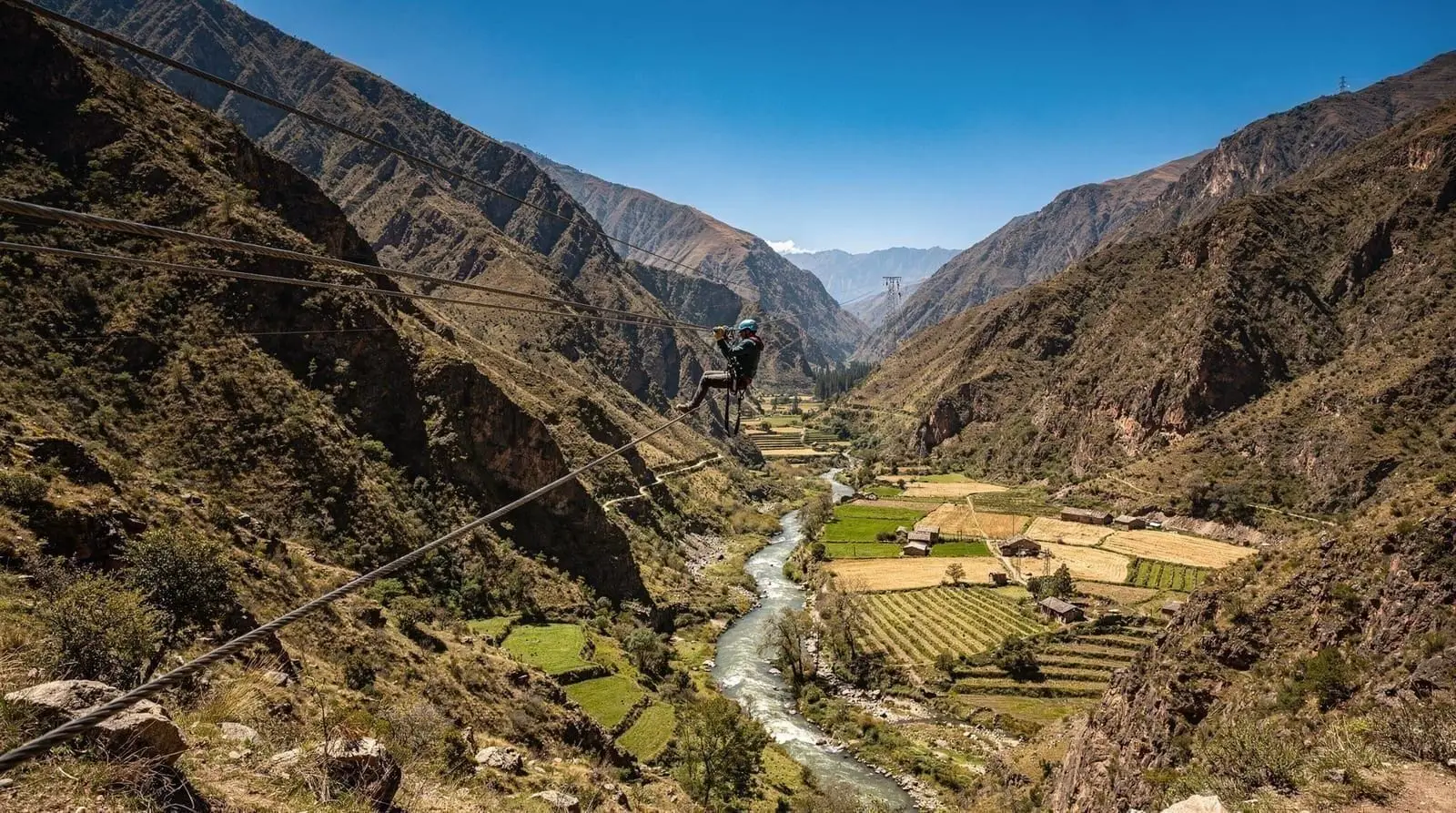
Ziplining in the Sacred Valley: a safety-first guide
Is ziplining in the Sacred Valley worth it?
Yes, for travellers who want a half-day adrenaline break from ruins and want canyon scenery from the air. The main circuits sit near Santa Teresa and around the Urubamba valley, cost roughly S/120 to S/350 depending on length and whether a via ferrata is included, and are generally well run — but operator safety standards vary, so vet your provider before booking.
Adrenaline between the ruins
The Sacred Valley is sold almost entirely as an archaeology-and-agriculture experience — terraces, salt pans, Inca towns, market stalls. That is most of its appeal, but it leaves a gap for travellers who want a few hours of pulse-raising activity between the ruins, and ziplining fills it neatly. Strung across the valley’s side canyons and tributary gorges, the lines give you the one perspective the ruins cannot: the landscape from the air, the Urubamba river threading the valley floor while you slide above it on a steel cable.
It is also, handled sensibly, one of the more accessible adventure activities in the region. You do not need to be fit, experienced, or acclimatised to the same brutal degree as a high pass — the valley floor sits lower than Cusco, which helps. What you do need is a clear-eyed approach to operator safety, because Peru’s adventure sector is lightly regulated and the gap between a meticulous operator and a careless one is exactly the gap that matters when you are clipped to a wire over a canyon. This guide covers where the lines run, what they cost, and — most importantly — how to judge whether the operator deserves your trust.
For how this slots into a wider valley day, pair it with our one-day Sacred Valley itinerary and the practicalities in getting around the Sacred Valley.
| Where | Urubamba valley canopy circuits, Santa Teresa (near Machu Picchu), or the Pachar cliffside via ferrata/Skylodge |
| Cost | Around S/120–S/350 (about $32–$95), depending on circuit length and add-ons |
| Time needed | 2–4 hours for a standard circuit; 6–8 hours for a combined adventure day |
| Getting there | Cusco-based operators run transport; Santa Teresa circuits sit on the overland route to Machu Picchu |
| Best time | Dry season (May–October) for fewer weather delays; book the morning slot year-round |
Where the lines actually are
“Sacred Valley ziplining” covers a few distinct locations across the wider Cusco region, and they are not interchangeable.
The Urubamba valley circuits. Several operators run zipline canopy tours in the side gorges around the Urubamba valley, the heart of the Sacred Valley between Cusco and Ollantaytambo. These are the most convenient as a half-day add-on to a valley itinerary, with a series of lines crossing a tributary canyon and often a hanging bridge between platforms.
Santa Teresa, near Machu Picchu. On the alternative back route to Machu Picchu — the road-and-trek approach via Santa Teresa and Hidroeléctrica — sits one of the region’s longest and best-known zipline circuits, with multiple cables spanning a river canyon. Many travellers taking the budget overland route to Machu Picchu, or on an Inca Jungle adventure trip, ride these lines as part of the journey. Operators here often pair the zipline with rafting on the Urubamba.
The cliffside via ferrata and Skylodge. Above the valley near Pachar, a famous via ferrata climbs a sheer rock face to transparent capsule pods (the Skylodge), and the descent is by a series of ziplines bolted to the cliff. This is the premium, vertigo-heavy end of the spectrum, priced accordingly, and a different proposition from the standard canopy circuits.
Decide which experience you actually want before booking: a quick canopy thrill, a long canyon-crossing circuit, or the cliff-climb-and-descent adventure.
Zipline, via ferrata, or both? Choosing your circuit
The three products above suit different travellers. Use this comparison before you book, rather than after.
| Circuit | Best for | Intensity | Typical length |
|---|---|---|---|
| Urubamba valley canopy | A quick half-day add-on to a Sacred Valley itinerary | Low–moderate | 2–3 hours |
| Santa Teresa circuit | Travellers on the overland route to Machu Picchu, or combining with rafting | Moderate–high | Half day |
| Pachar via ferrata + Skylodge | Vertigo-comfortable travellers wanting the region’s premium adventure product | High | Half to full day |
If you are short on time and based in Cusco, the Urubamba valley circuits are the simplest to slot into a single day; see our best day trips from Cusco for how they compare on effort against ruins-only excursions.
What it costs
Prices span a wide range because the products are so different:
- Short canopy circuits (a handful of lines, a couple of hours): roughly S/120 to S/200 (about $32 to $54), sometimes excluding transport from Cusco.
- Longer multi-line circuits near Santa Teresa, often with transport and sometimes lunch: roughly S/180 to S/300 (about $48 to $80).
- Combined adventure days (zipline plus via ferrata, or zipline plus rafting): S/250 to S/350-plus (about $67 to $95-plus).
- The Skylodge cliff experience is a separate, considerably pricier overnight or premium-day product.
Always confirm what the quoted price includes — transport from Cusco or your Sacred Valley base, the number of lines, gear, a guide-to-guest ratio, and any meal. The cheapest quote sometimes excludes the round-trip transfer, which adds up. As with most things in the region, see our best day trips from Cusco for how ziplining compares on cost and effort with the valley’s other excursions.
How to judge operator safety
This is the section that matters most, because Peru has no single rigorous national regulator for zipline operators, and equipment and training standards genuinely vary. A good operator will welcome these questions; an evasive one is a warning in itself. Before you book or clip in, establish the following.
Equipment. Are harnesses, helmets, and gloves provided as standard? Do the lines use a redundant braking system rather than relying on a guide catching you or on you braking by hand alone? Is there a backup connection (a second carabiner or lanyard) so you are never attached by a single point? Reputable operators use trolleys with built-in brakes and double attachment.
Inspection and gear condition. Ask, or simply look: cables, carabiners, and harnesses should be visibly maintained, not frayed, rusted, or sun-cracked. Operators on well-run circuits inspect their lines regularly and can tell you so.
Guides. How many guides are on the circuit, are they trained in the gear and in rescue, and do they personally check each guest’s harness before every line? A guide who clips you in without checking the buckle is a red flag.
Body briefing. You should be told how to position yourself, how to slow down, and what to do if you stall mid-line. A circuit that sends you off without a clear briefing is cutting corners.
Limits. Honest operators enforce weight limits (commonly around 40 kg to 120 kg, as the braking and harness rely on them), age minimums, and health exclusions. An operator willing to ignore a stated weight limit to take your money is one to walk away from.
If an operator cannot answer these clearly, choose another. There are enough reputable ones in the Cusco market that you never need to gamble.
What the experience is actually like
If you have never ridden a zipline, the canopy circuits in the valley follow a predictable rhythm worth knowing in advance, because it takes the edge off the first-line nerves.
You arrive, sign a waiver, and are fitted with a full-body or seat harness, a helmet, and gloves. A guide briefs you on body position — typically leaning back, legs up and crossed, hands off the cable except where they show you to brake — and runs a short practice on a low line or a static check. Then you climb to the first platform, the guide clips your trolley to the cable and checks your harness, and you step off. The initial drop is the only genuinely heart-in-mouth moment; after that, most people relax into it within a line or two and start looking at the canyon rather than gripping the harness.
Between lines you walk short trails or cross hanging bridges to the next platform, which spaces the adrenaline out and gives your nerves time to reset. A typical circuit runs five to eight lines of varying length and speed, finishing with the longest. Guides usually offer to film or photograph you mid-line, sometimes for a small fee, which is the sensible alternative to risking your own phone over a gorge.
The Santa Teresa circuits feel more committing — longer cables, bigger drops, faster speeds across a wide river canyon — and reward travellers who already know they enjoy heights. The Skylodge via ferrata is a different animal entirely: a sustained vertical climb on fixed rungs and cable that demands a real head for heights, with the ziplines used to come back down. Match the product to your appetite rather than booking the first “Sacred Valley zipline” you see advertised.
Who should and should not do it
Well suited: Travellers wanting a half-day adrenaline break from ruins, families with older children (subject to age and weight limits), and anyone who enjoys heights and movement. The standard canopy lines need no special fitness.
Think twice: Anyone with a serious heart condition, recent surgery, severe vertigo, or pregnancy should skip it, and the via ferrata in particular demands a genuine head for heights and basic mobility. The standard ziplines are mostly passive, but the cliff climb is not.
A note on altitude: The valley floor lines sit lower than Cusco, so altitude is less punishing than on a high pass, but you should still be reasonably acclimatised — see our getting around the Sacred Valley guide for how the elevations compare across the valley.
Practical tips for the day
- Wear closed-toe shoes with grip, fitted clothing (loose sleeves and scarves can catch), and tie back long hair.
- Leave loose items behind — phones and cameras are easily dropped from a moving line; use a secured pouch or a guide’s GoPro service if offered.
- Sun protection matters even mid-canyon; the UV is strong and there is little shade on the platforms.
- Book the morning slot in the wet season (November to March), as afternoon storms can suspend operations.
- Combine smartly: ziplining slots neatly into a Sacred Valley day or, near Santa Teresa, into the overland approach to Machu Picchu. See the one-day Sacred Valley itinerary for sequencing.
Booking: last-minute vs in advance
In the Urubamba valley and around Ollantaytambo, it is often possible to book a canopy circuit the day before or even the same morning through a Cusco tour agency or your accommodation, especially outside the July–August peak. The Santa Teresa circuits and the Skylodge via ferrata are a different story: they run limited daily slots, sell out days ahead in high season, and are worth locking in as soon as your Machu Picchu dates are fixed.
Book directly through an established operator rather than a street tout — our unlicensed tour agencies in Cusco guide explains why the cheapest street-corner offer is often the one to skip, and the same logic applies to adventure activities as much as ruins tours.
If heights aren’t your thing
Ziplining is not the only adrenaline option in the valley, and it is worth knowing the alternatives before you commit to a cable over a canyon. Rafting on the Urubamba gives a similar adventure-day feel without the height exposure, graded from gentle floats to genuine white water depending on the season and stretch.
Horseback riding around Cusco and the Sacred Valley offers a slower, ground-level way to cover terrain, and ATV and quad tours near Cusco deliver speed and dust rather than altitude. Any of these pairs naturally with a half-day of ruins, and none require the same head for heights the via ferrata demands.