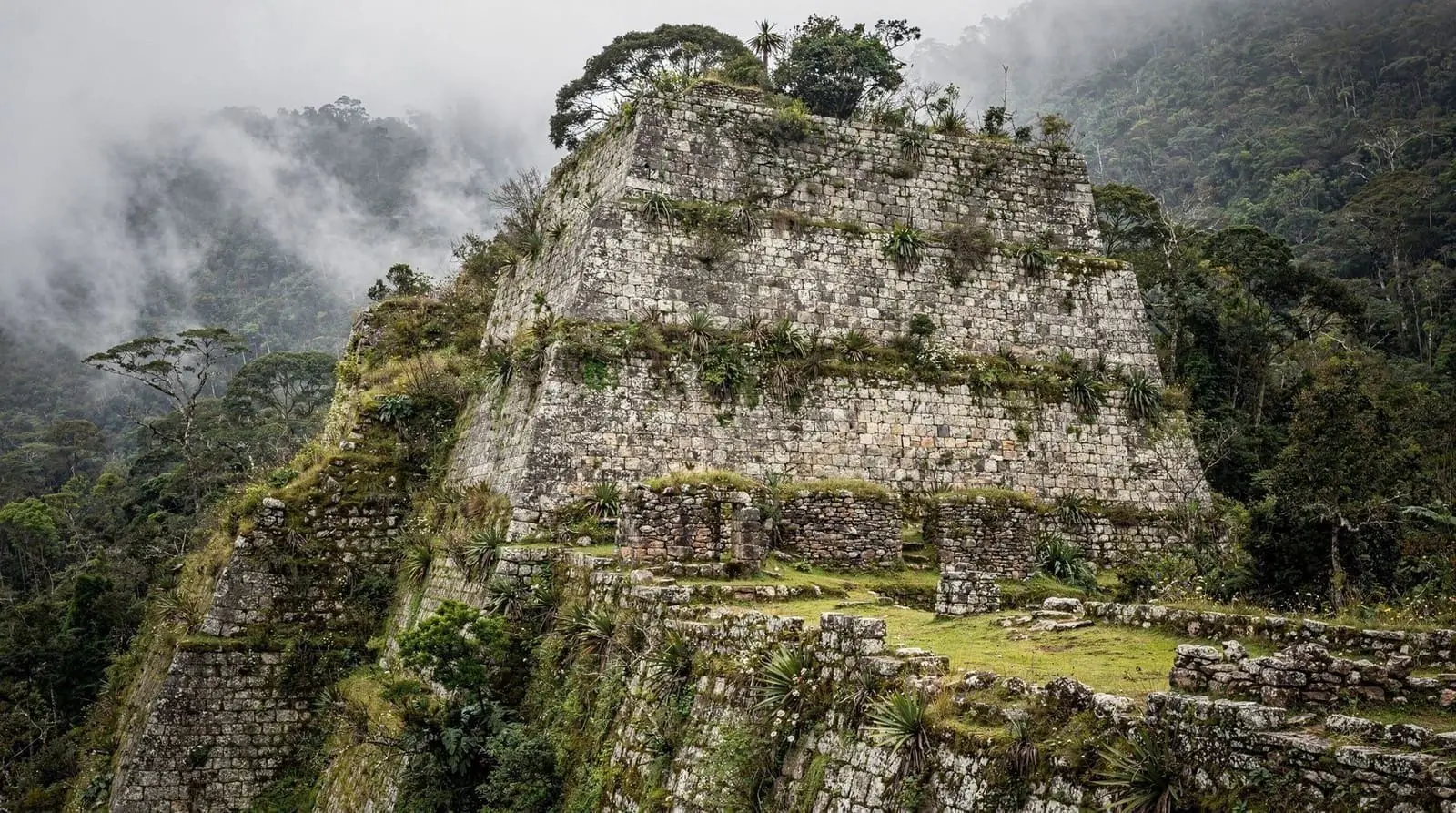
Kuélap fortress guide
From Chachapoyas: Kuélap Fortress and Cable Car Tour
What is Kuélap and is it worth visiting?
Kuélap is a massive Chachapoya stone fortress on a ridge at 3,000 m above the Utcubamba valley, built from around 500 CE and older than Machu Picchu. It is worth visiting for its scale, its 20 m walls and its solitude — you may share it with a few dozen people rather than thousands — provided you accept it has little of Machu Picchu's polish or interpretation.
A fortress that took the Incas years to break
When the Inca armies pushed north in the 1470s, they ran into a culture that did not fold easily. The Chachapoya were cloud-forest mountaineers fighting on home terrain, and their principal stronghold was one of the most formidable stone enclosures in pre-Columbian America. Kuélap held out long enough, and the region stayed restive enough afterward, that the Incas resorted to deporting large numbers of Chachapoya people to other provinces to prevent further resistance — a standard imperial tactic reserved for populations they could not otherwise pacify.
Stand inside the walls and the logic is obvious. Kuélap occupies a narrow ridge at around 3,000 m with the Utcubamba valley dropping away steeply on both sides. Its outer walls, built of roughly hewn limestone mortared with clay, rise up to 20 m and ring a platform roughly 600 m long and 110 m wide. The single main entrance is an inverted-cone passage so narrow that only one person passes at a time. The whole thing is a statement of defensive intent.
This guide goes deep on what you are looking at, how to plan the visit, and how to set your expectations honestly. For logistics on the town you will base from, see the Chachapoyas complete guide, and for the site overview the Kuélap destination page.
| Where | ridge above the Utcubamba valley, ~50km from Chachapoyas |
| Cost | around S/15 admission, plus S/30 cable car if running |
| Time needed | 2-3hrs on site, 8-9hrs full round trip from Chachapoyas |
| Getting there | cable car from Nuevo Tingo, or road + 45min walk |
| Best time | morning, before afternoon cloud settles over the ridge |
The numbers that matter
Kuélap is often reduced to one comparison — that it contains roughly three times the stone volume of the Great Pyramid of Giza. That figure is contested and the comparison is a bit of a parlour trick, but the underlying point stands: this is an enormous structure. The platform alone is the length of six football pitches. The walls in places match a six-storey building. More than four hundred circular dwellings cover the interior.
It was built starting around 500 CE and occupied for roughly a thousand years. That makes it not a rival to Machu Picchu but something older and culturally distinct — a Chachapoya creation, predating the Inca expansion that swallowed the region. Treating it as a northern knock-off of an Inca site, as the marketing does, misreads it entirely.
Inside the walls: what you are actually seeing
The lack of on-site interpretation means most visitors walk past the things worth understanding. Here is what to look for.
The entrance passages. The main tunnel narrows to under a metre at its base, forming the famous inverted cone. Entering one by one creates a deliberately choreographed, slightly disorienting arrival into the interior. Archaeologists read this as crowd control during major gatherings and as an extreme defensive advantage if the walls were ever breached. Two secondary entrances at either end share the funnel shape.
The circular dwellings (kullpi). These cylindrical stone houses were the standard Chachapoya domestic unit and appear at sites across the region. Most survive to chest height; a few have been partially restored. The cylindrical form, so different from Inca rectilinear masonry, is the clearest marker of a separate architectural tradition.
The friezes. Where surface decoration survives on the lower exterior courses, look for the zigzag and rhombus patterns — the Chachapoya signature motif, which reappears on the painted cliff mausoleums at Revash. Distinct from these are the carved serpent-head reliefs (cabezas de serpiente) on the main outer wall, which likely carried a separate religious meaning.
El Tintero and El Castillo. El Tintero, “the inkwell,” is a large round enclosure on the eastern end with a circular interior altar, its shape unlike anything around it. El Castillo, at the site’s highest point, offers the widest views and is believed to have served a ceremonial or administrative function. From there you grasp how the ridge made the site both defensible and visually commanding.
The Torreón. This circular tower near the centre is the most intact standing structure, its walls reaching roughly 6 m. Whether it was a watchtower, a priestly residence or an observatory is debated. The viewing platform behind it gives the best overview of the site’s scale.
Tickets, hours and the cost of a visit
Admission is S/15 (about $4) for foreign adults, with student discounts for valid ID holders. The site is open daily 8 am to 5 pm. The cable car, when operating, carries a separate charge of around S/30 round trip (about $8) unless folded into a tour price; the last valley-station departure is usually around 3:30 pm.
On-site guides can be hired at the entrance for S/40-70 per group. Guides arranged through Chachapoyas agencies are generally better prepared — ask explicitly whether they know Chachapoya history and not just the Inca period, because many default to the Inca narrative they are more familiar with.
A small café near the cable car upper station sells snacks and drinks, but bring your own water, sun protection and a light waterproof. At 3,000 m the weather turns fast and the temperature is noticeably cooler than the valley floor.
Getting there: cable car or road
Kuélap is roughly 50 km from Chachapoyas by road, following the Utcubamba valley before a switchback climb. There are two ways up to the fortress itself once you reach the base area:
- The cable car (teleférico), which crosses about 4 km from Nuevo Tingo to the plateau in around 20 minutes, rising over the cloud forest with views across the valley. When it runs, it is the standout arrival in northern Peru. It has, however, suffered repeated and sometimes lengthy closures — confirm its status before building a plan around it. Full detail is in the Kuélap cable car guide.
- The road and walk, always available as the fallback. Vehicles reach a car park below the walls, from which a steep stone path climbs roughly 45 minutes to the entrance.
Most visitors come on an organised day tour from Chachapoyas, leaving by 8 am and back by 4-5 pm. Private transport runs S/80-120 per vehicle each way. Shared combis to Nuevo Tingo exist but coordinating the return independently is awkward.
Kuélap fortress and cable car tour from ChachapoyasPlanning your day on site
The full round trip from Chachapoyas runs eight to nine hours. On site, allow two to three hours — Kuélap rewards slow exploration because there is no single viewpoint that captures it the way the Inti Punku frames Machu Picchu. The scale reveals itself gradually as you walk the platform.
A practical order: enter through the main tunnel, work along the outer wall looking for friezes and serpent heads, then move inward through the dwellings to El Tintero, finishing at El Castillo for the panoramic finale. Go in the morning if you can — the afternoon cloud often thickens over the ridge, and the light for both viewing and photography is far better early.
Pace yourself on the climb if you are not acclimatised. Chachapoyas at 2,335 m gives partial adjustment, but visitors straight from sea level may feel breathless on the uphill from the car park. The site has no guardrails on some elevated sections, so families with young children need to supervise closely — though the tunnel and the giant walls tend to make Kuélap more memorable for kids than the more polished Inca sites.
Honest expectations
Kuélap is not Machu Picchu and pretending otherwise sets visitors up for disappointment. It lacks the dramatic glacier-and-terrace setting, the dense interpretation, the UNESCO funding and the postcard view. What it offers instead is genuine scale, genuine age, genuine solitude, and the cloud forest still intact around it. If you find famous sites oppressive when crowded and you prefer your archaeology with silence and imagination, Kuélap will delight you. If you want a polished, legible, photo-ready experience, calibrate accordingly. The full head-to-head is in Kuélap vs Machu Picchu.
The other honest note: the cable car is genuinely the highlight of the approach, but it is unreliable. Do not let a single point of failure define your trip. The road and walk are perfectly viable and the fortress is the same fortress either way.
Combining Kuélap with the rest of the region
Kuélap anchors a multi-day exploration rather than a standalone excursion. The satisfying sequence runs Kuélap on day one, Gocta waterfall on day two, the Karajía sarcophagi and Quiocta caves on day three, and the Revash mausoleums with the Leymebamba museum on day four. Each deserves its own day; do not let an operator bundle the fortress and the waterfall into one.
If you are arriving from the coast, a circuit running Trujillo to Chiclayo to Chachapoyas and on to Cajamarca makes geographic sense. See the itineraries hub for route options and how to get to Chachapoyas for the practicalities of arriving.
Kuélap fortress full-day tour from ChachapoyasWho should make the trip north
Chachapoyas sits far enough off the Cusco-Machu Picchu-Lima circuit that reaching it takes real commitment — a flight to Jaén or Chiclayo, or a long overnight bus, followed by the drive out to the fortress itself. That effort filters the crowd: people who make it to Kuélap tend to want the solitude and the pre-Inca history specifically, not a convenient add-on. If your trip already leans toward archaeology and quieter sites — the Chachapoyas vs Cusco guide lays out that trade-off directly — the detour pays off. If your time in Peru is short and Machu Picchu is the priority, Kuélap is easier to justify on a second trip than to squeeze in alongside it.
Frequently asked questions about Kuélap fortress
How much does it cost to enter Kuélap?
What are Kuélap's opening hours?
How long should I spend at Kuélap?
Do I need a guide for Kuélap?
Is Kuélap older than Machu Picchu?
Is Kuélap worth the detour from a standard Peru itinerary?
Top experiences
Bookable activities with verified prices and instant confirmation on GetYourGuide.
