Kuélap cable car guide
Chachapoyas: Llaqta of Kuélap with Cable Car
Is the Kuélap cable car operating?
The teleférico has had repeated closures since it opened in 2017, including an extended maintenance shutdown in 2023-2024, so its status changes. Always confirm with your tour operator, your Chachapoyas hotel or the Ministerio de Cultura before building a trip around it. When closed, the road-and-walk approach to the fortress is always available.
The most dramatic arrival in northern Peru, when it works
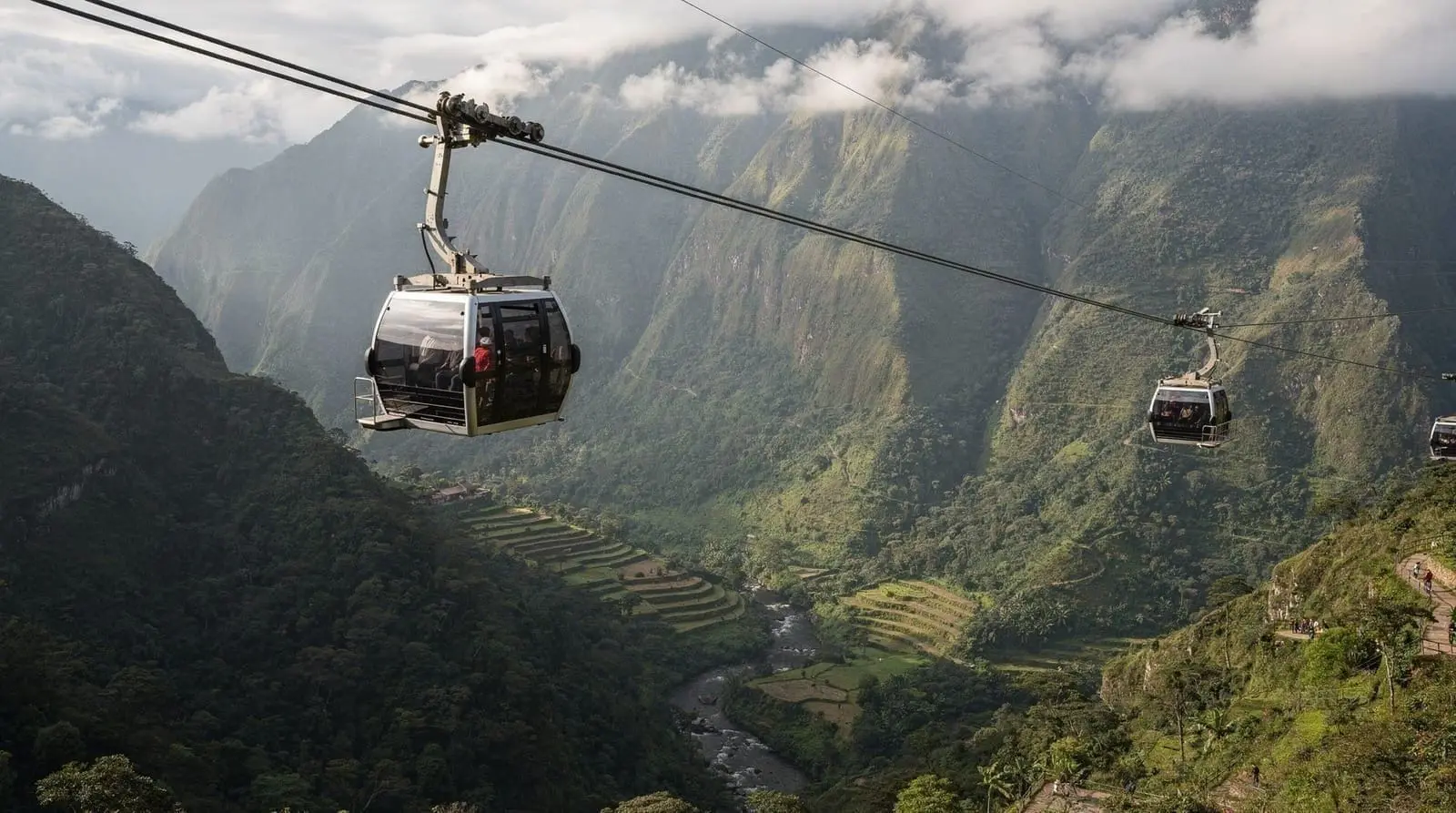
The Kuélap cable car opened in 2017 and instantly became one of the most spectacular ways to reach any archaeological site in South America. The cabins lift you about 4 km from the floor of the Utcubamba valley to the fortress plateau, climbing roughly 1,200 m over uninterrupted cloud forest, the fortress walls emerging from the mist as you approach. The crossing takes around 20 minutes and it is, when running, the single best part of the Kuélap experience.
| Where | Nuevo Tingo valley station, ~1.5hrs by road from Chachapoyas |
| Cost | around S/30 round trip (about $8), plus S/15 fortress admission |
| Time needed | ~20min crossing each way, or ~45min uphill walk if closed |
| Getting there | tour transfer or private car to Nuevo Tingo |
| Best time | early morning, before afternoon cloud builds over the ridge |
The catch is in that conditional. The cable car has been an unreliable piece of infrastructure since its first years. This guide covers what it costs, how it works, and — crucially — what to do when it is shut, because anyone planning a Kuélap trip needs a plan that does not depend on it. For the fortress itself, see the Kuélap fortress guide; for the wider region, the Chachapoyas complete guide.
The honest status picture
Here is the situation, stated plainly. The teleférico has experienced multiple operational interruptions since 2017, including an extended closure for maintenance across 2023 and into 2024. These shutdowns have been precautionary and infrastructural — funding, component replacement, system upkeep — rather than the result of any accident. The system was built to international standards by an experienced consortium, and there is no safety-record reason to avoid it.
What this means for you is simple: do not assume it is running. Status genuinely fluctuates, and announced reopenings have slipped before. Before you finalise a Kuélap day, confirm the current state through one of three sources:
- Your tour operator in Chachapoyas, who deal with it daily and have the most current information.
- Your hotel in Chachapoyas, which will know the local situation.
- The Ministerio de Cultura, which administers the site and the cable car.
Treat any single source’s “it reopens next month” with caution and verify close to your travel dates. This guide deliberately avoids stating a definitive open-or-closed status because it changes; the practical advice — verify, and have a fallback — does not.
How it works when it is running
The valley station sits at Nuevo Tingo, in the Utcubamba valley roughly 1.5 hours by road from Chachapoyas. A short shuttle connects the parking and ticketing area to the boarding station. From there the cabins cross the valley and climb to a plateau station, from which a gentle walk leads to the fortress entrance — far easier than the alternative road climb.
Key practicalities:
- Cost: roughly S/30 round trip (about $8) when not bundled into a tour, separate from the S/15 fortress admission.
- Crossing time: about 20 minutes each way.
- Last departure: the final valley-station crossing is typically around 3:30 pm, so plan your day to be back at the upper station in good time.
- Capacity and queues: cabins are small and on busy dry-season mornings (July and August) there can be a wait at the valley station. Arriving early avoids both the queue and the afternoon cloud.
The road-and-walk alternative
This is the part too few people plan for. When the cable car is closed — or simply if you prefer not to use it — you reach Kuélap entirely by road. Vehicles drive up a switchback road to a car park below the fortress walls, and from there a steep stone path climbs roughly 45 minutes to the entrance.
It is a genuine fallback, not a compromise that blocks the experience. The fortress is identical regardless of how you arrived. What you lose is the aerial crossing and a chunk of time and energy: the road climb is slower and more tiring than the cabin glide, and at 3,000 m the uphill walk is felt by anyone not acclimatised. What you gain is independence from the cable car’s reliability problems.
For families with young children or visitors with limited mobility, the difference is significant — the cable car makes Kuélap genuinely accessible in a way the road climb does not. If those travellers are in your group, the cable car’s status matters far more, and it is worth phoning ahead specifically to confirm.
Kuélap fortress full-day tour from ChachapoyasHow operators handle closures
The established Chachapoyas agencies adapt automatically. When the cable car is down, their Kuélap day tours switch to the road approach without changing much else — same departure window, same time on site, a little more walking. If you book a tour, you generally do not need to manage the closure yourself; the operator absorbs it. This is one practical argument for booking a tour rather than going fully independent: you offload the cable-car uncertainty onto people who track it daily.
If you book a package that specifically advertises the cable car and it turns out to be closed, ask in advance what the contingency is and whether pricing adjusts, since you would not be using the cable car ticket. Reputable operators are transparent about this.
Why the cable car was built — and why it struggles
The teleférico was not a vanity project but a deliberate attempt to solve Kuélap’s central problem: access. Before 2017, reaching the fortress meant a long, slow road journey followed by a tiring uphill walk, which kept visitor numbers low and limited the economic benefit to the surrounding communities. The cable car was conceived as the catalyst that would open Kuélap to mass tourism the way the train and bus system opened Machu Picchu — slashing the final ascent from a 45-minute climb to a 20-minute glide and, in theory, transforming the regional economy.
It worked, at first. Visitor numbers to Kuélap jumped after the cable car opened, and the dramatic crossing became the region’s signature image. But the same remoteness that made the cable car necessary has made it hard to sustain. A complex piece of mechanical infrastructure high in the cloud forest, far from major maintenance hubs and dependent on public funding, is expensive to keep running. The closures that have punctuated its life reflect this structural tension — the upkeep demands of cutting-edge transport in a place defined by its inaccessibility.
For visitors, the practical lesson is to hold the cable car lightly. It is a wonderful thing when it runs and a recurring source of disappointment when planned around uncritically. The fortress was reaching travellers for years before the cable car existed and continues to during every closure. Treat the teleférico as the icing, never the cake — and you will never have your trip derailed by its status.
Tourist-trap warnings around the cable car
- Don’t build your whole trip around it. The single biggest mistake is treating the cable car as the reason to visit and being deflated when it is shut. The fortress is the destination; the cable car is a bonus.
- Verify, don’t trust marketing. Promotional material and older blog posts often describe the cable car as simply “running,” because for stretches it is. Confirm close to your dates rather than relying on dated sources.
- Watch the last-departure clock. Visitors absorbed in the fortress occasionally miss the roughly 3:30 pm last valley crossing and face the road walk down. Keep an eye on the time.
- Bundled pricing can hide the ticket. When a tour quotes an all-in figure, check whether the cable car ticket is included and what happens to that portion if it is closed.
Fitting the cable car into your Kuélap day
The full Kuélap round trip from Chachapoyas runs eight to nine hours. With the cable car, the breakdown is roughly 1.5 hours road each way to Nuevo Tingo, 20 minutes crossing each way, and two to three hours on site. Without it, swap the crossings for the 45-minute uphill walk each way and add a little buffer for the slower road to the upper car park.
Either way, go early. The cloud forest builds cloud over the ridge through the afternoon, so a morning visit gives you the best chance of clear views and the best light. Pack water, sun protection and a waterproof layer regardless of how you ascend — the weather at 3,000 m changes quickly. Full on-site planning is in the Kuélap fortress guide.
Getting to the cable car base
The cable car station is part of the broader question of reaching this remote region. From Chachapoyas it is a road transfer; reaching Chachapoyas itself usually means flying to Jaén or Chiclayo and continuing by bus, or a long overnight coach from Lima. The full breakdown of routes, times and costs is in how to get to Chachapoyas, and the regional planning in the Chachapoyas complete guide. For where Kuélap sits in a wider trip, see the itineraries hub.
Making the most of the region while you’re there
Because the road to Nuevo Tingo already eats a chunk of the day, most visitors combine Kuélap with one or two of the other Chachapoyas-area sites rather than treating it as a single out-and-back trip. The Karajía sarcophagi and the Revash mausoleums are both reachable on separate half-days, and the Gocta waterfall makes a good rest day after the fortress.
If you’re weighing Chachapoyas against a more famous citadel, the Kuélap vs Machu Picchu comparison and the wider Chachapoyas vs Cusco guide both address that directly, and one traveller’s first-hand take is in Kuélap, the other citadel.
Frequently asked questions about Kuélap cable car
How much does the Kuélap cable car cost?
How long is the Kuélap cable car ride?
What happens if the cable car is closed?
Where does the Kuélap cable car start?
Is the Kuélap cable car safe?
Can I combine the Kuélap cable car with other Chachapoyas sites in one trip?
Top experiences
Bookable activities with verified prices and instant confirmation on GetYourGuide.
