Karajía sarcophagi guide
Chachapoyas: Karajía Sarcophagi & Quiocta Caves
What are the Karajía sarcophagi?
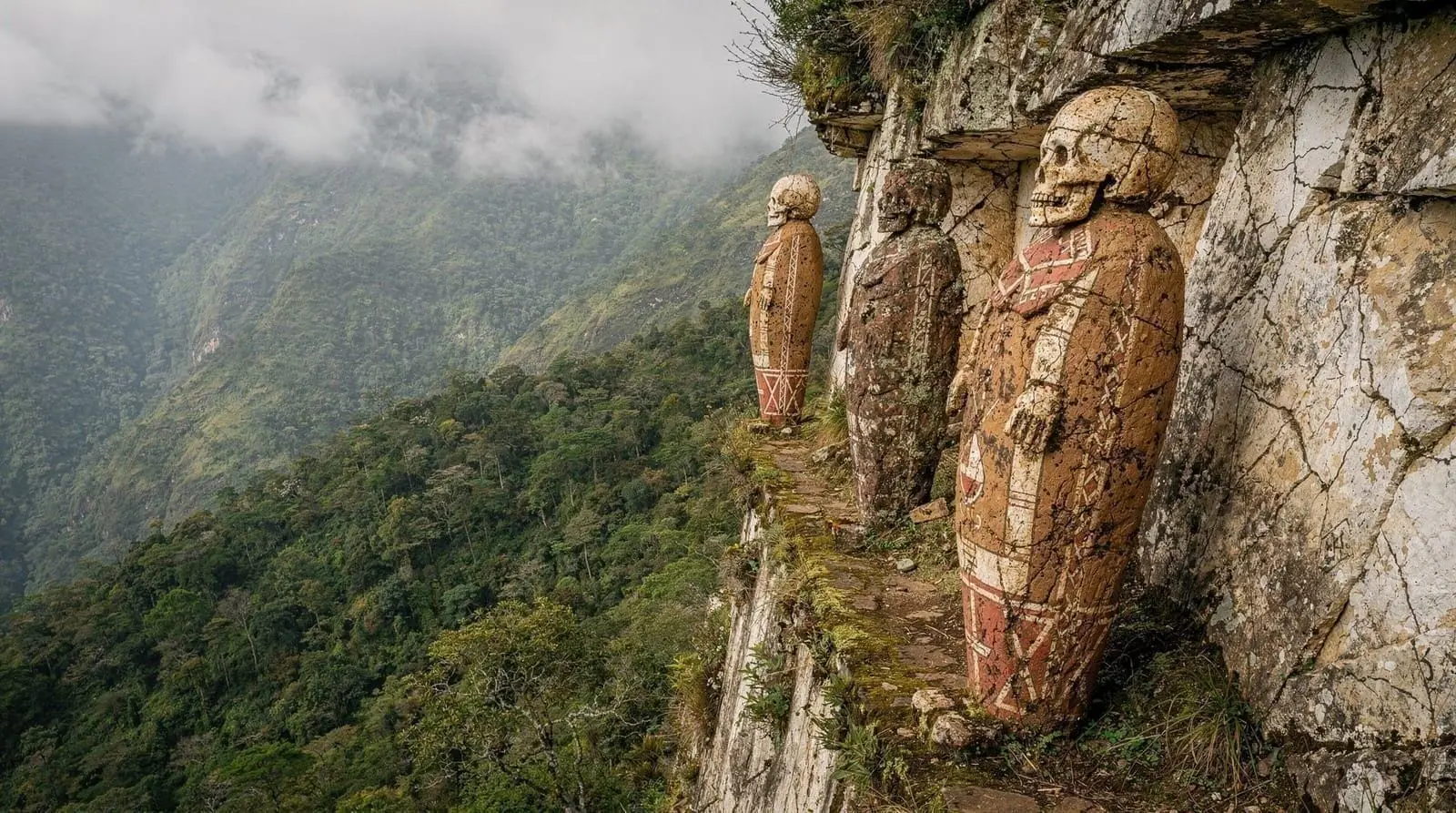
Karajía is a row of tall painted clay funerary figures, each about 2.5 m high, built by the Chachapoya around 500 years ago and wedged onto a near-vertical cliff ledge at roughly 2,800 m near Chachapoyas. You view them from below after a 45-minute hike from Cruzpata, usually combined with the nearby Quiocta caves.
Figures that have stared across a canyon for five centuries
There are few sights in the Americas quite as strange as the first view of the Karajía sarcophagi. Seven elongated human figures, each roughly 2.5 m tall, painted white with ochre and red detailing and topped with what look like oversized heads, stand on a narrow ledge cut into a near-vertical limestone cliff at around 2,800 m. They have occupied that ledge, largely undisturbed by humans and only modestly weathered, for roughly 500 years. They face outward across the canyon, as if keeping watch — which, in the Chachapoya worldview, is more or less exactly what they were meant to do.
Karajía is one of the signature experiences of the Chachapoyas region and, unlike the long hikes to Kuélap or Gocta, a comparatively gentle outing that fits a relaxed half-to-full day. This guide covers the figures themselves, the practical visit, and the Quiocta caves it is usually paired with. For the wider region, see the Chachapoyas complete guide.
| Location | Near Cruzpata, Luya district, ~1.5hrs from Chachapoyas |
| Hike | 45min down, 45–60min back up |
| Altitude | ~2,800 m |
| Entry fee | ~S/5 + small community fee |
| Usual pairing | Quiocta caves |
What you are looking at
These are sarcophagi (purunmachus in the local tradition) — funerary capsules, each containing the remains of a high-status individual placed in a seated, knees-to-chest position. The Chachapoya built them from clay, sticks and grass over a wooden frame, then painted and shaped the exterior into a stylised human form, with a moulded head, a jaw, and sometimes a second small face or trophy skull mounted on top. The exaggerated heads and the row of figures standing shoulder to shoulder give them their uncanny, totemic presence.
The group at Karajía is the most famous, but cliff sarcophagi appear across Chachapoya territory. Their inaccessibility was deliberate: placing the dead high on a sheer cliff kept ancestors visible to the community below, protected them from looters and the elements, and reinforced a belief system in which the dead stayed present in the social world rather than being buried out of sight. The placement is also why they survived — almost everything reachable was eventually robbed or destroyed, while these stayed safely out of reach.
A note on a famous detail: one of the figures was historically topped with a human skull, and over the years the lineup has shifted slightly as the ledge and figures have weathered. Do not expect a perfectly preserved, freshly painted row — what you see is genuinely ancient and shows its age, which is part of the point.
The visit: hike, distance and time
Karajía sits near the village of Cruzpata, in the Luya district roughly 1.5 hours by road from Chachapoyas. From Cruzpata the trail descends about 45 minutes into the canyon to the cliff-face viewpoint, then climbs the same way back, taking 45 minutes to an hour on the return.
The descent is easy. The uphill return is the harder part, moderate rather than tough but felt at altitude, especially if you are not acclimatised to the roughly 2,800 m elevation. Horses can sometimes be hired at Cruzpata for the climb back, useful for tired legs or less mobile visitors. The trail is straightforward and well-trodden.
At the viewpoint you see the figures from below and at a distance — you cannot reach the ledge, and that is intentional. Binoculars or a zoom lens make a real difference, turning distant white shapes into the detailed, expressive figures they are. Allow time simply to stand and look; the effect of the row staring out across the valley is the experience.
Costs and how to go
Approximate costs, in soles with USD at roughly S/3.7 to the dollar:
- Site entry: around S/5 (about $1.50), plus a small community fee at Cruzpata.
- Guided day trip from Chachapoyas (Karajía plus Quiocta caves): roughly S/60-90 (about $16-24) including transport.
- Horse hire: an extra fee, arranged at Cruzpata.
You can visit independently — a combi from Chachapoyas towards Luya drops you near Cruzpata, from where the trail begins — but the timing and return transport are awkward to coordinate, and the cultural context is easy to miss without a guide. Most visitors take the day tour, which is inexpensive, handles the logistics, and almost always pairs Karajía with the Quiocta caves into a single satisfying outing.
Karajía sarcophagi and Quiocta caves tour from ChachapoyasSome operators run a Karajía-focused full day with a slightly different itinerary.
Full-day Karajía sarcophagi tour from ChachapoyasQuiocta caves: the usual companion
The standard Karajía day trip includes the Quiocta caves, a limestone cavern system near the village of Lamud. The caves run several hundred metres into the hillside, with stalactites, stalagmites and chambers, and the entrance area was used by the Chachapoya as a burial site — you may see bones and skulls near the mouth. Inside, the floor is muddy and the going can be wet and slippery, so footwear with grip and a willingness to get dirty are essential. Headlamps are usually provided or rented at the entrance.
Quiocta is a good contrast to Karajía: where the sarcophagi are about distance and the open canyon, the caves are about enclosure and descent. Together they make a varied day that suits travellers who want archaeology and a touch of adventure without a punishing hike.
The making of a sarcophagus, and why so few survive
Understanding how the purunmachus were built helps explain both their strange appearance and their fragility. The Chachapoya did not carve them from stone. Each began as a cylindrical frame of wood and cane, packed with clay, grass and small stones, then modelled into the elongated capsule shape and finished with a moulded head — sometimes with a protruding jaw, sometimes crowned with a real or sculpted skull. The surface was then plastered and painted white with red and ochre detailing. Inside sat a single individual of high status, seated knees-to-chest, often accompanied by grave goods.
This construction is precisely why so few survive. Clay-and-grass figures exposed on a cliff are vulnerable to rain, earthquakes and time, and most of the region’s sarcophagi have long since collapsed, weathered to formlessness, or been destroyed by looters reaching the more accessible ledges. The Karajía group endured because its ledge is genuinely inaccessible — too high and too sheer to reach without serious climbing equipment. The same inaccessibility that frustrates visitors hoping to stand beside the figures is the only reason there is anything left to see.
It also means what you are looking at is fragile and irreplaceable. The figures have shifted and degraded even within recorded history; one famous skull that once topped a figure has moved over the decades. There is no restoring them if they fall. Viewing from a respectful distance is not just a logistical limitation but a conservation necessity, and it lends the encounter a poignancy — these are survivors of a tradition that has almost entirely vanished from the cliffs that once held hundreds like them.
Honest notes and small warnings
- Manage the distance expectation. You view Karajía from below, not beside it. Some visitors arrive hoping to walk up to the figures and are briefly let down. Reframe it: the inaccessibility is why they survived, and the distant view across the canyon is the intended effect.
- Bring optics. Without binoculars or a zoom lens, the figures are smaller and less detailed than the photos suggest. With them, the visit is transformed.
- The Quiocta caves are genuinely muddy. This is not a polished show cave. Wear footwear you do not mind ruining and expect to get dirty.
- Cash only. Community gates and horse hire are cash-only; bring small soles.
- Weather and cloud. As everywhere in this cloud-forest region, mornings can be misty and views clearer earlier in the day. Go early when you can.
Karajía versus Revash versus Leymebamba: which burial sites to prioritise
If time is short, it helps to know how the region’s three main Chachapoya funerary sites differ, since seeing all three is a full extra day most itineraries do not have.
| Site | What you see | Access |
|---|---|---|
| Karajía | 7 tall painted sarcophagi on a cliff ledge | 45min hike, viewed from below at a distance |
| Revash | Small, house-like painted mausoleums | Longer hike, also viewed from a distance |
| Leymebamba Museum | 200+ actual preserved Chachapoya mummies, indoors | Easy, no hike required |
For a single half-day, Karajía is the most visually striking and the easiest to combine with the Quiocta caves. If you have a full extra day, add the Revash mausoleums and the Leymebamba museum for the fuller funerary picture — the museum in particular puts a human face on the tradition that Karajía and Revash only hint at from a distance.
Is the Chachapoyas detour worth it?
Chachapoyas is a genuinely different region from the Cusco circuit most Peru itineraries are built around, and reaching it takes real commitment — flights routing through Lima or Chiclayo, or a long overland journey, rather than a quick side trip. It rewards travellers with an interest in pre-Inca cultures and extra time to spare, but it is not the natural add-on that, say, the Sacred Valley is to Cusco. The Chachapoyas versus Cusco guide weighs the trade-off directly, and if you do make the trip, pairing Karajía with Kuélap — reachable by cable car and one of the most impressive pre-Inca fortresses in Peru — makes the detour clearly worthwhile.
How Karajía fits the wider trip
Karajía is one day in a multi-day Chachapoyas itinerary rather than a reason in itself to make the long journey north. The satisfying sequence runs Kuélap fortress on day one, Gocta waterfall on day two, Karajía and Quiocta on day three, and the Revash mausoleums with the Leymebamba museum on day four. The burial sites — Karajía, Revash and the Leymebamba mummies — together tell the fullest story of Chachapoya funerary belief, so try to see at least two of the three.
For the practicalities of reaching the region, see how to get to Chachapoyas, and for the broader cultural context the Kuélap fortress guide and the Chachapoyas destination page. Route ideas are on the itineraries hub.
Frequently asked questions about Karajía sarcophagi
How do you get to the Karajía sarcophagi?
Can you stand next to the Karajía sarcophagi?
How much does it cost to visit Karajía?
How long does the Karajía hike take?
Why did the Chachapoya put sarcophagi on cliffs?
How does Karajía compare to Revash or the Leymebamba museum?
Is Chachapoyas worth the long trip from Cusco?
Top experiences
Bookable activities with verified prices and instant confirmation on GetYourGuide.

