Revash mausoleums guide
From Chachapoyas: Mausoleums of Revash & Leymebamba Museum
What are the Revash mausoleums?
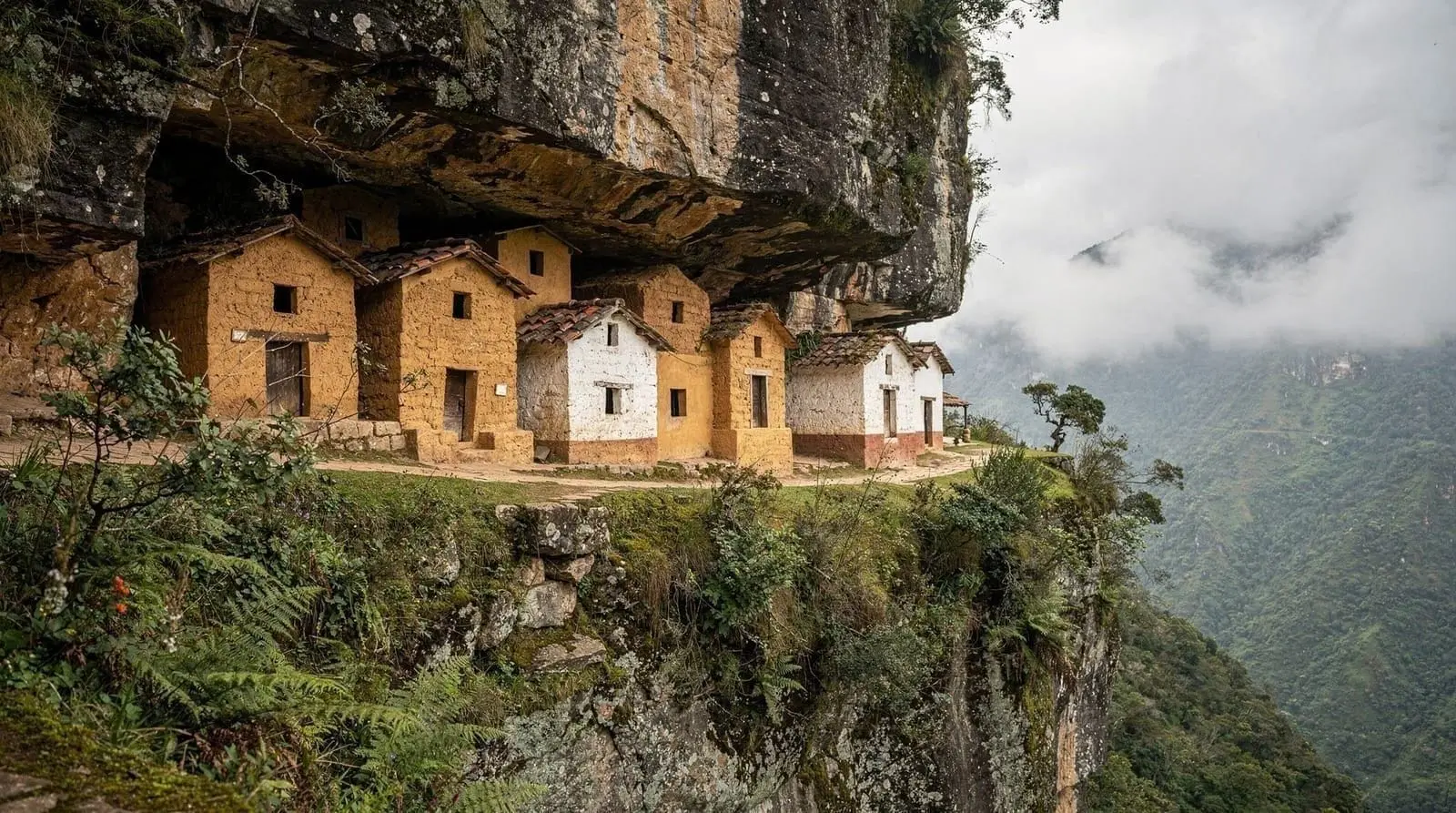
Revash is a cluster of small house-shaped Chachapoya mausoleums, painted ochre, red and cream, built into an overhanging limestone cliff in the Utcubamba valley south of Chachapoyas around 1,000 years ago. You view them from a trail below after a roughly 1.5 to 2 hour hike, usually combined with the Leymebamba museum.
Little painted houses for the dead
Where the Karajía sarcophagi confront you with towering human figures, Revash works on a quieter, more domestic register. Set into an overhanging limestone cliff in the Utcubamba valley south of Chachapoyas is a cluster of small mausoleums shaped like miniature houses — rectangular, gabled, with tiny windows and doorways, painted in ochre, red and cream. They look, from a distance, like a village built for occupants a fraction of human size. They are roughly a thousand years old, and they held the dead.
Revash receives fewer visitors than Karajía, partly because it sits further from Chachapoyas and demands a longer hike, and partly because it is less famous. That relative quiet is part of its appeal. This guide covers the site, the practical visit, and the Leymebamba museum it is almost always paired with. For the wider region, see the Chachapoyas complete guide.
| Where | Utcubamba valley near Santo Tomás, around 2 hours south of Chachapoyas |
| Cost | around S/5-10 site entry; S/80-120 guided day trip with Leymebamba |
| Time needed | full day (drive + 3-4 hour round-trip hike + museum) |
| Getting there | guided tour recommended — independent transport is genuinely awkward |
| Best time | dry season mornings (May-September), before cloud veils the cliff |
What you are looking at
The Revash mausoleums (chullpas in the broader Andean sense, though the Chachapoya form is distinctive) are collective tombs. Built of stone and mud plaster against and into the cliff, then painted, each “house” held multiple individuals along with grave goods. The gabled, multi-storey forms with their small openings genuinely resemble dwellings, which is thought to reflect a belief in the tomb as a home for the dead — a place where ancestors continued to reside.
The exterior surfaces carry painted decoration: geometric shapes, crosses, animal figures and human silhouettes in red and ochre, some still surprisingly vivid given their age and exposure. The same zigzag and rhombus motifs that appear on the walls of Kuélap recur here, tying the burial site to the wider Chachapoya visual world. Like Karajía, Revash was looted in places over the centuries, but the cliff placement protected much of it, which is why the painted houses survive at all.
The cliff setting does the same cultural work as at the sarcophagi sites: keeping the dead visible, present and protected, high above the valley where the living moved. Seeing Revash alongside Karajía and the Leymebamba mummies gives the fullest sense of how the Chachapoya thought about death and ancestry.
The visit: hike, distance and time
Revash lies in the Utcubamba valley near the village of Santo Tomás, in the area around Yerbabuena, roughly 2 hours by road south of Chachapoyas — notably further than Kuélap or Karajía, which is why it is usually paired with the equally southern Leymebamba museum into one long day.
From the trailhead, the hike to the viewpoint below the cliff runs roughly 1.5 to 2 hours each way, on a moderate path with some uphill sections. It is longer and a touch more demanding than the short Karajía walk but well within reach of anyone with reasonable fitness. As at the other cliff sites, you view the mausoleums from below, across a gap — there is no access to the ledge — so binoculars or a zoom lens are genuinely useful for picking out the painted detail.
Because of the long drive plus the hike, Revash is a full day out of Chachapoyas even before adding Leymebamba. Start early.
Costs and how to go
Approximate costs, in soles with USD at roughly S/3.7 to the dollar:
- Site entry: around S/5-10 (about $1.50-3).
- Guided day trip from Chachapoyas (Revash plus Leymebamba museum): roughly S/80-120 (about $22-32) including transport, higher than the closer sites because of the distance.
Visiting independently is possible but genuinely awkward here: the trailhead is remote, public transport south towards Santo Tomás is infrequent, and coordinating a return is difficult. This is the one Chachapoya day where the guided tour is close to essential for most travellers — the distances, the trailhead access and the museum logistics all argue for letting an operator handle it.
Revash mausoleums and Leymebamba museum tour from ChachapoyasLeymebamba museum: the essential companion
The standard Revash day continues to the Leymebamba museum, an hour or so further south in the town of Leymebamba. The museum holds more than 200 mummies recovered in 1997 from the clifftop site of Laguna de los Cóndores, displayed in purpose-built, climate-controlled cases alongside textiles, ceramics, wooden objects and Inca quipus. The mummies were found in remarkable preservation, and seeing them after viewing the cliff tombs at Revash closes a loop — the museum is, in effect, where the people from sites like these now rest and are studied.
It is one of Peru’s most significant and least-visited archaeological museums. The pairing of Revash and Leymebamba is deliberate and excellent: the cliff mausoleums show the architecture of Chachapoya death, the museum shows the people themselves. Full coverage is in the Leymebamba museum guide.
The wider Chachapoya burial landscape
Revash is one node in a remarkable funerary geography. The Chachapoya did not bury their dead in one way but in several, and the region preserves the full range. The standing sarcophagi of Karajía represent individual high-status burials shaped as human figures. The house-shaped mausoleums of Revash represent collective tombs styled as dwellings. The clifftop chambers above Laguna de los Cóndores — whose contents now fill the Leymebamba museum — show the same impulse on a grand scale. And the ossuaries within Kuélap itself show in-site interment alongside the cliff tradition.
What unites them is the logic of verticality and visibility. Across hundreds of kilometres of cloud-forest ridge, the Chachapoya placed their dead high, conspicuous and protected, on faces that could not easily be reached. Revash makes this legible at human scale: from the trail you can see exactly how the tombs were tucked under the overhang, sheltered from rain yet open to the valley. Travellers who see two or three of these sites begin to read the pattern, which is far more rewarding than seeing any one in isolation. This is the argument for not treating Revash as an optional extra but as one panel in a single story.
A practical consequence: if your time is limited, prioritise variety over completeness. Seeing Karajía (standing figures) and Revash (house tombs) and the Leymebamba mummies (the people themselves) gives you three distinct facets. Seeing only two cliff-figure sites of the same type would be more repetitive.
Honest notes and small warnings
- It is a long day. Two hours of driving each way plus a 3-4 hour round-trip hike plus the museum makes Revash and Leymebamba the longest standard outing in the region. Do not attempt it on the same day as anything else.
- You view from below. As at Karajía, you do not reach the mausoleums. Bring optics and reframe the distance as the reason the site survived.
- It is quieter and harder to reach. That is the trade-off — fewer crowds and a more intimate feel, at the cost of more travel and a longer walk.
- Cloud and weather. The cloud forest can veil the cliff, especially later in the day. Earlier is clearer.
- Cash only. Bring small soles for entry fees.
Who should make the trip and who can skip it
Revash rewards a specific kind of traveller more than others. If you have already stood in front of the Karajía sarcophagi and want to see how the Chachapoya handled death a second, different way, Revash is the natural next step — it is a genuinely different burial form, not a repeat of the same idea. It also suits travellers who actively prefer quiet sites: because the hike and the distance filter out casual visitors, you are likely to have the viewpoint largely to yourself, which is not true at Kuélap.
It suits these travellers less: anyone tight on days in Chachapoyas who has not yet done Kuélap or Karajía, anyone with limited mobility who cannot manage a 3-4 hour round-trip hike on uneven ground, and anyone hoping for close-up access to the tombs — as at the other cliff sites, you view from below and never touch the structures. If you must choose only two Chachapoya day trips, Kuélap and Karajía come first; Revash is the reward for a third or fourth day, not a first stop.
How Revash fits the wider trip
Revash is best as the fourth day of a multi-day Chachapoyas itinerary, after the headline sites. The satisfying sequence runs Kuélap fortress on day one, Gocta waterfall on day two, the Karajía sarcophagi and Quiocta caves on day three, and Revash with the Leymebamba museum on day four. The funerary trio of Karajía, Revash and the Leymebamba mummies is the cultural heart of the region; seeing all three is the most rewarding archaeology a visitor can do here.
If you are still weighing whether Chachapoyas deserves this much of your trip at all, the Chachapoyas vs Cusco comparison lays out the trade-off honestly, and the Kuélap: the other citadel blog diary gives a first-person feel for the region’s pace before you commit four days to it.
For the practicalities of reaching the region, see how to get to Chachapoyas, and for the broader story the Chachapoyas destination page. Route ideas are on the itineraries hub.
A second guided option worth knowing about is the tour that pairs Revash’s sister sites together on the same logic — seeing the standing figures and the cliff tombs close together deepens the sense of pattern:
Karajía sarcophagi and Quiocta caves tour from ChachapoyasFrequently asked questions about Revash mausoleums
How do you get to the Revash mausoleums?
Can you go inside the Revash mausoleums?
How much does it cost to visit Revash?
How long is the hike to Revash?
What is the difference between Revash and Karajía?
Is Revash worth the long day it takes?
Top experiences
Bookable activities with verified prices and instant confirmation on GetYourGuide.

