Ollantaytambo ruins guide
Cusco: Pisac, Maras, Moray, Ollantaytambo Small Group Tour
What is Ollantaytambo and why visit?
Ollantaytambo is a vast Inca fortress-temple above a living Inca town at the lower end of the Sacred Valley. It saw a rare Inca victory over the Spanish and has astonishing megalithic stonework. Entry is via the Boleto Turístico, it opens around 7am, and the same town is the train gateway to Machu Picchu.
The valley site that is also a working town
If you only climb one set of terraces in the Sacred Valley, make it Ollantaytambo. The fortress-temple rising above the town is the most dramatic of the valley’s Inca sites, and the town below it is unlike anywhere else in Peru: people still live inside the original Inca street grid, in houses built on Inca foundations, with the same stone water channels running down the lanes. Most valley sites are ruins you visit and leave. Ollantaytambo is a place people never stopped living in.
It is also the hinge of nearly every Machu Picchu trip, because the train station here is where almost everyone boards for Aguas Calientes. That dual role — extraordinary Inca site and essential transport hub — makes it the smartest place to base in the valley, and the easiest to rush past if you treat it as just a train stop. This guide covers the ruins themselves, the climb, the ticket and hours, the living town, the train logistics, and the honest timing advice that separates a crowded scramble from a memorable visit. For how Ollantaytambo fits the wider valley, start with the Sacred Valley destination guide.
| Where | Lower Sacred Valley, ~60 km from Cusco |
| Ticket | Boleto Turístico — Circuit III S/70 or full S/130 |
| Time needed | Half a day for the ruins, town and Pinkuylluna |
| Getting there | Colectivo, taxi or organised tour from Cusco/Urubamba |
| Best time | Opening (7am) or the last hour before close |
| Altitude | ~2,800 m — lower than Cusco, good acclimatisation base |
What you are actually looking at
The site sprawls across a mountainside at the western, lower end of the valley, about 60 km from Cusco at around 2,800 m. It combines several elements:
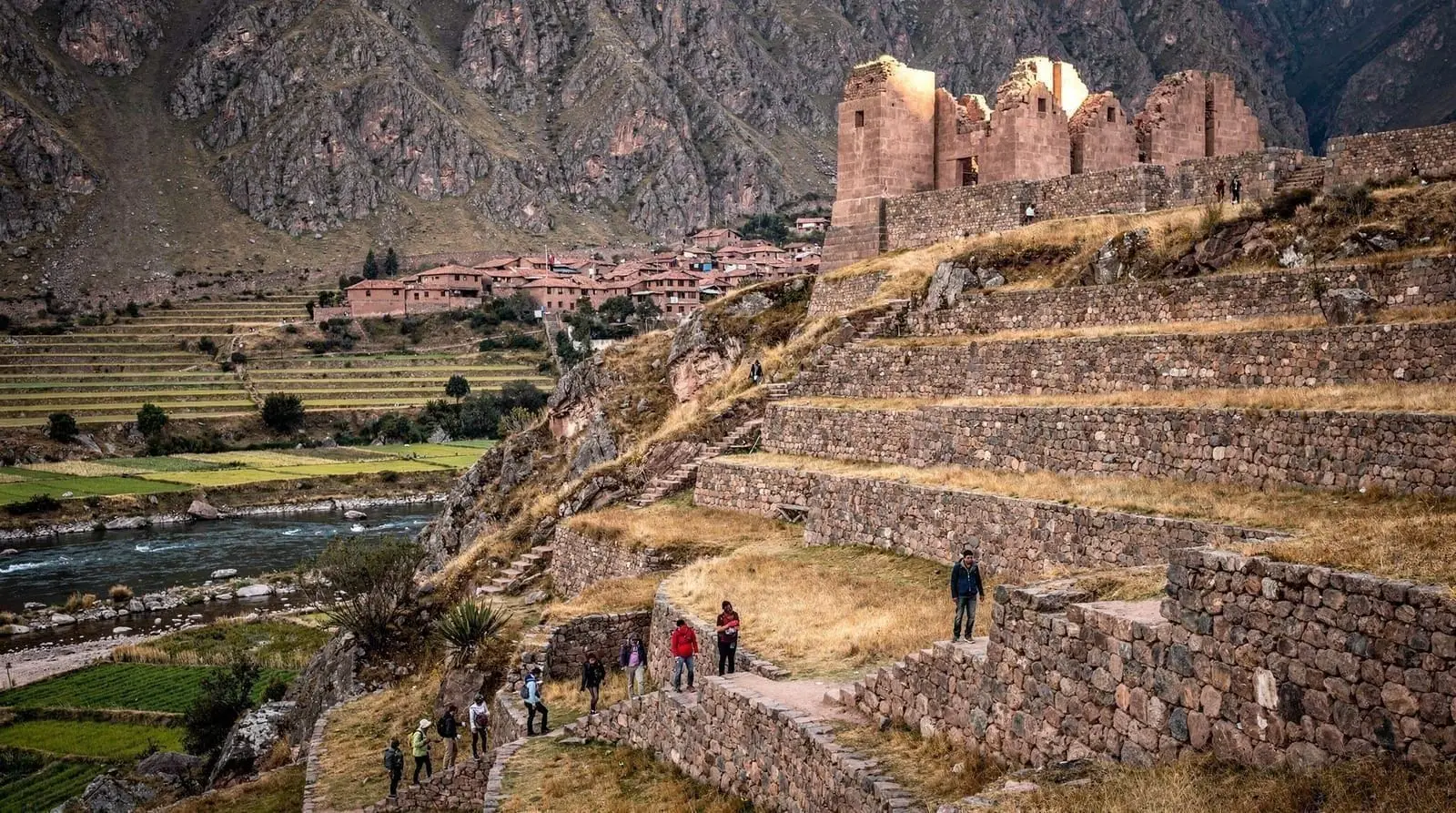
The terraces. A monumental staircase of agricultural and defensive terraces climbs the slope above the town — the part everyone photographs and climbs. They are steep, beautifully built, and the reason the site reads as a fortress.
The Temple of the Sun. At the top stands one of the great puzzles of Inca engineering: a row of six colossal pink rhyolite blocks, each weighing many tonnes, fitted together with thin stone spacers. The quarry they came from is high on the mountainside across the valley, and how the Inca moved blocks of this size across a river and up a slope still divides engineers. The temple was left unfinished when the Spanish arrived, so you see the building process frozen mid-construction.
The water works. The site has fountains, channels and a famous ceremonial bath that still runs, showing the Inca mastery of moving water by gravity.
The town grid below. The streets, called canchas, follow the original Inca layout. Walking them is free and arguably as rewarding as the paid site.
For the broader context of Inca building across the region, the Moray terraces guide makes a good companion, as the two sites show very different sides of Inca engineering.
The history that makes it matter
Ollantaytambo is one of the few places where the Inca beat the Spanish. In 1537, during the great rebellion, Manco Inca made his stand here. When a Spanish force under Hernando Pizarro attacked, the Inca rained down arrows and stones from the terraces and then flooded the plain below by diverting the river, miring the Spanish cavalry in mud and forcing a retreat. It was a genuine, if temporary, Inca victory, and standing on the terraces you can read the defensive logic of the place immediately.
The site was also a royal estate and ceremonial centre tied to the emperor Pachacuti, which explains the temple and the quality of the stonework. The unfinished Temple of the Sun is a poignant reminder that the empire was cut off mid-stride. A guide brings all of this alive; the stones say little without the story.
Tickets, hours and the climb
The ruins are entered only with the Boleto Turístico del Cusco. There is no single-site ticket at the gate. Your options:
- Boleto Parcial Circuito III (partial): S/70 (about $19), valid 2 days, covering Pisac, Ollantaytambo, Chinchero and Moray.
- Boleto General (full): S/130 (about $35), valid 10 days, covering 16 sites.
For a valley-focused trip the partial Circuit III ticket is the better value; the Cusco tourist ticket guide explains which to buy. Bring cash. Note that walking the town below the ruins is free — only the terraced archaeological site requires the boleto.
Opening hours run from about 7am to mid or late afternoon, commonly around 5-6pm depending on the season. Arrive at opening to climb in cool air and relative calm before the Cusco tour buses arrive mid-morning.
The climb. The main draw is the staircase up the terraces to the Temple of the Sun — well over 200 steps, steep and uneven. At 2,800 m it is more tiring than it looks, but most reasonably mobile visitors manage it slowly with water breaks. If the top is too much, the lower terraces, the water works and the town give plenty without the full ascent. Wear proper shoes, bring sun protection (the UV is fierce), and pace yourself.
The living town and the free experiences
Do not leave once you have climbed the terraces. The town of Ollantaytambo is the only place in Peru where you can walk an intact Inca street grid that has been continuously inhabited since the 15th century. Wander the cobbled canchas, follow the stone water channels, and look at the trapezoidal Inca doorways still in daily use. All of this is free.
Across the river, set into the mountainside, are the Pinkuylluna storehouses (qollqas), Inca granaries positioned to catch the cold wind. A steep free trail climbs to them and rewards you with the best overall view of the fortress and town — a superb alternative or addition to the paid site for those who want to keep moving and avoid the crowds.
The small main square has cafés and craft stalls, and the town makes an excellent, atmospheric base. Sleeping here means seeing the ruins in late-afternoon light after the day groups leave, and waking close to the train. El Albergue, beside the station, is the well-known platform-side option; the getting around the Sacred Valley guide covers transport and the Aguas Calientes guide the onward Machu Picchu end.
Beyond El Albergue, the town has a genuine range of accommodation for every budget — small family-run guesthouses tucked into the old canchas themselves, mid-range hotels a short walk from the plaza, and a handful of more comfortable properties with valley views on the outskirts. Booking a room inside the old town, rather than on the modern fringe, is worth the short extra walk for the experience of stepping out your door directly onto Inca-laid stone.
The train to Machu Picchu
Ollantaytambo station is the launch point for Machu Picchu. Both PeruRail and Inca Rail run the route to Aguas Calientes in about 1 hour 45 minutes, hugging the Urubamba River through tightening gorge scenery. There is no road to Machu Picchu, so the train — or a multi-day trek — is the only way in.
Practicalities:
- Book ahead, especially in dry season (May-September), when trains sell out.
- The town gets congested before peak departures; allow time to reach the platform.
- Basing in Ollantaytambo the night before an early train is the calmest way to start a Machu Picchu day, and it lets you acclimatise lower than Cusco.
Getting there and combining with the valley
Ollantaytambo sits at the lower end of the valley, about 60 km from Cusco. By colectivo (shared minivan), reach it from Urubamba or directly from Cusco; by taxi or private driver, a day around the valley runs roughly S/180-280; the getting around guide details the network.
On an organised loop, Ollantaytambo is the western anchor of the classic Sacred Valley day. The Pisac, Maras, Moray and Ollantaytambo small-group tour links it with the salt pans, the terraces of Moray and Pisac in one day with transport handled — efficient because public minivans don’t connect the spread-out sites well.
The Sacred Valley tour with Pisac and Ollantaytambo is a focused alternative if you want more time at the two flagship ruins and less driving. See the day trips from Cusco guide for how it fits a Cusco base, and Pisac for the eastern counterpart.
How the stones were moved: the engineering puzzle
The detail that lingers after a visit to Ollantaytambo is the Temple of the Sun and the question it poses. The six great monoliths of the temple wall are not the local fieldstone used for most of the site. They are rhyolite, and the quarry that produced them, known as Cachiqata, lies high on the mountainside on the opposite side of the valley, across the Urubamba River. Moving blocks weighing many tonnes from there to the temple meant hauling them down one slope, across the valley floor and river, and up the steep terraced hillside to the building site — without the wheel, without iron tools, and without draught animals capable of the work.
How the Inca did it is still debated, but the evidence on the ground is remarkable. A long ramp and a trail of “tired stones” — blocks abandoned partway through the journey — trace the route between quarry and temple, frozen mid-transport when work stopped. The leading explanations combine human muscle on a vast scale (thousands of labourers under the mit’a labour system), earthen ramps, log rollers or sledges, and clever use of gravity on the downhill sections.
Some researchers think the river was partially diverted or that causeways were built to cross it. The precision of the finished joints, with stones cut so closely that a blade will not fit between them, then had to be achieved with stone and bronze tools and endless patient grinding.
The temple was never finished. The Spanish conquest interrupted the work, which is precisely why Ollantaytambo is so instructive: you can read the construction process in arrested motion, from quarry to ramp to half-set wall, in a way that the completed sites at Machu Picchu or Cusco do not allow. It is a rare window into how the Inca actually built, rather than just what they built. For more on Inca construction across the region, the Moray terraces guide and the Cusco tourist ticket guide point to the other sites worth pairing with this one.
Standing at the quarry side of the story matters too: from certain points on the terraces, you can look directly across the valley toward Cachiqata and trace, with a guide’s help, the rough line the ramp likely followed. Few Inca sites let you see both the origin and the destination of the stone in a single glance, which is part of why archaeologists return to Ollantaytambo again and again to study the logistics of Inca engineering.
A suggested half-day at Ollantaytambo
To give the site its due without rushing, a workable plan:
- Arrive at opening (around 7am). Climb the main terrace staircase to the Temple of the Sun while the air is cool and the crowds are still in Cusco. Allow about an hour to the top and back, taking it slowly for the altitude.
- Explore the lower sectors. The ceremonial bath, the water channels and the fountains show the Inca mastery of moving water by gravity, and they involve far less climbing than the terraces.
- Walk the free town grid. Drop into the canchas below the ruins — the only continuously inhabited Inca street layout in Peru — following the stone water channels down the lanes. This costs nothing and is as memorable as the paid site.
- Climb to Pinkuylluna (optional). The steep, free trail to the Inca storehouses across the river rewards you with the best panorama of the fortress and town, and it is usually far quieter than the main site.
- Lunch or coffee on the main square, then either catch your train or settle in for the night.
This sequence fills a comfortable half-day and works whether you are passing through to a train or basing here. The point is to resist the 30-minute glimpse: the terraces, temple, water works, free town and storehouses together reward real time. For how the day connects onward, the Aguas Calientes guide covers the Machu Picchu end and the getting around the Sacred Valley guide the transport.
Honest timing and trap warnings
Go early or stay late. The site is busiest from mid-morning to early afternoon when the Cusco buses arrive. The 7am opening and the last hour before closing are dramatically calmer, with better light for photos and a quieter climb.
Don’t treat it as a quick train-side stop. Many people glimpse it for 30 minutes before a train and feel they have “done” Ollantaytambo. The terraces, the temple, the free town grid and the Pinkuylluna storehouses easily fill half a day.
The boleto trap. Tour sellers occasionally blur what your ticket covers. Ollantaytambo’s ruins need the boleto; the town is free. The neighbouring Maras salt pans need a separate cash entry. Read the tourist ticket guide.
Train crowds and touts. Around departure times the town and station get hectic, with persistent porters and vendors. Keep an eye on bags and confirm prices before accepting help.
Photography and drone rules. The ruins are photogenic from almost every angle, but drones are generally prohibited over the archaeological site without prior permit from the Ministry of Culture — do not assume you can fly one, and ask locally if in doubt. The Pinkuylluna viewpoint across the river is the best unofficial “aerial-feeling” shot without needing one at all.
Altitude. At 2,800 m Ollantaytambo is lower than Cusco, which is exactly why the valley is the smart acclimatisation base — but the terrace climb still demands more of you than the height suggests. Take it slowly if you have recently arrived in the Andes.
Frequently asked questions about Ollantaytambo ruins
How much does Ollantaytambo cost and what ticket do I need?
What are Ollantaytambo's opening hours?
How hard is the climb at Ollantaytambo?
Why is Ollantaytambo historically important?
Is Ollantaytambo worth staying overnight?
How do I get from Ollantaytambo to Machu Picchu?
Top experiences
Bookable activities with verified prices and instant confirmation on GetYourGuide.


