Gocta waterfall guide
Chachapoyas: Full Day to Gocta Waterfall, Amazon's Jewel
How tall is Gocta waterfall and how do you visit it?
Gocta, near Chachapoyas in northern Peru, was measured in 2006 at around 771 m across two drops, ranking it among the tallest waterfalls on Earth. You reach it by a cloud-forest hike of roughly 5-6 km each way from Cocachimba to the lower falls, or a shorter route from San Pablo to the upper falls. Most visitors join a guided day trip from Chachapoyas.
The waterfall the world overlooked until 2006
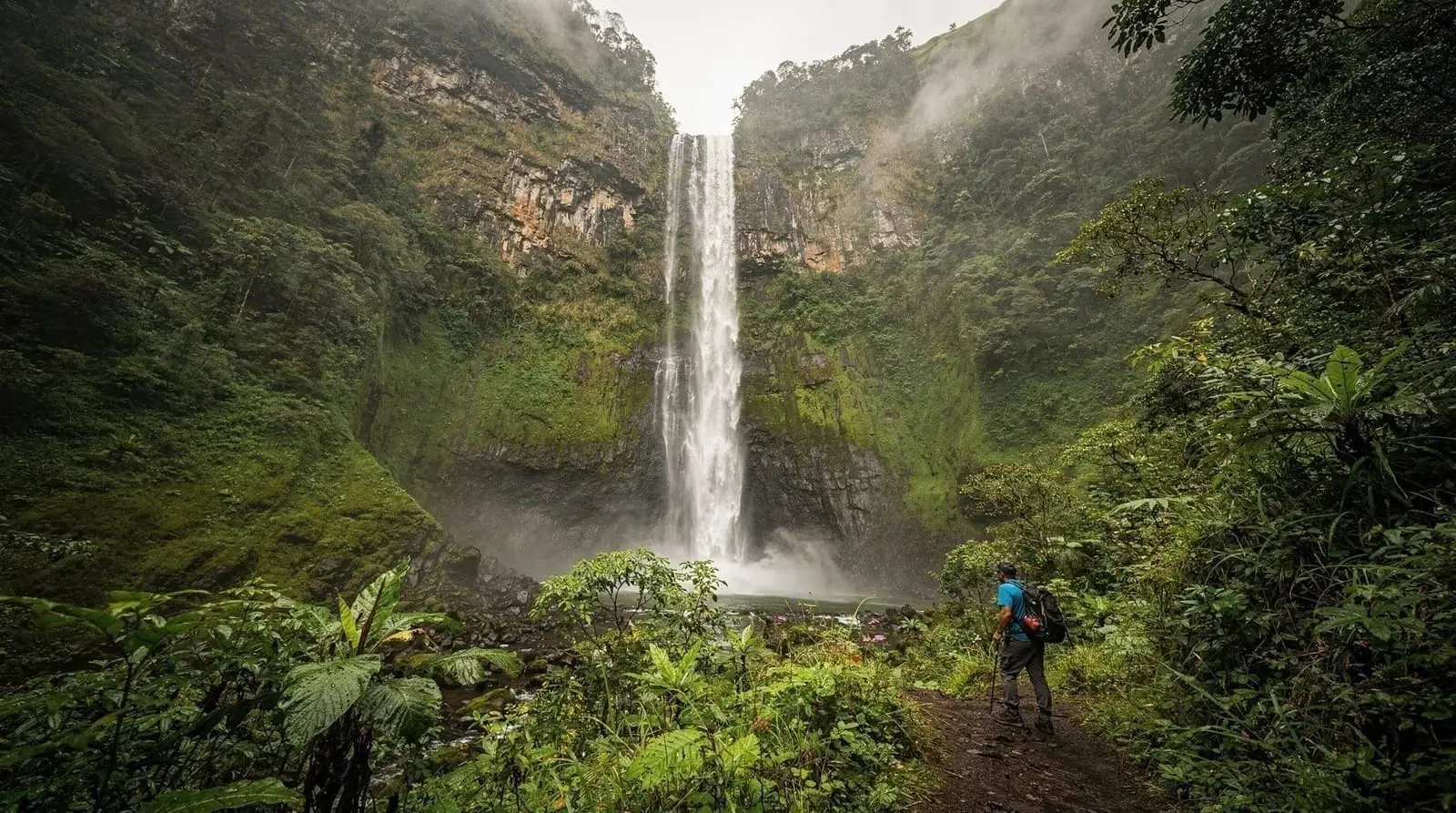
For generations the communities of the Cocachimba and San Pablo de Valera valleys lived within sight of an enormous waterfall and thought little of telling the outside world about it. Local lore held that a mermaid or a curse guarded the falls, which discouraged casual visits. Then in 2006 a German explorer, Stefan Ziemendorff, surveyed it, put a number on it — around 771 m across two drops — and announced Gocta as one of the tallest waterfalls on the planet. The rankings are disputed because measurement conventions differ, but Gocta is unambiguously in the global top handful, and overnight it became northern Peru’s second-most-famous attraction after Kuélap.
The waterfall sits in cloud forest near Chachapoyas and the reward is as much the hike as the falls — a walk through humid forest alive with spectacled bears, monkeys, hummingbirds and the flame-orange Andean cock-of-the-rock. This guide covers the routes, the realistic times and costs, and the weather caveats nobody advertises. For the wider region, see the Chachapoyas complete guide and the Gocta destination page.
| Height | ~771 m across two drops |
| Trail (Cocachimba) | 5–6 km each way, 2–2.5 hrs |
| Cost | S/10–15 gate entry; S/60–90 guided day trip |
| Best time | Early morning, before afternoon cloud builds |
| Getting there | Combi/taxi from Chachapoyas (~45 min) or a tour |
Two falls, two trailheads
Gocta drops in two stages, and there are two main villages to start from, which is the first thing to understand:
- Cocachimba is the classic base and the route to the lower falls, the bigger and more photographed of the two drops. The trail runs roughly 5-6 km each way, about 2 to 2.5 hours in each direction, ending at the pool below the cascade. This is the route most day tours use.
- San Pablo de Valera accesses the upper falls by a shorter, generally easier trail. It is the better choice for less confident walkers or anyone short on time, though the lower-falls view from Cocachimba is the more dramatic.
Connecting the two — seeing both falls in a single outing — is possible via a longer trail that links the levels, but it is a demanding full day and not what most visitors do. For a first visit, the Cocachimba lower-falls route is the standard recommendation.
The hike in detail
From Cocachimba the trail begins gently through farmland before entering the cloud forest proper. It undulates rather than climbing steadily, with some steep muddy sections and a few stream crossings. The falls come into view from a distance early on, growing as you approach until the final stretch brings you to the pool at the base, where the spray drifts over everything.
Realistic timing: budget 2 to 2.5 hours each way at an unhurried pace with photo stops, so a half-day on the trail itself plus transport. Faster walkers shave some off; families with children and casual hikers should plan for the longer end. Horses can be hired for part of the Cocachimba trail for an extra fee, useful for the uphill return when legs are tired, though they cannot cover the whole route.
The trail is well-marked and the junctions are signposted, but if you are walking independently, paying attention at the forks matters — the path to the upper falls and the path along the lower route diverge, and a wrong turn adds time. This is one reason many independent travellers still take a guide.
Wildlife and the cloud forest
The hike is genuinely good for wildlife, which sets Gocta apart from a generic waterfall walk. The cloud forest here supports spectacled (Andean) bears, several monkey species, and exceptional birdlife. The Andean cock-of-the-rock, Peru’s national bird, is a realistic sighting, as are tanagers and hummingbirds. Early morning is by far the best window — both for animals and because the afternoon cloud tends to thicken and obscure the falls.
Bring binoculars if you have them. A guide who knows the forest dramatically improves your wildlife odds, spotting and identifying things a solo walker would miss entirely. This is a second argument for the guided option beyond mere navigation.
Costs and how to go
Approximate costs, in soles with USD at roughly S/3.7 to the dollar:
- Community trail entry: S/10-15 (about $3-4) at the Cocachimba or San Pablo gate. This is cash-only and goes to the local community that maintains the trail.
- Guided day trip from Chachapoyas: roughly S/60-90 (about $16-24), including the 45-minute transport each way and a guide.
- Horse hire: an additional fee, arranged at the trailhead.
Two ways to do it:
- Independently. Take a combi or taxi to Cocachimba (about 45 minutes from Chachapoyas), pay at the gate, and walk. Cheapest, most flexible, but you manage the navigation and the return transport timing yourself.
- Guided day trip. The easiest option for first-timers — transport, navigation and wildlife spotting handled, and the group timing keeps you on the trail early.
If you want a shorter or alternative version, some operators run a Gocta excursion focused on the more accessible viewpoints rather than the full base hike.
Gocta waterfall excursion from ChachapoyasThe weather caveat nobody mentions
This is cloud forest, and the clue is in the name. Even in the dry season of May to September, mornings often begin under mist and short showers happen at any time of year. The waterfall is frequently partly veiled in cloud, and the dramatic full-height views are not guaranteed on any given day. The November-to-April wet season brings a fuller, more thunderous waterfall and lush green forest, but muddier trails and heavier, more persistent cloud.
The practical takeaways: go early, before the afternoon cloud builds; expect mud and wear footwear you do not mind ruining; and pack a real waterproof, not a token windbreaker, because the spray at the base alone will soak you. Anyone promising a guaranteed clear, full-height Gocta photo is overselling the climate. The broader seasonal picture is in best time to visit Peru.
Gocta versus the region’s other waterfalls
Gocta is the famous one, but it is not the only spectacular waterfall in the Chachapoyas area, and knowing the alternatives helps you plan. Yumbilla, north of Gocta near Cuispes, is actually taller — measured at around 895 m across multiple tiers — though thinner and less voluminous, and reached by a quieter, less developed trail. Waterfall enthusiasts and anyone wanting solitude often prefer it precisely because it sees a fraction of Gocta’s visitors. Chinata and other lesser cascades dot the same cloud-forest valleys.
The reason Gocta became the icon rather than Yumbilla comes down to its 2006 publicity, its more dramatic single-drop lower fall, and its more developed access from Cocachimba. For a first visit, Gocta remains the logical choice — the trail infrastructure, the guiding, and the wildlife are all better established. But if you have an extra day, are chasing height records, or simply want a waterfall hike without other walkers, Yumbilla is the connoisseur’s pick. Some travellers do both across two days, treating Gocta as the headliner and Yumbilla as the quieter encore.
A realistic note on all of them: these are cloud-forest waterfalls, so volume and visibility swing hugely with the season. In the dry months the falls are thinner but the trails firmer and views clearer; in the wet season they thunder but the cloud and mud thicken. There is no perfect time that maximises both — pick your priority.
What to pack
- Genuine waterproof jacket — for rain, cloud-forest drizzle and the spray at the base.
- Footwear with grip that you do not mind getting muddy; waterproof or quick-drying is ideal.
- Layers for the temperature swing between the warm valley and the cooler forest.
- Water and snacks — there is little along the trail.
- Insect repellent for the humid lower sections.
- Sun protection for the open farmland stretches and high-altitude UV.
- Cash in soles for the community gate and any horse hire.
- Binoculars and a dry bag for cameras, optional but recommended.
Combining Gocta with the rest of the region
Gocta is best as one day in a multi-day Chachapoyas trip, not a standalone reason to make the long journey north. The satisfying sequence runs Kuélap fortress on day one, Gocta on day two, the Karajía sarcophagi and Quiocta caves on day three, and the Revash mausoleums with the Leymebamba museum on day four. Waterfall enthusiasts can add the taller, thinner Yumbilla falls nearby.
Yumbilla waterfall tour from ChachapoyasFor the practicalities of reaching this remote corner, see how to get to Chachapoyas, and for route ideas the itineraries hub.
Fitness and who should attempt it
The Cocachimba hike is genuinely moderate rather than easy, and it is worth being honest about who it suits. A person with average fitness and no mobility issues handles the 10–12 km round trip comfortably in the recommended 4–5 hours, but the undulating terrain, occasional mud, and humidity add up over that distance more than the elevation gain alone suggests. Families with young children should budget for the longer end of every time estimate and consider hiring a horse for at least the return climb; older travellers or anyone with knee concerns should weigh the San Pablo upper-falls route instead, since it is shorter and gentler while still delivering a genuine waterfall payoff.
Guided versus independent: the honest tradeoff
Going independently saves money and lets you set your own pace, but a guide earns their fee here in two specific ways beyond navigation: spotting wildlife you would otherwise walk straight past, and timing your start early enough to beat the afternoon cloud that frequently veils the falls. A guided day trip also removes the return-transport puzzle — arranging a taxi or combi back from Cocachimba on your own schedule can mean waiting around at the end of a tiring hike. For a first visit, especially if wildlife-spotting matters to you, the guided option is the more reliably satisfying choice; independent travel suits confident hikers who would rather move at their own speed and are comfortable navigating without help.
Frequently asked questions about Gocta waterfall
How long is the hike to Gocta waterfall?
How hard is the Gocta hike?
How much does it cost to visit Gocta?
Can you swim at Gocta waterfall?
What is the best time of year to hike Gocta?
Is Gocta suitable for families with children?
Should I hire a guide for the Gocta hike or go independently?
Top experiences
Bookable activities with verified prices and instant confirmation on GetYourGuide.

